JustAnotherHuman said:
Thanks for the replies guys, I really enjoy learning about this kind of stuff and considering the implications.
I have always considered the phenethylamine and tryptamine psychedelics to be exogenous or external neurotransmitters, or exogenous/external modified neurotransmitters.
I share the same view eg! When you think about it, this is how most drugs produce their effects. It's most applicable to tryptamines and phenethylamines, but I think it extends to many other compounds. The cannabinoids come to mind.
Dennis Mckenna said it best when he said:"We're made of drugs. That's how drugs work."
There's just too many similarities between these compounds and our higher neurotransmitters, it's more than just chemical structure.
Our higher neurotransmitters would not be possible without plants providing our bodies with the essential precursor compounds, if we did not recieve Phenylalanine (and Tyrosine) provided from plants, our bodies would not be able to produce dopamine, epinephrine or norepinephrine. If we did not receive L-tryptophan from plants, our bodies would not be able to produce serotonin, melatonin, pinoline or DMT. So it's the plants that produce the molecules essential for the production our higher neurotransmitters...
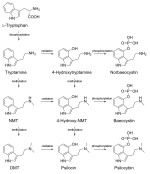
Look at how your neurotransmitters are produced, let's take 5-hydroxy-tryptamine, L-tryptophan enters the system, it is then enzamatically 5-hydroxylated (5-hydroxy-tryptophan) then decarboxalated to give 5-hydroxy-tryptamine, the body also produces DMT from tryptophan, tryptophan enters, is decarboxalated (AADC) giving tryptamine, which is then N methylated twice via SAM with INMT, (SAM Becomes SAH after it donates its methyl group) giving DMT....
Now, let's look at how plants and fungi produce these exogenous neurotransmitters:
( Rather than detail these pathways in text I have decided to include their biosynthetic pathways in the images attached to this post. )
Now, let's look at structure, (this is simply illustrating structural differences between the compounds) if you take 5-hydroxy-tryptamine and methylate it's amine nitrogen twice and move it's hydroxy grouping from position 5 to 4 you go from serotonin to psilocin, so we can see how some very minor changes to our neurotransmitters produce psychedelic molecules. Let's look at 3,4-dihydroxy-phenethylamine (dopamine) if you methylate the hydroxyl groups at positions three and four and add a methoxy group to position 5 you go from dopamine to mescaline (3,4,5-trimethoxy-phenethylamine)
Serotonin from outside sources would not be orally active, this is because of the exposed amine grouping which makes the molecule amenable to enzymatic deamination, and because of the free hydroxy grouping at position 5, which is a polar, hydrophilic, "bump" protruding from the side of the molecule preventing passage beyond the blood brain barrier. Now, let's protect our amine grouping by placing a methyl grouping on the alpha carbon of the ethylamine side chain, and let's address that hydrophilic, polar hydroxy grouping at position 5 by placing a methyl grouping there as well, by blocking these two positions of the molecule which prevent it access from the brain, we end up with 5-methoxy-alpha-methyl-tryptamine (alpha,O-dimethyl-serotonin), which is can incredibly potent psychedelic, being active between 2.5mgs to 5mgs
Then there's activity. Which ties this all together.
It's these compounds close structure to our neurotransmitters which is allowing us to explore and understand our endogenous receptor systems as well as the functions of our neurotransmitters and our brain as a whole. Now we can manipulate the alpha helical proteins of the receptor sites using molecules Which have the basic shape of the ligand for the receptor but which also have additional groupings protruding from this basic shape, thus bending the alpha helical proteins into novel shapes producing novel responses...
If you want to understand the atom, you must smash it. You know, sitting around looking at it, will never yield its secrets. You have to smash that sucker to bits and then collect the pieces and examine how it all came apart. In the same way we must smash ordinary consciousness. Get smashed and then look at the pieces flying in all directions. -terence McKenna
Hallucinogens (psychedelics) are psychoactive substances that powerfully alter perception, mood, and a host of cognitive processes. They are considered physiologically safe and do not produce dependence or addiction. Their origin predates written history, and they were employed by early cultures...

www.ncbi.nlm.nih.gov
I could spend all day discussing the relation between psychedelics and neurotransmitters, and in the above post I feel that I was barely scratching the surface on many facets of this topic...
-eg