• Members of the previous forum can retrieve their temporary password here, (login and check your PM).

DMT acetate to freebase conversion with pics

Migrated topic.

RayOfLight

Rising Star
Joined
Sep 22, 2009
Messages
508
Merits
82
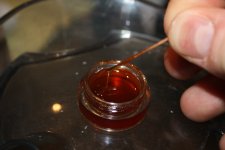
So after following the blab tek but instead of using fumaric acid to precipitate the dmt, swim used vinegar instead and it yielded a lovely looking reddish resin that smelled of vinegar
030.JPG
002.JPG
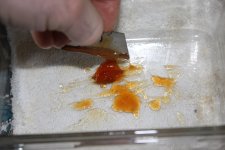
he then wanted to make some changa but learned it was unsmokeable in its current form and only good for oral doses.
001.JPG
hence the experiment.


The Dmt acetate was added to approximately 3 tablespoons of sodium carbonate and 150 ml of water, mixed thoroughly and dried
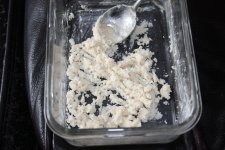
002.JPG013.JPG
it was then added to a jar, shaken vigorously into approximately 200 ml 99% isopropyl alcohol and decanted for approximately 1 hour
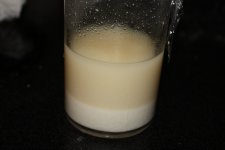
018.JPG
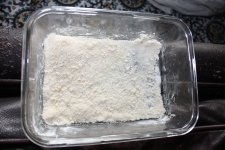
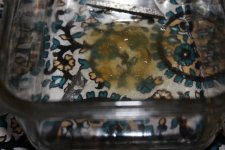
The now Dmt containing iso was separated and filtered from the sodium carbonate and put in a pan to evaporate overnight, a few hours into the evaporation it looked to be some kind of gelatin untill thoroughly dried over night
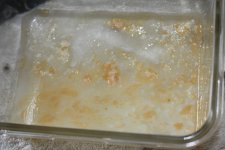
002.JPG023.JPG
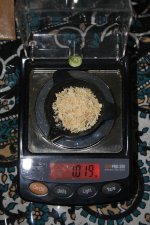
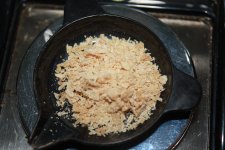
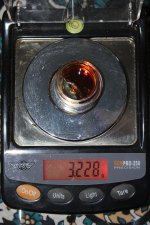
the final product is scraped up and weighed.028.JPG031.JPG032.JPG
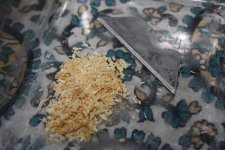
 
Great job and fantastic looking end product! :surprised

The loss in yield is very disappointing although typical for this style of freebase conversion.

Have you considered trying the new freebasing technique that involves evaporating your vinegar with heat? The heat breaks apart the acetic acid bond and vaporizes the acetate out of material leaving behind your freebase.

The end result will likely be more gooey but if you are making Changa you will not sustain such a large loss in yield and you could make a pretty thick Changa batch from red gooey ultra-potent DMT freebase.

House made some Ruby Goo Changa:

 
But wait...

* When you add excess sodium carbonate to an aqueous solution of DMT acetate, you're left with freebase DMT, sodium acetate, water, CO2 and unreacted sodium carbonate.

* After drying, it's fb DMT, sodium acetate and sodium carbonate.

* The IPA pull leaves behind the unreacted sodium carbonate. But sodium acetate is soluble in IPA, so your IPA contains both DMT and sodium acetate; in fact, for each DMT molecule there is one molecule of sodium acetate. So only ~70% of your product is DMT.

To get rid of the sodium acetate, you'd have to wash your DMT with water, in which sodium acetate is very soluble (which fb DMT is not).

Or am I missing something?
 
You just reminded me, I was wondering the same thing about fumarate conversion using sodium carbonate. Would there be sodium fumarate producd, which would then be picked up by the acetone or alcohol used to pull your freebase dmt?

I tried googling it but cant find any info on solubility of sodium fumarate, except in water, in which it is about apparently 10 times more soluble than fumaric acid.

According to wikipedia, sodium acetate is very soluble in water (approx 100g/100ml), less in methanol (16g/100g) and much less in acetone (0.5g/kg). So maybe pulling with a acetone and washing with (cold?) water would work. Might lose some dmt freebase in the water though.
 
A yet different approach, not involving IPA, acetone or any other similar solvents: instead of using sodium carbonate as base, use an ammonia solution.

The excess ammonia will evaporate, leaving behind only freebase DMT and ammonium acetate (or fumarate). So there is no base to remove, only the acid neutralization product. Which brings us to the same place as the IPA-using protocol proposed in the OP, but without using IPA or similar solvents.

This can be washed with cold ammonia solution (and then dried), which will incur some DMT losses, but perhaps less as there is less stuff to remove, so less water is needed.
 
I use this approach for such conversion
(it is actually necessary for me as I use salting out of dmt from toluene during my extractions)

Dissolve dmt salt in water. I use directly cleaned vinegar saltings.

Basify it. Dmt fb precipitate.

Filter out using funnel with cotton ball in it, dmt fb stays in funnel, basic water goes through it and can be discarded.

Wash dmt fb with small amount of very cold plain water or with sodcarb basic water while still in funnel.

Pour IPA into the funnel, it will dissolve dmt, as it goes through slowly because of cotton ball. Of course, keep the IPA.

Evaporate. (I use glass petri dish).

Wash dmt fb sticked to glass with small amount of cold water and check pH of this water. If too basic, repeat this step.
 
The loss in yield is very disappointing although typical for this style of freebase conversion.

Have you considered trying the new freebasing technique that involves evaporating your vinegar with heat? The heat breaks apart the acetic acid bond and vaporizes the acetate out of material leaving behind your freebase.
Looking back on this thread has set me thinking - has there ever been a proper analysis of DMT acetate? Do we reallyknow the molar ratio of DMT to acetic acid in the substance as prepared?

What if the acetic acid is present as the diacetate, which is known to exist in the case of sodium? This might go some way towards explaining the disappointingly low yields.

A few simple titrations and pH measurements might help throw more light on this matter.
 
* When you add excess sodium carbonate to an aqueous solution of DMT acetate, you're left with freebase DMT, sodium acetate, water, CO2 and unreacted sodium carbonate.

* After drying, it's fb DMT, sodium acetate and sodium carbonate.

* The IPA pull leaves behind the unreacted sodium carbonate. But sodium acetate is soluble in IPA, so your IPA contains both DMT and sodium acetate; in fact, for each DMT molecule there is one molecule of sodium acetate. So only ~70% of your product is DMT.

To get rid of the sodium acetate, you'd have to wash your DMT with water, in which sodium acetate is very soluble (which fb DMT is not).
According to wikipedia, sodium acetate is very soluble in water (approx 100g/100ml), less in methanol (16g/100g) and much less in acetone (0.5g/kg). So maybe pulling with a acetone and washing with (cold?) water would work. Might lose some dmt freebase in the water though.

So, was there ever any consensus on this?
 
So, was there ever any consensus on this?
I'd add that some formation of sodium bicarbonate would be inevitable, and that has lower solubility in water than the normal carbonate, especially at lower temperatures. In acetone I'd expect sodium bicarbonate to be practically insoluble, too. Not that that was necessarily your main (or even a subsidiary) concern…

Playing around with hygroscopic solvents and water-soluble salts may lead to troublesome, anomalous or disappointing results if care isn't taken to sure as near to anhydrous conditions as practicable. This is a variable that has the potential to disrupt consensus if dampness of solvents fails to get taken into account.

I hope these vague ramblings prove useful, but do feel free to ask something more specific for further clarification.
 
@Transform lol. thanks. It's just one rabbit hole after the next.

Just making sure that the tek is sound. So, if i do the tek as described + water wash = then there shouldn't be any sodium acetate left?

If that's true, where does the wash come in? You can't wash ISO with water.
 
@Transform lol. thanks. It's just one rabbit hole after the next.

Just making sure that the tek is sound. So, if i do the tek as described + water wash = then there shouldn't be any sodium acetate left?

If that's true, where does the wash come in? You can't wash ISO with water.
In this method, the solids which remain after evaporation of the iso are what gets washed with water.

Iso can sort of be washed with highly concentrated sodium carbonate solution, but ime that gets a bit messy.
 
In this method, the solids which remain after evaporation of the iso are what gets washed with water.
ok, thanks, so i'd have to redissolve it in a solution that is not soluble with water prior to washing?
Feels rather roundabout...

Maybe i should be looking into fumaric acid method rather than salting with vinegar...

EDITED: ok, i'm nearing melt down zone. I'm going to just proceed with this batch and keep it as a tincture. Do more research for the next run. appreciate the help!
 
Last edited:
The edit button is missing from my posts at the moment for some reason, so i'm forced into a double post :) And even quoting myself, geez

Maybe i should be looking into fumaric acid method rather than salting with vinegar...

This statement turned out to be true in my situation, so in case someone comes this way with the same question:

I started with the Q21Q21 #1 tek until my d-limonene pulls were done (i used fresh d-limo for each pull)
Then, I converted to fumarate via BLAB tek step 4a
Lastly, I converted the fumarate to freebase (smokable) via BLAB tek step 6
= a non-toxic, simple, fun extraction that I can use for fumarate or freebase

This was a lovely process that I really resonated with! much gratitude to both @q21q21 + @Jorkest (not sure if either of you are still around but 🙏)
Appreciation to @drpotato for urging me towards FASI!
And, of course, @Transform for answering so many annoying questions and your TnT tek!
 
In this method, the solids which remain after evaporation of the iso are what gets washed with water.

Iso can sort of be washed with highly concentrated sodium carbonate solution, but ime that gets a bit messy.
you can wash iso with brine, you can regenerate diluted iso using brine. adding carbonate to the brine might be asking for trouble but, in principle that should also work.
brine washes are great, its super dense and resists emulsion, it sucks the water right out of the organic layer making it nice and clear, and even if theres not much room it still slurps up water soluble compounds that merely have some mobility in the solvent.


brine washes are a common step in organic chemistry extraction processes when the material cant or doesnt need to be rendered anhydrous. brine in this context is sodium chloride solution at maximum saturation, i keep a bottle of pool salt topped up with demineralized water at all times for this purpose. pool salt saturated in this way works decently because over time it drives any trace minerals to either stay as a solid, or, pulls them out 100% on the first loading, which is why i discard it if i dont want lithium or calcium chlorides present. calcium chloride in particular since its soluble in ethanol and will make a mess on subsequent basification.

Using brine is also kind of like a backwards approach to the same outcome as, any tek that salts out with literal table salt.
i strongly advise everyone to start up a brine bottle. crudely recrystalize some of the cheapest salt you can find, i think kosher salt should be all but chemically pure tho and suitable as-is, avoid stuff with iodine, and filter if it has silica anti caking agent. fill the bottle with coarse salt, and add hot water, then let it sit for a day. mix a sample with sodium hydroxide to test for precipitating anions, if none are present, use freely.
brine can be added to a sep funnel with no risk of clogging, since it wont get coated in oil going in like salt does, also, especially if its slightly colder, it will behave like a different phase as your aqueous layer, temporarily forming a phase that precipitation or dust wont freely migrate into, on the bottom, temporarily, as particles wont freely cross the threshhold, idk the utility but, its an option.

100% as well, if you shake your final extract with some brine, you should observe an immediate clarification of the solvent used as it pulls all the water out. the presence of water can cause oiling and polymerization, in some circumstances this can mean the difference between yellow and white crystals, or goo. somewhere between barely noticeable, and, night and day, it will have a positive effect on your DMT

but note, solvent mixtures containing acetone or ethanol will not behave consistently around brine or, salt in the water. if you switch over to mono potassium phosphate however, or a slurry of potassium carbonate, you can render acetone or ethanol almost anhydrous, with the former being documented to making ethanol optically anhydrous based on refractive index, acetone probably wont like a carbonate slurry though.
 
@drpotato or anyone else with the knowledge:

I'm trying to restore my d-limonene following a FASI process so i can re-use it.

I will wash 3 times with distilled water and decant.
Then wash 1 time with a brine

Do i need to do a last step with a drying agent like Pure Food-Grade Anhydrous Sodium Sulfate?

🙏
 
Back
Top Bottom