• Members of the previous forum can retrieve their temporary password here, (login and check your PM).

DMT N-Oxide : hydrate?

Icon

Titanium Teammate
Donator
I went down a rabbit hole last night learning about N-Oxide. I can't find the source at the moment, but I thought I saw a picture of the oxide molecule with an H2O attached to the oxygen. Then I found a page from Trout's notes, noting the hydrate of N-Oxide.
"mp 123-128 c Fish et al. 1955 (Showed one water of hydration.)"

I also learned that N-oxide is insoluble in pet ether but soluble in water. Candidate for the goo? I thought this was the idea for years, but then people seemed to drop it for polymorphs/polymers. I felt like I already read through all the N-Oxide threads here, but is there one I should be looking at for definitive info? I see the Wiki has trout's notes on oxide, but not much more about it.

And apparently xylene pulls it, which might account for why xylene seems to continue pulling when naphtha gives up. And maybe related to why xylene can't freeze precipitate spice?

Also, the picrate salt of N-Oxide is well documented, so I guess it can be salted out as crystals. I even found some research vendors selling N-Oxide freebase online, supposedly in solid crystal form. ($100 per milligram. :ROFLMAO: Step aside, Au!)
 
Last edited:
@Transform Can you help me? Any good threads about N-Oxide I should read? Or if you have time to summarize yourself.

When people talk about N-Oxide is it assumed that it's in hydrate form? I guess the context would be goo, either from evaporation or the stuff that settles out first in a concentrated solvent re-x.

I'm also confused how it could be a solid crystal, unless they just mean amorphous. I'm guessing heat/air/time will dehydrate the hydrate to the base N-Oxide, but if it's water soluble how does it re-order itself then when it's totally dehydrated. Maybe they crystallized it from a melt? I don't see a melting point for the freebase in Trout's notes, only the 123-128 c for the hydrate.

Is N-Oxide a totally separate process from the oxidation involving a loss of an electron? Or are they related?

Is there more info on the lost electron oxidation? Is it possible to measure the missing electron and have we confirmed that to be happening?

I feel like I'm going in circles chasing ghosts between polymers, polymorphs, oxidation, N-Oxide. I need help differentiating which is responsible for what. Yellow = oxidation? Goo = N-Oxide or polymers? Polymorph = melting point and habit?
 
All good questions, several of them outside my range of experience :LOL:

When previously mentioned on here over the years, I now get the impression that people (myself included) had no real idea of what we were talking about when discussing the N-oxide, rather it was an assumption based on the reported detection of DMT-N-oxide in various plant analyses dating back decades.

My own experiences with attempting zinc reduction and recrystallisation of goo were perplexing enough to cast doubt on the hypothesis, and not long after we had breakthrough ideas and experiments from the likes of @Loveall and @Brennendes Wasser along with some ever-astute observations from @benzyme.

Those were the final nails in the coffin for the N-oxide hypothesis as far as I was concerned, since the oligomerisation hypothesis does a far better job of explaining things as well as subsequently becoming backed up with some compelling experimental evidence.

So, N-oxide is a distinct compound, whereas oxidised polymeric goo isn't. And yes, formation of the N-oxide is indeed a totally separate process from the (presumably) one-electron steps in the oligomerisation process. Its degree of hydration - seemingly essentially a binary 1 or 0 - would be a matter of the method of preparation. It could be formed both from aqueous reactions or under anhydrous conditions. BW most probably produced the hydrate, iirc, but his data would bear re-examination in light of your observations.

Note that the hydrate is still technically the freebase, and you would have to delve fairly deeply into the literature in the hope of finding crystallographic information regarding either the anhydrous or the hydrated form. The question of whether it stays hydrated under 'normal' atmospheric conditions depends on a lot of factors, but you may be able to dig up analogous information regarding stability parameters for other tertiary amine oxides and their respective hydrates.

Now, I'm no expert on things like ESR and cyclic voltammetry, but they're a couple of tools that may help shed a little more light on the single-electron side of things.

Hopefully that gives you some clues in which directions you might find progress. In all likelihood I've overlooked a ton of stuff, but this is what I can muster of the top of my head, given certain time constraints.
 
I’ve purposefully made DMT n-oxide by adding my oxalate salt into h2o2. I ended up with a red goo that I’ve tried recrystallizing without success.

I plan on testing different things mainly the oral activity with maoi. From all the older reports I’ve read it was inactive when smoked and oral but doesn’t seem to have been tested with maoi
 
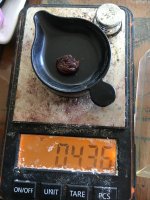
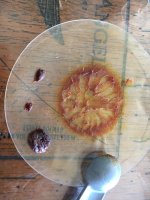
Once I have some free time I'll test 30mg and increasing from there. May actually test even smaller to start... small ball is 30mg, then 100mg and the largest is the weighed amount. I plant on converting back to dmt using hcl vinegar and magnesium strip.
 

Attachments

  • IMG_1882.JPG
    IMG_1882.JPG
    1.9 MB · Views: 3
  • IMG_1884.JPG
    IMG_1884.JPG
    1.7 MB · Views: 3
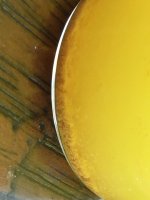
DMT oxide picrate salt. Added 1 to 1 picric acid amount. 1% solution and dissolved perfectly.
Will recristalize by heating and cooling later and then recover the picrate and convert back to Freebase DMT
 

Attachments

  • 2FBA9E7B-D392-4204-A698-673B5BEE6950.jpeg
    2FBA9E7B-D392-4204-A698-673B5BEE6950.jpeg
    683.5 KB · Views: 9
I hope you know exactly how hella dangerous picric acid can be, and in precisely what ways. Stuff like this ought to be accompanied by a safety assessment.

Still a good experiment, though!
Yes I've read up on it and have only made 1g of picric acid since I can keep recovering it. This is mostly for personal experimenting and getting more chemistry experience in general.

Main issue with picric acid is when completely dry and when forms metal picrates... I think the risk is overblown since even burning it isn't extremely energetic (picric acid in small amounts)... However making large amounts or not keeping in water is reckless... I keep it in a saturated solution a 1% solution. Hager's reagent is still used in some places.

Dried alkaloid picrates don't carry the same risk as metal picrates having melting points much higher usually over 150C. shouldn't consume though even if not deadly (stated as toxic but LD50 is fairly high "100+mg/kg") you would become yellow complexion for atleast a month from the reports I've read.

That being said everyone do your own research, I am not advocating the use.
 
Last edited:
From yellow to a orange/red crystal... I've read it is common to form dipicrate being red and recrystallizing will make it mono and form yellow.
All papers are from early 1900s and most stop using around 1960's
 

Attachments

  • IMG_1889.JPG
    IMG_1889.JPG
    1.2 MB · Views: 7
DMT oxide picrate salt. Added 1 to 1 picric acid amount. 1% solution and dissolved perfectly.
Will recristalize by heating and cooling later and then recover the picrate and convert back to Freebase DMT
Woahh!! How cool, thank you for experimenting! I'm jealous, I want to see the salt someday, but the acid sounded a little out of my reach. I suppose other salts are possible though.

Stay safe and measure the melting points please so we can compare with literature :) Would love to see the yellow re-x'd crystals.

Btw, do you mean convert back to freebase oxide? Or will you also reduce it?
 
Woahh!! How cool, thank you for experimenting! I'm jealous, I want to see the salt someday, but the acid sounded a little out of my reach. I suppose other salts are possible though.

Stay safe and measure the melting points please so we can compare with literature :) Would love to see the yellow re-x'd crystals.

Btw, do you mean convert back to freebase oxide? Or will you also reduce it?
It became a brown mass on trying to recrystallize (I'll reattempt it in the future)

After testing I want to try reducing it back to DMT using magnesium strip and vinegar.
 
Back
Top Bottom