
Last time I extracted DMT, I accidentally evaporated it when attempting to oven dry the crystals. I had converted it into DMT acetate, thinking that would have a sufficiently high boiling point to withstand the 60C but I was wrong. Anyone know of a salt with a high boiling point. What we really need is a method of predicting boiling points of salts. So I'll start with a quick primer for anyone who doesn't yet know this:
With ionic compounds its relatively simple. The melting point is determined by the strength of the ionic attraction between the two ions. For example sodium chloride melts at 801C whereas magnesium oxide melts at nearly 3000C. The massive difference is due to the fact that Na and Cl have just 1 charge on each atom, whereas magnesium and oxide have two. The electronegativity plays a role for example sodium fluorides MP is about 200C higher than that of sodium chloride. This is because fluorine is more electronegative than chlorine.
Now the situation becomes a whole lot more complicated with organic salts. I haven't really read this area myself, I just know that its not so clear cut as it is with ionic salts. What I do know though, is the general rules governing the melting points of non ionised organic compounds still applies and will influence the BP of the salt. The intermolecular forces exhibited by the organic compound, as well as its shape will play a role. Intermolecular forces are properties of the molecule which cause the molecules to attract to each other. One form on intermolecular attraction are dipole-dipole attractions. An obvious example of this is water, in H2O the oxygen atom is more negatively charged than the hydrogens, so the oxygen atom of one H2O molecule will be attracted to the hydrogen atoms of the other H2O molecules.
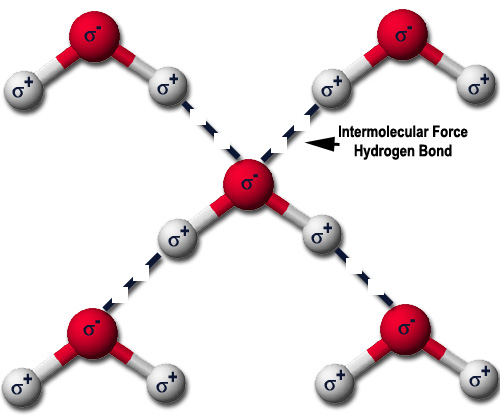
In the case of water, its an exceptionally strong form of intermolecular force called hydrogen bonding. It occurs mainly between -OH groups, and to a lesser extent with -NH2 groups. When two -OH groups from different molecules come in contact with each other, these are strongly attracted to each other.
Sorry I got a bit carried away there, I'm not trying to write a chemistry lesson here, just trying to get a discussion going on ways to find non volatile DMT salts. So I think what we need are acids with extra polar groups like -OH groups so we can get some hydrogen bonding going on. One that pops into my head is oxalic acid:

its got those two hydroxyl (-OH) groups which will contribute to hydrogen bonding. Or what about citric acid:
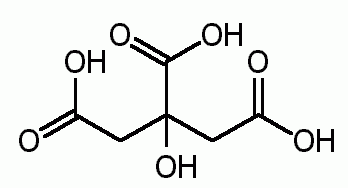
its only got 1 -OH group but it has 3 acid groups packed closely together. I bet there will be too much steric hindrance (meaning theres not enough room for 3 DMT molecules to fit in there) for all 3 acid groups to bond to DMT, so we'd have at least 1 free carboxyl group. Carboxyl groups are exceptionally good at hydrogen bonding because both the -OH and =O parts contribute.
Another thing I'm thinking is if I react DMT with HCl, I get DMT hydrochloride so in that case, only one of the ions is organic. I wonder if this means DMT-HCl will generally be less volatile than the fully organic salts like DMT fumarate, acetate, malonate etc. I'm sure plenty of you here have experimented with DMT-HCl, whats its boiling point like?
What we really need to do is do melting and boiling point tests and compile a list of boiling points for various DMT salts.
With ionic compounds its relatively simple. The melting point is determined by the strength of the ionic attraction between the two ions. For example sodium chloride melts at 801C whereas magnesium oxide melts at nearly 3000C. The massive difference is due to the fact that Na and Cl have just 1 charge on each atom, whereas magnesium and oxide have two. The electronegativity plays a role for example sodium fluorides MP is about 200C higher than that of sodium chloride. This is because fluorine is more electronegative than chlorine.
Now the situation becomes a whole lot more complicated with organic salts. I haven't really read this area myself, I just know that its not so clear cut as it is with ionic salts. What I do know though, is the general rules governing the melting points of non ionised organic compounds still applies and will influence the BP of the salt. The intermolecular forces exhibited by the organic compound, as well as its shape will play a role. Intermolecular forces are properties of the molecule which cause the molecules to attract to each other. One form on intermolecular attraction are dipole-dipole attractions. An obvious example of this is water, in H2O the oxygen atom is more negatively charged than the hydrogens, so the oxygen atom of one H2O molecule will be attracted to the hydrogen atoms of the other H2O molecules.
In the case of water, its an exceptionally strong form of intermolecular force called hydrogen bonding. It occurs mainly between -OH groups, and to a lesser extent with -NH2 groups. When two -OH groups from different molecules come in contact with each other, these are strongly attracted to each other.
Sorry I got a bit carried away there, I'm not trying to write a chemistry lesson here, just trying to get a discussion going on ways to find non volatile DMT salts. So I think what we need are acids with extra polar groups like -OH groups so we can get some hydrogen bonding going on. One that pops into my head is oxalic acid:
its got those two hydroxyl (-OH) groups which will contribute to hydrogen bonding. Or what about citric acid:
its only got 1 -OH group but it has 3 acid groups packed closely together. I bet there will be too much steric hindrance (meaning theres not enough room for 3 DMT molecules to fit in there) for all 3 acid groups to bond to DMT, so we'd have at least 1 free carboxyl group. Carboxyl groups are exceptionally good at hydrogen bonding because both the -OH and =O parts contribute.
Another thing I'm thinking is if I react DMT with HCl, I get DMT hydrochloride so in that case, only one of the ions is organic. I wonder if this means DMT-HCl will generally be less volatile than the fully organic salts like DMT fumarate, acetate, malonate etc. I'm sure plenty of you here have experimented with DMT-HCl, whats its boiling point like?
What we really need to do is do melting and boiling point tests and compile a list of boiling points for various DMT salts.


