

-
Members of the previous forum can retrieve their temporary password here, (login and check your PM).
You are using an out of date browser. It may not display this or other websites correctly.
You should upgrade or use an alternative browser.
You should upgrade or use an alternative browser.
TEK Ethyl acetate approach [CIELO]
- Thread starter Loveall
- Start date
This topic contain a TEK
Migrated topic.


aizoaceous
Titanium Teammate
I used an online tool to calculate theoretical titration curves of monobasic and dibasic mescaline fumarate with NaOH. It's not my tool, but the output matches my hand-calculation at a few points. These calculations are nontrivial when pKa values are close together, and in general must be solved numerically. For 400 mg of salt, I input 1.22 mmol each mescaline and fumaric acid for the monobasic, 1.48 mmol and 0.74 mmol for the dibasic. I believe this is consistent with @Loveall's calculation.
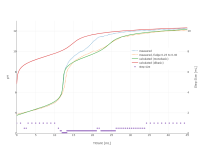
I plotted the two calculated curves along with the measured curve, obtaining the figure below:
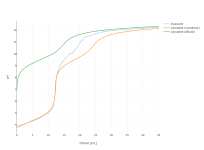
The calculated monobasic fits remarkably well at lower pH. It diverges starting around pH 8, possibly as the mescaline begins to precipitate since that effect isn't modelled. They reconverge later, possibly because precipitated mescaline behaves the same as dissolved mescaline at pH >> pKa (neither can accept a proton) so the model accidentally becomes accurate again. (Edit: Actually mescaline seems too soluble to precipitate, and that effect goes in the wrong direction anyways. It's more likely that the divergence relates to the change in step size per below.) The calculated dibasic is never very close. I believe my conclusion differs from @Loveall's because I'm comparing primarily at lower pH and modelling the partial dissociation of the amine; but I believe the calculation will be most accurate at lower pH per above.
The starting pH alone may also provide a clue that it's monobasic. The pH of the dibasic salt is maximally sensitive to excess acid (since it's on the steepest part of the titration curve of mescaline with fumaric acid), but still seems distinguishable. That same tool calculates pH 3.78 for the monobasic salt, 6.82 for the dibasic, 4.77 for the dibasic with 20% excess acid.
That said, I don't see why the yield calculation by mass would be wrong. A solvate would go in the wrong direction. Was that yield calculated from the freebase to the salt, or the salt to the freebase? The latter seems easier to make accurate, with repeated extraction, drying over sodium sulfate, and repeated extraction of the sodium sulfate. The water could also be evaporated and weighed to cross check, perhaps after re-acidifying with a known mass of fumaric acid since excess sodium hydroxide would gain mass from atmospheric carbon dioxide. I haven't worked much with mescaline in general, so don't trust this part too much.
I plotted the two calculated curves along with the measured curve, obtaining the figure below:
The calculated monobasic fits remarkably well at lower pH. It diverges starting around pH 8, possibly as the mescaline begins to precipitate since that effect isn't modelled. They reconverge later, possibly because precipitated mescaline behaves the same as dissolved mescaline at pH >> pKa (neither can accept a proton) so the model accidentally becomes accurate again. (Edit: Actually mescaline seems too soluble to precipitate, and that effect goes in the wrong direction anyways. It's more likely that the divergence relates to the change in step size per below.) The calculated dibasic is never very close. I believe my conclusion differs from @Loveall's because I'm comparing primarily at lower pH and modelling the partial dissociation of the amine; but I believe the calculation will be most accurate at lower pH per above.
The starting pH alone may also provide a clue that it's monobasic. The pH of the dibasic salt is maximally sensitive to excess acid (since it's on the steepest part of the titration curve of mescaline with fumaric acid), but still seems distinguishable. That same tool calculates pH 3.78 for the monobasic salt, 6.82 for the dibasic, 4.77 for the dibasic with 20% excess acid.
That said, I don't see why the yield calculation by mass would be wrong. A solvate would go in the wrong direction. Was that yield calculated from the freebase to the salt, or the salt to the freebase? The latter seems easier to make accurate, with repeated extraction, drying over sodium sulfate, and repeated extraction of the sodium sulfate. The water could also be evaporated and weighed to cross check, perhaps after re-acidifying with a known mass of fumaric acid since excess sodium hydroxide would gain mass from atmospheric carbon dioxide. I haven't worked much with mescaline in general, so don't trust this part too much.
Last edited:
This is great, thank you so much!I used an online tool to calculate theoretical titration curves of monobasic and dibasic mescaline fumarate with NaOH. It's not my tool, but the output matches my hand-calculation at a few points. These calculations are nontrivial when pKa values are close together, and in general must be solved numerically. For 400 mg of salt, I input 1.22 mmol each mescaline and fumaric acid for the monobasic, 1.48 mmol and 0.74 mmol for the dibasic. I believe this is consistent with @Loveall's calculation.
I plotted the two calculated curves along with the measured curve, obtaining the figure below:
View attachment 106158
The calculated monobasic fits remarkably well at lower pH. It diverges starting around pH 8, possibly as the mescaline begins to precipitate since that effect isn't modelled. They reconverge later, possibly because precipitated mescaline behaves the same as dissolved mescaline at pH >> pKa (neither can accept a proton) so the model accidentally becomes accurate again. The calculated dibasic is never very close. I believe my conclusion differs from @Loveall's because I'm comparing primarily at lower pH and modelling the partial dissociation of the amine; but I believe the calculation will be most accurate at lower pH per above.
The starting pH alone may also provide a clue that it's monobasic. The pH of the dibasic salt is maximally sensitive to excess acid (since it's on the steepest part of the titration curve of mescaline with fumaric acid), but still seems distinguishable. That same tool calculates pH 3.78 for the monobasic salt, 6.82 for the dibasic, 4.77 for the dibasic with 20% excess acid.
That said, I don't see why the yield calculation by mass would be wrong. A solvate would go in the wrong direction. Was that yield calculated from the freebase to the salt, or the salt to the freebase? The latter seems easier to make accurate, with repeated extraction, drying over sodium sulfate, and repeated extraction of the sodium sulfate. The water could also be evaporated and weighed to cross check, perhaps after re-acidifying with a known mass of fumaric acid since excess sodium hydroxide would gain mass from atmospheric carbon dioxide. I haven't worked much with mescaline in general, so don't trust this part too much.
You are correct, I was focused on the end of the titration where the dimescaline fumerate makes a little bit more sense.
I see now that the lower pH data when looked at carefully (how you did) first the monomescaline hypothesis MUCH better.
I must reverse my conclusion here and say this does look like monomescaline citrate and after with you
I don't think any mescaline would precipitate. Did you see any clouding @starbob ?
Could you calculate by hand the he expected pH at 20ml of NaOH if not done already? Does that agree with the model or the experimental data? You can get two points, assuming mescaline either precipitates or not. If the points bracket the experimental pH, could mescaline solubility be derived (e.g. the fraction of mescaline remaining in solution). I believe the starting volume was ~120ml (@starbob ?)
Perhaps the deviation from the model is an effect of low freebase mescaline solubility @aizoaceous points out. I wonder if in a more dilute solution would fit the model better? For example, @starbob could repeat the titration but drop the mescaline salt weight down to 40mg, keep the same water volumes, and drop the NaOH down to 0.01M. Then @aizoaceus could fit that data again...

Also wouldn't mescaline precipitating lower the pH vs the model?
I think freebase mescaline in solution would help raise the pH, not lower it.
Are we sure the model includes the effect of freebase mescaline raising the pH before NaOH takes over?
I think freebase mescaline in solution would help raise the pH, not lower it.
Are we sure the model includes the effect of freebase mescaline raising the pH before NaOH takes over?
Are we sure the model includes the effect of freebase mescaline raising the pH before NaOH takes over?
If for example you change the pKa of mescaline in the model, does the curve respond as expected?
aizoaceous
Titanium Teammate
Assuming that 0% of precipitated mescaline accepts a proton while >0% of dissolved mescaline does, I think you're right. So that effect goes in the wrong direction, and does not explain the divergence. Maybe it's something like precipitated mescaline coating the probe so it doesn't actually reflect the solution pH? But I'm speculating wildly there.Also wouldn't mescaline precipitating lower the pH vs the model?
The initial pH would be strongly acidic without the amine, and we see a buffer effect around 9.5 in the calculated curves (but not the measured curve). Changing the pKa for the amine changes both of those as expected. So I'm pretty confident the model includes the effect of the amine in the textbook manner, though I'm less confident that's the correct model at higher pH.Are we sure the model includes the effect of freebase mescaline raising the pH before NaOH takes over?
I should note that the figure above was my first try superimposing, so I don't think I did any accidental curve-fitting here. The close fit at lower pH seems like it has to mean something (and implies good amateur lab work!), though the divergence at higher pH is bothersome.
I think it's easier to go from pH to titrant volume than the reverse. At pH = 9.5, dissolved mescaline would be half dissociated, and the acid would be fully dissociated. So:Could you calculate by hand the he expected pH at 20ml of NaOH if not done already?
- For the monobasic salt, 1.22 mmol of acid donate 2.44 mmol protons. The mescaline accepts 0.61 mmol protons, so the NaOH must accept the remaining 1.83 mmol. That means we need 18.3 mL titrant.
- For the dibasic salt, 0.74 mmol of acid donate 1.48 mmol protons. The mescaline accepts 0.74 mmol protons, so the NaOH must accept the remaining 0.74 mmol. This means we need 7.4 mL titrant.
It would indeed be interesting to know whether and when the solution clouded, or to repeat the experiment at lower concentration. At lower pH, the theoretical curve should be mostly insensitive to concentration. At higher pH, it should (very slowly) approach an asymptote 1 pH unit lower for each factor of ten weaker.
Thanks for verifying all that @aizoaceous
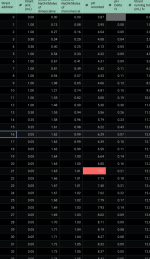
Wondering what else it could be, I looked at the raw data near the titration volume where the curves diverge (~12.5ml), the volume of tirant addition between points was dropped from 0.25ml to 0.05ml, a factor of 5x.
In the lower pH region, only two additions of 0.25ml where used. The rest of that curve has 0.5ml and and 1ml additions.
In the higher pH region there are no 0.5ml and 1ml additions. Additions here were all 0.05ml.amd 0.25ml.
I wonder if the titration setup struggles to deliver very small volumes? If it delivered more than demanded when sample volumes were asked for, that could explain the model vs experiment difference.
@starbob, are we sure the machine you are using is indeed capable of measuring small volumes well? If for example, you ask it to drop 0.05ml 100 times, do you get 5ml? What about 0.25ml 20 times? How about 0.5ml 10 times? And 1ml 5 times? If it remains precise while going up and down in demand, then I'm barking up the wrong tree. However, if you get more volume than expected from the 100 x 0.05ml and 20 x 0.25 tests it could help explain the divergence from the model.
Wondering what else it could be, I looked at the raw data near the titration volume where the curves diverge (~12.5ml), the volume of tirant addition between points was dropped from 0.25ml to 0.05ml, a factor of 5x.
In the lower pH region, only two additions of 0.25ml where used. The rest of that curve has 0.5ml and and 1ml additions.
In the higher pH region there are no 0.5ml and 1ml additions. Additions here were all 0.05ml.amd 0.25ml.
I wonder if the titration setup struggles to deliver very small volumes? If it delivered more than demanded when sample volumes were asked for, that could explain the model vs experiment difference.
@starbob, are we sure the machine you are using is indeed capable of measuring small volumes well? If for example, you ask it to drop 0.05ml 100 times, do you get 5ml? What about 0.25ml 20 times? How about 0.5ml 10 times? And 1ml 5 times? If it remains precise while going up and down in demand, then I'm barking up the wrong tree. However, if you get more volume than expected from the 100 x 0.05ml and 20 x 0.25 tests it could help explain the divergence from the model.
Attachments
Last edited:

I was dropping those all by eye since my pipette pump only went down to 0.15mL and I don't have anything else that's that accurate. I used a smaller pipette manually. I was careful trying to ensure i didn't double drop or whatnot, but I know drop sizes are not perfectly 0.05mL sorry.@starbob, are we sure the machine you are using is indeed capable of measuring small volumes well? If for example, you ask it to drop 0.05ml 100 times, do you get 5ml?
Maybe it's something like precipitated mescaline coating the probe so it doesn't actually reflect the solution pH?
It would indeed be interesting to know whether and when the solution clouded, or to repeat the experiment at lower concentration.
I believe the starting volume was ~120ml (@starbob ?)
I don't think any mescaline would precipitate. Did you see any clouding @starbob ?
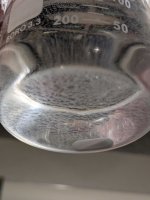
The solution was just slightly cloudy from the start, I've got good eyes and i could see it was not completely clear. I'd read it could be more accurate to have a higher concentration of the mescaline fumarate in the starting solution so I was starting at 50mL I thought would dissolve but it didn't for quite some time on stirrer, so I added 10mL more distilled water to bring it up to 60mL to start. I was stirring throughout all the additions, and I made sure it wasn't too high like chopping in air bubbles and that the probe wasn't exposed like above the small vortex. Even with 60mL it wasn't perfectly clear to be honest. Still the beaker today after all was done has something settled on the bottom (attached).
Attachments
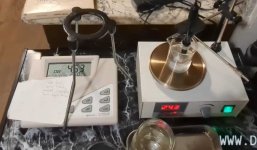
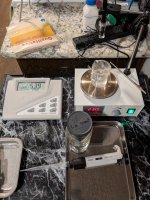





I'd be inclined to agree here - freebase mescaline is fairly soluble in water. From the concentrations in the titration it's possible to work out the maximum concentration of mescaline base, and whether that exceeds its known solubility.I don't think any mescaline would precipitate. Did you see any clouding @starbob ?
Mescaline solubility and other properties
Mescaline solubility and other properties Version 1.2 Note: when talking about IPA (isopropyl alcohol), a purity of 99% IPA is assumed. 91% IPA or less cannot substitute for 99% IPA. Freebase mescaline Composition: C11H17NO3 Melting point: 35-36°C (Kindler and Peschke, 103) Boiling point...
 forum.dmt-nexus.me
How does that square up with the volume of titrand? Ah, I see you've just posted that it was 60mL, so that can dissolve up to ~5050mg! This maximum comes with discounting any salting-out effect from the addition of NaOH.Does anyone know how soluble freebase mescaline is in water? I found this post on the nook but have not had any luck tracking down the source.
The Nook said:For freebase M, the solubility is 84100 mg/L. (MEYLAN,WM ET AL. (1996))
The sulfate has limited solubility in cold water, but is fairly soluble in hot water (hence it's use in making crystals)
The hydrochloride is quite soluble - .3g/ml +-.1g, from what I've found on other forums.
Addit: also, I don't suppose anyone has any numbers on how soluble freebase mescaline is in d-limonene?
It's impressive that the titration went so well if that was in fact undissolved M fumarate causing the turbidity. Is there a possibility it might be due to traces of calcium fumarate?
And well done to @Loveall for identifying the potential systematic error

I'd be inclined to agree here - freebase mescaline is fairly soluble in water. From the concentrations in the titration it's possible to work out the maximum concentration of mescaline base, and whether that exceeds its known solubility.
Also there's a figure of 84100 mgL⁻¹ quoted here:Mescaline solubility and other properties
Mescaline solubility and other properties Version 1.2 Note: when talking about IPA (isopropyl alcohol), a purity of 99% IPA is assumed. 91% IPA or less cannot substitute for 99% IPA. Freebase mescaline Composition: C11H17NO3 Melting point: 35-36°C (Kindler and Peschke, 103) Boiling point...
How does that square up with the volume of titrand? Ah, I see you've just posted that it was 60mL, so that can dissolve up to ~5050mg! This maximum comes with discounting any salting-out effect from the addition of NaOH.
It's impressive that the titration went so well if that was in fact undissolved M fumarate causing the turbidity. Is there a possibility it might be due to traces of calcium fumarate?
And well done to @Loveall for identifying the potential systematic error
Thanks for all the info! Don't be sorry, you did a lot of great work getting the data.
Could you measure 100 drops of 0.1M MaOH from the pipette and see how much volume that is? We should be able to renormalize the plot and replot it based on that. 50 drops would also work if that is too tedious.
Same for the 0.25ml additions. Sometimes devices don't work as well near the edge of their resolution.
aizoaceous
Titanium Teammate
You can tell that I don't usually work with mescaline, too accustomed to emulsions and oils. I agree that it's suspicious that the curves diverge when the step size changes, good catch from @Loveall and I think our current best explanation. That said, most of the divergence is over a region of 0.25 mL steps, which should have been within range of the pipette. There are too few <0.15 mL steps to materially affect the shape.
@starbob - Can you confirm whether those 0.25 mL steps were made with the adjustable pipette or by counting drops? It would be interesting to check your accuracy either way, like by dispensing ten steps onto your scale. (This is the usual way to calibrate adjustable pipettes. You can also measure the total volume, but it's usually easier to measure small mass than small volume.) The fit would be greatly improved if those were in fact 0.40 mL steps, though curve-fitting is easy so that doesn't mean much.
For curiosity, an assortment of droppers I had lying around measure between 24 uL and 46 uL per drop of distilled water. The variation was mostly between droppers, with less effect from angle than I'd expected. Different liquids may result in different drop sizes due to differences both in surface tension within the liquid and surface energy at the tip contact.
@starbob - Can you confirm whether those 0.25 mL steps were made with the adjustable pipette or by counting drops? It would be interesting to check your accuracy either way, like by dispensing ten steps onto your scale. (This is the usual way to calibrate adjustable pipettes. You can also measure the total volume, but it's usually easier to measure small mass than small volume.) The fit would be greatly improved if those were in fact 0.40 mL steps, though curve-fitting is easy so that doesn't mean much.
For curiosity, an assortment of droppers I had lying around measure between 24 uL and 46 uL per drop of distilled water. The variation was mostly between droppers, with less effect from angle than I'd expected. Different liquids may result in different drop sizes due to differences both in surface tension within the liquid and surface energy at the tip contact.
Attachments
Last edited:
the 1mL, 0.5mL and 0.25mL were all an adjustable pipette, but it's really spec'd for 1-5mL.@starbob - Can you confirm whether those 0.25 mL steps were made with the adjustable pipette or by counting drops?
You can see it's the 1000-5000uL near the bottom of this chart:

China Adjustable Pipette Suppliers, Manufacturers, Factory - Wholesale Price - WEST TUNE
As one of the most professional adjustable pipette manufacturers and suppliers in China, we're featured by good service and competitive price. Please rest assured to wholesale high quality adjustable pipette for sale here from our factory.
I'll check if it's accurate like suggested adding up a bunch, and similarly the pipette tip I used for the drops.
UPDATE: did repeated 10x and a 20x of 0.25mL on that adjustable pipette and they came back 0.28mL, 0.297mL, 0.347mL, 0.294mL & 0.3145mL. So avg ~0.31mL.
25x, 25x angled, 50x of drops came back 0.03584mL, 0.3548mL, 0.0358mL. So avg ~0.0357mL.
(10x of the 0.5mL on the adjustable came back 0.5039 so i'm not worried about that or 1mL.)
Last edited:
Nice, we can recalculate the tiration
Nice, we can re-calculate the 0.1M NaOH volume with this infothe 1mL, 0.5mL and 0.25mL were all an adjustable pipette, but it's really spec'd for 1-5mL.
You can see it's the 1000-5000uL near the bottom of this chart:
China Adjustable Pipette Suppliers, Manufacturers, Factory - Wholesale Price - WEST TUNE
As one of the most professional adjustable pipette manufacturers and suppliers in China, we're featured by good service and competitive price. Please rest assured to wholesale high quality adjustable pipette for sale here from our factory.www.westtune.com
I'll check if it's accurate like suggested adding up a bunch, and similarly the pipette tip I used for the drops.
UPDATE: did repeated 10x and a 20x of 0.25mL on that adjustable pipette and they came back 0.28mL, 0.297mL, 0.347mL, 0.294mL & 0.3145mL. So avg ~0.31mL.
25x, 25x angled, 50x of drops came back 0.03584mL, 0.3548mL, 0.0358mL. So avg ~0.0357mL.
(10x of the 0.5mL on the adjustable came back 0.5039 so i'm not worried about that or 1mL.)
Well, I'm excited to see the final fit to the model by @aizoaceous after the calibration update numbers provided by @starbob above.
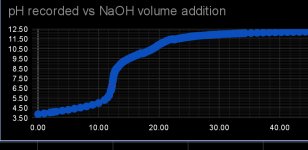
Here is the experimental plot by @starbob. I don't have the model prediction to obverlay. Looks like we may diverge up towards the end of titration, but a lot less than before.
Looks like we had monomescaline fumerate all along...
Here is the experimental plot by @starbob. I don't have the model prediction to obverlay. Looks like we may diverge up towards the end of titration, but a lot less than before.
Looks like we had monomescaline fumerate all along...
Attachments
aizoaceous
Titanium Teammate
I've replotted adjusting steps of 0.25 mL to 0.31 mL, 0.05 mL to 0.036 mL. The adjustment helps, though the fit is still worse than at lower pH.
I feel reasonably confident that this is monomescaline fumarate, but I think we're still missing something. I think the curve for any salt should have a flat spot around 9.5 as the amine buffers. We see that in the theoretical curves, but not the measured curve.
I feel reasonably confident that this is monomescaline fumarate, but I think we're still missing something. I think the curve for any salt should have a flat spot around 9.5 as the amine buffers. We see that in the theoretical curves, but not the measured curve.
Attachments
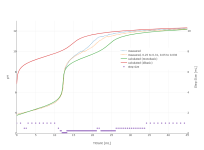
Well, it's a good sign that the experimental data got closer to the model when improving it. Perhaps the current gap is from (1) noisy dispense near the lower 0.15ml volume limit and (2) precipitation from the concentrated solution.
@starbob, more concentrated solutions can give more resolution, but to a point. If they are super concentrated and precipitate that can diverge from the model. I think there is a sweet spot, perhaps at 10x below saturation.
If @starbob, you could do it again in more dilute conditions to try to avoid precipitation (~10x) and use the more stable 0.5ml dispense volume. Perhaps use what xtalizes from the IPA was after a longer time in the freezer?
Regardless, this data convinces me that we have the monomescaline fumerate salt.
I will update the TEK.
This is important work, because many cactus growers are switching to fumaric salting. Glad we can give more accurate dosing Thank you so much @starbob and @aizoaceous
I wonder why the initially got a the very low expected mass ratio in citrate/fumarate split experiments.
@starbob, more concentrated solutions can give more resolution, but to a point. If they are super concentrated and precipitate that can diverge from the model. I think there is a sweet spot, perhaps at 10x below saturation.
If @starbob, you could do it again in more dilute conditions to try to avoid precipitation (~10x) and use the more stable 0.5ml dispense volume. Perhaps use what xtalizes from the IPA was after a longer time in the freezer?
Regardless, this data convinces me that we have the monomescaline fumerate salt.
I will update the TEK.
This is important work, because many cactus growers are switching to fumaric salting. Glad we can give more accurate dosing
Thank you so much @starbob and @aizoaceous I wonder why the initially got a the very low expected mass ratio in citrate/fumarate split experiments.
aizoaceous
Titanium Teammate
But @starbob didn't report any additional clouding during the titration, and @Transform's link implies the freebase should be plenty soluble. The obvious model for precipitation would make our divergence worse and not better. So I'd currently guess my initial speculation was wrong, and solubility plays no role here.(2) precipitation from the concentrated solution
A repeat titration would be interesting. I think the consistency of constant-volume steps would outweigh any benefit in accuracy from smaller steps near the steep part of the curve. Or has anyone very carefully (many pulls, lots of stirring, thoroughly wash the drying agent, evaporate the last pull alone to confirm nothing was left, etc.) converted fumarate to freebase and weighed the result? That seems like the more accurate direction for yield by weight. What did @starbob do with the solution after the titration? I assume the mescaline was or will be recovered, and its weight as freebase could be compared.
Explanation of mesc FB's water solubility here:But @starbob didn't report any additional clouding during the titration, and @Transform's link implies the freebase should be plenty soluble. The obvious model for precipitation would make our divergence worse and not better. So I'd currently guess my initial speculation was wrong, and solubility plays no role here.
A repeat titration would be interesting. I think the consistency of constant-volume steps would outweigh any benefit in accuracy from smaller steps near the steep part of the curve. Or has anyone very carefully (many pulls, lots of stirring, thoroughly wash the drying agent, evaporate the last pull alone to confirm nothing was left, etc.) converted fumarate to freebase and weighed the result? That seems like the more accurate direction for yield by weight. What did @starbob do with the solution after the titration? I assume the mescaline was or will be recovered, and its weight as freebase could be compared.
The three methoxy groups on mescaline have appreciable electrostatic interactions with polar water molecules. Thus making mescaline pretty soluble in water. While DMT is largely non-polar in nature. Edit - doesn't have much to do with the protonation of the amines(pKa's and such). Notice how it is free-base mescaline that is soluble in the water and not the acid 'salt'(which is very soluble in water).
Intermolecular forces, and electronegativity as some key-words if you're more curious about this.
Hopefully this is what you were looking for.
I haven't done anything with it yet! I'd meant to reply to your earlier comment on yield and re-acidifying to fumarate; that I'm currently planning on adding excess NaCl (kosherWhat did @starbob do with the solution after the titration? I assume the mescaline was or will be recovered, and its weight as freebase could be compared.
 ) and pulling with ethyl acetate, then re-salting citric acid to compare weight vs 400mg fumarate. I've never isolated freebase mescaline before I don't have a clue offhand how to do that to weigh it for comparison
  .
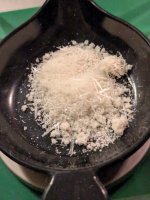
.To do another repeat titration I'd have to extract more or re-x I think because I've only got roughly 50mg of this sample left that was IPA re-x'd, and i don't trust my other stock as like a reliable normal CIELO example; it's a mix of normal extracted fumarate from CIELO, water re-x'd, and a big part of a result of a maximum water:EtAc experiment I did which turned out pretty chunky (attached).
Attachments
aizoaceous
Titanium Teammate
After extraction of the titration mixture, your ethyl acetate should contain mescaline base, some dissolved water, and some inorganic salts made soluble by the water. You could dry the ethyl acetate over anhydrous sodium sulfate, decant to separate the sodium sulfate, rinse the sodium sulfate a couple times with fresh ethyl acetate to recover mescaline from solvent trapped in the sodium sulfate, and then evaporate until the weight stops decreasing.I've never isolated freebase mescaline before I don't have a clue offhand how to do that to weigh it for comparison
Lots of universities have videos on YouTube that show the liquid-liquid extraction and drying. The easiest way I've found to evaporate solvent is a water bath below the boiling point of the solvent, with air blowing on the solvent surface. This avoids splashes from vigorous boiling that could cause injury, fire, or lost product. Professional labs use a similar method to evaporate vials and other quantities too small for the rotovap. I don't know what temperature is safe for mescaline, but 50 C is common, because it's safe for most alkaloids and also safe to briefly touch. I use an aquarium air pump, but a fan or blower would work too. The fumes must of course be exhausted outdoors, and present both a toxic and explosion hazard otherwise.
I may be showing my unfamiliarity with mescaline again, but I think you'll get a sticky oil. If so then you'll need to weigh it in the container where you evaporated it, by weighing the empty container and subtracting. If your container is too heavy for your milligram scale, then evaporate most of the way, transfer to a smaller container, then rinse the big container with fresh ethyl acetate and transfer and repeat.
I believe this would be more accurate than comparing crystallized salt to crystallized salt, since it removes the uncertainty of the remaining weight dissolved in the mother liquor. The freebase mescaline can be redissolved in ethyl acetate (or another solvent) and then salted as usual to recover crystals.
Similar threads


- Replies
- 15
- Views
- 758

Staff online
-
 endlessnessModerator
Members online
Total: 1,217 (members: 8, guests: 1,209)
Robots: 185
Robots: 185