• Members of the previous forum can retrieve their temporary password here, (login and check your PM).

TEK Ethyl acetate approach [CIELO]

This topic contain a TEK
Migrated topic.
Your second+ batches will see 1%+ mescaline. So instead of adding 70g to the extract, I would do a 6th pull with new EA to rinse the used EA out (this will also add volume to the extract, but by a different amount).

This increases your EA volume used, a little bit but is worth it. It makes sense to rinse with more EA and the extract % increases.

1st batch, normal. No 6th pull.

2nd batch do a 6th pull with 70g fresh EA

3rd batch do a 6th pull with 140g fresh EA

4th batch do a 6th pull with 210g of fresh ES


For example, your last batch will have EA incoming with ~ 4% mescaline. After your last pull there will be 70ml * 0.04 = 280mg of mescaline. Rinse that out with fresh 210ml of fresh EA to get back 280*(210/280) = 210mg of mescaline.

Also, I would only do this for 1% yielding powders. For 5% yielding powders I would not.

Make sense?

I thought I'd leave my xp here for all dealing with low-yielding cactus (in my case 0.2%)

I had the luck to find in a green dump literally kilos (50+) of pachanoi cuttings. They grow in almost every garden where i now live and people just trim and throw them away. I started collecting them since I came and now I have my own little collection and also a lot of dried cactus to experiment on.

I did my first two tries some months ago. I tried the tek as usually described on 100g each time. 1st time I got nothing and 2nd time I got goo. I was sure I had followed the tek properly so I was pretty sure these cacti are just low on alkaloids (which now im sure). So i stopped trying until some days ago I read the quote above.

I did two runs of 500g each time. Success! I was able to extract 0.9g citrate each time for a total of 1.8g.

So basically I was collecting the extract and then using it again and again on each batch.

Indeed you lose EA to the wet crumbs on each batch so what I did was doing the 5th pull with the remaining extract plus fresh EA to keep always the same working volume. I reckon that this fresh EA is enough to dilute the loaded EA that remains in the pot.

Of course I did run through a whole kg of powder for such amounts BUT this is the most mescaline I have seen in 8 years and I have enough for maybe 2-3 trips.
I was so happy with the results I thought I'd share. :p

One Peace
 
Was it the same starting cactus?

Did you see clouding when pulling with reclaimed EA? It will cloud if not neutral due to calcium citrate forming.
Yep, same cactus source with at least 1%.

I have an update and answer to your question. Yes, the ea reclaimed by washes did cloud and the malate product ended up powdery instead of needle crystals, did not bioassay or marquis it yet. We are again deviating from the tek and using sodium carb for the basification of cactus material instead of calcium hydroxide and malic acid instead of citric so it wouldn't be calcium citrate but sodium maleate?

Now the update: grabbed some of the reclaimed and dumped lots of activated charcoal to it. It lost the dark green and turned to clear yellow. Used that to process more of the same material in the same way (base with sod carb - squeeze the mass as much as possible while in ea - sod carb dry step - precipitate with malic acid) and I got needle crystals again. Still dropping so no yield yet, images to come.

Lessons: it's actually not difficult to get crystals with sodium carbonate for base (digressing from what's written in the tek, with the caveats) and fumaric or malic acid for salting, but citric leads to goo in our process deviation. A cleaner EA works much better. Also, the drop malic and don't mix the extract plus patience = needles is a very real thing.
 
I thought I'd leave my xp here for all dealing with low-yielding cactus (in my case 0.2%)

I had the luck to find in a green dump literally kilos (50+) of pachanoi cuttings. They grow in almost every garden where i now live and people just trim and throw them away. I started collecting them since I came and now I have my own little collection and also a lot of dried cactus to experiment on.

I did my first two tries some months ago. I tried the tek as usually described on 100g each time. 1st time I got nothing and 2nd time I got goo. I was sure I had followed the tek properly so I was pretty sure these cacti are just low on alkaloids (which now im sure). So i stopped trying until some days ago I read the quote above.

I did two runs of 500g each time. Success! I was able to extract 0.9g citrate each time for a total of 1.8g.

So basically I was collecting the extract and then using it again and again on each batch.

Indeed you lose EA to the wet crumbs on each batch so what I did was doing the 5th pull with the remaining extract plus fresh EA to keep always the same working volume. I reckon that this fresh EA is enough to dilute the loaded EA that remains in the pot.

Of course I did run through a whole kg of powder for such amounts BUT this is the most mescaline I have seen in 8 years and I have enough for maybe 2-3 trips.
I was so happy with the results I thought I'd share. :p

One Peace
Wow that is dedication. For low yielding plants you can get that last 0.2% to crash out more reliably with fumaric.

It seems like you have not noticed a boost in yield when storing PC? Do you have any observations around this?
 
Interesting results with used EA salted with fumaric.

The regeneration step can be skipped. It is neutralized by the wet crumbs incredibly quickly, within 10s, remains clear, and the rest of the pull proceeds as normal.

Need at least one person to confirm this result before updating the TEK.

Cheers.
 

Attachments

  • PXL_20251031_033529176.MACRO_FOCUS.jpg
    PXL_20251031_033529176.MACRO_FOCUS.jpg
    474 KB · Views: 2
Interesting results with used EA salted with fumaric.

The regeneration step can be skipped. It is neutralized by the wet crumbs incredibly quickly, within 10s, remains clear, and the rest of the pull proceeds as normal.

Need at least one person to confirm this result before updating the TEK.

Cheers.

Unfortunately the product from form EA that skipped fumaric regen is contaminated with something (yields are too high). Perhaps Calcium fumarate is soluble in EA but crashes when fumaric is added?
 
Unfortunately the product from form EA that skipped fumaric regen is contaminated with something (yields are too high). Perhaps Calcium fumarate is soluble in EA but crashes when fumaric is added?
Weird. Why the heck should calcium fumarate be soluble in EA? The only idea that comes to mind is that a calcium-mescaline complex is formed, which breaks down with more acid - but why wouldn't we see this with the citric version? Would this imply that (acidic?) calcium citrate is soluble in EA? That's something that could be tested.
 
Weird. Why the heck should calcium fumarate be soluble in EA? The only idea that comes to mind is that a calcium-mescaline complex is formed, which breaks down with more acid - but why wouldn't we see this with the citric version? Would this imply that (acidic?) calcium citrate is soluble in EA? That's something that could be tested.


The contamination only shows up when using EA that was not regenerated (neutralized) and salted with fumaric.

If skipping regen is attempted with citric, the EA clouds when pulling and takes a long time to become neutral. Perhaps it is calcium citrate clouds. It is hard to filter/decant and unusable.

The contamination when skipping fumaric regen is a mystery to me. I tried to dissolve it water and it became milky (reminds me of milk of calcium hydroxide but it is neutral). I filtered the milk and did an A/B on it but no mescaline moved to the solvent.

Could the milk be a Calcium/Mescaline/Fumaric complex???

I am stumped but have more contaminated product to do more experiments...
 
The contamination only shows up when using EA that was not regenerated (neutralized) and salted with fumaric.

If skipping regen is attempted with citric, the EA clouds when pulling and takes a long time to become neutral. Perhaps it is calcium citrate clouds. It is hard to filter/decant and unusable.

The contamination when skipping fumaric regen is a mystery to me. I tried to dissolve it water and it became milky (reminds me of milk of calcium hydroxide but it is neutral). I filtered the milk and did an A/B on it but no mescaline moved to the solvent.

Could the milk be a Calcium/Mescaline/Fumaric complex???

I am stumped but have more contaminated product to do more experiments...

Ok, I added more base to try to break things up and I seem to be recovering the mescaline now form the no Regen fumaric experiment.

IDK what happened.
 
one little question, is the ethil acetate used in cielo tek food grade?, its MEk subsitute food grade?, i can get ethil acetate 99% pure and 0.2% ethanol, the technical sheet does no include other excipients i guess and i do not have access to food grade ae kind of hard to get in most places. anyone with information around toxicity reports in this tek? thank you
 
one little question, is the ethil acetate used in cielo tek food grade?, its MEk subsitute food grade?, i can get ethil acetate 99% pure and 0.2% ethanol, the technical sheet does no include other excipients i guess and i do not have access to food grade ae kind of hard to get in most places. anyone with information around toxicity reports in this tek? thank you
At 99% it's unlikely there will be significant toxicity as a result of any contaminants under normal circumstances. EA is sold as a MEK substitute in part due to its lower toxicity than the latter. By toxicity information, do you mean the data typically laid out in the SDS which accompanies the product - at least in the sense of being available online - or were you concerned about the significantly less than 1% of contaminants other than ethanol, most of which is likely to be water?

There may be trace amounts of other solvents as a result of the non-food grade transport chain. These may vary or be absent, and it would take either detailed insider knowledge of the production and transport chain or some accurate analysis via GCMS - on a batch-by-batch basis in both cases - to be able to comment with any certainty on what is essentially a marginal concern.

There may be some permissible amounts for various impurities as part of quality assurance standards, and a separate designation for food grade material, but these would only relate to the batch of EA you may happen to have as maximum allowable amounts, rather than a precise figure for their confirmed presence.

This could be seen as a long-winded way of saying "I don't know but here's how you might begin to go about finding out for yourself", although it seems like you'd be able to go ahead with the grade of solvent that you have in mind to yield a safe enough product, and any subsequent qualms you may have ought to be allayed by recrystallisation of the mesc citrate from a suitable solvent.
 
one little question, is the ethil acetate used in cielo tek food grade?, its MEk subsitute food grade?, i can get ethil acetate 99% pure and 0.2% ethanol, the technical sheet does no include other excipients i guess and i do not have access to food grade ae kind of hard to get in most places. anyone with information around toxicity reports in this tek? thank you
You can do the (1) evap test and (2) ask the manufacturers for any quality controls they have (heavy metal analysis, etc).
 
We were able to make sodium carbonate work as the base for the CIELO procedure. Nearly the same procedure as the published tek so I won`t describe in too much details.

1 - get sod carb at around 1/5 w/w to cactus powder. So 100 g of cactus and 20 g of sod. Mix them well.
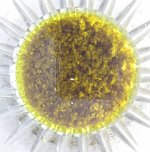
2 - spray filtered water, mix the powder so it makes small clumps, spray more and mix, rinse and repeat until it starts to turn dark (be it by the base working or just moist powder). Don`t spoon mix, don`t push the powder against each other, always spray and shake-mix, be patient (this diverges from the tek).
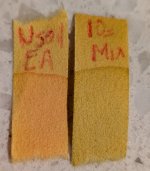
3 - if too big clumps form, grab a scissor and cut them as much possible before wetting more, see pics.
proc1.jpgproc2.jpg
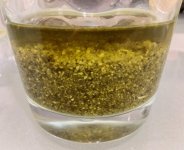
4 - the right amount of water is unknown, as it gets darker and before it starts glistening, just stop. best to not overshoot. Let it react for minimum of 10 min. Add in etac to cover moist powder (room temp or cold, couldn`t notice any difference on extraction but it smells less while cold). Mix and etac will start to turn yellow.
proc3.jpg
5 - if clumpy or not satisfied with chunk sizes, cut more with scissors while in etac. Time is not an issue (divergence from tek), you can leave it in for >30 mins, I got no congealing.
proc4.jpg
6 - filter and collect etac.
7 - add more etac and repeat. On the 3rd extraction, the mass may be squeezed through a strainer, fork, spoon or whatever means to pull out as much etac as possible. Pic below is after 4th pull, after heavy squeezing, and it continues to break apart (diverges from tek, seems like if clumps form on the first etac pull they will get stuck forever, but if you get it to etac while properly wet and not chunky, it won`t congeal... you can always scissor cut or perhaps even put it on a blender). Also added a bit more water with sod carb straight to the etac+powder after 3rd pull, mixed well and left for more 15 mins. etac collected continues to be yellow or it might start to come out a bit darker green.
8 - not sure how many times to make the pulls, but my rule of thumb is 10x more etac than g of powder, so 10 g = 100 mL. I would say a minimum. Did not test pH as did not have proper pH paper tests. Last pull (usually 5th) was left in for 30 mins or so (at this point more than an hour has been through, no congealing observed). Hardest squeeze ever on the last pull.
goodprep.jpg
9 - add sod carb to filtered loaded etac for the chem drying step, follow tek, this may be fundamental due to the squeezes. Filter out sod carb and you got perfect loaded etac.
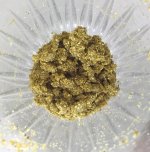
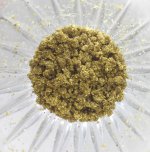
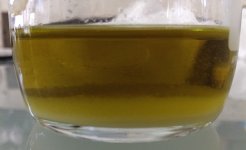
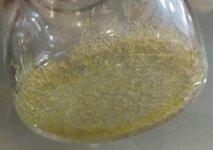
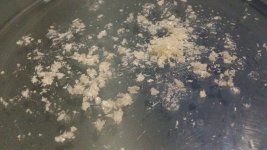
10 - drop mesc with fumaric acid or malic acid. fumaric makes white powder (left), malic makes nice chunky yellowish crystals (right and below).
fummliquid.jpgfummpefinall.jpg
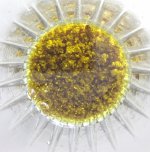
11 - recover solids and solvent (reclaim solvent per tek). wash solids with cold clean et ac until it comes out transparent. We do it by decantation, so fumaric requires centrifugation to speed this up, malic drops like a rock and is real easy to wash-decant, though it grabs yellow from the solvent and likely requires re-crys to turn full white (had no luck with this using etac or isopropyl). Below is malate solid light magic.
fumfinal.jpg

We got yield of ~2.6% from a peruvianus (very glaucus, but it might be a terschekii, have not been able to properly id, got it from seeds claiming to be san pedro 20 years ago) cut from a pot and left in the dark for 3 months. Initial tests with sod carb inevitably congealed the mass and led to 1.0-1.7% yield, adding the water straight on and mixing just gels everything and makes larger clumps... underwatering, spraying and cutting chunks as much as possible does the trick at keeping it all apart and this improves on getting etac to come in and out and around the mass, also helps in recovering as much as etac from the mass, leaving it extracting and shaking as long as possible, etc.

Around 400 mg of oral mesc malate is a moderate to intense at peak, below 300 mg is nice but very light, with little visual effects. Feeling and existing is awesome, senses 1000% high and the most beautiful shards of light are made. The world gains gravitas. At peak, ego dissolution and forgetfulness within a sea of fluid light occurs for some 30 mins and psychological support is recommended or get your shit together and embrace breathing. Nausea and the gut-throat crunch are common, but strangely at 400 mg less nausea was felt. I always get headaches at > t0900 hr at any dose and take NSAIDs and choline supplements to cut it a bit though it only goes away on the next day.

These were very helpful to choose doses: doi.org/10.1038/s41398-024-03116-2 ... doi.org/10.1038/s41386-023-01607-2 ... (there are many others). Coupled with the salt calculator that someone (Transform???) has made available here, there is some sensible preparation and assurance to go up the stairs.

Thank you CIELO team!

 
Last edited:
Great to hear of your results!

There's a lot of nuanced tricks to working with SC instead of lime it seems, so thanks for sharing all those tips. I particularly like the scissor trick. The fact that this uses the highly accessible sodium carbonate helps massively in side-stepping the stumbling block of lime sometimes being hard to find.

This variant is something that ought to be tested with butyl acetate as well. We're yet to see whether any food acids can be optimised for that particular solvent, although - as mentioned elsewhere - it does appear to function for precipitating harmala citrate when adding a saturated citric acid solution in BuOAc [CASBA]. How does the solubility of malic and fumaric acid in EtOAc compare with that of citric? [Actually, I just found a paper - attached - for malic acid in various solvents including EtOAc, so that part of the question is answered.]


These were very helpful to choose doses: doi.org/10.1038/s41398-024-03116-2 ... doi.org/10.1038/s41386-023-01607-2 ... (there are many others). Coupled with the salt calculator that someone (Transform???) has made available here, there is some sensible preparation and assurance to go up the stairs.
Those URLs are truncated, can you repost the full ones?

The salt calculator wasn't me (although I did add a few extra bits to it) - I think it may have been @Samvidbuho but I'd have to check.
We got yield at ~2.6% from a peruvianus (very glaucus, but it might be a terschekii, have not been able to properly id, got it from seeds claiming to be san pedro 20 years ago)
Do you have any pictures? Terscheckii is quite distinct from peruvianus/macrogonus on a number of quite specific features.
 

Attachments

  • kai2013.pdf
    721.8 KB · Views: 2
Here's one calculator, by @Infundibulum
And another, with additional pH calculation:
 
We were able to make sodium carbonate work as the base for the CIELO procedure. Nearly the same procedure as the published tek so I won`t describe in too much details.

1 - get sod carb at around 1/5 w/w to cactus powder. So 100 g of cactus and 20 g of sod. Mix them well.
2 - spray filtered water, mix the powder so it makes small clumps, spray more and mix, rinse and repeat until it starts to turn dark (be it by the base working or just moist powder). Don`t spoon mix, don`t push the powder against each other, always spray and shake-mix, be patient (this diverges from the tek).
3 - if too big clumps form, grab a scissor and cut them as much possible before wetting more, see pics.
View attachment 106053View attachment 106055
4 - the right amount of water is unknown, as it gets darker and before it starts glistening, just stop. best to not overshoot. Let it react for minimum of 10 min. Add in etac to cover moist powder (room temp or cold, couldn`t notice any difference on extraction but it smells less while cold). Mix and etac will start to turn yellow.
View attachment 106056
5 - if clumpy or not satisfied with chunk sizes, cut more with scissors while in etac. Time is not an issue (divergence from tek), you can leave it in for >30 mins, I got no congealing.
View attachment 106057
6 - filter and collect etac.
7 - add more etac and repeat. On the 3rd extraction, the mass may be squeezed through a strainer, fork, spoon or whatever means to pull out as much etac as possible. Pic below is after 4th pull, after heavy squeezing, and it continues to break apart (diverges from tek, seems like if clumps form on the first etac pull they will get stuck forever, but if you get it to etac while properly wet and not chunky, it won`t congeal... you can always scissor cut or perhaps even put it on a blender). Also added a bit more water with sod carb straight to the etac+powder after 3rd pull, mixed well and left for more 15 mins. etac collected continues to be yellow or it might start to come out a bit darker green.
8 - not sure how many times to make the pulls, but my rule of thumb is 10x more etac than g of powder, so 10 g = 100 mL. I would say a minimum. Did not test pH as did not have proper pH paper tests. Last pull (usually 5th) was left in for 30 mins or so (at this point more than an hour has been through, no congealing observed). Hardest squeeze ever on the last pull.
View attachment 106058
9 - add sod carb to filtered loaded etac for the chem drying step, follow tek, this may be fundamental due to the squeezes. Filter out sod carb and you got perfect loaded etac.
10 - drop mesc with fumaric acid or malic acid. fumaric makes white powder (left), malic makes nice chunky yellowish crystals (right and below).
View attachment 106059View attachment 106054
11 - recover solids and solvent (reclaim solvent per tek). wash solids with cold clean et ac until it comes out transparent. We do it by decantation, so fumaric requires centrifugation to speed this up, malic drops like a rock and is real easy to wash-decant, though it grabs yellow from the solvent and likely requires re-crys to turn full white (had no luck with this using etac or isopropyl). Below is malate solid light magic.
View attachment 106060

We got yield of ~2.6% from a peruvianus (very glaucus, but it might be a terschekii, have not been able to properly id, got it from seeds claiming to be san pedro 20 years ago) cut from a pot and left in the dark for 3 months. Initial tests with sod carb inevitably congealed the mass and led to 1.0-1.7% yield, adding the water straight on and mixing just gels everything and makes larger clumps... underwatering, spraying and cutting chunks as much as possible does the trick at keeping it all apart and this improves on getting etac to come in and out and around the mass, also helps in recovering as much as etac from the mass, leaving it extracting and shaking as long as possible, etc.

Around 400 mg of oral mesc malate is a moderate to intense at peak, below 300 mg is nice but very light, with little visual effects. Feeling and existing is awesome, senses 1000% high and the most beautiful shards of light are made. The world gains gravitas. At peak, ego dissolution and forgetfulness within a sea of fluid light occurs for some 30 mins and psychological support is recommended or get your shit together and embrace breathing. Nausea and the gut-throat crunch are common, but strangely at 400 mg less nausea was felt. I always get headaches at > t0900 hr at any dose and take NSAIDs and choline supplements to cut it a bit though it only goes away on the next day.

These were very helpful to choose doses: doi.org/10.1038/s41398-024-03116-2 ... doi.org/10.1038/s41386-023-01607-2 ... (there are many others). Coupled with the salt calculator that someone (Transform???) has made available here, there is some sensible preparation and assurance to go up the stairs.

Thank you CIELO team!
Thanks for the report. I couldn't figure out how make sodium carbonate to not congeal.

Please measure the water (spray bottle weight pre and post delta for example). Interested in that.

Can you say anything about the fumarate and malate weights? Hopefully you split the EA and then salted so we can compare. If you salted one pull with fumaric and the next with malic we can't compare the mole ratio/salt form.

Cheers.
 
User bobcollege freebased some mescaline fumerate salt and posted their results on Reddit.

They started with 400mg of cleaned fumarate product (IPA re-X to double confirm no fumaric acid contamination).

Then slowly added NaOH and kept track of the pH to freebase the salt.

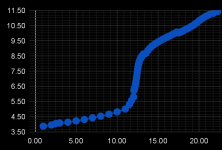
The pH at the pKa of mescaline (~9.5) was reached after adding 15ml of 0.1M NaOH solution.

Does this confirm the dimescaline fumarate salt form? I think so, but want a second opinion from the nexus folks. My logic could be wrong.

We don't have direct NMR or mass spec % for the fumarate salt so we used the yield ratio of 1/1.6 vs citrate (known salt form) to propose dimescaline fumarate. Bioassay results were consistent with this, but those are subjective.

Here is the logic I used:

Fumaric acid: FumH2
Mescaline freebase: M
Mescaline salt: MH+

If monomescaline fumarate, the freebasing reaction is:

FumH(MH) + 2NaOH -> FumNa2 + M + 2H2O

If dimescaline fumarate:

Fum(MH)2 + 2NaOH -> FumNa2 + 2M + 2H2O

In either case, at least 2 moles of NaOH are needed per mole of salt to complete the reaction (maybe a little more because of freebase mescaline affinity to H+).

The quantity of NaOH used was 1.5 milimoles. That could freebase up to 0.75 milimoles of salt (or slightly less because of the affinity of freebase mescaline to grab H+).

For 400mg of fumarate product, we would have:

- Monomescaline fumarate hypothesis: 1.2 milimoles of starting salt. That is too much salt to freebase with only 1.5 milimoles of NaOH and raise the pH. At least 2.4 milimoles of NaOH are needed. Hypothesis rejected.

- Dimescaline fumarate hypothesis: 0.074 milimoles of starting salt. That matches well with the 1.5 milimoles of NaOH needed to reach a high pH. '''Dimescaline fumarate Hypothesis is supported by the data.'''

For reference the pH curve pof the 400mg mescaline fumarate salt vs 0.1M NaOH volume added (in ml) is attached.
 

Attachments

  • Screenshot_20251111-111258.png
    Screenshot_20251111-111258.png
    58.6 KB · Views: 4
Last edited:
Thanks for the report. I couldn't figure out how make sodium carbonate to not congeal.

Please measure the water (spray bottle weight pre and post delta for example). Interested in that.

Can you say anything about the fumarate and malate weights? Hopefully you split the EA and then salted so we can compare. If you salted one pull with fumaric and the next with malic we can't compare the mole ratio/salt form.

Cheers
Oh dearest Loveall, the keeper of the sky tek.

Water was about 70% w/w so if 100 g powder then 70 g water spray wise. Every attempt to drop more than 5 mL at once makes large clumps that may be cut... Spraying and mixing repeatedly and patiently worked very well. Also remember that on the last pulls some water like 5-10 mL plus a sprinkle of sodcarb was thrown straight into the etac plus powder and mixed-incubated for 15 min before collect etac, in the hopes of pulling more magic out, not sure if this helped at all in yields, certainly did not make it congeal. In fact, if it did not congeal while watering, after adding it to etac it never congealed at all, even after heavy squeezing, as if etac

We did a bunch of trials using 15 g of powder. There were no exact splits of a pull for exact comparison. But, in a couple of those we used fumaric and yield was 3% of very fine very white powder (against the 2.6% of the malate), one time adding 400 mg of fumaric and the other the 400 was added over a 3 days room temperature incubation, yielding the same results in either. The fumaric acid used was a very fine powder while the DL-malic was of grains, not sure but maybe that makes a difference in getting needles. Fumarate powder is a drag to cleanup by decanting and will lose too much to a filter paper, the malate chunky crystals, although ending up yellow-tan was very straight-forward.

Forgot to add that there was at least 3 days of crystallization before collecting the yield.

Also tried to dissolve the malates and the fumarates in hot isopropyl (25 mg in 500 ul) and not only it failed to dissolve everything but it ended up coming back as the same yellow-tan malates and powdery fumarates.

And what you mentioned in your last post as a way to evaluate if di or mono is very important. I am assuming always mono for dosages conversion to HCl or sulfate equivalents so it may be over shooting doses.
 
That's me BTW ;)
Also hoping for second opinion from nexus folks 🙏
I had hoped to see two equivalence points for di-mescaline fumarate, but that was just based on my very very inexperienced reading/googling of how to do something like this.
Well, fumaric acid pKas are only 1.5 units apart. Maybe they are too close for a good separation?

IDK why we don't see two points. You could expect that BOTH the dimescaline and/or monomescaline could' have two equilibration points since each releases two molecules (H+ and MH+ for the former and MH+ and MH+ for the latter).

You can titrate pure fumaric acid and see what happens. I think 500mg will dissolve in 100ml at room temp.
 
Back
Top Bottom