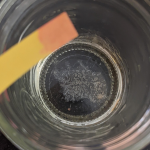
Ok.
Another possible easy test would be to add fumaric to the solvent crashed with citric. Have you tried that yet?
Another possible easy test would be to add fumaric to the solvent crashed with citric. Have you tried that yet?

Loveall said:Another possible easy test would be to add fumaric to the solvent crashed with citric. Have you tried that yet?

_Trip_ said:I believe Loveall has, there's a topic on here somewhere but if you check the CIELO tek wiki page he has written them in there towards the bottom of the page.
Ethyl acetate approach [CIELO] - Preparation - Welcome to the DMT-Nexus here's the results it's in this thread.
orchidist said:_Trip_ said:I believe Loveall has, there's a topic on here somewhere but if you check the CIELO tek wiki page he has written them in there towards the bottom of the page.
Ethyl acetate approach [CIELO] - Preparation - Welcome to the DMT-Nexus here's the results it's in this thread.
Thank you! That seems pretty convincing that the fumarate is a 1:1 salt. I'm very surprised that the malate would be 2:1 while others are not, considering the 2nd pKa is quite a bit weaker than either citric or fumaric acid.
Glad to finally have a baseline yield for what I'm working with. Hopefully it can be pushed up. If not, at least my yield is in range of published values.
Found a more thorough compilation of data in Trout's notes
Metta-Morpheus said:Hi Cheelin,
I have gone thru and deleted your one word/emoji posts. These are useless and just take up space. Please refrain from further one word responses.
Metta-Morpheus

Cheelin said:Metta-Morpheus said:Hi Cheelin,
I have gone thru and deleted your one word/emoji posts. These are useless and just take up space. Please refrain from further one word responses.
Metta-Morpheus
Petty!
Thanks Loveall et al, great tek!

If it's comparing apples with apples we want, the reference standard should, clearly, be the malate salt.orchidist said:Yeah, not the most exciting result for sure, but right now I'm happy I got anything
It would for sure be most useful if everyone reported their yields in terms of the freebase, not whatever salt was formed so we could compare apples to apples. But now that I've got a baseline and procedure that is working for me, I can at least compare directly against myself and look for consistency in the yield. If there's a lot of variability, probably my fault, otherwise, probably unimpressive starting material.
Eventually I'll have my own harvestable columns and not have to rely on a third party for my material.

 ]
]downwardsfromzero said:If it's comparing apples with apples we want, the reference standard should, clearly, be the malate salt.orchidist said:Yeah, not the most exciting result for sure, but right now I'm happy I got anything
It would for sure be most useful if everyone reported their yields in terms of the freebase, not whatever salt was formed so we could compare apples to apples. But now that I've got a baseline and procedure that is working for me, I can at least compare directly against myself and look for consistency in the yield. If there's a lot of variability, probably my fault, otherwise, probably unimpressive starting material.
Eventually I'll have my own harvestable columns and not have to rely on a third party for my material.
[chemistry joke - check the etymology of malic acid if you don't get it
Malate is, to a large extent, the salt form we can expect in the cactus - but really I'd like to bump that link to the salt equivalent calculator spreadsheet: {which will be here when I can find it, unless someone beats me to it ↓↓↓}
My other hobby gives me tons of exposure to etymology, especially of the botanical sort.
Nice one; a bit further down that thread there's an updated spreadsheet with mescaline citrate included and sooner or later I/someone could add malates as well.orchidist said:dfz, I think I found the conversion spreadsheet here. Looks great!
Nemooo said:This is for the Ethyl acetate approach thread by Loveall. I can't seem to post in there.
Great job on coming up with a greener and faster method that appears to give high purity product!
A few suggestions:
1) Dry the solvent before trying to precipitate the alkaloid salts:
- I saw some effort to dry the ethyl acetate, but CaCl2 is generally not compatible with amines or esters as they can form a complex with it, it can also be slow and finicky.
- K2CO3 is your best bet, compatible with both amines and ethyl acetate. Only use just enough and give it time to do its job. Molecular sieves are a possibility too.
- A dry solvent will make things more reproducible and will lead to faster crystallisation and also should avoid the formation of the biphasic "oil" some have seen. The "oil" appears to be a very saturated solution of alkaloid salt and acid, the addition of the acid in the presence of water in the solvent means the more polar compounds can form aggregates and eventually separate out due to the increase in polarity/ ionic nature. The fact they are in solution also means the stoichometry of the alkaloid salt could vary.
2) Dissolve the solid acid of choice (citric, fumaric etc) in ethyl acetate first, then add this to the ethyl acetate extract.
- This, providing the extraction solvent is dry enough, will mean the amount of acid can more accurately titrated (yes excess acid is soluble in ethyl acetate, but if a biphasic system develops it will also partition itself between the aqueous and organic layers complicating things).
- The ethyl acetate may need to be heated or sonicated to get more acid to dissolve but this is ok, just let it cool before adding to the extract.
3) Consider trying succinic acid:
- Fumaric acid is a Michael acceptor and there are cases in the literature recording amines reacting with it in this way. Probably fine most of the time, but should a solution need heat sterilisation that could be a problem.
4) Do an A/B extract on the residue to prove all alkaloids have been extracted.
- I think you should do this to confirm it gets all the alkaloids.
5) Melting point
- Do a melting point.This will tell you how pure it is.
- Popping or change in crystal structure prior to melting would indicate solvent or water or crystallisation/ hydrate.
- Otherwise more spectroscopic data to show it is clean and doesn't need recrystallisation. That Mass Spec you showed doesn't say how it was obtained, and doesn't tell the whole story. Im guessing it was run in positive mode only so no acids present?
6) Recrystallisation.
- Would be great to see some solubility information on the citrate/ fumarate/ succinate and also recrystallisation.
Loveall said:Orcjidist, I used whole cactus powder earlie on and got xtals. However, there could be difference s in drying, cactus, etc.
Have you always gotten goo using citric acid with the other whole cactus powders?
Anyone else get xtals with whole cactus powder? If yes, how did they dry it?
Anyone get goo with outer skin after feeling they got the process done right?

CIELO TEK said:Q: After adding citric acid, goo precipitated instead of crystals, what gives?
This is the most common issue people encouncer. Cause/Causes are unkown, but there are some theories:
-Poor TEK execution: This is believed to be the most common issue. Make sure the TEK instructions were followed, in particular: well mixed paste, short pull times, clean extract free of debris (including water droplets), citric acid is in range, etc. In particular, before adding citric acid, allow the extract to rest and ensure water is not an issue.
-Cactus powder: Some cacti or parts of some cacti may cause goo. orchidist[22] shower that in one case, use of fumaric acid resulted in crystals, while citric acid resulted in goo.
-Xtalization dynamics: A separate water phase with salt/acid could separate before xtals form. Try dissolving citric acid in fresh ethyl acetate and slowly adding that drop wise to the extract.
If you see or overcome goo, please report it on the forum. You could help solve this issue that some workers come across.