
• Members of the previous forum can retrieve their temporary password here, (login and check your PM).

TEK Ethyl acetate approach [CIELO]

This topic contain a TEK
Migrated topic.
Ethanol extraction is being explored as a way to extract mescaline from cacti. Ethanol is cheaper and easier to find than other solvents like Limonene. It can absorb water, which helps with the extraction process. The steps involve making a paste with Ca(OH)2 and NaCl, then pulling with ethanol. Neutralization is done with sulfuric acid, and the resulting precipitate is collected for further testing. This method is simple and straightforward, similar to commercial coffee decaffeination using ethanol.
Thanks for your observation. This thread is specifically about using ethyl acetate for the solvent, and directly precipitating mescaline salt by addition of a solid organic acid. It works very well, and the required materials are relatively easy to obtain, whereas sulfuric acid has become harder to obtain in the EU of late, for example, being limited to a maximum concentration of 15% when sold to the general public, which is rather less useful for precipitating mescaline sulfate crystals.

If you want to outline more details and results of the ethanol/lime tek, feel free to do so in another thread, possibly its own one, or maybe one of these that come up with a quick search on he topic:
**

**
(This question effectively gave birth to the CIELO tek ^ )


We would love to know the kind of yields and purity you get with your method. The CIELO tek we find discussed here typically produces good yields of pure monomescaline dihydrogencitrate sesquihydrate, as indicated by professional lab tests.
 
Ethanol extraction is being explored as a way to extract mescaline from cacti. Ethanol is cheaper and easier to find than other solvents like Limonene. It can absorb water, which helps with the extraction process. The steps involve making a paste with Ca(OH)2 and NaCl, then pulling with ethanol. Neutralization is done with sulfuric acid, and the resulting precipitate is collected for further testing. This method is simple and straightforward, similar to commercial coffee decaffeination using ethanol.
Ime ethanol is not suitable (most likely too polar) for this, it pulls too much plant matter and water and alkaloid salt will not precipitate properly.
 
Great to hear of experimental results, even failures and difficulties. The poor solubility of ascorbic acid in EA is rather predictable given its high proportion of polar oxygen atoms. This may help with crystallisation since it makes it likely that the M ascorbate will be a hydrate, so moist EA may be advantageous in this situation (fingers crossed on that!)

Looking forward to hearing how it goes since this is something I specifically didn't bother with on account of that poor solubility.

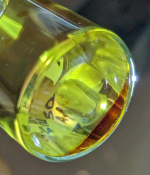
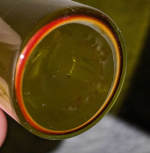
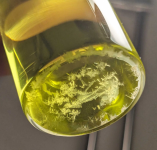
This test ascobic acid saturated ethyl acetate later went awry; after left on my desk for weeks a yellower tint appeared then a red residue started forming both in droplets on the vial walls and freely flowing on the bottom. Why red though? Might be worth trying to see how much ascorbic acid can be added to ethyl acetate without water starting with a much smaller ascorbic acid amount than I did. But maybe not worthwhile...
shows green only due to blue-white LED lamp

Well before that red residue appeared, separately I tried ascorbic acid in a small 2.5g CIELO batch and ran into maybe the same red residue eventually, but that may have stemmed from my goo recovery attempts. I was splitting a 5g paste into two, one to be citrate and the other ascorbate for comparison but it was a whole new process for me at that small of scale and I botched it a bit. Likely too much water came through as both CA and AA vials seemed to goo out.
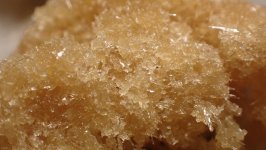
The CA vial appeared like normal goo, partially crystallized later and easily fully crystallized after decanting away most EtAc and replacing with fresh EtAc (kind of what I'd expect).

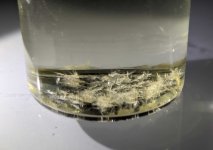
The AA vial however didn't seem to fully dissolve the AA and opaque goo formed around the AA crystals on the bottom. I thought adding more water would help dissolve the AA, but that was a mistake, while it dissolved the AA; an almost imperceptible liquid layer appeared oddly half way up the vial, as if it was half water which was impossible with the tiny water amounts I was using. So I tried decanting the top layer off and adding more fresh EtAc but then it formed a white goo on the bottom and eventually red residue but this later fully hardened into something like a resin on the bottom.
I thought I would take another crack at it sooner so I didn't report this earlier, but I might not ever get to it.
[EDIT]: If I were to try it again I'd probably do 1.5g/L AA:EtAc based on what I understood from this study on solubility.
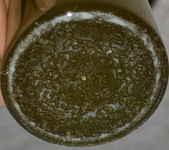
Ascorbic Acid vial:
undissolved AA & gooafter addtl. water addedred resin

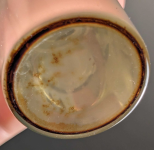
Citric Acid vial:
CA goo partially crashed outmescaline citrate
 
Last edited:
This test ascobic acid saturated ethyl acetate later went awry; after left on my desk for weeks a yellower tint appeared then a red residue started forming both in droplets on the vial walls and freely flowing on the bottom. Why red though? Might be worth trying to see how much ascorbic acid can be added to ethyl acetate without water starting with a much smaller ascorbic acid amount than I did. But maybe not worthwhile...
View attachment 98483

Well before that red residue appeared, separately I tried ascorbic acid in a small 2.5g CIELO batch and ran into maybe the same red residue eventually, but that may have stemmed from my goo recovery attempts. I was splitting a 5g paste into two, one to be citrate and the other ascorbate for comparison but it was a whole new process for me at that small of scale and I botched it a bit. Likely too much water came through as both CA and AA vials seemed to goo out.
The CA vial appeared like normal goo, partially crystallized later and easily fully crystallized after decanting away most EtAc and replacing with fresh EtAc (kind of what I'd expect).

The AA vial however didn't seem to fully dissolve the AA and opaque goo formed around the AA crystals on the bottom. I thought adding more water would help dissolve the AA, but that was a mistake, while it dissolved the AA; an almost imperceptible liquid layer appeared oddly half way up the vial, as if it was half water which was impossible with the tiny water amounts I was using. So I tried decanting the top layer off and adding more fresh EtAc but then it formed a white goo on the bottom and eventually red residue but this later fully hardened into something like a resin on the bottom.
I thought I would take another crack at it sooner so I didn't report this earlier, but I might not ever get to it.
[EDIT]: If I were to try it again I'd probably do 1.5g/L AA:EtAc based on what I understood from this study on solubility.
Ascorbic Acid vial:
View attachment 98475View attachment 98479View attachment 98474

Citric Acid vial:
View attachment 98476View attachment 98477
Ascorbic acid decomposes into red goo when left exposed to atmospheric oxygen, especially under basic conditions. Citric acid has the advantage of being much more stable wrt oxidation.
 
CHEELIN’S GREAT SUCCESS CIELO METHOD
Follow this exactly until you make your first batch of white needles; with a “flavor” that is moderately bitter, but not sour. At that point, you will be an expert.

Then, thank 69ron for the paste recipe, Loveall for the tek, and Shroombee and others who helped refine it. After that, modify the processing method to suit yourself.


Pre-Steps:
1. Start with Humility in Your Heart - Forget anything you think you know about extracting alkaloids from plant material, or from any chemistry experience you have ever had. You know nothing about this tek until you produce the proper product.

2. Focus Exclusively and Purposefully on the Task at Hand - the actual working time for a single run of this tek is approximately 1 hour, set aside a 3-hour block of uninterrupted time, because of pre-step 1.

3. Do Not Begin the Tek Until You Have:
A. Read the wiki and this post completely,
B. Printed out this post,
C. Asked for clarification regarding anything in this post that does not make sense to you.
D. Acquired all the materials and equipment specified in this post,
E. Calculated, re-calculated, and pre-measured the quantities of materials necessary for the complete run,
F. Organized and laid out all equipment required for the complete run and the printed copy of this post.


Equipment Needed: No Plastics if possible, certainly none that degrade upon contact with Ethyl Acetate
A. One timing device that can be easily observed, hands-free, while running the tek
B. One or two pens that can be used to mark off steps, make your scaled materials list & process steps, and to record significant observations
C. A piece of paper to write on
D. A roll of paper towels to protect working surfaces and clean/wipe
E. A scale with at least 100g capacity, that tares
F. One stainless steel spoon to help measure powders and mix materials
G. One long-handle, small scoop, stainless steel spoon for mixing the pulls
H. At least 1 250ml capacity glass or inert plastic graduated cylinder
G. One stainless steel, glass, or ceramic soup bowl for making paste
H. Two 1-qt mason jars, at least one set of lids
I. One smaller mason jar, about 2x the amount of solvent you will be pulling, plus set of lids
J. A stainless steel funnel, to hold your filter when combining/filtering solutions
K. A glass baking dish for evaporating jar wash
L. A pipette/burette or syringe w blunt tip needles (aka industrial syringe needles) for “small”volume solution use
[note: i like using 60mL luer lock syringes for solvent additions and 10mL luer lock syringes for solvent rinsing and water washes. I use plastic ones, cuz I’m clumsy; but the rubber plunger tip deforms after several exposures to the solvent, so if you choose to use syringes, have a couple extras in reserve.]
M. Paper coffee filters
N. Single-edge razor blade for scraping evaporated jar wash
O, Parchment paper & scissors for making envelopes to hold finished product
P. A 4-cup stainless steel french press


Ingredients Needed:
A. Cactus Powder that has been ground to a particle size and consistency of baking flour, with a moisture content no greater than 10%.
B. Food-Grade Hydrated Calcium Hydroxide, also called Pickling Lime (I use Mrs. Wages brand)
C. Distilled Water
D. Food-Grade Citric Acid (I use Milliard brand)
F. Ethyl Acetate, pick the grade that is accessible and comfortable for you (I use KleenStrip or Jasco brands)


Create a Process Tracking Sheet: (OR, just use the below on the post you printed out)
On a sheet of paper, list the following items vertically:

Date:

Pickling Lime
Distilled Water
Cactus Powder

Mix Paste - 8 minutes
Rest Paste - 10 minutes

Each pull: 1 minute stirring 70-90 revolutions, then 2-minute rest, then filter into collection jar.

Ethyl Acetate Pull Volumes:
1st pull
2nd pull
3rd pull
4th pull
5th pull
6th pull

Rest pulls at least 1-hour, do what’s necessary to settle cloudiness and remove visible sediment and water

Citric Acid


Ingredient Amounts:
Here are the standard amounts for a 100g cactus powder run:
Cactus Powder - 100g
Pickling Lime - 25g
Distilled Water - 300mL
Ethyl Acetate - 946mL
Citric Acid - 5g (I realize this is different from the wiki)

To minimize losses and regret, and to improve your chances of early success, use 15 or 20g of cactus powder until you successfully produce the proper product.

To calculate the scaled amounts needed:
1.Choose the amount of cactus powder you will use
2. Divide this amount by 100 to get your scaling factor
3. Multiply each of the material amounts listed above by the scaling factor, to get the amounts you need for your chosen size cactus powder run. Write each amount down on your process sheet.
4. The scaled volume of ethyl acetate needs to be subdivided into pull volumes.
a. Multiply the scaled amount by 25%, this is the volume of the first pull, write it on the process sheet.
b. Subtract the 1st pull volume from the total scaled volume, divide the result by 5. This is the volume of each pull, 2 through 6, write it on the process sheet.


Pastemaking:
1. Put distilled water and pickling lime in mixing bowl and stir until a consistently milky solution is made.
2. Dump in cactus powder, stir until all the milky solution is absorbed by the powder.
3. Start 8-minute timer
4. Stir paste, fold in half, mash all areas, fold in half, mash all areas, repeat non-stop for the full 8 minutes.
Paste should be a consistent color & texture, texture ranging from mashed potatoes-like to cookie-/play-dough-like.
5. Transfer paste into french press, cover, reset timer, rest for 10 minutes


Solvent Pulls:
1. Remove french press lid and plunger-strainer.
2. Chop up paste into roughly 1/2 - 3/4” chunks.
3. Dump in solvent dose for 1st pull
4. Cross off 1st pull on process sheet
5. Start 3-minute timer
6. Stir 70-90 revolutions for 1-minutes
7. Let paste rest for 2 minutes
8. Put plunger-strainer into press, pour solution (won’t be much for 1st pull) through strainer through coffee filter-funnel setup into pull collection jar. Don’t squeeze paste; just let pulled solvent drip out til driprate is less than 1 drip per second, tilt press to upright, let drip again til less than 1 drip/ second.
9. Repeat steps 3 through 8, until 6th pull is completed.
The paste during the last stir should look like applesauce, if earlier that’s even better. The pulled volume should be emerald green, and about 90% of the amount added.
10. Remove filter funnel and put lid on collection jar, let rest 1 hour. The solution should be clear.
11. At the end of settling period, the solution should be crystal clear, with no apparent sediment or water droplets/layer. Settle longer if necessary, filter/decant to separate crystal clear solution from sll else.
12. Do not proceed to salting until the solution is crystal clear, free of sediment and water; else you end up contaminating or reducing the yield of your product.


Salting & Crystallization:
1. Pour your crystal clear solution through a filter-funnel setup into a smaller jar, roughly 2x the pulled solvent volume.
2. Dose with citric acid.
3. Stir a couple times, solution should become cloudy.
4. Cover jar, put in undisturbed location, let crystallize for 48 to 72 hrs.


Filtering & Rinsing:
1. Gently swirl crystallization jar, remove lid, pour 3/4s of solution through filter-funnel setup into used solvent jar.
2. Gently swirl remaining solution, dump all of solution into filter-funnel.
3. Take 5-10mL of Fresh EA, tilt empty crystallization jar, rinse interior walls & bottom of jar, swirl, dump into filter, repeat once. Set jar aside to dry.
4. With more Fresh EA, rinse filtrate with as little as needed until filtrate stops changing color.
5. Let filtrate drain, then remove filter from funnel, place filter on paper towel to dry.
6. When filter no longer appears wet, gently fold up product in filter, set aside to completely dry for several hours.
7. Remove dried product from filter, weigh for yield calculation, store.


Jar Washing & Residue Recovery:
1. When crystallization jar is completely dry, rinse & swirl twice with 5-10mL hot distilled water (contacting all interior surfaces), and dump into a clean baking dish.
2. Let water evaporate w/wo fan, scrape residue with razorblade, weigh for yield calculation, combine with filtered product.


Attached are pics from a 15g cactus powder run, 72hr filter yield 0.222g, evaporate yield 0,006g,Total Yield 0.228g, 1.5%.


I follow impeccably this tek, making a point at doing exactly as said, and still got the goo :)

So i tried modifying one thing at a time:
This recepy didn't asked for a fridge rest ; so i did a fridge rest with half , and added the CA at room temp so no further water droplet should form.
I got the same result with or without fridge rest.

The only parameters that could be a bit off, which i will test later :
-i'm using calcium hydroxide from a building shop (pickling lime is not a thing here... )
-The cactus is grinded quite fine ; i noticed that as soon as i add the CaOH&water, it makes a sticky paste. I tried with CaO and it stays sandy much longer. Dunno why...
in all 4 cases (CaOH/CA, fridge rest / no fridge rest), the result are similar, with a yellowish goo precipitating at the bottom of the EA.

Hypothesis : could it simply be the cactus itself?

Question:
I recovered the goo by mixing with a bit of water and evaporating. So I always get citric acid contamination. What's the best way to clean to citric acid in your opinion?

Ultimatly, i might just backsalt with vinegar and have a dark-amber end-product; i guess it's much more full spectrum, which i kind of like :) . just a pain to manipulate ^^
 
-i'm using calcium hydroxide from a building shop (pickling lime is not a thing here... )
Not sure what part of the world you're in, but aquarium suppliers will usually carry lime of reasonable purity for pH control of saltwater aquaria as "Kalkwasser" (or whatever).

Another - admittedly more lengthy - approach is to produce your own by precipitating from calcium chloride using a soluble hydroxide. If separating chloride from the product turns out to be too annoying, precipitate high purity calcium carbonate using food grade sodium carbonate and roast it at 950°C for a few hours, then slake with distilled water.

The starting material, calcium chloride, can be recrystallised from spent dehumidifier packs: filter out the insolubles then put the resulting solution in a tightly-sealed container into the fridge and then the freezer. If carried out slowly enough, this will result in quite sizeable crystals of calcium chloride (the slower, the purer too). After decanting off the (usually brownish) supernatant, these crystals will start to deliquesce if left exposed to the air - this effect can be put to use as a means of dissolving the calcium chloride once more before recrystallising it again as before. The twice-recrystallised material should be pure enough for use in preparation of lime for cactus extraction.

Hypothesis : could it simply be the cactus itself?
Maybe, but one thing I've noticed from following this thread is that goo may result from insufficient addition of citric acid, and you don't appear to have commented on how you may or may not have controlled for that factor (or, I was too lazy to check 😁 )
I recovered the goo by mixing with a bit of water and evaporating. So I always get citric acid contamination. What's the best way to clean to citric acid in your opinion?
From what I gather, IPA recrystallisation should deal with this. Boiling 99.9% IPA.
 
Not sure what part of the world you're in, but aquarium suppliers will usually carry lime of reasonable purity for pH control of saltwater aquaria as "Kalkwasser" (or whatever).

Another - admittedly more lengthy - approach is to produce your own by precipitating from calcium chloride using a soluble hydroxide. If separating chloride from the product turns out to be too annoying, precipitate high purity calcium carbonate using food grade sodium carbonate and roast it at 950°C for a few hours, then slake with distilled water.

The starting material, calcium chloride, can be recrystallised from spent dehumidifier packs: filter out the insolubles then put the resulting solution in a tightly-sealed container into the fridge and then the freezer. If carried out slowly enough, this will result in quite sizeable crystals of calcium chloride (the slower, the purer too). After decanting off the (usually brownish) supernatant, these crystals will start to deliquesce if left exposed to the air - this effect can be put to use as a means of dissolving the calcium chloride once more before recrystallising it again as before. The twice-recrystallised material should be pure enough for use in preparation of lime for cactus extraction.


Maybe, but one thing I've noticed from following this thread is that goo may result from insufficient addition of citric acid, and you don't appear to have commented on how you may or may not have controlled for that factor (or, I was too lazy to check 😁 )

From what I gather, IPA recrystallisation should deal with this. Boiling 99.9% IPA.
Thanks, that's really helpful. I ordered some lime online to see if that could be a determining factor

I used 5g CA /liter of EA as suggested in Cheelin great post. The cactus is not especially strong (, but estimated 2kg fresh = 100g dry = one rather heavy dose, which i don't know how it translate to mescaline. And that's exactly why i persevere on the path, so i can relate to what "a strong dose of mescaline" is ^^
I know this cactus tend to yield 0.8% full spectrum (backsalted with vinegar).
I don't think the issue is the amount of CA ; also adding more doesn't create more clouding.

i thought about IPA ; so the citric acid doesn't disolve and i can decant it out?
 
i thought about IPA ; so the citric acid doesn't disolve and i can decant it out?
Other way round, more or less - citric acid dissolves at normal temp, but M citrate only dissolves in the boiling solvent, so you get to re-x your product and remove excess citric. (At least, I hope I've remembered this correctly. Even if it turns out differently you won't have lost anything but a little solvent. I'm still a bit foggy after a recent illness and may be confusing things with DMT fumarate.)
 
Other way round, more or less - citric acid dissolves at normal temp, but M citrate only dissolves in the boiling solvent, so you get to re-x your product and remove excess citric. (At least, I hope I've remembered this correctly. Even if it turns out differently you won't have lost anything but a little solvent. I'm still a bit foggy after a recent illness and may be confusing things with DMT fumarate.)
Ah yeah, that makes sense, thanks =)
yeah i don't risk anything trying!

As i'm here...
so i'm was aking myself question about the solubility of the different salt produced during the different A/B procedures... calcium citrate & caclium acetate for exemple. Are they soluble in the solvents, partially? how easy is to remove those ?
they are a bit elusive sometime because they can be mix with the end product (if it's not a needle crystal kind of result) and go unnoticed, no?
 
calcium citrate & caclium acetate for exemple. Are they soluble in the solvents, partially? how easy is to remove those ?
Calcium citrate will be essentially insoluble in dry IPA, whereas the acetate will tend to form a gel (this effect is used with ethanol for making BBQ lighting gel). The gel is easy to decant away from, but may lead to minor yield reduction, so I suppose you may want to dry it out - it dries to a powder - and then reapply fresh solvent to see whether any tiny extra amount of yield makes this worth doing routinely or if it's simply not worth bothering about (and I strongly suspect the latter).
 
Interesting unfolding !

I got crystals on my last try (following Cheelin tek quite accurately)
So now, let's back engineer ;
Most likely, it's the cactus, as i used a different batch ; this batch is 80% bridgesii (or hybrids) - rather young ones (5years olds), while the previous batch was 80% pachanoi.
I got a poor yield of 0.3%.

The parameters that did change :
- i pulled with re-used EA
- i seeded the precipitation jar with a symbolic pinch of crystal from one of my rare previous success

I got more of that batch of cactus powder, so i'm gonna eliminate these 2 variation, if i get crystal precipitation again, then i would conclude that in my case, the problem is not the TECH but the cactus itself. That's not really solving the mystery, but it's a step!
 
Results about The Mystery of the Goo

So, i repeated the success with that last batch of cactus powder. I used fresh solvent, divided the solvent in 2 after combining all the pulls : one i seeded with a bit of crystals, the other one i did not.
They both precipitated crystals, though the one seeded give much bigger crystals.

But the main conclusion is : The goo formation was entirely related to the type of cactus used.
I used the exact same TEK, which failed systematically on some batch of powder, and succeeded systematically with another batch.

I guess it's a question of alkaloid mix ? maybe some alkaloids mess up the crystalization process, while other cactus have much lower amount of those and it doesn't occur?P6181918.JPG
 
Last edited:
Goo occurs for some concentrations of mescaline, citric acid, and water.

We have learned that ideal water concentration is between 0.5% and 2.5%, excess citric acid is good, and the more mescaline concentration the less chances of goo. Folks such as BW have mapped some of this 3D phase space.

If you are seeing goo with one cactus and not the other, you may be in a space where mescaline concentration pushes you betweem the goo/xtal condition. Dropping the water should get you to a wider process window where even low mescaline concentration xtalizes.

I think you have too much water in your paste, wich causes too much water in your extract. Fridge rest helps, but only to a certain point. It cannot overcome too much excess water. There is a confounding factor where plant matter becomes more soluble in water/EA mix, and in extremely wet paste plant sruff can affect the fridge rest and unfortunetly solubilize more water in EA.

I belive we cut down the water reccomendation by a factor of 2 since Cheeling wrote his process.

I would reccomend you switch to the main tek wich has been updated to make goo a lot less of an issue.
 
Last edited:
Goo occurs for some concentrations of mescaline, citric acid, and water.

We have learned that ideal water concentration is between 0.5% and 2.5%, excess citric acid is good, and the more mescaline concentration the less chances of goo. Folks such as BW have mapped some of this 3D phase space.

If you are seeing goo with one cactus and not the other, you may be in a space where mescaline concentration pushes you betweem the goo/xtal condition. Dropping the water should get you to a wider process window where even low mescaline concentration xtalizes.

I think you have too much water in your paste, wich causes too much water in your extract. Fridge rest helps, but only to a certain point. It cannot overcome too much excess water. There is a confounding factor where plant matter becomes more soluble in water/EA mix, and in extremely wet paste plant sruff can affect the fridge rest and unfortunetly solubilize more water in EA.

I belive we cut down the water reccomendation by a factor of 2 since Cheeling wrote his process.

I would reccomend you switch to the main tek wich has been updated to make goo a lot less of an issue.

Very instructing , thanks !
i didn't went back to the main post, as it took me long enough to surf most of this topic xD

Interestingly, all my goo happened with quite a variation in wetness of the paste ; from chunky to more flowy. And the exact same paste consistency gave crystals in second case - beside being a really low yield, actually lower than my "goo batch" !

So, if the fridge rest isn't enough, should i chemically dry the EA , just for the sake on trying to confirm your results ?
where can i find this 3D phase space? =)
 
Very instructing , thanks !
i didn't went back to the main post, as it took me long enough to surf most of this topic xD

Interestingly, all my goo happened with quite a variation in wetness of the paste ; from chunky to more flowy. And the exact same paste consistency gave crystals in second case - beside being a really low yield, actually lower than my "goo batch" !

So, if the fridge rest isn't enough, should i chemically dry the EA , just for the sake on trying to confirm your results ?
where can i find this 3D phase space? =)
I don't have a good summary of the 3D space. BW (brenedesswasher, spelling?) did some water skews.

You can do a partial chemichal dry with calcium sodium carbonate. So far it works everty time. Simply add enough so it stops changing (it clumps if the EA is wet). Calcium Sodiun carbonate is not strong enough to remove too much water, which is great. Not in the main tek, but I want to add it if enough people replicate good results.
 
Last edited:
I don't have a good summary of the 3D space. BW (brenedesswasher, spelling?) did some water skews.

You can do a partial chemichal dry with calcium carbonate. So far it works everty time. Simply add enough so it stops changing (it clumps if the EA is wet). Calcium carbonate is not strong enough to remove too much water, which is great. Not in the main tek, but I want to add it if enough people replicate good results.
I'm up for trying... it will take a couple months to cut the cactus, age it, dry and extract. Then i can do some side to side, with fridge rest, calcium carbonate, etc :) and see if it affect the yields. Would you do a fridge rest first, then the calcium carbonate? any rough quantity we expecting to use / liter of EA ?
 
I'm up for trying... it will take a couple months to cut the cactus, age it, dry and extract. Then i can do some side to side, with fridge rest, calcium carbonate, etc :) and see if it affect the yields. Would you do a fridge rest first, then the calcium carbonate? any rough quantity we expecting to use / liter of EA ?
Separate. Yes, about a liter or EA total and you can salt samples of thar with different conditions.
 
Back
Top Bottom