
• Members of the previous forum can retrieve their temporary password here, (login and check your PM).

Research Ethylene and other ways to increase biosynthesis in cacti experiment

Research done by (or for) the DMT-Nexus community
how ripe were the apples? They also increase production with time. Like that saying a bad apple ruins the bunch it as it releases ethylene it increase even more ethylene production due to absorbing more and rotting eventually from senescence? That is my understanding.

It works since I've also seen people use apples to induce flowering in pineapple rather than using calcium carbide or ethylene products
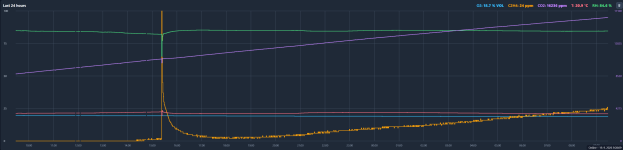
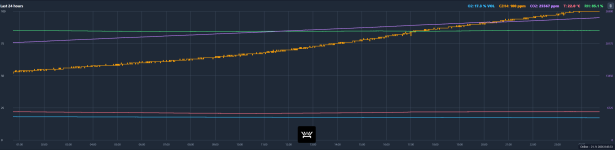
You are absolutely right modern. After 24 hours it started to rise and obviously higher ethylene levels caused faster ripening. Now it looks much better...
(ignore the peak at 15:24, I had to switch off the power and it takes some time for the sensor to show correct values)

1789803150744.png
 
IDK appropriate CO2 levels but maybe add a small hole on the bottom of the container since co2 is denser than air and ethylene. Can reduce co2 while keeping ethylene losses to a minimal.
 
IDK appropriate CO2 levels but maybe add a small hole on the bottom of the container since co2 is denser than air and ethylene. Can reduce co2 while keeping ethylene losses to a minimal.
No need, I will use an external air filter with soda lime for CO₂ removal. I have to install it yet.
 
IDK appropriate CO2 levels but maybe add a small hole on the bottom of the container since co2 is denser than air and ethylene. Can reduce co2 while keeping ethylene losses to a minimal.
if the gases are mixed, a simple hole wouldn't be selective.


Monterey Florel would be a cheap ethylene source would be repeatable and easy to apply as well. At 4% you would use 5-10ml per L for a 200-400ppm rate of ethylene which is what is used for pineapples.


Monterey Florel would be a cheap ethylene source would be repeatable and easy to apply as well. At 4% you would use 5-10ml per L for a 200-400ppm rate of ethylene which is what is used for pineapples.
Ok, it seems this might be a solution if there are problems with ethylene acquired from the apples.

I just finished the first test run of the boxes with ethylene generation (just apples, not cacti), and it seems the apples can generate enough ethylene for our purposes. The boxes are airtight, so once the desired level is reached, there is no need to generate more, and it has to be down-regulated.

The previous ethylene generation test almost damaged the ethylene sensor, because I didn’t know it had a maximum allowed ethylene concentration and left it there for a week at very high concentrations (>400 ppm). It took more than a week for the sensor to recover and return to zero readings, and to be honest, I’m not sure whether its readings are still shifted. But it seems to measure okay, and because I will target around 80 ppm, it is probably not critical whether it is ±10 ppm.
 
Back
Top Bottom