
-
Members of the previous forum can retrieve their temporary password here, (login and check your PM).
You are using an out of date browser. It may not display this or other websites correctly.
You should upgrade or use an alternative browser.
You should upgrade or use an alternative browser.
Experiential Differences RE: DMT w/THC vs. Without
- Thread starter Phantom462
- Start date






Smoalk more, apparently. I mean, this is about qualitative difference in the DMT experience with or without cannabis. Apparently 



This is something Ive been thinking about, this sort of "wisdom over-reliance", its something that seems to happen a lot here, as I see it anyways.
Kinda feels like it misses to point a little bit.
Can relate to that Shaded. In general I am only interested in the homegrown thoughts of the individuals here. Established teachings of any nature smell a bit stale to me for some reason.
There's reason I poke holes in everything and there's a method to the madness.Smoalk more, apparently. I mean, this is about qualitative difference in the DMT experience with or without cannabis. Apparently
I'll never leave the combination of cannabis and DMT. I actually really like to add some cannabis to changa bowls as well. So lovely.
One love
The problem for me with the concept of an established teaching is the same as any religion.
Given the many interpretations human minds can make reality from one source text, in 2,000 years there could easily be civil war between hostile Buddhist factions much like today's wonderful list of book following loons killing each other.
The only truth worth listening to for me are the individual's. As soon as we get a following our truth is no longer ours.
Given the many interpretations human minds can make reality from one source text, in 2,000 years there could easily be civil war between hostile Buddhist factions much like today's wonderful list of book following loons killing each other.
The only truth worth listening to for me are the individual's. As soon as we get a following our truth is no longer ours.

In many instances i don't think it's relying on wisdom. Ultimately it's a personal path, each person learns and understands though their own experience, unless they want to believe without evidence. But there are instances in which we need the help of other people or we want guidance from other people including "wisdom sources". It doesn't mean blindly believing but integrating their perspective and verifying ourselves if it's true or not. Often the words of other people can describe better than we can the things we experienced ourselves. I think everyone including these wisdom sources relied on someone else at some point.This is something Ive been thinking about, this sort of "wisdom over-reliance", its something that seems to happen a lot here, as I see it anyways.
Kinda feels like it misses to point a little bit.
While I've been a part of this (though I did try to attenuate my contribution by linking something in one of my original posts to cannabis and DMT), @Transform has been dropping hints that are increasingly more direct that this thread has been derailed.
Apologies for my part. Apologies if too philosophical.
I've been thinking about my history with DMT and how I'm in an alignment phase and can't help but wonder if I'd be more comfortable going deeper if I didn't try to do just freebase. My first several experiences were with the sandwich method.
One love
Apologies for my part. Apologies if too philosophical.
I've been thinking about my history with DMT and how I'm in an alignment phase and can't help but wonder if I'd be more comfortable going deeper if I didn't try to do just freebase. My first several experiences were with the sandwich method.
One love

thc seems to boost the psychospiritual realm a little more, more "astrally" and a little less grounded in reality or hyper-sobriety


Way too complicated IMHO! Goes to show that what different people find helpful varies a lot.Anicca (impermanence) and anatta (nonself) are two "marks of existence" at the base of the Buddhist teaching and they're common to all schools. Nonself is related to impermamence and to "dependent co-arising". Impermanence means that nothing is fixed and unchanging, while dependent co-arising means that everything manifests and unmanifests according to the presence or abscence of conditions and there is nothing that exists "by itself".
Then with the Yogachara school of Mahayana there was a "mapping" of the human consciousness, which is described as composed by 8 consciousnesses. The last two are not present in Theravada texts. There are the six sense conciousnesses (the five senses + the "mind" sense, the one that perceives thoughts); the 7h consciousness, manas (the one that gives rise to the sense of self by grasping at the eight consciousness; this one is the closest to our "ego") and the 8th consciousness, alayavijnana ("storehouse consciousness"), that bears karmic seeds resulting from the impressions of other consciousnesses and from previous lives, in fact this is the only consciousness that survives between lives.
When alayavijnana is purified/transformed and freed from the grasping of manas, there is awakening / liberation. It becomes the "Great Mirror Wisdom" consciousness because reality is perceived as it is, free from defilements. In Chan/Zen Buddhism the Great Mirror Wisdom consciousness is identified with the Buddha-Nature that is present in all beings. This concept is also akin to the "Luminous Mind" of Buddhist Tantra.
Some people see this as a comeback of the self in a different form, but the counterargument to this is that Great Mirror Wisom and Buddha-Nature are just words to describe what is beyond concepts, so it is not a comeback of the self. Some texts use "negative" descriptions of nonself, especially in a culture where almost everyone believed in the existence of a soul, to avoid eternalism. Some texts use "positive" descriptions of nonself to avoid nihilism.
All the teachings are provisional.
Definitely, sorry for my active participation on the derailment.this thread has been derailed
Would it be possible for the mods to more proactively split apart these kind of tangents from the threads where they appear? Plus more discipline by "derailful" users like me.

Going to the topic of THC and psychedelics, that's a combo I've never had, and I don't think I will.
I only appreciate cannabis at high doses, but the hangover I get from that makes it a net negative. I find cannabis to be much more confusing and inciting to delusion than the usual psychedelics. At lower doses it just slows me down without much benefit. And it's not that I don't get benefit from other substances that slow me down: pregabalin is immensely helpful to me for dealing with anxiety.
I find interesting how cannabis becomes much more visual when I have it less than a few months after a psychedelic experience. Also, the visuals seem to be a faded-out and blurry version of those of whichever psychedelic I had. Interestingly, I've had this happen to a lesser degree with pregabalin and Ayahuasca: if I take pregabalin during the week after Ayahuasca, I get faint Ayahuasca-like CEVs. This is notable because pregabalin isn't supposed to have any visual component.
I only appreciate cannabis at high doses, but the hangover I get from that makes it a net negative. I find cannabis to be much more confusing and inciting to delusion than the usual psychedelics. At lower doses it just slows me down without much benefit. And it's not that I don't get benefit from other substances that slow me down: pregabalin is immensely helpful to me for dealing with anxiety.
I find interesting how cannabis becomes much more visual when I have it less than a few months after a psychedelic experience. Also, the visuals seem to be a faded-out and blurry version of those of whichever psychedelic I had. Interestingly, I've had this happen to a lesser degree with pregabalin and Ayahuasca: if I take pregabalin during the week after Ayahuasca, I get faint Ayahuasca-like CEVs. This is notable because pregabalin isn't supposed to have any visual component.

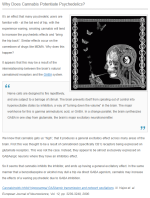
Why Does Cannabis Potentiate Psychedelics? | countyourculture
Why Does Cannabis Potentiate Psychedelics?
isomerdesign.com
FWIW I'm high almost all day every day, including all my trips. I think there's extra synergy with ayahuasca for some reason though. On Aya a hit of weed unlocks the floodgates. It's olfactory catalyzed, like I'm smelling all the strains I've ever smelt, and reliving all the highs I've had. I get couch locked and immersed in the highly visual manifestations of my thoughts. And cannabis sustains that level of breakthrough-vividness as long as I renew the high every 30 minutes or so.
Last edited:
Very interesting. I didn't know cannabis has GABA antagonist effect. Harmalas do, too, so maybe that could contribute to the synergistic effect in that case as well.View attachment 104936
Why Does Cannabis Potentiate Psychedelics? | countyourculture
Why Does Cannabis Potentiate Psychedelics?isomerdesign.com
Despite its name and structure, pregabalin is surprisingly not a GABA agonist! I used to think it was, too. It seems that works by reducing the release of excitatory neurotransmitters.
I have tried it in low doses with (1P-) LSD and 2C-B to reduce muscle tension. It didn't seem to reduce the effects at all, but it made me feel more "disconnected" from them. The combination also increased the disinhibition that pregabalin tends to cause, in ways that seem that could be dangerous at higher doses of pregabalin.
I get feelings of mental stimulation from pregabalin by itself, but that's likely because it works very well to reduce my baseline anxiety, better than anything else I've ever tried. It's a crutch so I avoid using it more than once a week.
I have tried it in low doses with (1P-) LSD and 2C-B to reduce muscle tension. It didn't seem to reduce the effects at all, but it made me feel more "disconnected" from them. The combination also increased the disinhibition that pregabalin tends to cause, in ways that seem that could be dangerous at higher doses of pregabalin.
I get feelings of mental stimulation from pregabalin by itself, but that's likely because it works very well to reduce my baseline anxiety, better than anything else I've ever tried. It's a crutch so I avoid using it more than once a week.

Gabapentinoids are terrible! Did nothing for my anxiety, pain or muscle tension. Nothing but weird feelings without any benefits so I quickly told my doctor never again for the gabapentinoids. I can’t even properly describe how they make me feel but I never liked it.
Everything brings me back to weed. A big old dab can solve a lot of problems without all the side effects I hate with many prescription drugs.
Everything brings me back to weed. A big old dab can solve a lot of problems without all the side effects I hate with many prescription drugs.
This thread tells me one thing for sure. If your a stoner, your gunna be a stoner. And love it.
If not…
If not…
Have you taken any psychedelics with your pregabalin? As a GABA agonist I wonder if it dulls the trip. But it's interesting you get flashbacks with it
Like blig blug said, it’s not really a gaba agonist.
The Contribution of NMDA Receptors in Antinociceptive Effect of Pregabalin: Comparison of Two Models of Pain Assessment - PMC
Pregabalin has shown remarkable antinociceptive effects in neuropathic pain; however, its efficacy against acute and visceral pain remained controversial. The present study aimed at investigating the involvement of N-methyl-D-aspartate (NMDA) ...
 pmc.ncbi.nlm.nih.gov
It does feel dissociative. Maybe it’s a bit like a very low dose of DXM(but I enjoy that).

Does anyone know if CBD-Only weed will potentiate DMT?
And how about THCV+DMT?
And how about THCV+DMT?
I've never noticed a potentiation, but it does add a calming effect.Does anyone know if CBD-Only weed will potentiate DMT?
And how about THCV+DMT?
THC and DMT are prime combination for me, but as you may read, it's not for everyone.
One love
Similar threads

- Replies
- 45
- Views
- 2K


- Replies
- 11
- Views
- 771

- Replies
- 127
- Views
- 4K
- Replies
- 23
- Views
- 989

Members online
Total: 2,127 (members: 9, guests: 2,118)
Robots: 237
Robots: 237