• Members of the previous forum can retrieve their temporary password here, (login and check your PM).

Extraction with Acetone

Migrated topic.
xdragon said:
With acetone being bulkier than formaldehyde, imine formation and cyclisation rate will definitely be slower.
Acetone and DMT will not form N-isopropylidene-DMT, and Pictet-Spengler cyclization will not take place. DMT is a tertiary amine, it lacks the N-H bond that would allow the ketimine to form through a carbinolamine intermediate.
 
Hailstorm said:
xdragon said:
With acetone being bulkier than formaldehyde, imine formation and cyclisation rate will definitely be slower.
Acetone and DMT will not form N-isopropylidene-DMT, and Pictet-Spengler cyclization will not take place. DMT is a tertiary amine, it lacks the N-H bond that would allow the ketimine to form through a carbinolamine intermediate.
Yes, although both NMT and tryptamine itself will form N-isopropylidene derivatives.

xdragon - inductive effects from the two methyl groups will also make the carbocation-equivalent centre less electrophilic so it's not just steric considerations that will be affecting the reaction rate.
 
Sorry to dig up an old thread.. this is the only info I can find on freeze precip with acetone.

I am attempting to crystalize an Acacia floribunda extract.. this species is notoriously difficult to obtain a solid extract from. It is usually an amber/yellow oil/toffee texture.

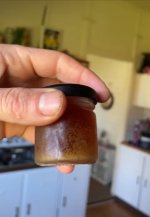
I have been attempting to precipitate DMT from acetone .. at first it looked very promising. I dissolved my alkaloids in a small jar. The acetone took on a deep red colour.

After about half an hour in the freezer, cream coloured precipitate was noticed floating in the solution. I filtered the solids onto a coffee filter and dried them. They ended up a “putty” like texture and were a dark brown when scraped up.

The precipitate is far less sticky than the usual difficult to handle extract but it seems the majority of the DMT remained dissolved.

I’m not at all bothered if the extract crystallizes - my hope is to at least get it to a point where it can be dried and scraped up. It’s difficult to store otherwise. Whatever the really sticky stuff is, it’s still highly soluble in cold acetone which is encouraging.

I then evaporated the acetone in a separate dish, which yielded what seemed to be the bulk of the extract still.. again, an amber oily consistency. Both the precipitate and the evaporated acetone are highly active.

@benzyme .. is there a certain level of saturation required with acetone to drop all of the alkaloids out when freeze precipitating?

This seems like a potentially good way to tidy up Acacia floribunda extract. But the precipitates were a fraction of the total extract.

Any advice would be greatly appreciated.

Below a shot of the jar fresh out of the freezer.
 

Attachments

  • IMG_7004.jpeg
    IMG_7004.jpeg
    844.4 KB · Views: 19
Last edited:
Hi,
You can try calculate with already extracted DMT the saturation at RT for example.

On the other hand, you can salt the dmt out with an acid with no effort. Really good foor storage :)
 
I don’t have any fumaric acid.. do you think a little citric acid would work ok? I would then probably do a mini a/b on the precipitate .

Thanks for the quick response!
 
Perhaps you could add a bit of water as is outlined here? Maybe that could lower solubility enough while still not freezing the solution at low temps.
 
I'm not a data cruncher, I do the work.
After extraction, I do the same as I would with DCM...pour the acetone in anhydrous MgSO4. What I can provide is LCMS data, there are no adducts.

what I illustrate is that you can doubt, naysay, theorize why it wouldn't work...but won't know until you run the experiment.
Are you not concerned about aldol condensation of the acetone?

I know for a fact that MgSO4 will cause it to occur. CaSO4 is the best drying agent for acetone due to the larger size of Ca, making it unable to react with acetone.

That said, I don't guess it really matters because the basic soup of the DMT extraction is going to cause much more condensation in the acetone then your drying agent.

What I don't know is where the equilibrium is nor if the aldol condensation products are worth worrying about anyways. I'm also not 100% sure how to reverse this process since it can also occur in acidic conditions.

Not sure if pH balancing the aldol product(s) would regenerate the acetone. Not that it seems to even matter. If it works, it works.

Now, this is now a dated thread and I'm wondering if you are still using acetone today? Have you optimized the method or switched to another solvent entirely?

Awesome as always, and thanks for your research!
 
Acetone is the best! (Btw if you are curious about etymology, the word is derived from the mystical experience from the alkaloids it pulls, in which your ass is at one with the universe. Hence it is called "ass-at-one" [unfortunately often mispronounced these days as ass-uh-tone].)

To avoid pulling out the worthless plant junk, first you need to use some NPS on your basified bark. Then you're ready for the acetone.

If you leave the acetone in the bark for a while and keep it warm, at a high pH, you'll pull a lot more than just DMT+NMT. With Acacia you'll pull a red liquid I call metta. With mimosa you'll pull various tryptamines and some goo that feels like an opiate when vaped.

I hope those who read this know youre joking. LOL
 
Answering my own question, I did a test for 24 hours using plain water/NaOH/Acetone at room temperature, and saw no signs of change in the acetone layer. Doesn't seem like aldol condensation is a big concern. I used 30 and 40% NaOH water solutions.

However, it does look like a small ammount of water and NaOH can end up in the acetone. I say this because some salt crashed when adding 10% sulfuric drops to the separated acetone layer. This was after starting with 20% NaOH water.

This salt formation was avoided if the acetone is dried over MgSO4 after separation (a good practice on general). I would not skip MgSO4 sulfate drying for acetone pulls.

Interestingly, adding solid NaOH to the separated acetone layer caused a few ml of water to pool at the bottom along with the excess NaOH. The decanted acetone from this step did not produce salts either. I think this is because the addition of the NaOH to the acetone created saturated NaOH water which separates and creates purer acetone. I think this all makes sense after inspecting the ternary triangle above. One can suck up this small water layer at the bottom (add it back to the base water) and then proceed to add MgSO4 (less is needed this way).

Cheers.
CaSO4 is better than MgSO4 for drying acetone. MgSO4 can cause aldol condensation, though I admit that I don't know how much of a problem it is. It may never cause problems, or it might only cause problems after years of recycling the same acetone.

Hopefully someone else will one day chime in.
 
Are you not concerned about aldol condensation of the acetone?

I know for a fact that MgSO4 will cause it to occur. CaSO4 is the best drying agent for acetone due to the larger size of Ca, making it unable to react with acetone.

That said, I don't guess it really matters because the basic soup of the DMT extraction is going to cause much more condensation in the acetone then your drying agent.

What I don't know is where the equilibrium is nor if the aldol condensation products are worth worrying about anyways. I'm also not 100% sure how to reverse this process since it can also occur in acidic conditions.

Not sure if pH balancing the aldol product(s) would regenerate the acetone. Not that it seems to even matter. If it works, it works.

Now, this is now a dated thread and I'm wondering if you are still using acetone today? Have you optimized the method or switched to another solvent entirely?

Awesome as always, and thanks for your research!
CaSO4 is better than MgSO4 for drying acetone. MgSO4 can cause aldol condensation, though I admit that I don't know how much of a problem it is. It may never cause problems, or it might only cause problems after years of recycling the same acetone.

Hopefully someone else will one day chime in.

It’s a not a practical problem, the dry acetone is usually used shortly after drying. If I remember correctly someone has already explained/researched this before and found that the use of MgSO4 is perfectly fine for all extracting purposes. (Should be here somewhere).
 
Back
Top Bottom