aizoaceous
Titanium Teammate
Kanna isn't frequently discussed here, but I've seen a few earlier threads. This is Sceletium tortuosum, an ice plant used traditionally in South Africa for mood elevation. The active constituents are mesembrine alkaloids. These are objects of significant study in the normal scientific literature, as antidepressant drug candidates. They're also increasingly popular as recreational drugs, since 1-2 mg intransal or sublingual produce strong euphoria. This raises obvious concerns of addiction potential, but that so far seems surprisingly low. Tolerance does occur with frequent use, but increased dosage generally doesn't recover the original sensations, instead resulting in feelings similar to a panic attack or in unpleasant gastrointestinal symptoms. Kanna is currently legal in most jurisdictions.
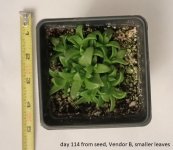
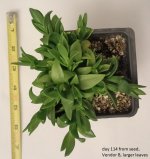
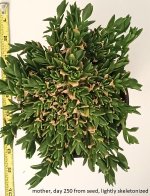
I've been growing kanna from seed. So in general, each plant is genetically unique, with potentially different alkaloid content. Since kanna isn't self-fertile, we expect high heterozygosity and thus potentially high variation. I have access to HPLC equipment, allowing me to quantify this. I've just begun, but here are some early results. I posted some of this earlier on reddit, but that account got banned (perhaps misclassified as spam, perhaps due to the content, not sure) and this is probably a better forum anyways.
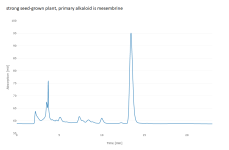
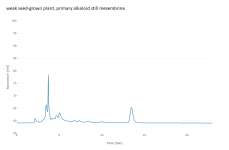
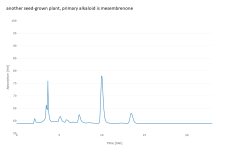
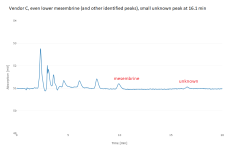
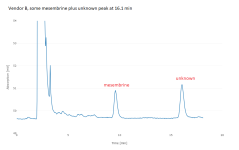
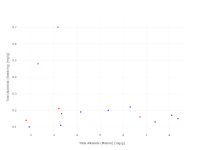
The variation is remarkable. All my seed-grown plants contain mesembrine, but the abundance within the same batch of seeds varies by almost 10:1. Different plants have different additional alkaloids. I'm unable to identify most of those peaks, and many of the peaks that I've identified aren't confident yet.
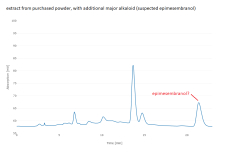
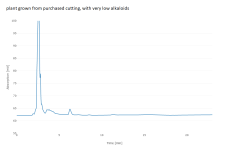
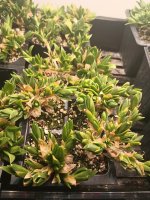
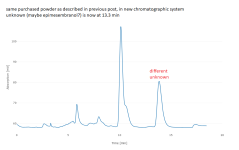
A different plant grown from cuttings purchased on eBay looked morphologically identical to my seed-grown plants, but contains negligible alkaloids. None of my seed-grown plants had epimesembranol, but I think some unfermented dried material that I purchased did. So I don't think I've collected the full gene pool yet, though I don't know whether drying significantly changes alkaloid ratios. Fermentation definitely changes the alkaloid ratios, though the literature is not too consistent on how; papers show both conversion of mesembrine to a mesembrenone and the reverse.
The practical consequences of everything above include that:
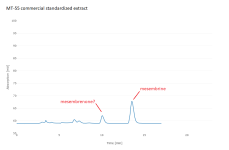
My HPLC method was adapted from Srinivas Patnala's doctoral thesis, replacing his acetonitrile with methanol and his column with one I already had. Injection is manual, overfilling a 20 uL loop. The mobile phase is 55:45 water:methanol (by weight, not the usual volume), plus 0.1% concentrated ammonia solution, isocratic. The column is Waters Xbridge C18, 5 um, 4.6 mm x 250 mm. (Note that many C18 columns aren't rated for the high pH of this mobile phase.) Detection is by UV absorbance at 280 nm. I'm working on a better standard, but for now I just used some MT-55 extract, a standardized commercial product. I'm hoping to identify the other peaks more confidently once I take UV spectra and maybe isolate enough to get some melting points, or maybe I'll buy the stuff to exactly replicate Patnala's method and hope my retention times match exactly.
I've been growing kanna from seed. So in general, each plant is genetically unique, with potentially different alkaloid content. Since kanna isn't self-fertile, we expect high heterozygosity and thus potentially high variation. I have access to HPLC equipment, allowing me to quantify this. I've just begun, but here are some early results. I posted some of this earlier on reddit, but that account got banned (perhaps misclassified as spam, perhaps due to the content, not sure) and this is probably a better forum anyways.
The variation is remarkable. All my seed-grown plants contain mesembrine, but the abundance within the same batch of seeds varies by almost 10:1. Different plants have different additional alkaloids. I'm unable to identify most of those peaks, and many of the peaks that I've identified aren't confident yet.
A different plant grown from cuttings purchased on eBay looked morphologically identical to my seed-grown plants, but contains negligible alkaloids. None of my seed-grown plants had epimesembranol, but I think some unfermented dried material that I purchased did. So I don't think I've collected the full gene pool yet, though I don't know whether drying significantly changes alkaloid ratios. Fermentation definitely changes the alkaloid ratios, though the literature is not too consistent on how; papers show both conversion of mesembrine to a mesembrenone and the reverse.
The practical consequences of everything above include that:
- Anyone growing from seed has no idea what they're getting unless they test. So amateur growers looking for an active plant should start with a known active clone, unless they're deliberately pheno hunting.
- Anyone purchasing dried plant material also has no idea what they're getting. Kanna is most frequently sold as an HPLC-standardized extract, and this reinforces the benefit of that. Anyone using unstandardized (e.g. homemade) extracts should be particularly careful to start with a low dose, since the next batch could be 10x as strong as the previous one.
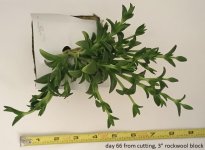
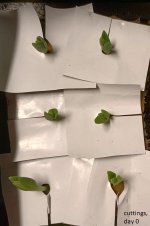
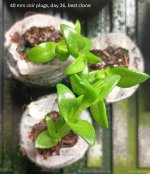
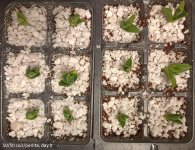
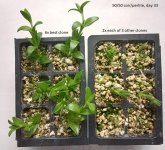
- Cultivating the plant. I'm growing mostly in 50/50 coco/perlite now, with hydroponic nutrients similar to a typical cannabis "bloom" recipe. I'm also experimenting with rockwool, with good results so far.
- Taxonomy. I see a reference (in the thesis mentioned below) to a key by Gerbaulet, but I've been unable to find it. The only morphological feature mentioned in that thesis is the vein structure of the leaves, which is tortuosum-type (long secondary veins parallel to the main vein) for all of my plants. I see almost nothing in the literature on the chemotaxonomy.
- Extraction at ~100 mg scale. My current procedures work, but fine solids from the plant material are a constant nuisance, requiring long settling and/or centrifuging to break emulsions.
My HPLC method was adapted from Srinivas Patnala's doctoral thesis, replacing his acetonitrile with methanol and his column with one I already had. Injection is manual, overfilling a 20 uL loop. The mobile phase is 55:45 water:methanol (by weight, not the usual volume), plus 0.1% concentrated ammonia solution, isocratic. The column is Waters Xbridge C18, 5 um, 4.6 mm x 250 mm. (Note that many C18 columns aren't rated for the high pH of this mobile phase.) Detection is by UV absorbance at 280 nm. I'm working on a better standard, but for now I just used some MT-55 extract, a standardized commercial product. I'm hoping to identify the other peaks more confidently once I take UV spectra and maybe isolate enough to get some melting points, or maybe I'll buy the stuff to exactly replicate Patnala's method and hope my retention times match exactly.