• Members of the previous forum can retrieve their temporary password here, (login and check your PM).

Genetic variation in the alkaloid content of seed-grown kanna

aizoaceous

Titanium Teammate
Kanna isn't frequently discussed here, but I've seen a few earlier threads. This is Sceletium tortuosum, an ice plant used traditionally in South Africa for mood elevation. The active constituents are mesembrine alkaloids. These are objects of significant study in the normal scientific literature, as antidepressant drug candidates. They're also increasingly popular as recreational drugs, since 1-2 mg intransal or sublingual produce strong euphoria. This raises obvious concerns of addiction potential, but that so far seems surprisingly low. Tolerance does occur with frequent use, but increased dosage generally doesn't recover the original sensations, instead resulting in feelings similar to a panic attack or in unpleasant gastrointestinal symptoms. Kanna is currently legal in most jurisdictions.

I've been growing kanna from seed. So in general, each plant is genetically unique, with potentially different alkaloid content. Since kanna isn't self-fertile, we expect high heterozygosity and thus potentially high variation. I have access to HPLC equipment, allowing me to quantify this. I've just begun, but here are some early results. I posted some of this earlier on reddit, but that account got banned (perhaps misclassified as spam, perhaps due to the content, not sure) and this is probably a better forum anyways.

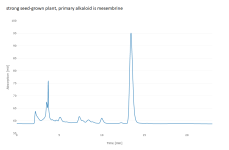
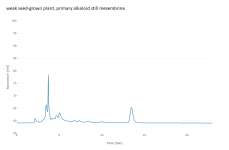
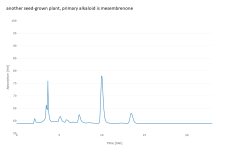
The variation is remarkable. All my seed-grown plants contain mesembrine, but the abundance within the same batch of seeds varies by almost 10:1. Different plants have different additional alkaloids. I'm unable to identify most of those peaks, and many of the peaks that I've identified aren't confident yet.

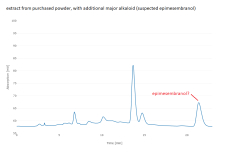
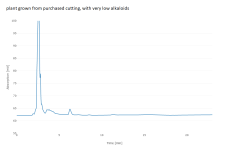
A different plant grown from cuttings purchased on eBay looked morphologically identical to my seed-grown plants, but contains negligible alkaloids. None of my seed-grown plants had epimesembranol, but I think some unfermented dried material that I purchased did. So I don't think I've collected the full gene pool yet, though I don't know whether drying significantly changes alkaloid ratios. Fermentation definitely changes the alkaloid ratios, though the literature is not too consistent on how; papers show both conversion of mesembrine to a mesembrenone and the reverse.

The practical consequences of everything above include that:
  • Anyone growing from seed has no idea what they're getting unless they test. So amateur growers looking for an active plant should start with a known active clone, unless they're deliberately pheno hunting.
  • Anyone purchasing dried plant material also has no idea what they're getting. Kanna is most frequently sold as an HPLC-standardized extract, and this reinforces the benefit of that. Anyone using unstandardized (e.g. homemade) extracts should be particularly careful to start with a low dose, since the next batch could be 10x as strong as the previous one.
If there's interest, then I'll keep posting as I get more results. I'm continuing to grow seeds from new sources, none as good as this first batch but strikingly different. I also have some notes on extraction and chromatographic separation of the alkaloids (on a C18 SPE cartridge), and their subjective effects. I'd appreciate any comments, especially on:
  • Cultivating the plant. I'm growing mostly in 50/50 coco/perlite now, with hydroponic nutrients similar to a typical cannabis "bloom" recipe. I'm also experimenting with rockwool, with good results so far.
  • Taxonomy. I see a reference (in the thesis mentioned below) to a key by Gerbaulet, but I've been unable to find it. The only morphological feature mentioned in that thesis is the vein structure of the leaves, which is tortuosum-type (long secondary veins parallel to the main vein) for all of my plants. I see almost nothing in the literature on the chemotaxonomy.
  • Extraction at ~100 mg scale. My current procedures work, but fine solids from the plant material are a constant nuisance, requiring long settling and/or centrifuging to break emulsions.
Technical details: I took a single offset from each plant, around 350 mg fresh weight. I placed it in a 15 mL centrifuge tube with 5 mL of 0.5% aqueous sulfuric acid and ten 1/4" diameter stainless steel balls. I shook the tube on a reciprocating saw for 45 s, after which the tissue looked pretty much homogenized. I filtered about 1 mL of that liquid through a 0.45 um syringe filter, diluted it by a factor of 5 with mobile phase, and injected.

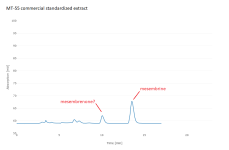
My HPLC method was adapted from Srinivas Patnala's doctoral thesis, replacing his acetonitrile with methanol and his column with one I already had. Injection is manual, overfilling a 20 uL loop. The mobile phase is 55:45 water:methanol (by weight, not the usual volume), plus 0.1% concentrated ammonia solution, isocratic. The column is Waters Xbridge C18, 5 um, 4.6 mm x 250 mm. (Note that many C18 columns aren't rated for the high pH of this mobile phase.) Detection is by UV absorbance at 280 nm. I'm working on a better standard, but for now I just used some MT-55 extract, a standardized commercial product. I'm hoping to identify the other peaks more confidently once I take UV spectra and maybe isolate enough to get some melting points, or maybe I'll buy the stuff to exactly replicate Patnala's method and hope my retention times match exactly.
 

Attachments

  • mes-mt55.png
    mes-mt55.png
    18.3 KB · Views: 17
  • mes-strongest.png
    mes-strongest.png
    20.4 KB · Views: 10
  • mes-weakest.png
    mes-weakest.png
    17.5 KB · Views: 9
  • mes-other-primary.png
    mes-other-primary.png
    18.7 KB · Views: 8
  • mes-powder.png
    mes-powder.png
    24 KB · Views: 8
  • mes-cutting-inactive.png
    mes-cutting-inactive.png
    16.4 KB · Views: 16
  • mes-plants.jpg
    mes-plants.jpg
    168.7 KB · Views: 17
Very interesting write-up! Thank you for taking the time to post this here - I'd definitely be interested in reading about your future results.

I had been wondering lately if anyone was looking more into Sceletium Tortuosum. It's a plant that I have been growing for years, but have never really done anything with other than harvest and ferment. I'm very glad to see that someone with knowledge of chemistry is checking into it.
 
Since I sampled the 22 plants described above (from Vendor A), I've germinated 25 additional seeds purchased from Vendor B, plus 100 seeds from Vendor C. From this, I've sampled an additional 9 and 55 plants respectively. To decrease my labor, I'm now sampling before transplanting into individual cells or containers, around 75 days after germination. These results are therefore not directly comparable to my results above, but interesting structure is visible even without that. Sample prep and chromatography were as above, except with slightly stronger eluent (50/50 water/methanol, w/w) to save time. Retention times are given here in the new system, and not comparable with chromatograms above.

Each vendor's population seems distinguishable, though morphology and chemotype in Sceletium also vary greatly with environmental and cultural conditions so it's easy to get fooled. Vendor A feels like the same population used by most (all?) commercial extracts, probably first characterized by Nigel Gericke, the South African medical doctor to whom I believe most modern use of kanna is traceable. It's high in alkaloids, principally mesembrine with some mesembrenone (i.e., Δ4-mesembrenone). Additional alkaloids may include Δ7-mesembrenone, but they're generally low.

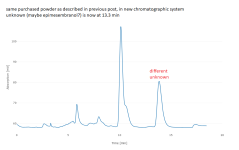
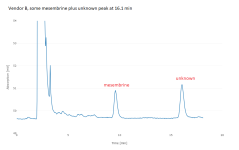
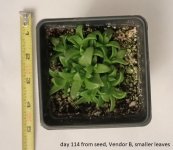
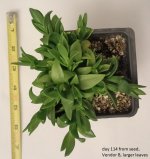
The samples from Vendor B have about 1/10 as much mesembrine as Vendor A. This may be due to cultural conditions, since I'm now sampling when the plants are smaller and seeing less dryback. A factor of ten is pretty big, but per below I've seen comparable variation in the same clone under different conditions. These plants also have a big unidentified peak around 16.1 min, with area comparable to the mesembrine. (This is a different peak from the suspected epimesembranol in the purchased powder mentioned above, which in the new system occurs at 13.3 min. So I'm less confident in that identification now. Patnala is unfortunately no help, since he identified only a single peak around that time.) The size and growth habit of the plants also seems to vary more.

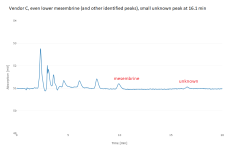
Vendor C is about 1/2 as strong as Vendor B. It has a higher ratio of Δ7-mesembrenone to mesembrine. It sometimes has a detectable peak around 16.1 min, but much smaller.

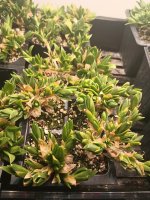
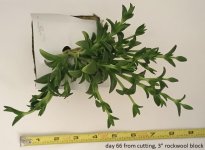
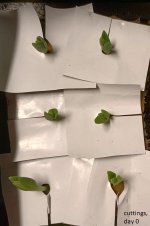
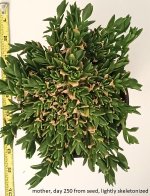
I've also taken cuttings from selected plants from Vendor A. I'm now growing those clones both in rockwool and in my original 50/50 coir/perlite. The rockwool achieves faster growth; I've attached a picture, just 66 days from a cutting with two leaves. It has much lower alkaloids though, decreasing with time now to about 1/10 of the mother. (That said, the mother has roughly doubled its mesembrine since I first sampled it, while its mesmebrenone dropped by a factor of four. So they're clearly not too consistent, even within the same individual. That also means I don't know how well my selection at a seedling stage will predict mature alkaloid content.)

I suspect that both the fast growth and the lower alkaloids are due to the lower dryback, due to the higher water holding capacity of the rockwool vs. my coir. It's possible that higher EC (maybe just more concentrated fertilizer, or maybe with sodium chloride since it's a halophyte) would result in higher alkaloid content. It's also possible that less frequent watering would help--I'm (rather arbitrarily) watering weekly, with the result that my coir/perlite usually dries out completely, but my rockwool doesn't. I'll try some experiments once those clones are a little bigger, since I'm hoping I can grow them quickly and then stress them to produce alkaloids. As a rough indicator, I believe that kanna that doesn't see enough dryback to skeletonize is likely to be weak.

The growth habit is generally horizontal, and cuttings oriented vertically soon resume their horizontal growth. This results in the asymmetric shape seen here, though it seems to be evening out with time. Seed-grown plants are more symmetric. There may be some genetic variation in success in rooting cuttings, though my sample so far is small. I've just now taken an additional 24 cuttings: 12 of my current favorite and 4 each of three others, half in rockwool and half in 50/50 coir/perlite. I should see new growth within about three weeks.

I've extracted and consumed (diluted in citrate buffer, sublingual) plant material from Vendor A. As expected from the chromatogram, it's very good, essentially a homegrown duplicate of the extracts manufactured by Gericke's company. The plants from Vendors B and C aren't big enough to consume yet, but I'll try as soon as they are. I also plan to isolate the 16.1 min component by preparative chromatography on a large SPE cartridge, to consume it alone. (I did this with the 13.3 min already; it was somewhat euphoric but more intoxicating, different but strictly worse than mesembrine or mesembrenones for me.)

None of my seed-grown plants have flowered yet. I believe my three populations are different enough that hybrids may be interesting, though Vendors B and C look so much weaker (change in sampling method aside) that the hybrids might just be strictly worse than selections from Vendor A.

It's a plant that I have been growing for years, but have never really done anything with other than harvest and ferment.
How do you typically consume it, and how much do you typically consume? An active dose for my plants would be anywhere between 250 mg and >30 g fresh weight. The higher end is presumably not possible without extraction (and I prefer extracts in any case, faster onset I think).

I haven't yet tried fermentation, since the papers I found showed decreased total alkaloids and the unfermented profile of my best clones looks really good. That's another rich area of study though, filled with unexplained mechanisms and contradictory published results.
 

Attachments

  • mes2-powder.png
    mes2-powder.png
    35.2 KB · Views: 5
  • mes2-vendor-c.png
    mes2-vendor-c.png
    31.7 KB · Views: 3
  • mes2-vendor-b.png
    mes2-vendor-b.png
    32.6 KB · Views: 5
  • mes2-cutting-day66.jpg
    mes2-cutting-day66.jpg
    50.2 KB · Views: 6
  • mes2-cutting-day0.jpg
    mes2-cutting-day0.jpg
    38.2 KB · Views: 7
  • mes2-smaller.jpg
    mes2-smaller.jpg
    45.6 KB · Views: 6
  • mes2-larger.jpg
    mes2-larger.jpg
    60.6 KB · Views: 6
  • mes2-mother.jpg
    mes2-mother.jpg
    97.8 KB · Views: 6
How do you typically consume it, and how much do you typically consume? An active dose for my plants would be anywhere between 250 mg and >30 g fresh weight. The higher end is presumably not possible without extraction (and I prefer extracts in any case, faster onset I think).
Unfortunately, the amount I usually take isn't something I have ever paid much attention to. I tend to mix what I grow 50/50 with cannabis and vape it in a dry herb vaporizer. I would then vape throughout the night, refilling as needed.

I am growing some more from seed right now, but it'll be a while until they are ready. When the time comes, I will start measuring my amounts (With and without cannabis).

I haven't yet tried fermentation, since the papers I found showed decreased total alkaloids and the unfermented profile of my best clones looks really good. That's another rich area of study though, filled with unexplained mechanisms and contradictory published results.
That's very interesting, I'd always fermented because that's what I read was usually done. Once ready, I'm going to ferment only half of what I gather. While not at all very scientific or accurate, I'm curious if I will be able to tell a difference in effects.
 
I've run some miscellaneous samples. I tested Aptenia cordifolia and Delosperma echinatum, which are reported in the literature to be active. Mesembrine wasn't detected, with LOD around 0.01 mg/g fresh weight; good kanna is well above 1 mg/g. I tested a single individual of each, received as cuttings and a rooted plant respectively. (For anyone propagating A. cordifolia, note that while it looks somewhat succulent, the cut end of the stem can't be left to callus. If not kept moist then it just shrivels up.) I assume that both I and the literature are accurate as to the samples tested, and that we're just seeing variation within the species, in the same way that the S. tortuosum cuttings that I purchased were inactive.

I also tested Carpobrotus edulis from a nearby population, which is reported in the literature to be inactive. Mesembrine was again not detected. That was a long shot, but active C. edulis would be amazing so I might try more samples. It's everywhere here, though mostly from deliberate plantings that naturalized so the genetic diversity may be bad. C. edulis is much tougher than the others, failing to homogenize by bead beating unless it's first cut into small pieces.

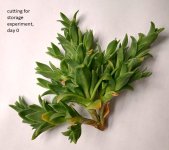
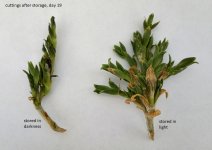
I sacrificed one of my rockwool-grown plants for a storage experiment, breaking it into three pieces. One was placed in a dark cupboard. Another was placed under lights. The last was placed outdoors; I'd intended to give it sun, but other plants quickly grew around it so I think it actually got deep shade. Initial samples taken from the three branches showed very similar abundance of mesembrine, with 0.80 mg/g fresh weight, 0.81 mg/g, and 0.83 mg/g. This is rather low, probably because of insufficient dryback.

After 19 days, the dark cutting had 43% of its initial weight, and 111% of its initial mesembrine. The light cutting had 60% of its initial weight, and 133% of its initial mesembrine. I couldn't find the cutting outdoors, and thought I'd lost it.

After 34 days, the dark cutting had 10% of its initial weight, and 67% of its initial mesembrine. The light cutting had 45% of its initial weight, and 166% of its initial mesembrine. I found the cutting I thought I'd lost outdoors, which had 52% of its initial weight, and 110% of its initial mesembrine.

I assume that the dark cutting lost weight faster because the other two were alive enough to operate their stomata, resulting in "growth" similar to a rooted plant under drought, while the cutting in darkness just died and shrivelled up uniformly. The appearance reflects this, with the cuttings in light showing the characteristic skeletonization of lower leaves, but no such pattern on the cutting in darkness.

I believe this reinforces the importance of drought stress in growing strong kanna. It's probably easier just to stop irrigation while the plants are still on their roots, but the process appears to also work on a cutting. I guess the South African growers know all this and more, but don't publish for competitive reasons.

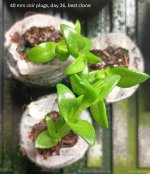
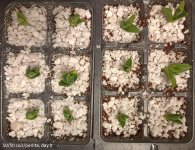
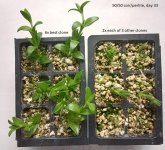
My first batch of clones are steadily increasing in alkaloid content, though still below the mothers. This is probably from increased dryback, since the plants are getting bigger but I'm still watering weekly; the biggest ones suck their blocks almost dry now. From the second batch, all 24 of the cuttings that I mentioned above have rooted, though my preferred clone is consistently much more vigorous than the others, especially in the cells of 50/50 coir/perlite mix. I also tried some in 40 mm coir plugs (the kind that expand in water to fill a mesh bag), and those look surprisingly good, faster than either the 50/50 or the rockwool. All of these were grown on a flood tray until new growth was evident, irrigated once daily. That's probably too often but it's a shared system.

That's very interesting, I'd always fermented because that's what I read was usually done. Once ready, I'm going to ferment only half of what I gather. While not at all very scientific or accurate, I'm curious if I will be able to tell a difference in effects.
I'd note that fermentation is reported to decrease concentration of oxalic acid, so it's possible that vaporizing the unfermented plant material would be more irritating or dangerous. I believe that oxalate presents no risk when swallowed or chewed, since many common vegetables contain far greater amounts (unless calcium oxalate crystals mechanically stab you like with taro leaves?). Vaporizing may present a different risk, though. Extraction should reject the oxalate almost perfectly. I get best results extracting first into acidified water, but that's prone to trouble with emulsions and clogged filters. I recently extracted CIELO-style (at @Woolmer's suggestion); that was very easy and yielded well, though purity was worse.

Patnala reports that South African cultivators assess potency by "use as snuff", which seems like it should work but feels hard on the nose. He also provides a TLC method (unfortunately with a solvent system including DCM) that could be used to roughly quantify with basic equipment.
 

Attachments

  • mes4-coir-40mm-day26.jpg
    mes4-coir-40mm-day26.jpg
    70.9 KB · Views: 5
  • mes4-storage-cutting-day0.jpg
    mes4-storage-cutting-day0.jpg
    68.3 KB · Views: 5
  • mes4-storage-cutting-day19.jpg
    mes4-storage-cutting-day19.jpg
    72.9 KB · Views: 6
  • mes4-coir-perlite-day0.jpg
    mes4-coir-perlite-day0.jpg
    182.8 KB · Views: 5
  • mes4-coir-perlite-day33.jpg
    mes4-coir-perlite-day33.jpg
    156.5 KB · Views: 4
I've continued to grow my Sceletium tortuosum. The plants from Vendors B and C became sufficiently root-bound that I needed to pot them up, so I re-analyzed to help select which ones I'd keep. I used exactly the same method as before, bead beating to homogenize followed by HPLC-UV.

Alkaloid concentration increased greatly from that seedling stage, to an average around 5 mg per g fresh weight. I therefore believe my low concentrations earlier are explained by low dryback, not genetics. These new samples are actually stronger than Vendor A was, though that's again perhaps explained by dryback in their undersized pots. The plants from Vendors B and C were watered weekly and completely dry a few days after watering, noticeably skeletonized. The unidentified peak at 16.1 min is no longer present.

I thus believe that mature plants grown from all three vendors' seeds perform similarly, and all very well under my hydroponic conditions. This absolutely does not mean all S. tortuosum is equally good, since I have a completely inactive plant (from a purchased cutting) and most wild samples reported in the mainstream literature are weak. It just means the seeds from all three vendors are the result of similar or identical selection.

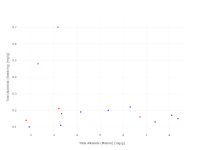
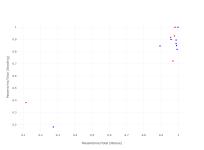
Looking at a scatter plot of total (mesembrine + mesembrenone) alkaloid concentration at the seedling stage vs. now, I see no particular structure. This is consistent with dryback as the primary driver and not genetics, and unfortunately means my selection for high alkaloids at that time was probably ineffective. I've colored plants from Vendor B in red, Vendor C in blue. The red may be systematically higher as a seedling, but that may just be our usual dryback.

mes6-total.png

Looking at a scatter plot of mesembrine as a fraction of total alkaloids, we see clear structure. This may suggest that high-mesembrine vs. high-mesembrenone clones reliably exist, though more tests will be required to confirm this persists. Perhaps the high-mesembrenone trait is recessive, but I can't find any relevant literature. Inbreeding to fix either trait from seed may be possible, but probably not worthwhile since it's easier to propagate clonally.

mes6-ratio.png

With my hydroponic conditions, none of my plants grown indoors have flowered, not even the mothers from Vendor A that are now over 18 months old. That's bad for breeding, but potentially convenient when growing for harvest. Very little area is required to grow for personal consumption. Properly managed, a single 1020 tray should yield hundreds of doses every few months.

It's unfortunately impossible to harvest the base of a shoot without also harvesting the tip. When drought stress is applied to increase alkaloids, the tip is last to skeletonize. The remaining leaves have thus lost a disproportionate share of their photosynthetic capacity. The plants usually survive this, but I've lost a couple. It's prudent to keep the mothers well-irrigated, stressing and harvesting sacrificial clones.

Clones planted outdoors flowered within a few months. I don't know what factors explain that. I don't think it's dryback, since they get daily irrigation outdoors, and I don't think it's day length since my lights are at 16 hours and it's summer here. My first guess would be daily light integral, or maybe day/night temperature? I haven't analyzed samples from outdoors for alkaloids, but may in future.

All recreational aspects aside, I've found the drug to be generally beneficial, providing mood elevation without degradation of clarity of thought. Zembrin is approved by Health Canada to "help support cognitive functioning in adults", a somewhat nebulous claim but consistent with that. I've consumed a high-mesembrine extract daily for periods of weeks or longer and stopped abruptly for weeks with no adverse effects.

Internet forums discussing commercial mesembrine products often field questions from users with history of meth, cocaine, or opiate use, explicitly seeking maximum euphoria; but despite this, I've seen minimal evidence of addiction or other detrimental use. The abuse profile seems broadly similar e.g. to bupropion, with on-target effects inherently prone to addiction but side effects bad enough to naturally deter overuse. The side effects are better here too, since nausea or other GI symptoms are safer than bupropion's seizure. Acute fatal overdose seems practically impossible, with LD50 in mice >1000x an active dose.

Patent filings show many salts and analogs under development, I guess reflecting similar observations by those startups. Self-cultivation and extraction are pretty easy though, with unusually low medical and legal risk. I thus consider S. tortuosum to be understudied by those with amateur interest in plant-origin drugs, and will continue my experiments.
 
The only time I got an effect from kanna was when I pre-dosed harmine.
Where did you get your kanna? I purchased milled powder from two sources and both were weak, <10% of the plants I've grown myself. I've speculated those were wild-harvested, since both the low mesembrine and the late-eluting peak (suspected epimesembranol) are more similar to wild types reported in the literature. That provides both an ecological reason and a functional reason to grow one's own.

I've used my kanna primarily sublingually, consistent with indigenous practices. That effect should be unmistakable. I'm not aware of any tradition of smoking or vaporizing it. The efficacy and safety are thus less known, though modern vaping does seem reasonably popular without reported adverse effects (without harmalas).

𝘒𝘢𝘯𝘯𝘢 𝘢𝘯𝘥 𝘩𝘢𝘳𝘮𝘢𝘭𝘢 𝘨𝘰 𝘵𝘰𝘨𝘦𝘵𝘩𝘦𝘳 𝘢𝘮𝘢𝘻𝘪𝘯𝘨𝘭𝘺
I don't think this is necessarily bad to explore, but I doubt it has mesembrine's >1000x therapeutic index. Since your last link mentions 5-MeO-DMT with harmalas, I'd note that Jonathan Ott reports a mild experience from 10 mg 5-MeO-DMT with harmalas, and I can confirm this myself (though others report much stronger experiences at the same dose). The dose in the 2005 fatality was probably on the 100 mg order, so maybe 10x. This is an unusually small margin. If raw plant material is consumed and not lab-tested extracts, then natural variation in concentration of the active constituents may consume much or all of that.

The kanna is probably much safer (since 5-MeO-DMT is much more toxic alone), but you're in uncharted territory. You may prefer to use extracts instead of raw plant material, to at least remove some of that natural variation. This would permit more consistent dosing, and allow you to share your experiences in ways that others could more easily replicate. If your kanna is weak then that may also be the most efficient use of it. I was unable to get effects from a sublingual dose of my weak purchased powder, but the CIELO-style extract works. Extraction into acidified water works too, but with more trouble filtering.
 
Man, your work is amazing. Really well done. It is interesting what you say about the phenotypic variation. I have noticed this too, walking around in the field and tasting random plants. My one set of clones I got from an old guy who was growing many of the species, and the specific clone he gave me (of S. tortuosum), he said, was the strongest he had. It has a significantly more bitter taste than any other phenotypes and species I have tasted.

I would love to get more details on your hydroponic setup. Mine grow quite nicely, but yours are so beautifully dense. Do you find growth stalls during summer?

I recently scored a variety of species and phenotypes from the botanical garden that were getting chucked out, and I am busy rooting them all.
 
The hydroponic system is pretty standard. I continue to prefer coir plugs for clonal propagation, the kind that come compressed and expand in water. I keep them in a tray that floods with hydroponic solution every two days. This gives me just enough dryback for good air pruning and algae control. Exact timing will of course depend on environment. I'm usually around 25 C and 50% RH, sometimes dryer.

I tried propagating in a humidity dome (maybe RH 90%) once, to reduce my watering effort. That didn't work at all, and everything rotted. The roots can stay permanently wet, but the aerial parts must not.

When the bottom and sides of the plug are heavily rooted, I transplant to a pot of 50/50 coir/perlite with gypsum added for buffering. I mix that myself, but similar products are sold pre-mixed here for cannabis growers. I don't know whether the gypsum is actually required. The cation exchange sites on coir typically come preloaded with Na or K and will exchange other cations out of the solution, often resulting in Ca deficiency in other crops.

I'm using typical two-part hydroponic nutrients, EC 1300 uS/cm and pH 5.8 (though probably neither is critical), about 90% of nitrogen as nitrate with the rest as ammonium. Fertilizers of this type are sold here for cannabis, and for greenhouse vegetables like tomatoes and cucumbers. For most vigorous growth, I try to water a little before the medium dries back completely. A few days completely dry doesn't seem to matter much, though. I've never had any trouble that I attributed to overwatering, probably thanks to the high perlite content. The standard succulent advice to ensure the medium dries back completely before watering is not necessary here.

I typically aim to harvest around three weeks after the last watering. This drought stress is very important, since well-irrigated clones have shown <10% of expected alkaloids. Moderate skeletonization should be observed at harvest time. I try to leave some un-skeletonized leaves when I harvest. Most of my clones have regrown after harvest, but a couple died. I'm not yet sure whether it's better to harvest plants multiple times, or to make a single terminal harvest for each clone. Regrowth showed similar alkaloid profile to initial growth.

Ice plants tend to be halophytes, so it's possible that much higher EC would be tolerated. That might improve alkaloid production. Drought stress to the roots looks like high EC, and there's a paper that reports this effect in vitro. That could come from higher fertilizer concentration, or literally from added sodium chloride, similar to the EC stress applied to improve flavor in hydroponic tomatoes. I may do some experiments there.

I'm growing in a climate-controlled room under white LEDs, 16 hours on and 8 off. It gets a few degrees cooler in winter, but I doubt the plants experience significant seasonal cues. This doesn't seem to hurt them, though it might explain my failure to flower indoors. Sceletium's occasional use as a houseplant may provide a further hint that it can tolerate this lack of seasonal cues. I've kept most of my plants around 12 klux at the leaves. I kept 6 of the 14 seedlings plotted above around 6 klux; I saw some etiolation, but no systematic difference in alkaloids.

You almost certainly have much more diverse genetics than I do. Analysis would be very interesting, and TLC would probably be sufficient e.g. to distinguish my outlying two high-mesembrenone clones in the scatter plot above, even just by eye without densitometry. I'm not aware of any clones with known chemotype that are openly available in any country (though I guess one could ask the nurseries referenced in Patnala's thesis for the same stuff they give him?). I'm sure the growers supplying the extract market have many, but that all seems proprietary so far.
 
Back
Top Bottom