• Members of the previous forum can retrieve their temporary password here, (login and check your PM).

Gleditsia triacanthos (Honey locust) is indeed entheogenic.

Google “Missihuasca Hypothesis” by Phillip Newman. I can only read the abstract but Gleditsia is discussed.

It’s planted quite a bit around here in parks and commercial properties. The issue has always been digging up roots of trees planted out in parks etc. I once saw one stripped of bark on a strata property at work (gardener).

Couldn’t say why a person chose to destroy the tree..but this info is not hard to come by these days.

It’s not like it’s in danger here but I could imagine what ppl could start doing in the parks etc if this turned out to be a useful tree in this sense..but good news is it does grow big and huge here so anyone can grow it.

It’s kinda like phragmites here…different issue but have left it alone because native populations of it are getting rare and invasive populations were eradicated.
 
Google “Missihuasca Hypothesis” by Phillip Newman. I can only read the abstract but Gleditsia is discussed.

It’s planted quite a bit around here in parks and commercial properties. The issue has always been digging up roots of trees planted out in parks etc. I once saw one stripped of bark on a strata property at work (gardener).

Couldn’t say why a person chose to destroy the tree..but this info is not hard to come by these days.

It’s not like it’s in danger here but I could imagine what ppl could start doing in the parks etc if this turned out to be a useful tree in this sense..but good news is it does grow big and huge here so anyone can grow it.

It’s kinda like phragmites here…different issue but have left it alone because native populations of it are getting rare and invasive populations were eradicated.
Yes I'm aware of it. That's the inspiration for this post 😅
I believe there are sustainable ways to harvest it. It is easily grown from seed. It also sends out suckers, you could have a mother tree and harvest the suckers to control the spread.
 
var. inermis

Notice the long pods. The easiest way to tell Gleditsia and Robinia apart is to look at the pods. Robinia pods are small maybe finger length…Gleditsia will be much longer/fatter and they curl.
 

Attachments

  • IMG_0394.jpeg
    IMG_0394.jpeg
    4.9 MB · Views: 13
  • IMG_0395.jpeg
    IMG_0395.jpeg
    3.4 MB · Views: 13
  • IMG_0396.jpeg
    IMG_0396.jpeg
    3.3 MB · Views: 13
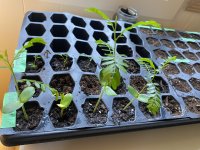
Germinated a few from that tree. I had ordered seeds of the wild thorny variety, but what arrived were tiny black little seeds that look like Robinia and nothing like Gleditsia. So local park collected inermis variety it is.
 

Attachments

  • IMG_0404.jpeg
    IMG_0404.jpeg
    2.5 MB · Views: 5
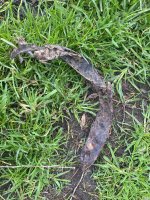
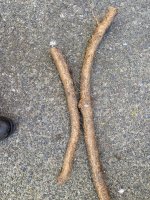
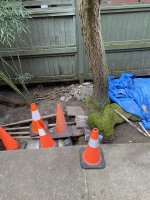
So some root had to get dug up on one of my work sites…now my question is…was this tree grafted to robinia rootstock?…and how well will this tree do now that it’s had some roots cut?
 

Attachments

  • IMG_0461.jpeg
    IMG_0461.jpeg
    3.7 MB · Views: 10
  • IMG_0460.jpeg
    IMG_0460.jpeg
    2.6 MB · Views: 10
So some root had to get dug up on one of my work sites…now my question is…was this tree grafted to robinia rootstock?…and how well will this tree do now that it’s had some roots cut?
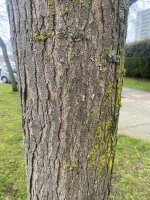
There's a definite grafting ring visible on that first pic. You might want to take a very close look at the bark on either side of that join, even though at first glance it may seem to match.
 
Looks grafted to me also and looks like robinia roots. Too bad I don’t have a work project involving a robinia to compare.

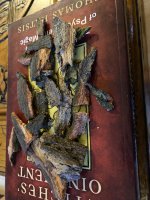
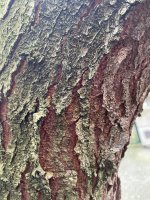
Here’s a pic of bark taken from a larger limb of one that had to be pruned off a building. You can see the red in the bark PD Newman describes in the roots.
 

Attachments

  • IMG_0407.jpeg
    IMG_0407.jpeg
    1.9 MB · Views: 11
I will extract the little bit of trunk and branch bark when I find the time but not expecting much. I might go buy a more established tree if I can find them without the graft.

The good news is this tree has recovered from some serious root removal…too bad it’s grafted to Robinia. I’m sure being grafted like that changes things. Not sure how an ungrafted Gleditsia would do with that much root removed.

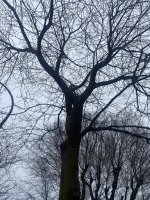
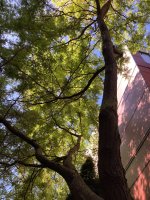
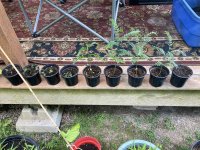
Here’s the tree now and my seedlings…
 

Attachments

  • 5450FF86-47E1-4FD0-B279-711463A758DA.jpeg
    5450FF86-47E1-4FD0-B279-711463A758DA.jpeg
    3.5 MB · Views: 4
  • 971F49DE-9F5B-4E3A-B5A2-D529B9E3F820.jpeg
    971F49DE-9F5B-4E3A-B5A2-D529B9E3F820.jpeg
    5.8 MB · Views: 4
I will extract the little bit of trunk and branch bark when I find the time but not expecting much. I might go buy a more established tree if I can find them without the graft.

The good news is this tree has recovered from some serious root removal…too bad it’s grafted to Robinia. I’m sure being grafted like that changes things. Not sure how an ungrafted Gleditsia would do with that much root removed.

Here’s the tree now and my seedlings…

The "Missihuasca" paper describes myths that suggest the root bark is the active component; of course, a positive result from trunk bark would also be meaningful. Apparently the wild trees have extensive lateral roots.
 
Someone with local feral populations needs to go try it. The trees are not that uncommon in urban settings here but they don’t seem to spread even though the seeds are viable…likely because these areas are heavily maintained by the city etc..

If branch bark is at all active, that’s great because these things require a bunch of pruning each season.
 
You would only have to consume 2.1 grams of triacanthine to possibly die. A half a kilo of dried leaves or pods would do it. 30 mg/kg x 70Kg =2100 mg =1g/1000 mg = 2.1 grams. Please do not kill yourself by being mathematically incompetent. For the love of God man.
 
You would only have to consume 2.1 grams of triacanthine to possibly die. A half a kilo of dried leaves or pods would do it. 30 mg/kg x 70Kg =2100 mg =1g/1000 mg = 2.1 grams. Please do not kill yourself by being mathematically incompetent. For the love of God man.
I am incorrect about the amount. You are correct. I apologize for my misunderstanding. 2.1 grams could be derived from 21 kg of dried leaf. Again I apologize.
 
I am incorrect about the amount. You are correct. I apologize for my misunderstanding. 2.1 grams could be derived from 21 kg of dried leaf. Again I apologize.
Fortunately, the extraction process should be enough to leave the vast majority of the triacanthine out. We'll be sure to be careful if anyone of us is thinking of consuming a crude brew made with about a third of our bodyweight of honey locust material, however ;)
 
Back
Top Bottom