• Members of the previous forum can retrieve their temporary password here, (login and check your PM).

Gleditsia triacanthos (Honey locust) is indeed entheogenic.

Wise_fool

Esteemed member
Joined
Sep 2, 2024
Messages
15
Merits
42
I was listening to the mind escape podcast, episode #275.
P.D. Newman was discussing entheogenic plant use by native Americans. He said he has found evidence of the Cherokees using an Ayahuasca analogue comprised of Gleditsia triacanthos and Passiflora incarnata. The idea of honey locust being active has been around a while, in fact Trout bioasseyed it in his book some simple tryptamines.
P.D. Newman also bioassayed it and said the resulting effects were indistinguishable from Ayahuasca. He took about 10 grams of honey locust with 25 grams of passionflower. I do not know which part of the root was used whether the whole root or just the root bark.
According to trout the tree responds badly to having the roots disturbed. Fortunately honey locust sends out suckers which could be sustainable harvested without damaging a mother plant. It's also quick from seed. The wood has other uses as well. It's good firewood and is rot resistant so it makes excellent fence posts, tool handles, etc.
 
Now that's super interesting! I wonder if those two grow around my area...I have to find a species map.
Honey locust has been widely introduced around the world including (obviously) Europe. I'd suggest finding a tree guide for your country. Y'know, books :D
 
Dunno if this helps:
Гледичия трёхколючковая — Википедия и применение?wprov=sfla1
Not really, as it's in Russian. Even though most Bulgarians can more or less understand Russian, I've found a better resource, which is the GBIF - Global Biodiversity Information Facility which has a global species distribution map that is very helpful. I can't say how accurate it is, but I hope it's at least mostly accurate. Seems like there are a few occurrences of Gleditsia triacanthos on the territory of Bulgaria, but it's rather sparse, perhaps targeted cultivation would be much more fruitful than seeking it in the wild.
 
Not really, as it's in Russian. Even though most Bulgarians can more or less understand Russian, I've found a better resource, which is the GBIF - Global Biodiversity Information Facility which has a global species distribution map that is very helpful. I can't say how accurate it is, but I hope it's at least mostly accurate. Seems like there are a few occurrences of Gleditsia triacanthos on the territory of Bulgaria, but it's rather sparse, perhaps targeted cultivation would be much more fruitful than seeking it in the wild.
Well, I looked for a Bulgarian version but all I could find was the Russian one, which at least has a small comment on range within the former USSR (as far as my rudimentary comprehension of the language allowed me to guess!)

I will admit this is equivalent to a Russian person presenting me with, say, an Italian wikipedia page and saying, "well, at least it's in the right alphabet…" 😁
 
Well, I looked for a Bulgarian version but all I could find was the Russian one, which at least has a small comment on range within the former USSR (as far as my rudimentary comprehension of the language allowed me to guess!)

I will admit this is equivalent to a Russian person presenting me with, say, an Italian wikipedia page and saying, "well, at least it's in the right alphabet…" 😁
Hey, something is better than nothing, right? :)
 
Try iNaturalist. Honey Locust is an invasive in many countries.
iNaturalist was my second option but GBIF provided enough info to somewhat answer my question. I'll reference both resources in the future though, thanks!
 
There's a load of this stuff growing on my land - this thread adds weight to my hunch that it requires further investigation.

If you could provide some links to the podcast(s) and any other source of supporting information, that would be most helpful.
Episode 275 of the mind escape podcast.
It's on Spotify.

 
Oh! In Argentina it is considered an invasive species, a true pest! In fact, I live on 1/2 hectare of land, at the foot of a mountain range, and it is full of it! Here we know it by the name "acacia negra". I have been on the verge of cutting them several times, because they grow so much! Now I'm going to think about it better!!!.:eek:
 
Oh! In Argentina it is considered an invasive species, a true pest! In fact, I live on 1/2 hectare of land, at the foot of a mountain range, and it is full of it! Here we know it by the name "acacia negra". I have been on the verge of cutting them several times, because they grow so much! Now I'm going to think about it better!!!.:eek:
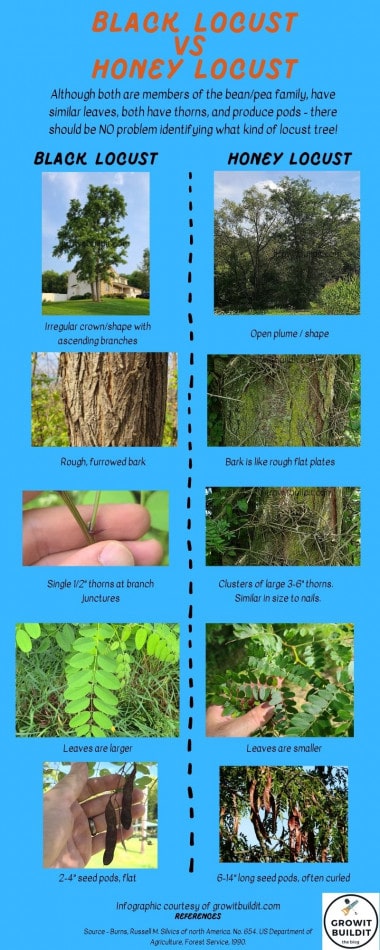
The word "negra" makes me wonder if you are confusing honey locust with black locust. They are similar and often confused.

Black-Locust-vs-Honey-Locust-infographic-1.jpg
 
There's a load of this stuff growing on my land - this thread adds weight to my hunch that it requires further investigation.

If you could provide some links to the podcast(s) and any other source of supporting information, that would be most helpful.
Do some experimenting and report back to us! 🙏😁
 
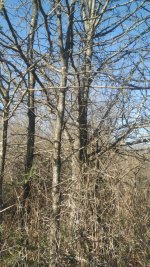
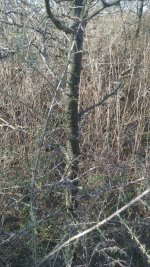
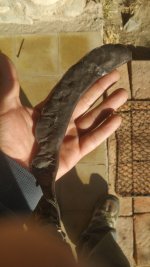
View attachment 100035View attachment 100036View attachment 100037
What do you think? It appears to be Gleditsia triacanthos...:unsure:
Do those pods have a purplish hue to them at all? (e.g., https://upload.wikimedia.org/wikipe...cust_fruits.jpg/1280px-Honeylocust_fruits.jpg )
That's a shade that doesn't render so well on most digital photographs. If it's more the dark brown-black that it appears to be, I'd suggest it's much more likely the black locust, or maybe carob (Ceratonia siliqua). [This latter species was widely planted for carob production before it was realised that nobody actually liked the stuff :LOL: ] Adding to that the lack of obvious spines and we've an even stronger case for it not being the target species. Sorry!
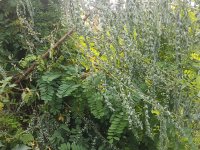
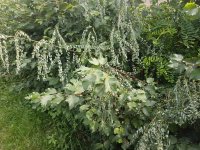
Meanwhile, I went out on an impromptu bike ride today and found a spot where some gleditsia (milder-spined variety) had been timmed fairly recently:
20240907_130938.jpg
20240907_130944.jpg
This may be a sign to start researching in earnest…

(Or I may, in my enthusiasm, have failed to rule out Robinia pseudoacacia :rolleyes: but I think the spines and leaf shape say otherwise.)
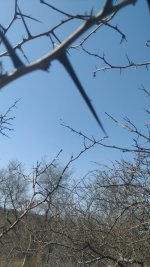
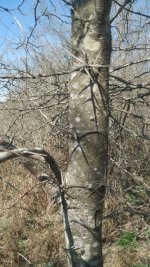
 
Do those pods have a purplish hue to them at all? (e.g., https://upload.wikimedia.org/wikipe...cust_fruits.jpg/1280px-Honeylocust_fruits.jpg )
That's a shade that doesn't render so well on most digital photographs. If it's more the dark brown-black that it appears to be, I'd suggest it's much more likely the black locust, or maybe carob (Ceratonia siliqua). [This latter species was widely planted for carob production before it was realised that nobody actually liked the stuff :LOL: ] Adding to that the lack of obvious spines and we've an even stronger case for it not being the target species. Sorry!

Meanwhile, I went out on an impromptu bike ride today and found a spot where some gleditsia (milder-spined variety) had been timmed fairly recently:
View attachment 100038
View attachment 100039
This may be a sign to start researching in earnest…

(Or I may, in my enthusiasm, have failed to rule out Robinia pseudoacacia :rolleyes: but I think the spines and leaf shape say otherwise.)
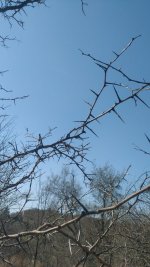
Oh, you can't see the spines! They have spines, lots of them; only my camera is not very good. They are very poisonous if you get stuck in them. The pod has shades of blood red, which turns to dark brown, in a gradient.
1.jpeg2.jpeg3.jpeg
 
Last edited:
OK, that sounds a whole lot more hopeful! Maybe we can compare notes later on. Did you find out which plant parts might be the most promising to investigate?
I'm not really the most appropriate person to go into this topic, since I know nothing about chemistry. But I imagine I can perform extraction procedures similar to those used for mhrb. I have everything I need for an extraction, but I haven't done one yet (waiting for the holidays). For now, I've found this material, which I'm leaving here, in case it's useful for those who know more than me:

Some simple tryptamines - Trout and friends - Second edition
It says there that: "...Positive assay (in roots) co-tlc by Appleseed. Plant reactedbadly to root sampling (stopped producing any leaves for18 months) so a second sample was never taken...".
 
Last edited:
Back
Top Bottom