


Recently, inspired by blig-blug's success with mimosa CWE I wanted to try the same with rue for the purpose of daily harmala use. But then I thought if it is effective, it makes sense to use it for harmala extraction, no more hours of smelly rue cooking and no messy filtration, it would take a few days to complete but the effort is much reduced. CWE doesn't make as much sense for dmt extractions because of the large water volume and we already have STB.
I will first outline the general steps and then go in more details about what I did in this first experiment and the results I got. Although I've been a big proponent of whole seed rue extractions, I believe for CWE griding the seeds is necessary, so that is the only high effort/power step.
Harmala rue CWE general steps:
for the first experiment I wanted to assess the efficiency of the water soaks and determine how many pulls are required so I performed steps 4,5,6,7, and 9 on each soak separately.
From here on I will refer to water soaks by pulls.
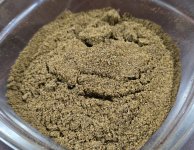
Ground rue seeds.
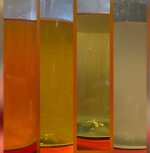
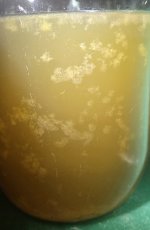
Dilution of harmala solution color with each successive pull, cloudiness in the last one from squeezing the ground seeds.
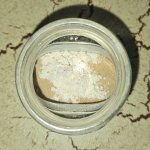
Contrast between freebase harmalas from the first 5 pulls and pull 6
Pulls 4 and 5 yielded very little on first basificatiom so I combined them but after the water washes the amount was not worth recovering, I estimate it was around 100 mg.
Pull 6 went through 2 more A/B steps and crystalisations so it became much cleaner and there might have been additional losses so for a fair comparison I increased its 150 mg yield by 20% to 180mg.
And here's the full results
Pull 1: ......................................................... 1.41g /60.7%
Pull 2: ........................................................... 0.35g /15%
Pull 3 (+squeeze): ....................................... 0.28g /12%
Pull 4&5 (+squeeze): .................................. 0.1g /4.3%
Pull 6 (freeze/thaw+simmer+squeeze): ... 0.18g /7.8%
Total yield 2.32g / 4.6%
I usually expect around 6% from these seeds but I've had them since 8-9 years and the 50 g I used were traveling with me for many years and were stored in a plastic bag in a cupboard so they might have lost somr potency. In the next experiment I will use the same seeds but from the properly stored stash.
Disregarding pull 6 (the simmer), 2.14g / 4.3% were collected through CWE alone equating to 92.2% of the total alkaloids.
60.7% were collected on first pull alone, and I believe if I had poured off all the water from that pull and squeezed the seeds it would have reached 70% or a 3% yield (disregarding pull 6). This makes me think that CWE is actually not that effective pulling harmalas, and the grinding action on step 1 is the most effective step for releasing the harmala alkaloids.
The results from this first experiment are great in my opinion, considering the avoidance of the smelly rue cooking and the filtration hassle, especially when working with ground seeds. The steps can be followed as is for people who don't mind spending the time but I believe significant improvements can still be achieved. Here's some thoughts and potential ways of improvement:
I Plan on doing a second CWE experiment soon and try some of these ideas. Although I'm sure freeze/thaw cycles would work great, for now I want to try without it as I'd like to find a process with as little effort/power and discretnenss as possible so for now only the grinding is the effort/power extensive step. My goal would be to maximize yield on first 2 pulls and hopefully achieve above 90%.
Any feedback and thoughts on how to improve the process would be greatly appreciated!
I would like to thank @blig-blug for the discussions we had on the CWE process and I'm looking forward to hearing about the results of his CWE experiment.
I will first outline the general steps and then go in more details about what I did in this first experiment and the results I got. Although I've been a big proponent of whole seed rue extractions, I believe for CWE griding the seeds is necessary, so that is the only high effort/power step.
Harmala rue CWE general steps:
- finely grind rue seeds, the finer the better.
- mix the ground seeds with an large volume of acidified water (2 L), let soak for 24h and mix it every few hours.
- for the last few hours let the extraction vessel stand undisturbed so the ground seeds can settle at the bottom.
- pour the the liquid through a cotton cloth into a large glass vessel (3 L), leaving the ground seeds behind. then top the ground seeds with fresh acidic water to begin the next soak.
- basify the liquid from the first soak and let settle for few hours.
- decant as much as possible of the liquid leaving the crude harmala freebase behind.
- acidify the harmalas with a minimal amount of acid so that they redissolve and pour through a coffee filter into a collection vessel, getting rid of undissolved stuff.
- by this time, or in some more hours, the second soak should be complete and steps 3, 4, 5, 6 and 7 are repeated. A total of 5 soaks should be enough to extract the majority (>90%) of the harmalas.
- the collected filtered acidic harmala solution is then based and 2-3 water washes are performed before drying and collecting the freebase.
for the first experiment I wanted to assess the efficiency of the water soaks and determine how many pulls are required so I performed steps 4,5,6,7, and 9 on each soak separately.
From here on I will refer to water soaks by pulls.
- starting with 50g rue seeds, I ground them as fine as I could with a coffee/spice grinder Moulinex AR110, I passed the gorund seeds through a fine sieve and kept grinding until almost all of it passed, there is some at the end that won't grind fine enough and appear to be part of the seed hull.
- I then added the ground seeds to a 2L PET plastic bottle, added 50 ml 5% distilled white vinegar and topped it with room temp water (I used mineral drinking water but distilled would be preferred). during the 24h soak I left the bottle on its side and shook it every few hours for a total of around 10 times. in the last few hours, after one last shake, I left it sitting upright for the seeds to settle (if your bottle has ridges give it a flick a couple of times during these last settling hours so that the fine sediment collected on the ridges would fall)
- I poured the water into a 3L glass jar through a cottom cloth leaving the gorund seeds behind, some minor amount of floaters will be poured along and I just discarded it. I then added 50 ml of acid and topped the bottle with water.
- I based with a strong NaOH solution (50g dissolvedin 500ml water). I use a glass pipette to add the base and stirr with a glass rod until the harmalas crash out and no more color change is observed, then I add a few more mls for good measure. If using pH paper, a pH of 11 should be enough. I then gave it a good stir to knock any freebase stuck at the surface, coverd it and let it settle overnight.
- In the morning I decanted as much as possible of the liquid, acidified with vinegar until color change is observed and the solution becomes fluorescent again, I add a bit more acid for good measure but a lot of stuff won't dissolve so one should not keep adding acid. I let the solution rest for some hours for the impurities to settle, then pour the solution slowly through a coffee filter leaving the impurities till the end so they won't clog the filter early on.
- I then based again using as little base as I could, let settle, decanted and did 2-3 water washes with at least 10x the volume each (I used mineral water with 7.9 pH). Finally I moved it to a narrow cup and let it settle in the fridge, poured off the water, and put it a wide dish to dry on the roof in the shade.
- I repeated the same for the remaining 4 pulls and collected the freebase separately. The CWE liquid became dilute quickly which made the basification a bit tricky as it was hard to observe the harmala precipitation, so it's better to rely on color change or pH measurement. Also because of the low harmala concentration, the freebase started to crystalize even on first basification. The crystals make the harmalas appear much more than they are and then they break down and compress during water washes giving the impression of yield loss. At some point (pull 3 and 5) I attempted to squeeze the water out of the ground seeds hoping it would improve yields but it didn't seem to help significantly, but it could be that the seeds were already low on harmalas.
- Finally, to make sure the seeds were depleted, I gave them a freeze/thaw and a 1h simmer, then proceed as above. However I experimented with freebase crystalisation on this pull so additional A/B cycles were done.
Ground rue seeds.
Dilution of harmala solution color with each successive pull, cloudiness in the last one from squeezing the ground seeds.
Contrast between freebase harmalas from the first 5 pulls and pull 6
Pulls 4 and 5 yielded very little on first basificatiom so I combined them but after the water washes the amount was not worth recovering, I estimate it was around 100 mg.
Pull 6 went through 2 more A/B steps and crystalisations so it became much cleaner and there might have been additional losses so for a fair comparison I increased its 150 mg yield by 20% to 180mg.
And here's the full results
Pull 1: ......................................................... 1.41g /60.7%
Pull 2: ........................................................... 0.35g /15%
Pull 3 (+squeeze): ....................................... 0.28g /12%
Pull 4&5 (+squeeze): .................................. 0.1g /4.3%
Pull 6 (freeze/thaw+simmer+squeeze): ... 0.18g /7.8%
Total yield 2.32g / 4.6%
I usually expect around 6% from these seeds but I've had them since 8-9 years and the 50 g I used were traveling with me for many years and were stored in a plastic bag in a cupboard so they might have lost somr potency. In the next experiment I will use the same seeds but from the properly stored stash.
Disregarding pull 6 (the simmer), 2.14g / 4.3% were collected through CWE alone equating to 92.2% of the total alkaloids.
60.7% were collected on first pull alone, and I believe if I had poured off all the water from that pull and squeezed the seeds it would have reached 70% or a 3% yield (disregarding pull 6). This makes me think that CWE is actually not that effective pulling harmalas, and the grinding action on step 1 is the most effective step for releasing the harmala alkaloids.
The results from this first experiment are great in my opinion, considering the avoidance of the smelly rue cooking and the filtration hassle, especially when working with ground seeds. The steps can be followed as is for people who don't mind spending the time but I believe significant improvements can still be achieved. Here's some thoughts and potential ways of improvement:
- Grinding the seeds further and using a finer sieve
- Griding presoaked seeds with an immersion blender
- Freeze/thaw cycles
- Not filling the soaking bottle all the way to the top to allow for more aggressive shaking. When it's full shaking it feels more like gentle mixing.
- Grinding the seeds with an immersion blender between pulls would be good but I want to avoid that for the mess free spirit of CWE.
- 24h soak is probably overkill, 12h should be fine I believe, but I liked the 24h workflow where I can time it to a period where I know I'm likely to be free and freebase settling is done overnight. The workflow is generally very flexible and one can take as much time as they'd like. Once the acidified solutions are collected, the process is fast to get the cleaned freebase. It's possible to collect as freebase after first basification to reduce the number of steps but I felt that collecting it in salt form is safer against potential degradation.
I Plan on doing a second CWE experiment soon and try some of these ideas. Although I'm sure freeze/thaw cycles would work great, for now I want to try without it as I'd like to find a process with as little effort/power and discretnenss as possible so for now only the grinding is the effort/power extensive step. My goal would be to maximize yield on first 2 pulls and hopefully achieve above 90%.
Any feedback and thoughts on how to improve the process would be greatly appreciated!
I would like to thank @blig-blug for the discussions we had on the CWE process and I'm looking forward to hearing about the results of his CWE experiment.
Last edited:












 (it's a lot of liquids aha)


