• Members of the previous forum can retrieve their temporary password here, (login and check your PM).

Harmala CWE experiment

@Ambrosaure another base that is convenient in availability and in not having any risks of having excess base in the end result is ammonia.


What helps break down the fibers is the process of freezing and thawing, so they don't need to remain frozen for any particular time. Once they're completely frozen you can thaw them already (although there's no harm in leaving them frozen for longer).
thanks! finally I found soda pretty easily so I took that, but I note ammnoiac for next time (but it's more expansive than soda)

Also, I'm not sure if I understood right this part of the recipe so in case:
  • In the morning I decanted as much as possible of the liquid, acidified with vinegar until color change is observed and the solution becomes fluorescent again, I add a bit more acid for good measure but a lot of stuff won't dissolve so one should not keep adding acid. I let the solution rest for some hours for the impurities to settle, then pour the solution slowly through a coffee filter leaving the impurities till the end so they won't clog the filter early on.
  • I then based again using as little base as I could, let settle, decanted and did 2-3 water washes with at least 10x the volume each (I used mineral water with 7.9 pH). Finally I moved it to a narrow cup and let it settle in the fridge, poured off the water, and put it a wide dish to dry on the roof in the shade.

What I understand is:
- basify the harmalas liquid will decant it (make visible separation between the tannin and harmalas) (and also what should the liquid color look like at this point?)
- wait until it's the most decant it can get
- put back vinegar (we don't took anything before that from the yellow liquids right?)
- filter to get off impurities
- base again, decant, wait
- and now we can get the harmala white powder? not sure if i'm right. So we filter the potion to get that, wash it with water (I don't understand "10x volume each", if we have like 1g of powder thats mean 10g of water?)
- and then dry it

I'm gonna basify for the first time in my life, I hope it's gonna work 😁
 
Last edited:
super cheap sodium carbonate at the store so I'm just gonna buy that
While that is absolutely OK, it's still worth noting that the SC produced from baking soda would technically be closer to food grade than the stuff (presumably Heitmann brand, if I'm inferring your region correctly?) which is sold as a cleaning agent (and there's also the stuff sold as "aktiv Natron" which is essential the cleaning-grade form of sodium bicarbonate).
visible separation between the tannin and harmalas
While I wouldn't necessarily call the base-soluble components of rue 'tannins', the rest of your procedure looks about right. Patience is key - you're gonna get a lot of practice with decanting, and bear in mind that if you keep your supernatant and washings, you'll be able to rescue some of the fine solids that sometimes escape. Have a plentiful supply of large jars ready, and best of luck!
 
While that is absolutely OK, it's still worth noting that the SC produced from baking soda would technically be closer to food grade than the stuff (presumably Heitmann brand, if I'm inferring your region correctly?) which is sold as a cleaning agent (and there's also the stuff sold as "aktiv Natron" which is essential the cleaning-grade form of sodium bicarbonate).
Oh okay I understand! I will know for next time :) and I'm not german, I'm french aha (why did you think I was German haha?) , I bought this one excatly
While I wouldn't necessarily call the base-soluble components of rue 'tannins', the rest of your procedure looks about right. Patience is key - you're gonna get a lot of practice with decanting, and bear in mind that if you keep your supernatant and washings, you'll be able to rescue some of the fine solids that sometimes escape. Have a plentiful supply of large jars ready, and best of luck!
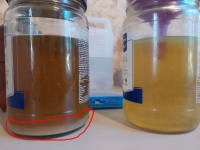
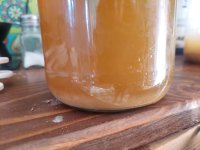
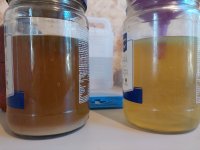
Ok thanks! Here for the record is the first pull after his first decant, and the second pull just before being decanted (I just poured the soda right in and stirred it with a metal spoon so I wouldn't have to add any more liquid)
I took the rue and put it the freezer to get more from the third pull
I use 30g of rue
20260408_095040.jpg
 
acidify the harmalas with a minimal amount of acid so that they redissolve and pour through a coffee filter into a collection vessel, getting rid of undissolved stuff.
just a rapid question because I'm doing this step now, it is normal that I had to put a LOT of white vinegar to get a ph 6? Maybe I put too much soda and that's why but I even had to find a bigger jar
 
just a rapid question because I'm doing this step now, it is normal that I had to put a LOT of white vinegar to get a ph 6? Maybe I put too much soda and that's why but I even had to find a bigger jar
If you needed to use a very large amount yes, it probably means you had an excess of sodium carbonate that hadn't dissolved, together with your harmalas. I personally like to dissolve the base (when it's sodium carbonate or sodium hydroxide) before adding it, making a saturated solution that I then add as needed to the acidic part. That way it's less likely you have undissolved base in your harmalas.

It's important to make sure that your final product doesn't have sodium carbonate. For that, you can put the harmala freebase in water and stir (it won't dissolve), and then check pH. If the pH is high, you can do washes adding water, decanting, and repeating the cycle until the pH is close to 7. The larger the volume of water you use for this, the less cycles you'll need.
 
why did you think I was German haha?
oops, sorry :oops: must be the "saure" (="sour") bit of your name, and it's resemblance to "Säure" = "acid". But, hey, only one country off, eh? One of the other French Nexians is close to the border and… European history, etc. 😁

Regarding the addition, of a solid base - if you imagine what happens when a particle of SC enters the harmala solution, the harmala freebase forms instantaneously, right at the surface of the particle as the SC begins dissolving. The resulting crust of insoluble freebase effectively stops any more of the SC from going into solution and, well, you now know the result.

I do feel like my explanation of converting baking soda may have contributed to your decision, and I did omit to emphasise that use of SC solution, and not solid, was actually necessary to help avoid this minor inconvenience. Please accept my apologies - but I hope you also learned something.

The liquid volume you hoped to save with that method has now been more than made up for by the additional vinegar you've had to use, as vinegar is typically far more dilute than the sodium carbonate solution you'd want to be using. A possible silver lining here is that your next base precipitation should come done nice and clean.

A couple of quick questions - what water did you use? And, now that I know my assumption was wrong, did you use anhydrous soda or the hydrated form?
super cheap sodium carbonate at the store
 
oops, sorry :oops: must be the "saure" (="sour") bit of your name, and it's resemblance to "Säure" = "acid". But, hey, only one country off, eh? One of the other French Nexians is close to the border and… European history, etc. 😁

Regarding the addition, of a solid base - if you imagine what happens when a particle of SC enters the harmala solution, the harmala freebase forms instantaneously, right at the surface of the particle as the SC begins dissolving. The resulting crust of insoluble freebase effectively stops any more of the SC from going into solution and, well, you now know the result.

I do feel like my explanation of converting baking soda may have contributed to your decision, and I did omit to emphasise that use of SC solution, and not solid, was actually necessary to help avoid this minor inconvenience. Please accept my apologies - but I hope you also learned something.

The liquid volume you hoped to save with that method has now been more than made up for by the additional vinegar you've had to use, as vinegar is typically far more dilute than the sodium carbonate solution you'd want to be using. A possible silver lining here is that your next base precipitation should come done nice and clean.

A couple of quick questions - what water did you use? And, now that I know my assumption was wrong, did you use anhydrous soda or the hydrated form?
saure comme from "dinosaure" actually haha (I was a lot into dinosaur as a kid 😁🦖🦕)

No problem at all, I learned something so no worries. I expected to have difficulty doing this recipe anyway. And btw I remember I have acid citric so I could have use that instead of 1L of white vinagar 🤦🏽‍♂️ and I did a second mistake, I through we needed to put the ph back to 11 so I put a ton of soda lol (for changing 🤣). And after rereading I saw it only needed to be base 😅 Well, I can only do better for the next two pull aha

I used demineralised water :) And I used anhydrous soda 😅 But blig blue explained just above why I shouldn't do that so I'm not gonna do that for the 3th pull

So your message made me have a new question, for the last step, when we wait for the harmalas to decant again do we need to wait a lot of time or should it be instant? If it's instant can I filter it now and retrieve the freebase?
 
for the last step, when we wait for the harmalas to decant again do we need to wait a lot of time or should it be instant? If it's instant can I filter it now and retrieve the freebase?
Waiting a while for the fine solids to settle helps to improve yields a little, as well as letting the 'cake' of precipitate to consolidate somewhat, so that losses are reduced during decanting.

If you can put it in the fridge for this part, the gentle vibrations help with the settling process while the lower temperature keeps the solubility of the freebase to a minimum.

If it's more convenient for you to proceed as soon as the solution has visibly cleared of turbidity, that's fine but it may be worth keeping the decanted liquid to check whether anything more settles out.
 
Oh okay I understand! I will know for next time :) and I'm not german, I'm french aha (why did you think I was German haha?) , I bought this one excatly

Ok thanks! Here for the record is the first pull after his first decant, and the second pull just before being decanted (I just poured the soda right in and stirred it with a metal spoon so I wouldn't have to add any more liquid)
I took the rue and put it the freezer to get more from the third pull
I use 30g of rue
View attachment 108866
It does not seem right, there is no visible sediment in your jars.
 
It looks somewhat different that harmalas, very fine particles, more like some undissolved salt. Harmala sediment looks more like bigger chunks.
But maybe it's just picture and everything is fine, you will see later.
 
@Ambrosaure thank you for trying this recipe, and thank you to everyone for the useful replies. I'm curios if you proceeded with the steps and got a final yield.

I second the advice of using a sodium carbonate solution rather than the powder. the fine looking precipitate I believe is normal when using sodium carbonate and having a dilute harmala solution.
 
I'm currently doing a new run with CWE and the preliminary results seem interesting.

I'm doing 2 50g runs in parallel, first one is same as before but using 1.5 L in a 2 L bottle to allow for more aggressive shaking. The second one also using 1.5 L with an initial freeze/thaw cycle.

I've done 2 pulls on each and here's the numbers

No freeze pull 1: ............ 1.01 g
No freeze pull 2: ............ 0.43 g

Freeze pull 1: ................. 1.52 g
Freeze pull 2: ................. 0.46 g

Results from previous experiment with no freeze and using 2 L pulls:

Pull 1: ............................. 1.41 g
Pull 2: ............................. 0.35 g


Comparing the 2 current runs, it appears a single freeze/thaw cycle does increase yield. However, this is not very accurate as I've had some mishaps with the first pull of the no freeze run. While shaking, the bottle cap came loose and the water/seed mix sprayed out, luckily I was holding the bottle by the cap and not a lot came out, no more than 5%. And then I screwed up the filtering trying to use a funnel instead of fixing the cloth to a jar like before, and things got messy and I wasn't able to recover as much water as I'd like from the pull.

Comparing to the previous experiment, the no freeze pull is significantly lower (partially due to the mishaps), and the freeze pull is not significantly higher. I think it's unlikely to be due to the reduced volume as the harmalas are highly soluble. So I am not sure how to explain this, perhaps the grinding was better on the previous experiment.
One more note, upon drying the first freeze pull I realised it had base contamination, so I redissolved in acid, based, and washed twice with water. So some additional losses occured there.

Now comparing the second pulls, the freeze run has the highest alkaloids, even though it is more depleted than the other runs and no mishaps happened. Which makes me think that freezing did have a useful effect on the ground seeds alowing easier alkaloid transfer even for subsequent pulls.


Now with the mishaps, and the difficulty keeping track of the 2 experiments, I realized I currently don't have the mental availability and clarity to properly run 2 experiments in parallel. So I combined the ground seeds and put them in the freezer for now, I will simmer them later to extract the remaining alkaloids. It should still be possible to get useful numbers as the starting amounts are identical and known. This will also be useful to know the strength of the stored seeds compared to the ones I used in the previous run.


I'll finish this, and then do one more experiment. Multiple freeze/thaw cycles followed by 2 pulls. I believe this will achieve the 90% mark. Originally I wanted to avoid using the freezer but since virtually everyone has a freezer and even a small one would do, freezing will be great way to reduce the number of pulls from 5 to 2 or 3.


View attachment 108204
The white residue indicating base contamination. As well as a sour taste.


View attachment 108205
Cool freebase crystalisation.

Unfortunately this second experiment had to be stopped and the results won't be further updated.

Some notes:
- Ensuring the freebase is fully dry and getting it's true dry weight is not so easy. This may lead to additional apparent losses when the freebase is further processed.
- using heat to dry the freebase may produce small amounts of harmala red, the true nature of which is not known yet. it may turn to gunk when acidified.
 
Last edited:
Back
Top Bottom