• Members of the previous forum can retrieve their temporary password here, (login and check your PM).

Harmaline/harmine to THH - safe kitchen conversion tek required. Again.

Migrated topic.
Procedure: (Example) 10 grams of harmaline dissolved in 10% aqueous hydrochloric acid had zinc dust added gradually (with occasional shaking). The mixture was heated on a water bath until the yellow coloration disappeared. After filtering off any unreacted zinc, ammonium chloride was added to prevent precipitation of zinc hydroxide. Addition of ammonia caused an immediate precipitation of white material. This was shaken into Ethyl acetate; which recovered THH. (See Siddiqui et al. 1983 for their version of this procedure.) (This should also work for harmine) Siddiqui et al. 1983 reported that the addition of NH4Cl prior to basification with Ammonia increased the yield for this reaction from 50% to around 80% (by preventing the precipitation of Zinc hydroxide).


I pretty much followed what it says except the Hcl solution was weaker (2 N, that's about 6%) and used DCM instead of Ethyl acetate. Sorry for the quality of the pictures but that's the best I could do with my camera.

This conversion came up so many times before but I never realised how simple and straightforward it was untill Infundibulum pointed it out, thanks for that.

Harmine/Harmaline freebase was aquired with the usual Manske method, which was repeated quite a few times (too many times as it turned out from the yield), till the water turned out clear and freebased with ammonia. I think 69Ron mentioned before that something else gets through the Manske precip. other than Harmine/Harmaline, and if freebased with a hydroxide it only precipitates the two.

resource.ashx


resource.ashx


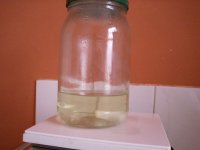
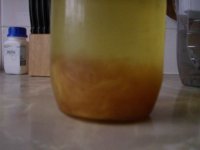
700 mg of the freebase was put into 200ml Hcl water, heated and stired untill dissolved. Added zinc little by little by little untill there was no more change in colour (which happened very quickly), the whole thing stired and kept at 80 C throughout.

resource.ashx


Here I added the ammonium chloride, wasn't sure how much to ad so I made it 10 gramms. There was some precipitation that wouldn't dissolve in DCM at freebasing, but it didn't seem to affect the yield(?).

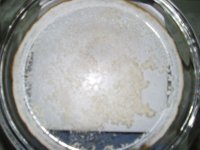
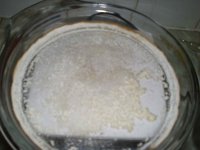
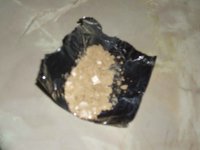
The freebase:

resource.ashx


resource.ashx


The outside ring is unreducted harmaine/harmaline, it would not dissolve in cold Hcl water, but did in warm. The ammount of it was very small compared to the white freebase.

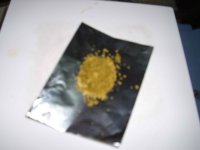
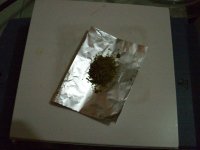
The Hcl salt:

resource.ashx


resource.ashx


The yield was 690 mg, that's 87% percent yield of freebase by weight.
 

Attachments

  • IMG_0694.JPG
    IMG_0694.JPG
    182.4 KB · Views: 0
  • IMG_0707.JPG
    IMG_0707.JPG
    116.6 KB · Views: 0
  • IMG_0708.JPG
    IMG_0708.JPG
    190.1 KB · Views: 0
  • IMG_0712.JPG
    IMG_0712.JPG
    150 KB · Views: 0
  • IMG_0714.JPG
    IMG_0714.JPG
    138.3 KB · Views: 0
  • IMG_0719.JPG
    IMG_0719.JPG
    108.1 KB · Views: 0
  • IMG_0720.JPG
    IMG_0720.JPG
    258.4 KB · Views: 0
T said:
The yield was 690 mg, that's 87% percent yield of freebase by weight.
Nice work, always in my "to do" list :)
Btw now the point is to be sure that IS THH.
Bioassay apart, I suggest a preliminary test.

Diluted 20mg THH in acidic water (50ml or more, pH 3 HCl).
Put under UV an take a photo.

THH Hcl glows blue under UV (when highly diluted)
Harmine/Harmaline glow green under UV.
 
distopia said:
THH Hcl glows blue under UV (when highly diluted)
Harmine/Harmaline glow green under UV.
Really?

SWIM has seen both harmine and harmaline glowing blue under UV in acidic solution but they glow green under basic solutions.

SWIM does not know about THH glow however.

Bioassay at the moment is the best shot for kitchen chemists.

The only troubling step is that a harmine/harmaline mixture was used. SWIM has never seen any procedure describing the reduction of harmine to harmaline and/or THH. All the tried and tested routes to THH use a reducing agent and harmaline, not harmine.

It is uncertain at this very moment whether harmine can be reduced to harmaline and THH just as harmaline reduces to THH using reducing agents like zinc and sodium borohydride. Harmine and harmaline are similar molecules but not identical. Despite how similar structurally they may be they have very different physical properties like pKa and logP values as wellas different pharmacokinetics. Why one assume that they have the same chemical properties, esp when it comes to their reduction, this I really do not understand.

@T, your end product may have loads of harmine that did not get reduced.
 
Infundibulum said:
distopia said:
THH Hcl glows blue under UV (when highly diluted)
Harmine/Harmaline glow green under UV.
Really?

SWIM has seen both harmine and harmaline glowing blue under UV in acidic solution but they glow green under basic solutions.

That's really strange.
My Peganum Harmala acid water extraction... always glow green/yellow (more green for my eyes).
Erowid reference (link Dave G) report a yellow glow.

Bioassay at the moment is the best shot for kitchen chemists.

I like the UV method because of Shulgin.
"Extraction techniques with harmala can be evaluated for effectiveness using UV light."
If we really have two different glow colors for harmine/harmaline and THH you can eventually evaluate some contamination (green-yellow glow vs blue glow) with the UV method too.

Btw. Is not a pub med references but I remember the "green face" of ۩, some time ago :)

Maybe the point is the UV wave length; I use a cheap UV led light...
But I'm pretty sure about the different glowing.
 
Hm, you may be right here.

Wavelength may indeed play a role. SWIM's using a UV transilluminator that emits UV at 254nm. This wavelenght is very different from commonly sold blacklights and is very damaging to skin and eyes if used without precaution.

SWIM really needs to get a common blacklight at some point and test the fluorescence out!
 
The salt was bioassayed, 100 mg sublingually. Only had THH in Aya brews before, so I can only compare it to harmine/harmaline.
It was a lot easier on the body than the former two, in fact there were no bodily effects noticed except a very pleasant light-headedness. The mental effects were very similar, very lucid, a very clear headspace, has a sort of sharpness to it. Similar to harmine/harmaline, but somehow a whole new ball game. Also was weaker than the same ammount of harmine/harmaline taken the same way.

Did not play around with the freebase a lot, as I wanted to make sure every way I could that I got back what's expected, so I converted it back to Hcl salts. The frebase was like wet icing sugar, seemed kind of hard to handle. It would be nice to be able to have it as a solid powder as the sugar like quality did not end with how it looked like, from a tiny taster: it's super sweet! The salt tastes horrible, but has a very slight sweet after taste as well.

what is the mechanism behind ammonia preventing the precipitation of zinc, in addition to precipitating the freebase material? could it not be substituted by another base such as sodium carbonate?

I would be very interested to know that as well. It doesn't change the ph and would only make it a bit more acidic. The precipitation that didn't dissolve in DCM was dried. It dried to tasteless, hard, greyish crumbs. I forgot to test if it dissolves in acidic or neutral water before throwing it out. I wonder how much ammonium chloride to add not to have these precips, if they can be prevented at all. They did not seem to affect the yield, but than the freebase THH(?) could be simply collected after decanting the water if someone has no DCM. Maybe full saturation?

The only troubling step is that a harmine/harmaline mixture was used. SWIM has never seen any procedure describing the reduction of harmine to harmaline and/or THH. All the tried and tested routes to THH use a reducing agent and harmaline, not harmine.

It is uncertain at this very moment whether harmine can be reduced to harmaline and THH just as harmaline reduces to THH using reducing agents like zinc and sodium borohydride. Harmine and harmaline are similar molecules but not identical. Despite how similar structurally they may be they have very different physical properties like pKa and logP values as wellas different pharmacokinetics. Why one assume that they have the same chemical properties, esp when it comes to their reduction, this I really do not understand.

@T, your end product may have loads of harmine that did not get reduced.

There are some publications out that document the reduction of harmine to THH (info from Erowid):

First prepared by Fischer 1889 [Preparation 1] and 1897 [Preparation 2]
Examples of published preparations:
1. Harmine or Harmaline reduced in alcoholic solution by Sodium.
2. Harmine or Harmaline reduced in Isoamyl alcohol solution by Sodium.

I will soon start to make my Caapi copy, and most of the THH I will make from harmine as only a little is needed for the Cc and rue is supposed to have plenty of it. I will separate the harmine as best as I can and will try the same method with it.
 
T said:
The only troubling step is that a harmine/harmaline mixture was used. SWIM has never seen any procedure describing the reduction of harmine to harmaline and/or THH. All the tried and tested routes to THH use a reducing agent and harmaline, not harmine.

It is uncertain at this very moment whether harmine can be reduced to harmaline and THH just as harmaline reduces to THH using reducing agents like zinc and sodium borohydride. Harmine and harmaline are similar molecules but not identical. Despite how similar structurally they may be they have very different physical properties like pKa and logP values as wellas different pharmacokinetics. Why one assume that they have the same chemical properties, esp when it comes to their reduction, this I really do not understand.

@T, your end product may have loads of harmine that did not get reduced.

There are some publications out that document the reduction of harmine to THH (info from Erowid):

First prepared by Fischer 1889 [Preparation 1] and 1897 [Preparation 2]
Examples of published preparations:
1. Harmine or Harmaline reduced in alcoholic solution by Sodium.
2. Harmine or Harmaline reduced in Isoamyl alcohol solution by Sodium.
Thanks for this info,

However, none of these routes that utilise harmine also utilise sodium borohydride or zinc. They use elemental sodium! This is insane, elemental sodium is a far far far far stronger reducing agent than zinc or sodium borohydride. It's reducing potential is so strong that it is very risky to play with it without the appropriate caution, falicities and other equipment. NO KITCHEN CHEMIST SHOULD THINK ABOUT USING ELEMENTAL SODIUM!. It is also a very good thing that it is not commonly available.

But these conversion references that use harmine and sodium to make THH support my idea. It appears that harmine needs a seriously strong reducing agent to reduce it to harmaline and then THH. Another line of supporting evidence comes from TIHKAL; Shulghin does not describe the synthesis of Harmaline as a reduction from Harmine. He uses an approach much different from the phenomenally "easy" reduction of harmine to harmaline. There must be reason for this!
 
Infundibulum said:
But these conversion references that use harmine and sodium to make THH support my idea. It appears that harmine needs a seriously strong reducing agent to reduce it to harmaline and then THH. Another line of supporting evidence comes from TIHKAL; Shulghin does not describe the synthesis of Harmaline as a reduction from Harmine. He uses an approach much different from the phenomenally "easy" reduction of harmine to harmaline. There must be reason for this!

Shulghin probably used harmaline he synthesized himself, not exctracted harmine/harmaline from rue, so he had no reason to mix it with harmine. And he probably followed a logical decision to use it rather than harmine if the harmine -> harmaline -> THH reduction path is correct.

Fischer and co-workers provided evidence for the
occurrence of two easily reduceable double bonds in harmine
through its reduction with Na in ethanol to tetrahydroharmine.

This is a good book on harmaloids.

But you're right, there's no proof that harmine would get reduced to harmaline and subsequently THH by zinc, so I'll try the next time with relatively pure harmine. I doubt that I'd have unreducted harmine in the end results though, it would be easily noticeable, if nothing else than by the colour, and rue has more harmine in it then harmaline from what information I've found.
 
T said:
Infundibulum said:
But these conversion references that use harmine and sodium to make THH support my idea. It appears that harmine needs a seriously strong reducing agent to reduce it to harmaline and then THH. Another line of supporting evidence comes from TIHKAL; Shulghin does not describe the synthesis of Harmaline as a reduction from Harmine. He uses an approach much different from the phenomenally "easy" reduction of harmine to harmaline. There must be reason for this!

Shulghin probably used harmaline he synthesized himself, not exctracted harmine/harmaline from rue, so he had no reason to mix it with harmine. And he probably followed a logical decision to use it rather than harmine if the harmine -> harmaline -> THH reduction path is correct.
Not sure what you try to say here; My point is that Shulghin synthesises THH by reducing harmaline (easy reaction) but he doesn't synthesise harmaline from reducing harmine, and I ask, why? This is my point. The answer is possibly that reducing harmine to harmaline it is not as easy as it appears in theory.


T said:
Fischer and co-workers provided evidence for the
occurrence of two easily reduceable double bonds in harmine
through its reduction with Na in ethanol to tetrahydroharmine.
Yeah, but as I said above easily reduceable double bonds with a killer reducing agent like sodium (Na).

Given the absence of data on the reduction of harmine to harmaline (and then to THH) using either sodium borohydride or zinc, whoever manages to make harmaline (and/or THH) this way using harmine as the starting material should really consider that he did an important, publishable scientific discovery. I am not joking here!
 
Infundibulum said:
Not sure what you try to say here; My point is that Shulghin synthesises THH by reducing harmaline (easy reaction) but he doesn't synthesise harmaline from reducing harmine, and I ask, why? This is my point. The answer is possibly that reducing harmine to harmaline it is not as easy as it appears in theory.


T said:
Fischer and co-workers provided evidence for the
occurrence of two easily reduceable double bonds in harmine
through its reduction with Na in ethanol to tetrahydroharmine.
Yeah, but as I said above easily reduceable double bonds with a killer reducing agent like sodium (Na).

Given the absence of data on the reduction of harmine to harmaline (and then to THH) using either sodium borohydride or zinc, whoever manages to make harmaline (and/or THH) this way using harmine as the starting material should really consider that he did an important, publishable scientific discovery. I am not joking here!

Okay, I get it now.
I was being a smartass here. All the excitment and wishful thinking...

It's possible that all that's not been reduced at the end was all the harmine that was in there originaly, and it was such a small amount because I repeated the salting so many times.
 
Infundibulum said:
SWIM's using a UV transilluminator that emits UV at 254nm.

Too much!
I use a cheap, 5$ flashlight! It has a white led light and a laser too! :D
Btw, technically, UV cheap led lights are not really UV... they are around 400nm, quite far from your really professional transilluminator.

Btw, in this very case, cheap means good.
Harmala/Harmaline glow green/yellow
THH glows blue.

Bioassay is a really hard way in this case.
Without a deep practical knowledge about THH.. it could be hard define a sample.
Especially if it has some contamination, with parental alkaloids.
I think that "cheap UV test" could be the most economical and affordable way for a preliminary qualitative analysis.

Just my two cents :)
 
T said:
I was being a smartass here. All the excitment and wishful thinking...

It's possible that all that's not been reduced at the end was all the harmine that was in there originaly, and it was such
a small amount because I repeated the salting so many times.
Of course you're not being a smartass here! I'd say similar things not too long ago until I went through loads of searching to see that harmine is reduceable but difficultly so using our current means! Having said that, it is still worth trying as you or SWIY did.

It is possible that a certain catalyst is needed to speed up the reaction of harmine reduction. For Harmaline to THH Shulghin used not only sodium borohydride as the reducing agent but platinum oxide as the catalyst. Zinc or other NaBH4 harmaline reductions use some alcohol (methanol, ethanol) as the catalyst. Similarly, harmine may require some catalyst in order to achieve reduction via zinc.

distopia said:
Infundibulum wrote:
SWIM's using a UV transilluminator that emits UV at 254nm.


Too much!
I use a cheap, 5$ flashlight! It has a white led light and a laser too! Very happy
Btw, technically, UV cheap led lights are not really UV... they are around 400nm, quite far from your really professional transilluminator.
SWIM really really needs to get one of those gadgets.... it's a wonder he doesn't have one yet!
 
so it is not even worth trying this zinc reduction of harmaline to THH? what if a little extra zinc was used and let react for a longer time? Has anyone else tried this and not get a blue glow instead of green?
 
some harmine and zink once fell into a bottle of acetone contining hcl - it sat for 2 or 3 days - reacting and bubbling the whole time.
It glowed blue still - it was filtered, then based and - the resulting product is pure white - but there is too much of it and it feels very heavy.
is there some kinda zink salt or soemthing mixed in ?
 
ok wow - that kicks ass - i checked up on some of my previous pix of harmine and harmaline from a rue extraction and it was green under uv - so - ... success with the reduction it seems - that was too easy.
surely.
ok so how do i separate out the zink stuff as its far too heavy - must be contammed somehow.
 
more on that reduction -

harmine was added to water hcl acid was added - zink was added.
after a day it was still bubbling - more hcl was added - the next day it had nice white shiny xtals growing in it, i shook it up - added more hcl(solution then glowed blue under uv - but im sure i recall it glowing blue on the first day too), filtered, then added sodium carbonate water - loads precipped which was filtered out and dried to produce a pure white very heavy solid substance.
 
Back
Top Bottom