• Members of the previous forum can retrieve their temporary password here, (login and check your PM).

I did not do this harmala extraction correctly. Ideas?

bismillah

My Personalized Tag
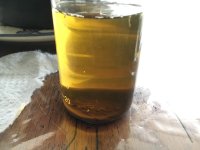
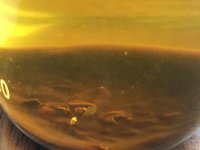
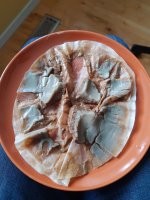
Picure attached is of my final filtered sediment. As you can see it has some sort of gross gray gel on the top.. that gel came out of solution at a higher pH than the brown sediment which must be the harmalas.

My entire process was as follows:
Several boils of rue seeds in vinegar, combined and reduced

Added magnesium strips to the solution to try converting harmaline into tetrahydroharmaline as described by Gordotek, leaving overnight

Precipitated solutes by adding NaOH until colour change

Redissolved in vinegar and repeated precipitation several times.

I'd like to note that this nasty gray gel didn't form during any of the preceding precipitations, only during the last one.

This stuff looks gross and not at all like harmalas should, as far ws I know anyway. I would like to ask the advice of you who are more knowledgeable in chemistry, as to what it might be and how to remove it. (Magnesium salts? The tek does suggest using ammonia as a base to keep metal salts in solution, but clean ammonia was not available in my area).
 

Attachments

  • IMG_20240423_113539527.jpg
    IMG_20240423_113539527.jpg
    1 MB · Views: 13
Gel is likely magnesium hydroxide, except this doesn't make sense with the repeated A/B cycles you put this through since the reduction. Very puzzling, indeed. This brings up a long list of questions, but Occam's razor suggests this could be a tap water issue - is this water from the domestic faucet that you've used?

What can you discern about the gel's properties?
How does it behave on drying?
Will it redissolve in vinegar before or after drying?
What happens to it when heated strongly with a flame?
Can you measure the density of the dry material?

Have you noted the full history of your material - everything you've done to it and everything it's been in contact with?
Has the solution been in contact with any aluminium containers or implements?
Are you confident about the quality of your reagents? Are they all from the same respective batch?
Did you use the same amount of lye each time?

Please can you take another picture but with a white/grey/black background? The orange plate - nice as it is - confuses matters a little.

[IME the best way to get rid of magnesium is to acidify with phosphoric acid and add ammonia dropwise. Magnesium ammonium phosphate precipitates cleanly as a fairly dense, pure white powder at around pH 6, well before the rest of components. I'd strongly suggest you look at ways of obtaining some decent ammonia (even if that involves treating urine with lye - although you should be able to purchase urea fairly easily instead).]

On the plus side, it looks as though you can physically remove much of the gel with a knife blade and/or a teaspoon. [Keep hold of it to check for actives.] Then you can redissolve everything that remains (in acidified distilled water) and repeat the precipitation extra carefully so you can keep the gel fraction somewhat separate.

Another thing I would consider is fastening a filter paper over the end of a (glass) tube so the precipitate can form in a thicker (deeper), narrower layer. Once all the liquid has filtered through, it should be possible to slide the precipitate out and get a cleaner separation of the harmala/gel 'sausage'. Glass tubes can be found at some craft shops for candlemaking or something like that. At a push (no pun intended!), an aeropress might be up to the job.

It looks like you performed the reduction directly on the rue tea? It may have been better to have isolated the alkaloids first.
 
Try doing a mansake extract... harmine and harmaline both are insoluble in salt water so I'd assume TTH is aswell.

I have just added some harmalas I had to some vinegar water and dissolved. I then added some magnesium shavings and will test if adding the a saturated salt brine works well... I'll be checking to see if the blacklight shows blueish vs the green/blue hue it is now. I didn't weigh anything.

I'll report here how it turns out.

Edit: Just read that hcl salt is what is insoluble in salt water... So will adding hcl drops into the solution convert the harmala salts from acetate to hcl since it is a strong acid?
Edit 2: Ok so no need to add hcl... apparently the H+ comes from the water in saturated salt solution as does the CL- so mansake makes HCL salt even if I used vinegar solution.
 
Last edited:
Try doing a mansake extract... harmine and harmaline both are insoluble in salt water so I'd assume TTH is aswell.

I have just added some harmalas I had to some vinegar water and dissolved. I then added some magnesium shavings and will test if adding the a saturated salt brine works well... I'll be checking to see if the blacklight shows blueish vs the green/blue hue it is now. I didn't weigh anything.

I'll report here how it turns out.

Edit: Just read that hcl salt is what is insoluble in salt water... So will adding hcl drops into the solution convert the harmala salts from acetate to hcl since it is a strong acid?
Edit 2: Ok so no need to add hcl... apparently the H+ comes from the water in saturated salt solution as does the CL- so mansake makes HCL salt even if I used vinegar solution.
Good call, although by keeping magnesium chloride in solution there will be a small amount of this sticky, hygroscopic salt remaining on the harmala HCl, so a couple or so of Manske cycles may be necessary in order to get a satisfactory result.

The Manske will work whenever there's sufficient concentration of Cl⁻ and H⁺ ions present, so both HCl and the salt/vinegar mix should get the job done.
 
I will try the Manske method. Bit of a bother, using all that table salt... but better than nothing.

It is possible that there were other ions in the solution, from the unfiltered tap water or the metal pot I used to boil the seeds. Hard to imagine such a large quantity getting into solution, though. I'll update with my results when I get around to it.
 
metal pot I used to boil the seeds.
But that was the first few boils of the seeds, and you put the tea through several A/B cycles since then, correct? Seems unlikely you'd inadvertently make that much sodium aluminate without having noticed it before, although wet gels can be remarkably voluminous. When they dry out a surprisingly small amount of solid remains afterwards.

I think the gel comes from the slow accumulation of minerals from your tap water. Does the water leave limescale when boiled?

It would still be worth doing a few simple tests on the gel. Finding out what it is would help inform us on the optimal course of action if you were to encounter further difficulties.

If you can get hydrochloric acid ("spirits of salt") you don't strictly need to use salt for the Manske.
 
So after a while of the magnesium strip reacting a precipitate formed... I left it overnight and it settled. I'll verify the pH but there is a lot of precipitate considering starting amount of harmalas and they were fairly clean. The blacklight does indicated a more blue tone to the liquid so it did convert some to THH. I'll test the mansake in a day or two after filtering

EDIT: I checked the pH and it was around 6. So I think its just something with a solubility when more acidic. I added some more vinegar and dropped pH to around 5 and will see if there is less precipitate. Fresh vinegar increased the reaction of the magnesium strips again.
 

Attachments

  • IMG_6865.JPG
    IMG_6865.JPG
    1.4 MB · Views: 2
  • IMG_6867.JPG
    IMG_6867.JPG
    1.1 MB · Views: 2
Last edited:
So based on my attempt of Manske salt extraction to leave behind the magnesium in the water it worked. After filtering off the hcl precipitate there was still a shine to the salt mother liquid so some harmalas did stay behind BUT I added some more salt and nothing precipitated. I added lye and the precipitate that formed was most likely magnesium hydroxide since it didn't 'fall' out of solution but rather clouded for a few hours.

I then redissolved the hcl in fresh tap water and proceeded to slowly add lye until it started to precipitate. at 8ish pH I stopped to separate the harmine and after filtering off I added lye again only started to precipitate at high ph. The freebase of the harmaline/thh is extremely fine and filter didn't catch it so I put a compact cotton ball and am letting it filter slowly. Will redissolve some to check the color under blacklight. In theory it should be mainly thh which there was a noticeable change even when combines.

TLDR: Fairly certain Manske works for precipitating THH HCL without ammonia.
 
Last edited:
So just to follow up. Manske 100% precipitates THH along with any harmine and harmaline remaining. I didn't weigh the harmaline so added random amount of magnesium strips for the conversion which after separation of the acidic water with the HCL salts as soon as ph reached 7-8 thh starts to precipitate and was confirmed with Black light. I didn't add enough magnesium since harmaline remains in the filtered solution.

I was put off originally in THH conversion since I wouldn't be able to seperate from magnesium with normal basifying to precipitate the harmalas freebase. IDK if Manske was already confirmed for THH but would be nice to include this tidbit in the tek. I only saw Gordo's tek on this topic and using ammonia despite being 'easy' put me off on the idea.
 
Back
Top Bottom