• Members of the previous forum can retrieve their temporary password here, (login and check your PM).

Is all mescaline salts created equally? Isotopes or just purity?

modern

Titanium Teammate
Joined
Oct 3, 2015
Messages
685
Merits
787
So while preparing solutions for spotting I decided to test 4mg/ml of each powder fraction of different hcl salts of mescaline.

The purist mescaline sample I have been using in all my solubility tests of different salts and even formed a different crystal form has not dissolve what so ever in 96% ethanol. My mescaline carbonate bubbling experiment has had minimal solubility as well which I’d assume means extremely high purity? I’ll be leaving it for 12 hours but even after shaking for a minute zero dissolved.

My mescaline hcl with just normal clean up dissolved partially. And the other “impurities” that are washed all dissolved.

I remember a while back researching MAss spectroscopy and there are different isotopes of the same compound and was wondering if that is another possibility? I have zero idea.

With Cielo being so high yield as well as hplc from altitude perhaps all the salt forms are precipitated since it’ll al be in the curve? I’ll be testing TLC of whatever amount dissolved in the ethanol.

Like I mentioned I have tested these salts separately multiple times and only the more pure mescaline fractions had strong euphoria where the “other alkaloids” which may be mescaline only had energy and higher dose had a “limitless” effect but little to no visuals and little euphoria especially compared to lower doses of the washed white crystals.

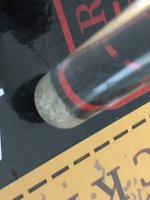
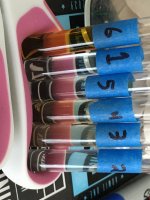
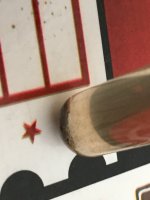
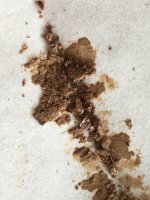
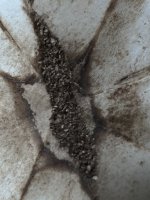
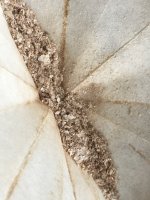
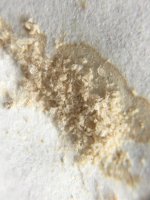
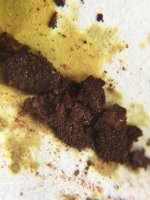
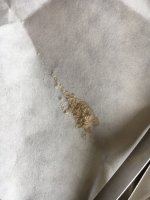
1 is my ultra clean mescaline hcl. 2 is the mescaline carbonate which I salted to hcl. The last is some very dark crystals that didn’t precipitate after attempting another round of iso99. These were the impurities that already dissolved earlier.
 

Attachments

  • 69BA40F7-1B9D-4EF7-8F88-77318C37B7AA.jpeg
    69BA40F7-1B9D-4EF7-8F88-77318C37B7AA.jpeg
    1 MB · Views: 1
  • 36E5C5E0-0CB8-4FDC-99F4-2F2B1918631C.jpeg
    36E5C5E0-0CB8-4FDC-99F4-2F2B1918631C.jpeg
    1,005.7 KB · Views: 1
  • 0181F725-1397-4B9F-B673-6D9C8FB1B6F1.jpeg
    0181F725-1397-4B9F-B673-6D9C8FB1B6F1.jpeg
    1.1 MB · Views: 1
  • 69481650-909E-49ED-8378-6B04A3F7449F.jpeg
    69481650-909E-49ED-8378-6B04A3F7449F.jpeg
    838.9 KB · Views: 1
Number 4 is the “impurities” that dissolved after the second round of iso99 washes. They formed some crystals that look like mescaline. From this the dark insoluble hcl salts were removed.

This is the only vial that had blacklight reaction shining a light green color.
 

Attachments

  • 41F8A9F5-8F5E-4FA7-939A-1E36472F3DEA.jpeg
    41F8A9F5-8F5E-4FA7-939A-1E36472F3DEA.jpeg
    1.4 MB · Views: 3

Solubility of mescaline hcl should be 10mg/ml in ethanol. Also mescaline carbonate I think was soluble in alcohol in my tests… I’ll reattempt in the future.

From memory the mescaline carbonate is soluble in isopropanol but I'll need to repeat it since I only remember the water solubility.
 
Last edited:
1. Mescaline carbonate that added hcl to convert… maybe didn’t convert but it did dissolve in high concentration hcl.
2. The xylene fraction after carbonate bubbling. All iso99 soluble.
3. My cleanest mescaline hcl sample used in all my solubility and extraction experiments.
4. Mescaline hcl that was washed until no more discoloration of the iso99
5. This is the solid crystals after second round of iso99 washes that remained. Dissolved first attempt and was allowed to dry completely. Color doesn’t come off despite soaking in iso99
6. This is the “other alkaloids” that dissolved the second iso99 washes but looks like mescaline hcl when evaporating.
 

Attachments

  • E6E73D4A-9BAD-4DAD-B8C5-BFE4F1583986.jpeg
    E6E73D4A-9BAD-4DAD-B8C5-BFE4F1583986.jpeg
    1.5 MB · Views: 7
  • 8957791F-FEAC-4DAA-A288-7731F01B17E3.jpeg
    8957791F-FEAC-4DAA-A288-7731F01B17E3.jpeg
    1 MB · Views: 7
  • F27DEBE8-E6DB-423A-B58C-BCE0C6433EF4.jpeg
    F27DEBE8-E6DB-423A-B58C-BCE0C6433EF4.jpeg
    1.3 MB · Views: 6
  • E2AD9476-79F2-421C-9D45-C8C17091707B.jpeg
    E2AD9476-79F2-421C-9D45-C8C17091707B.jpeg
    1.1 MB · Views: 6
  • F664E4F1-EC16-4258-B5F9-85517D359728.jpeg
    F664E4F1-EC16-4258-B5F9-85517D359728.jpeg
    1.3 MB · Views: 6
  • B25B35C0-6A26-4276-B66F-985049B31C77.jpeg
    B25B35C0-6A26-4276-B66F-985049B31C77.jpeg
    1.8 MB · Views: 7
Last edited:
IIRC, Shulgin reported the difficulty with HCl is that it displays varying levels of hydration depending on the reaction conditions, which in turn leads to inconsistent physical properties between different samples of mesc HCl. Maybe you've also been seeing polymorphic behavior? Most likely it's the different levels of (different) impurities that will be messing things up.

Things can get frustratingly perplexing when you don't have access to high purity reagents and the full range of lab gear and analytical equipment!
 
IIRC, Shulgin reported the difficulty with HCl is that it displays varying levels of hydration depending on the reaction conditions, which in turn leads to inconsistent physical properties between different samples of mesc HCl. Maybe you've also been seeing polymorphic behavior? Most likely it's the different levels of (different) impurities that will be messing things up.

Things can get frustratingly perplexing when you don't have access to high purity reagents and the full range of lab gear and analytical equipment!
I'll be doing tlc reagent test tomorrow or next week to atleast see if the "other alkaloids" contains mescaline. I repeat later to try quantitative when I can dissolve my pure mescaline to dissolve properly. Might just make some citrate for the tlc.

Yea maybe just due to purity and hydration issues. IDK if polymorphic changes... I've never seen that mescaline hcl salting form I shared. Didn't make needles but thick crystals.

Recently saw this video and thought it was very interesting how it 'spread' and lab couldn't replicate it.
 
This is where you need definitive qualitative analysis - various forms of spectroscopy, basically, and possibly a pinch of x-ray crystallography.
Actually could have been mescaline carbonate like I suspect caused the insolubility in ethanol 96%. The issue I see with this is HCL salt that was NEVER carbonate also shows some insolubility. IDK what to make of it... I'll solve these in water to test.

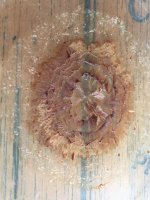
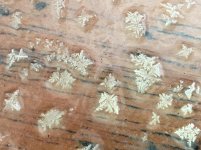
The photo is either recrystallized carbonate/carbanate OR a polymorph of hcl but IDK since not soluble in ethanol. Starting to be a pain but if someone could test for themselves how the experience of the washed mescaline hcl is from the washed 'other salts' I've repeated a few times with different experiences.

I just need to get this TLC over with to see next step forward.

You always provide helpful info :) Most things are too 'advance' or just out of my scope since I doubt a college lab would do test for a random citizen considering the compound.
 

Attachments

  • crystals.jpg
    crystals.jpg
    233.8 KB · Views: 4
So I made undetectable mescaline lol.

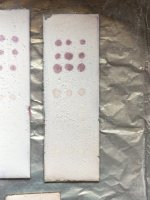
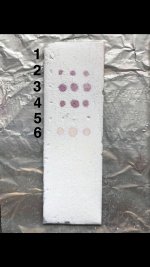
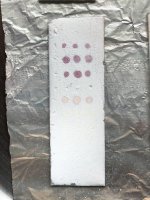
The 100% mescaline which I can dissolve in ethanol 96% shows no staining and the mescaline carbonate from tea also shows zero staining but couldn’t dissolve. Number 1 is first 3 spotting which don’t show up and number 5 is after the three spots. The “impurities” of kash which are washed all contain mescaline so kash is just ugly but is all mescaline. which makes my yields all compatible to Cielo…

Placebo effect must be very strong because I’ve tested a few times. I’ll repeat these with mobile phase to check the rF values.

I need to check the carbonate salts activity. Doesn’t make sense it would be inactive? Maybe someone can test with a drug reagent kit? Very easy to form either via evaporating freebase mescaline from isopropanol or even ethyl acetate (concentrate first) then evaporate completely and let the goo/oil form salts. Or make tea and bubble co2

the xylene fraction of the tea after co2 shows tiny amount of staining circling the dot.
 

Attachments

  • 68C0C9E1-D895-4370-9F68-B2702D73F64F.jpeg
    68C0C9E1-D895-4370-9F68-B2702D73F64F.jpeg
    1.5 MB · Views: 4
  • 00426CAE-0D3A-47F0-8091-7F4A1A3B870F.jpeg
    00426CAE-0D3A-47F0-8091-7F4A1A3B870F.jpeg
    1.3 MB · Views: 4
I am also having trouble dissolving this salt. Does carbarate have trouble becoming freebase in high ph? I added excess lye and will leave it 24hours to hopefully break it. Random red dots appeared making me think it released from the crystals but have zero idea. Will be a while until I can recover this mescaline since I’ll need to evaporate the alcohol solution I pours all the salts together so can’t pull with xylene due to alcohol mixing
 
Carbamates might not react as primary amines in a presumptive test for such, or maybe you've somehow recovered a sample of calcium carbonate. Or, as you've said, maybe your reagents are bunk.

I'd be considering thermal decomposition of the CO2 precipitated material at this point, just to see if it actually contains any carbon at all, i.e. with charring of a small sample.

A carbamate should hydrolyse to carbonate and the amine at a suitably high pH, although the exact details of this particular compound are, shall we say, decidedly obscure - there's no record for it on PubChem, for starters. Furthermore, we honestly have no real idea what the insoluble material might be since it was prepared using an unproven technique.
 
Carbamates might not react as primary amines in a presumptive test for such, or maybe you've somehow recovered a sample of calcium carbonate. Or, as you've said, maybe your reagents are bunk.

I'd be considering thermal decomposition of the CO2 precipitated material at this point, just to see if it actually contains any carbon at all, i.e. with charring of a small sample.

A carbamate should hydrolyse to carbonate and the amine at a suitably high pH, although the exact details of this particular compound are, shall we say, decidedly obscure - there's no record for it on PubChem, for starters. Furthermore, we honestly have no real idea what the insoluble material might be since it was prepared using an unproven technique.
I have some that is 100% mescaline salt made from oxalate reacted with h2o2 to form freebase and likely formed the salt from the CO2 released. I have ZERO doubt it was mescaline since I used it for all my solubility tests of acids. Now the exact salt formed IDK... I doubt it is oxide since the tea salt is identical in properties but IDK.

The tea CO2 salts I assume it is the same since in theory I obtained in a similar manner and the same solubility.

The ninhydrin is fresh and I don't make much more than around 40ml at a time. The issue I had was the salt is insoluble. I don't have any Marquis but do you think it would react to give the orange color? Also do could you tell me if I sprayed the ninhydrin directly to the salt would it react showing purple?

I'll try burning some next time... what temperatures do you suspect would be needed? As for PubChem I don't find most obscure salts that were tested here in the past but even the CO2 from the air to form carbonate is such a light reference and never provides properties of this only the freebase.
 
Try adding a drop of detergent to your ninhydrin first (confirm that it still works as previously, with a known positive sample) - since I've also been wondering if it was an issue with wetting. This was another reason why the urea derivative (or dimescaline carbamide, to give it yet another name) seemed like a plausible candidate. (Another compound with no data on PubChem.)

Wouldn't it be possible that cactus tea + CO2 deposits carbonates of magnesium and calcium? Except, they'd fizz with a drop of HCl.

If you look at @Brennendes Wasser's experiments on vaporisation you'll see data on charring temperatures there. About 280°C seems like a likely level for it to start - purely a guess based on figures for some salts and freebases, so it could be way off. Also, BW had a proper piece of kit for this so you may have to apply your ingenuity again if you want some vaguely reliable figures from your own experiment.
 
I’ll try adding some soap… I didn’t try spraying directly on the crystal since was unsure if would do anything. The lack of staining I assume is because of zero solubility just like oxalate.

I can use a ir temp prob aiming at the center of the glass watch glass. Seems reliable and relatively accurate. So what would I expect to happen?

Honestly I can’t give anymore insight but no fizzing occurred when I added hcl.

I’ll just wait for someone else to attempt and test. But I’ll try the vaporizing next time
 
I can use a ir temp prob aiming at the center of the glass watch glass. Seems reliable and relatively accurate. So what would I expect to happen?
You also need to consider how you'll control the heating rate. The IR thermometer should make a reasonable approximation, especially if you can calibrate it with something.

If it's an organic compound, it will almost certainly leave a charred residue. Just as the very crudest way of eliminating the possibility of some inorganic compound (which may or may not also char, if there's organics mixed in)

Do you have the exact chemical history of each of these insoluble samples written down in one place somewhere? It's got a bit late here and I've rather lost track.
 
You also need to consider how you'll control the heating rate. The IR thermometer should make a reasonable approximation, especially if you can calibrate it with something.

If it's an organic compound, it will almost certainly leave a charred residue. Just as the very crudest way of eliminating the possibility of some inorganic compound (which may or may not also char, if there's organics mixed in)

Do you have the exact chemical history of each of these insoluble samples written down in one place somewhere? It's got a bit late here and I've rather lost track.
One that had insoluble salts was a kash washed hcl salts where a portion didn’t dissolve. (I still have it in solution) never had co2 added artificial. But I kept only the very washed portion which I see now was a mistake.

Completely insoluble was co2 bubbles like tea.

The 100% mescaline that was insoluble is as follows.
Cactus preformed kash and washed to keep only “clean” hcl>Vinegar>wash soda>Xylene> salted with benzoic acid> Lye> salted with oxalic acid> tested solubilities> Added to test to make oxalate from water lime> OASIS test run> added hcl> washed to test purity> think I did salicylic acid test here from lime water as well> made oxalate again> add h2o2 > should freebase but also releases co2> few hours after is dissolved into solution a white precipitate forms which I assumed was carbonate.


Bottom portion is more in-depth the top part.
So the main crystal im certain in mescaline but was insoluble I have been collecting different washed kash mescaline hcl salts pulled with xylene. I then preformed different tests such as testing trying to form carbonate slowly adding sodium carbonate to a vinegar solution and the reverse then I would freebase it all and pull again and tested benzoic acid in xylene and it stuck to the glass I then freebased again and tried oxalate which I preferred since easier to recover. I tested the solubility and formed water tek using the the in solubility in isopropanol and water (OASIS) then I added hcl to free the mescaline again and form hcl and washed to remove the oxalate so in theory I have pure hcl again. After that I calculated purity to be around 60-70% based on the insolubility in isopropyl which might have been a mistake. Following that I wanted to test different forms of converting to a “safer salt” and tested h2o2 and after the oxalate dissolves forms a precipitate which I assumed was carbonate. From there I attempted to form hcl since thought pKa was 6.3-6.7 whichever. And it did “dissolve” but seems to revert? I also attempted salicylic acid converting from aspirin and couldn’t distinguish between SA and the mescaline salt only under uv light I think before I retested the conversation of oxalate again.
 
Easiest way to replicate would be make oxalate from xylene or lime water. Then add concentrated h2o2 and heat to speed up reaction. Or leave it a few days until until a precipitate forms.
 
This may be easier to understand.

Also the mescaline “carbonate” is likely bioactive because like I mentioned it dissolved in hcl acid when I tried to salt so likely dissolves in stomach acid
 

Attachments

  • E1DFA487-FE7C-4DC7-8368-464920B5E431.jpeg
    E1DFA487-FE7C-4DC7-8368-464920B5E431.jpeg
    344.6 KB · Views: 2
Last edited:
So trying to better understand this and reading and hearing different new things just adding to my confusion... I assume all drugs have S and R isomers? Does NMR and HPLC distinguish between these minor differences? iso-mescaline may be different but are S-(-)Mescaline and R-(-)Mescaline detected thru these tests?

I saw some of these actually cause different different effects. Even S and R Methamphetamine.

I have zero understanding on this but maybe someone here has more insight... ALSO recently heard a portion of trouts talk and he mentioned how in the past a drug was obscuring the detection via lab tests of I think 2cb or 2ce by using vitamin E. It is possible that this can happen with mescaline hiding other compounds since I've not seen them show the other alkaloids but again I have ZERO understanding on this.

Besides HCL possibly being different hydration causing different solubility properties can it also be the different isomers or something else? Maybe too hard to know without labwork.
 
Back
Top Bottom