
• Members of the previous forum can retrieve their temporary password here, (login and check your PM).

Is all mescaline salts created equally? Isotopes or just purity?

So trying to better understand this and reading and hearing different new things just adding to my confusion... I assume all drugs have S and R isomers? Does NMR and HPLC distinguish between these minor differences? iso-mescaline may be different but are S-(-)Mescaline and R-(-)Mescaline detected thru these tests?

I saw some of these actually cause different different effects. Even S and R Methamphetamine.

I have zero understanding on this but maybe someone here has more insight... ALSO recently heard a portion of trouts talk and he mentioned how in the past a drug was obscuring the detection via lab tests of I think 2cb or 2ce by using vitamin E. It is possible that this can happen with mescaline hiding other compounds since I've not seen them show the other alkaloids but again I have ZERO understanding on this.

Besides HCL possibly being different hydration causing different solubility properties can it also be the different isomers or something else? Maybe too hard to know without labwork.
Only substances with at least one chiral centre (keeping it simple for now...) have S and R isomers. Mescaline has no chiral centre - it is optically inactive, achiral. It has only one form - the S and R designations cannot be applied here (other than in the case of salts formed with chiral acids - like the malate - but that's still not the mescaline itself being chiral). [While not applicable to mescaline, there are possibilities in chromatography for distinguishing enantiomers through the use of a chiral stationary phase. In NMR, it would be a matter of using a chiral shift reagent, like some europium or gadolinium complex with strongly chiral ligands, perhaps.]

The bulk of the 2C phenethylamines are also achiral, with the exception of ones with a chiral substituent somewhere else in the molecule, like 2C-T-17. It's the alpha-methyl group that, in a sense, makes the amphetamines chiral in comparison with phenethylamines.


Which talk of @Keeper Trout was it? It would be helpful to find the exact reference regarding this obscuration effect. Spectroscopic effects are not the same as chromatographic ones, or co-crystallisation phenomena, for that matter.

It's neither isomers, nor enantiomers, nor isotopes at play here. I'd say we're looking at an unexpected derivative which formed, a surprisingly insoluble salt, or some other bulk impurity. I'm still leaning towards the urea/carbamate hypothesis, with the analogy in the tryptamines. Carbonate formation from atmospheric gases is a gentler process than direct carbonation, and we can see that mescaline has a remarkable affinity for CO2, which may well be reflected in its ability to form condensation products.

Replication of your methods and the ensuing results, followed by a proper laboratory analysis of the insoluble material, becomes imperative for getting to the bottom of this little mystery.
 
Which talk of @Keeper Trout was it? It would be helpful to find the exact reference regarding this obscuration effect. Spectroscopic effects are not the same as chromatographic ones, or co-crystallisation phenomena, for that matter.

It's neither isomers, nor enantiomers, nor isotopes at play here. I'd say we're looking at an unexpected derivative which formed, a surprisingly insoluble salt, or some other bulk impurity. I'm still leaning towards the urea/carbamate hypothesis, with the analogy in the tryptamines. Carbonate formation from atmospheric gases is a gentler process than direct carbonation, and we can see that mescaline has a remarkable affinity for CO2, which may well be reflected in its ability to form condensation products.

Replication of your methods and the ensuing results, followed by a proper laboratory analysis of the insoluble material, becomes imperative for getting to the bottom of this little mystery.

I read that many alkaloids form bicarbonate/carbamate... and if you heat the carbamate it'll decompose to carbonate at like 60C? I have zero idea since each salt can react differently. One interesting one however is in terms of how to dissolve this a carbamate but in relation to epoxy resins. I found it interesting since indeed the salt dissolved in HCL when I tried to convert it.
"Dilute organic acids are used to dissolve the salt. In most cases, the affected areas are treated with 10-20% citric acid.
In the case of strong carbamate formation, the somewhat unpleasant smelling acetic acid can be used alternatively or as a supplement in approx. 10% concentration. Both acids are worked into the contaminated surfaces using a scrubbing brush, sponge or cleaning machine and left on the surface for about 10-30 min. The surface is then rinsed with sufficient clear water. Both the concentration of the acids and the duration of the treatment should be selected according to the strength of the carbamate expression."


I'm gonna save the solids in my attempt to freebase the 'carbonate salt' and add vinegar to try to another attempt at recovery.

I think I have enough mescaline hcl salts to replicate the creating of the salt. I do want to see if activity is higher even if only my subjective experience.


I read that many alkaloids form bicarbonate/carbamate... and if you heat the carbamate it'll decompose to carbonate at like 60C? I have zero idea since each salt can react differently. One interesting one however is in terms of how to dissolve this a carbamate but in relation to epoxy resins. I found it interesting since indeed the salt dissolved in HCL when I tried to convert it.
"Dilute organic acids are used to dissolve the salt. In most cases, the affected areas are treated with 10-20% citric acid.
In the case of strong carbamate formation, the somewhat unpleasant smelling acetic acid can be used alternatively or as a supplement in approx. 10% concentration. Both acids are worked into the contaminated surfaces using a scrubbing brush, sponge or cleaning machine and left on the surface for about 10-30 min. The surface is then rinsed with sufficient clear water. Both the concentration of the acids and the duration of the treatment should be selected according to the strength of the carbamate expression."


I'm gonna save the solids in my attempt to freebase the 'carbonate salt' and add vinegar to try to another attempt at recovery.

I think I have enough mescaline hcl salts to replicate the creating of the salt. I do want to see if activity is higher even if only my subjective experience.
Great, thanks for the video link. And that epoxy website appears to support the carbamate hypothesis too 😊

I look forward to some further updates on the replication of the experiment. It would be good to be able to dig out some specific documentation for presumptive testing specific to organoammonium carbamates, but I've no idea at the moment whether such a thing even exists.
 
Recently saw this video and thought it was very interesting how it 'spread' and lab couldn't replicate it.


After watching the seed crystal video, it made me wonder… if one were to add a seed crystal of mescaline (citrate or HCL) to a super saturated solution of filtered tea, would mescaline crystals form in solution -like demonstrated in the video?
 
After watching the seed crystal video, it made me wonder… if one were to add a seed crystal of mescaline (citrate or HCL) to a super saturated solution of filtered tea, would mescaline crystals form in solution -like demonstrated in the video?
That is a good experiment... But remember for the tea you would still need to freebase it first since not only 1 salt type in plants...

Also considering how concentrated it would need to be for those two (very high solubility) You should do a 'pre extraction' first. This idea would be a good option for changing a salt from an 'unsafe salt' to these. Again main issue is the solubility of the two... something like 1g hcl to 1ml or something extreme like that and I think citrate is not too far behind.

Kinda off topic... I've seen water recystalization with cielo citrate... is the reason same as that video? After forming the salt crystal it would take MORE energy to convert so remains stable? Cause too little or too much affects citrate formation in ethyl acetate however in water doesn't matter?
 
This paper on carbamate synthesis seems worthy of inclusion on account of some of the data it presents pertaining to direct treatment of amine solutions with carbon dioxide. Some of the references may also act as useful stepping stones. https://pubs.acs.org/doi/10.1021/acsomega.3c08248
In the support information of that paper. Page S4
"Alternatively, the products could be purified via acidic treatment: the crude residue was taken up in dichloromethane, washed thrice with 1.5 M HCl solution, dried over anhydrous Na2SO4, filtered,and concentrated"

The salt remains carbonate despite the treatment...

The Issue I have is it seems that even in alkaline conditions the salt isn't very soluble... maybe becomes too stable? I left a high ph solution with the salts for a 2 days before attempting to pull. With the solids from the calcium hydroxide and possible insoluble salts I added HCL to dissolve it all (became 'clear')... then added excess NaOH to hopefully freebase without 'forming a salt'. IDK if that is how it works but my understanding is when it is dissolved they are just ions? those + and - cations and anions while in solution. So In theory the only precipitate I should have is calcium hydroxide and other impurities and have recovered mescaline freebase (as I write this I decided add the filtered solids back to pull with the xylene... I've seen freebase isn't completely soluble in water with my tests and also in solubility reports shared) . I'll attempt to pull with xylene and salt with citric acid and water.

I personally like these salts that are insoluble in water like oxalate and carbamate however to test via tlc using traditional solvents is an issue. They are also insoluble in alcohol... Maybe I can modify my tlc plates to make it acidic rather than traditonal. IDK if will fix my issue since will reform the carbamate but atleast can test the oxlate with a methanol hcl it does free the acid and form hcl. I'm gonna retest these salts with my mescaline powders. I made a solution with 4mg/ml so have a reference that I can reuse in the future if needed.


@Transform... someone mentioned wouldn't ninhydin stain other primary amines not just mescaline? I didn't know how to answer but I know the rF value of mescaline is already known as are many other of the alkaloids.... upon further research it seems mescaline is the only alkaloids in cacti and all the others fall under isoquinoline alkaloids. Would a primary amine that is under a isoquinoline alkaloids not stain with ninhydrin? I looked at the mechanism explaining the staining but I don't know enough to try an apply it.
 
Last edited:
Sorry, I forgot to emphasise - again - that the paper was covering carbamate esters while only briefly brushing over ammonium carbamate salts. Therefore the DCM extraction is unlikely to work for a putative mescaline auto-carbamate. [I'd need to check the solubilities for substituted ureas.]

There are dozens if not hundreds of papers on carbamate formation, it's a bit of a growth area and quite the rabbithole to fall down:
The main thing is we need to look more specifically for data on ionic (ammonium) carbamate formation, and take care to avoid putting too much weight on carbamate ester data.

(Wouldn't it be delightful if mescaline turned out to be the best amine for CCS!)
-----
Yes, ninhydrin would stain other primary amines. Cacti may contain other phenethylamines with fewer methoxy groups and/or hydroxy groups instead of the methoxys. I can't see any particular reason why isoquinolines would obscure primary amines in a colour test, although I'm not personally acquainted with the reactivities of individual IQs nor their dihydro- and tetrahydro- derivatives.
 
By the way, it ought not to be so surprising that mescaline auto-carbamate is virtually unheard of, since in this paper:
they state that the corresponding compound for N-methylethanolamine was previously unstudied.
"Higher temperature leads to more bicarbonate and less MAE carbamate at same CO2 loading but the concentration of protonated MAE is similar according to balance equation." Sci-Hub | Thermodynamic analysis of carbamate formation and carbon dioxide absorption in N-methylaminoethanol solution. Applied Energy, 281, 116021 | 10.1016/j.apenergy.2020.116021

In my attempt I used room temp when bubbling and also ice bath to increase CO2 solubility in the tea. There was something else pulled with xylene AFTER the salting of the super stable carbamate salt. The pulls likely pulled bicarbonate? mescaline salts and whatever else. The problem I'm encountering is the same as 'hcl salt' where different solubility to me would indicate different alkaloids but may also be hydration issues like you mentioned. Bicarbonate If it formed as well with the co2 bubbling is very soluble but the tlc showed minimal mescaline and actually showed a yellow/orange stain inicating secondary amine? Someone with lab access would need to test.

"It should be pointed out that carcinogenic N-nitrosamines and N-nitramines by-products of amine degradation, may form either from secondary/tertiary amines or from the degradation products of primary amine"

So burning the salt isn't a good idea... the paper shows this as the main issues when trying to 'recharge' the MAE to reuse for more CO2 capture. They use an 'ethanol-amine' so I assume that would be a large reason for degrading.


"They rapidly decay to nitrogen gas and carbocation [25, 42]. Therefore, as a primary amine for CO2 capture, MEA is unable to form stable N-nitrosamines directly in the form of either liquid or gas. However, MEA can degrade into secondary amines which are then nitrosated to N-nitrosamines and N-nitramines by reaction with nitrite."
https://www.sciencedirect.com/science/article/abs/pii/S1385894717319447 Sci-Hub | Emerging N- nitrosamines and N- nitramines from amine-based post-combustion CO 2 capture – A review. Chemical Engineering Journal, 335, 921–935 | 10.1016/j.cej.2017.11.032

I don't know how easily mescaline would degrade but mostly seems to be if I were to heat the carbamate... That is the linked reference the paper you shared states for the N-nitros which are carcinogens.

@Transform... thouhts? Seems would be more dependent on the amine used would cause these issues.
Personally I don't see this as an real issue but oviously needs to be researched more... The papers mainly reference large scale carbon capture which is a larger issue. Main thing is not doing this near NOx sources...


I messaged attitude consultation in colorado to ask for their protocol of the cactus material since almost all papers use a defat step but different solvents here seems to make a difference. I also messaged Trout since he is fairly good at returning messages at a reasonable amount of time about the possibility of 2 defats pulling mescaline hcl and altering the end results. Personally I'm still reluctant to accept cielo as pure mescaline because yields are too high based on all publications prior. If attitude/altitude? testing returns my question with how they prepare the material I may change my opinion and perhaps 'washes' are what causes issues due to varying solubility of the same compound.
 
Xylene won't dissolve (inorganic) bicarbonate. It seems more than a little bizarre to me that a previously unheard-of mescaline bicarbonate would dissolve in xylene, too. And I think we ought to ignore nitrosamines for the moment unless you have some overarching reason for suspecting your cacti of containing significant amounts of nitrite. I suppose it's worth bearing in mind that internal combustion engines are one main source of NOx, though.

It seems that the ice bath may be likely to have increased the likelihood of carbamate formation over bicarbonate, in analogy to the observation of higher temperatures favouring bicarbonate - but we still don't know for definite that it's a carbamate. The reaction as a secondary amine is intriguing, though - which reagent was this?
 
Xylene won't dissolve (inorganic) bicarbonate. It seems more than a little bizarre to me that a previously unheard-of mescaline bicarbonate would dissolve in xylene, too. And I think we ought to ignore nitrosamines for the moment unless you have some overarching reason for suspecting your cacti of containing significant amounts of nitrite. I suppose it's worth bearing in mind that internal combustion engines are one main source of NOx, though.

It seems that the ice bath may be likely to have increased the likelihood of carbamate formation over bicarbonate, in analogy to the observation of higher temperatures favouring bicarbonate - but we still don't know for definite that it's a carbamate. The reaction as a secondary amine is intriguing, though - which reagent was this?
I didn't make a notation but I'm fairly sure I added lye to freebase everything to pull with xylene. But regardless that was more a POC attempt that I wanted to test if a full profile tea could work since pure compounds act differently at time.

I used Ninhydrin 5%... Most say to use 10% and others 2%...

Yea cars release NOx but again I'm not having large quantities done and exposure of the gas alone would probably cause more issues than the nitrosamine. To me it is a non-issue but just stating for future references.

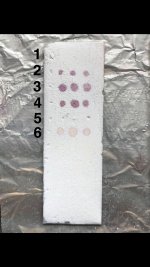
Number 6 is the remaining salts that were pulled from the tea which stained yellow/orange but had a ring or purple... when I ran the TLC it showed mescaline in small amounts but didn't show the yellow but I'll be repeating it this weekend.
 

Attachments

  • E1DFA487-FE7C-4DC7-8368-464920B5E431.jpeg
    E1DFA487-FE7C-4DC7-8368-464920B5E431.jpeg
    344.6 KB · Views: 4
Back
Top Bottom