I bought two accessions of
Lespedeza bicolor seeds from different sellers, with the goal of studying its alkaloid content.
L. bicolor is a member of the Fabaceae (legume family), but it's not a Mimosoid like
Mimosa or
Acacia. I've found little published on its biosynthetic pathways, and don't know to what extent those are shared vs. independently evolved.
Germination is reported to be difficult. A summary from the US Forest Service reports best germination after soaking in water for 3 minutes at 70 C. I tried three treatments: the hot water, nicking the seed coat with nail clippers (with no hot water), and no treatment. I sowed into 50/50 coir/perlite saturated with tap water (pH ~ 7.5, hard), about 1/4" deep.
My results were rather bad. One accession didn't germinate at all. For the other, 2/16 germinated with hot water, 0/8 with the nick, and 2/8 with no treatment. This nonetheless gave me four plants. I irrigated with typical hydroponic solution. After three months, I took about 150 mg of fresh leaf from each, and homogenized by bead beating in a 15 mL centrifuge tube with 5 mL household vinegar and 10 1/4" ball bearings, by shaking with a reciprocating saw for 1.5 min. The mixture from each tube was then filtered through an 0.45 um syringe filter and injected without further dilution to my HPLC, using the method discussed in earlier comments.
Looking at the chromatogram by fluorescence, we see big variation:
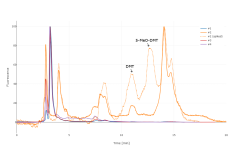
Only #2 shows any promise, with a small peak near the expected retention time for DMT. To confirm that retention times didn't shift due to matrix effects, I also ran a sample of #2 spiked with a
Phalaris extract known to contain DMT and 5-MeO-DMT. Those eluted as expected, providing reasonable confidence that it's really DMT.
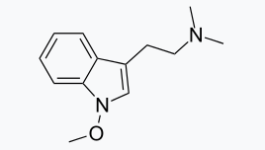
The concentration is very low, around 3 ug per g fresh weight. I'm very confident that the other samples didn't contain DMT. I'm very confident that none of the plants contained 5-MeO-DMT. All other peaks are unidentified. (Would any chemists care to guess where 1-MeO-DMT aka lespedamine would elute, and thus whether that might be the big peak at 14.1 min? This is a phenyl-hexyl column.) The many constituents may present a high risk of false positives by less selective methods like the TLC reported by Trout et al. Enough positive bioassays are reported that I guess something's there though, from either better genetics or an active constituent other than DMT.
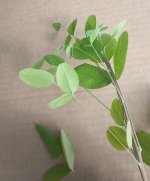
I've planted two individuals outdoors, #2 and the fastest-growing one. I plan to retest, to see how that profile changes over time. (The fastest is 3x as tall as the shortest now; I guess the variation isn't limited to the alkaloids.) My results here are mostly negative, but the large observed variation makes it likely that better genetics exist, whether in my seeds or elsewhere in the species. I believe
Lespedeza bicolor is a research topic for now, not an easy practical source; at least, extraction from leaves of a plant grown from random seeds seems unlikely to yield useful amounts of DMT.