• Members of the previous forum can retrieve their temporary password here, (login and check your PM).

LSH / LSI doubts

Short-chain aldehydes are fairly reactive, so I for one would be willing to accept the plausibility of adducts even with something as relatively unreactive as an amide nitrogen. The supporting evidence of the example with acetaldehyde and acetamide seems sound enough and, while the product there resulted from a 2:1 amide to aldehyde ratio, lysergamide itself is bulky enough to limit the stoichiometry to 1:1.

Whether I'll get to test these hypotheses experientially myself remains to be seen.
 
I'm not a chemist. This is about lysergic acid α-hydroxyisopentylamide vs lysergic acid α-hydroxyethylamide I assume. I asked an AI since I'm dumb. Please correct me if this information is inaccurate:

"The dramatic difference in stability between the two adducts comes down to physical crowding, known in chemistry as steric hindrance. When the adduct forms, LSH attaches a small, compact methyl group to the central connecting carbon, which fits comfortably next to the massive lysergic acid backbone and allows the molecule to remain relaxed. In contrast, LSI forces a bulky, branching isobutyl group into that exact same space. The sprawling structure of the isobutyl group physically collides with the rest of the molecule, creating severe internal pressure. This crowding acts like a spring-loaded trap, making LSI so highly strained that the mild warmth and moisture of the mouth cause it to rapidly snap apart, whereas the uncrowded LSH holds together long enough to be absorbed sublingually."
 
Last edited:
It's really fascinating that these decades long speculations about lysergamide aldehyde adducts are still alive, but still without any real progress.
Progress?
I think that depends who you speak to.
Even kash was on the trail without realising.
He consistently mentioned peppermint & lemon as being crucial parts and now we understand why - they're both ALDH inhibitors.

Tbh I always thought their use as sources of acetaldehyde was unreasonable.
 
"The Aojiru young barley grass powder supplies extremely high levels of the 3 aldehydes: isovaleraldehyde, valeraldehyde, and crotonaldehyde which condense onto the amide of LSA when stirred for 10 minutes in tartaric acid acidified water, forming a 2oz brew containing Lysergic Acid Isovaleraldamide, Lysergic Acid Valeraldamide, and Lysergic Acid Crotonaldamide for a triple psychedelic combination just as powerful as LSD, but even beyond LSD as mentioned above."

https://grahamhancock.com/stahlm1/

what gemini thinks of the above:


"The author's premise requires three impossible miracles to be true at the same time:
A chemical miracle to bond the molecules in water without a reducing agent.
A thermodynamic miracle to prevent water from immediately destroying that bond.
A biological miracle for a bulky, mono-substituted amide to ignore decades of SAR data and magically outperform LSD."


I found this to be both informative and hilarious.
 
The Aojiru young barley grass powder supplies extremely high levels of the 3 aldehydes: isovaleraldehyde, valeraldehyde, and crotonaldehyde
This isn't true or at least it's inaccurate. The original reference used to make that claim was misread/misinterpreted (by tregar) which led to inaccurate claims about total aldehyde content.
 
Last edited:
Progress?
I think that depends who you speak to.
Even kash was on the trail without realising.
He consistently mentioned peppermint & lemon as being crucial parts and now we understand why - they're both ALDH inhibitors.

Tbh I always thought their use as sources of acetaldehyde was unreasonable.
Imo real progress would be a method for mixing seeds with some admixture to achieve reliable effects.
What we have so far is bunch of speculations, lot of failed attempts to try the method and very weak confirmation that it could really work, and of course, lot of posts from suspicious accounts in many internet forums.
 
Last edited:
Fwiw, after a bit of looking into it, one example of a reaction between isovaleraldehyde and an amide (albeit a sulfonamide) is in the synthesis of butizide:
In that instance, there's also a neighbouring amino group which contributes to driving the reaction through the formation of a highly stable six-membered ring.

Lysergic Acid Isovaleraldamide, Lysergic Acid Valeraldamide, and Lysergic Acid Crotonaldamide for a triple psychedelic combination just as powerful as LSD,
I've said it before and I'll say again now, that nomenclature is absolute trash - there's every possibilty that any adduct would be the α-hydroxy compound analogous to LSH, so the "-aldamide" terminology equates to misinformation, even before we get to the "better than LSD" kind of puffery.
A biological miracle for a bulky, mono-substituted amide to ignore decades of SAR data and magically outperform LSD.
The thing is though, LSD itself is something of a biological miracle in how it has just the right sterics going on for its substituted amide group to click into a small sub-pocket of the 5-HT₂ₐ receptor like a key in a lock. This affords the molecule a remarkable potency only exceeded by one enantiomer of LSZ (the conformationally restricted 2,4-dimethylazetidine analog of LSD), where the tip of the key is essentially pinned into an even more optimised configuration with an additional bridging methylene group.

This is of course a prime example of the peak research that Prof. Dave Nichols and his team have carried out, so if any group is capable of producing experimental results that bring us nearer to some firm conclusions about what might be going on here, it's those folks. We shouldn't exclude the possibility of there being another 'magic pocket' in the 5-HT₂ₐ receptor where some of these α-hydroxyalk(en)yl-substituted lysergamides might perform a similar miracle.

If that turns out to be the case, we should expect to see a difference between some aspect(s) of the activity of the E- and Z-crotonaldehyde adducts., but that's starting to get a bit ahead of itself.

 
LSD itself is something of a biological miracle in how it has just the right sterics going on for its substituted amide group to click into a small sub-pocket of the 5-HT₂ₐ receptor like a key in a lock.

Did you ever see this?
Heffter Research Institute
LSD and Its Lysergamide Cousins
(by Dr. Nichols)

Quote from that chapter:
The important thing to note from the table below in the far right column is the fact that LSD has a potency in rats in the drug discrimination behavioral assay of 48 nanomoles per kilogram of rat body weight. Only two other compounds have comparable activity entries 6 and 16.​
Curiously entry 6 is a monoalkylamide that has the same molecular weight as LSD itself, that is it has a total of four carbon atoms attached to the amide. Entry 16 has a five carbon group attached to the amide.​
We have no evidence as to whether either of these compounds would be active in man but these rat data suggest that they might be.​
 
Did you ever see this?


Quote from that chapter:
The important thing to note from the table below in the far right column is the fact that LSD has a potency in rats in the drug discrimination behavioral assay of 48 nanomoles per kilogram of rat body weight. Only two other compounds have comparable activity entries 6 and 16.​
Curiously entry 6 is a monoalkylamide that has the same molecular weight as LSD itself, that is it has a total of four carbon atoms attached to the amide. Entry 16 has a five carbon group attached to the amide.​
We have no evidence as to whether either of these compounds would be active in man but these rat data suggest that they might be.​
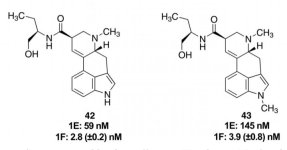
Yes - thanks for linking it. Then there's compound 8, also with a five carbon substituent, having a comparable 5-HT2aR affinity but double the EC50 when compared to LSD. That starts to exhibit a similar geometry to the α-hydroxyisopentyl substituent resulting from the adduct formation between LSA and isovaleramide. It's a shame there weren't any branched-chain alkyl substituents included in that table. The homologue of compound 8 with an extra methyl group at the 4-position might prove to be an instructive member of this SAR series.

And of course, compound 8 also bears certain similarities to LSZ, including it being the R-enantiomer that has the significantly higher activity.
 
Someone can make a kind of summary of where we are here?

And what about LSA itself? in my research, i did remember encountering quite a bit of skepticism about it : is it really the main active in HBW?
people who tried pure LSA says it's very different to HBW ;

I'm willing to try the adduct approach again, if someone give me proper advice to how to potentially succeed. I will report back.
I'm used to HBW, i have been taking for nearly 20 years. Of course there's always many factors, but i hope i can share some insights.
 
Back
Top Bottom