Adding the the sulfate salt while water is basic (no common ion effect) could precipitate gunk but not mescaline. After that, neutralize (or go to ~pKa-2) to turn on the common ion effect and see if the mescaline salt crashes when cold.

 and was found to be stronger, less speedy, and more visual than the starting material. The increase of potency in mescaline-like effect was in reasonable proportion to loss in gram quantity. Unexplored side note: the AS containing supernatant byproduct containing the cactus accessory alkaloid was placed at 4° for eventual isolation of that alkaloid, after some months a white solid formed in the jar that looks nothing like AS crystallized mescaline.
 At some point I will at least reclaim alkaloids from all that AS filled liquid. Presumably by basing, extracting to xylene, salting to water, basing with Ca(OH)2, distilling off the ammonia, extracting with xylene, and salting with HCl.
In it I put 2,14g •HCl into 100ml dH2O and crashed it out with 30g AS to yield 1,16g [54% theoretical yield] after recrystallization.
At some point I will at least reclaim alkaloids from all that AS filled liquid. Presumably by basing, extracting to xylene, salting to water, basing with Ca(OH)2, distilling off the ammonia, extracting with xylene, and salting with HCl.
In it I put 2,14g •HCl into 100ml dH2O and crashed it out with 30g AS to yield 1,16g [54% theoretical yield] after recrystallization.

 , so it doesn't seem the equations are that representative.
Elrik said:Yes, when the magnesium test failed I wasn't sure if it was the magnesium interference or sulfate concentration issue. Since AS worked at 30g but not 20g that means for an equivalent sulfate ion situation I would have to use over 40g, possibly almost 60g of magnesium sulfate heptahydrate while cooling to 0°, which clearly would not work due to solubility constraints.
Some day I really have to figure out why it didn't work with a refined scop acetate solution. The most likely scenarios are either acetate somehow blocks the common ion effect of sulfate, though I have no idea how it would, or the active constituent of my scop clone is not mescaline, which would be remarkable to say the least.
Soon I should reclaim those grams of scop alkaloid from the AS mess and try again, this time with scop hydrochloride. That way I don't dump another quarter kilo of my beloved scop chips into making more ammonium sulfate-mescaline solution mess :lol:
Do you see any better way of separating cactus alkaloids and AS than my plan of basing, extracting to xylene, salting to water, basing with Ca(OH)2, distilling off the ammonia, extracting with xylene, and salting with HCl? I think that should work, and a trace of ammonium chloride wouldn't be toxic if it was less than 100% effective, but the route seems kind of circuitous.
Elrik said:I suspect the gunk is largely comprised of pectins and the hyaluronic acid-like compounds known to be in cacti, compounds which could entrap alkaloids due to their acidity the same way tannin does in aya.
Dropping the pH to 2 or less would be expected to free the alkaloids from these compounds, and then it would just be a question of if mescaline sulfate would crystallize at 0° when it could be acidic enough to encourage bisulfate formation. Protonating hyaluronic acid-like compounds also makes them less mucilaginous.
That apparently leaves the proteins in the filtered slurry and the mescaline in the chilled acetone. We could try chilled ~85% aqueous acetone extraction before manske for protein/alkaloid separation.Attached Paper said:The plants were removed from the greenhouse in pairs and sliced and blended with 5 vol. of chilled acetone (-15C), at high speed, for 1 min in a Waring blender."

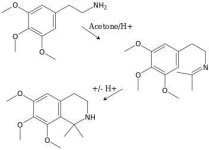
I also wonder about Pictet-Spengler cyclisation of the acetone-alkaloid iminium adduct to produce an isoquinoline (~1,1-dimethylanhalinine). While this reaction would seem to be possible, perhaps it would be sufficiently slow to be of lesser concern in yield losses. TLC would (or should possibly) give some indication as to whether this side-reaction occurs. It's more than a little disfavoured sterically, I suppose.Elrik said::lol: I actually did consider that method once, until I thought it through and realized the large amount of acetone involved and the subsequent recovery by distillation of all that.
And it would also crash out any acidic polysaccharides, so acid would have to be added to free the mescaline from that first, and then you'd have the problem of aldol condensations by stewing acetone [and acetone+alkaloid] with acid.