• Members of the previous forum can retrieve their temporary password here, (login and check your PM).

Mexamine

Migrated topic.
Joined
Jan 2, 2011
Messages
96
Merits
42
5-Methoxytryptamine (5-MT), also known as mexamine, is a tryptamine derivative closely related to the neurotransmitters serotonin and melatonin. 5-MT has been shown to occur naturally in the body in low levels.[1] It is biosynthesized via the deacetylation of melatonin in the pineal gland.[1]

5-MT acts as a full agonist at the 5-HT1, 5-HT2, 5-HT4, 5-HT6, and 5-HT7 receptors


the above was copied off of Wikipedia.

I noticed the 5-ht2 bit and it of course sparked my brain bits with thoughts of melatonin deacetylation and fat rails of mexamine but this almost seems to good to be true....

any of you smarter older grey matters care to in-lighten this simple random head?
 
ive looked into it numerous times..does not appear to be an active psychedelic..but people say the same thing about melatonin and I get effects from melatonin at times that are inbetween harmalas and DMT sort of so I dont know.

I remember reading a report with negative physical side effects I think.
 
Mexamine is not known to be active in any fun way that we might enjoy. Similar to tryptamine it's just not hallucinogenic. Interesting none-the-less.

I would be curious to hear about what products are formed from doping mushrooms with it. It is very easily prepared although the preparation of such requires inert atmosphere.
 
I believe I saw this chem listed in a diet pill today... I was like wtf isn't this illegal? But maybe I'me thinking of something else.
 
Found a link - http://www.dietpillreviewing.com/lipodrene.html

Look at ingredient list is that what you mean?

EDIT I'll make it easy:

Proprietary Blend with Thermo-RX and Extend RX 557.5mg

Acacia Rigidula extract (leaves) (25mg methylsynephrine yeilding 75mg phenylethylamine alkaloids including b-phenylethylamine, n-methyl-b-phenylethylamine alkaloids: B-phenylethylamine, n-methyl-b-phenylethylamine, and r-beta-methylphenylethylamine), Phenylethylamine HCL, citrus aurantium (25mg synephrine), Theobromine, Green Tea Extract (45mg EGCG), Hoodia extract (cactus), Cassia nomame extract (plant), naringen (fruit), 6,7 Dihydroxybergamotin (fruit), 5-methoxytryptamine HCl, l-5-hydroxytryptophan, Yohimbe HCl.
Caffeine (Anhydrous) 100mg

Other Ingredients: Dextrose, microcrystalline cellulose, hydroxy propyl methylcellulose, stearic acid, magnesium stearate, sodium starch, triacetin, titanium dioxide, FD&C yellow #5 aluminum lake, silica, fd&c yellow #6 aluminum lake.

Also interesting to note that it has acacia extract is rigidula an active species I wonder? It talks about all kinds of other alkaloids and phens too.
 
InMotion said:
Mexamine is not known to be active in any fun way that we might enjoy. Similar to tryptamine it's just not hallucinogenic. Interesting none-the-less.

I would be curious to hear about what products are formed from doping mushrooms with it. It is very easily prepared although the preparation of such requires inert atmosphere.

Once again InMotion with a great idea for experiments/research :thumb_up:

Did anyone try doping musshooms with mexamine and get an analysis result back?
 
Loveall said:
InMotion said:
Mexamine is not known to be active in any fun way that we might enjoy. Similar to tryptamine it's just not hallucinogenic. Interesting none-the-less.

I would be curious to hear about what products are formed from doping mushrooms with it. It is very easily prepared although the preparation of such requires inert atmosphere.

Once again InMotion with a great idea for experiments/research :thumb_up:

Did anyone try doping musshooms with mexamine and get an analysis result back?

Actually it is active, not really psychedelic but it has a definite effect on mood. I found it induced a sleepy effect like melatonin but also some calm euphoria with about 20 milligrams.

I did try doping but as I mentioned in chat I wasn't able to get the results :( Id like to try it again
 
Ok, apparently there is a way to deacelytate melatonin in an NaOH alcohol solution once the temperature gets hot enough. One way to do this is using a 4+ carbon alcohol, but those are not typically over the counter.

An alternative is to use IPA and get to the right temperature by using a kitchen pressure cooker.

CAUTION: IPA vapor will form and is flammable. While any IPA that escapes from the jar will be mixed with the water vapor in the PC there is a possible risk. There are some people that extract vanilla using vodka and an electric pressure cooker, apparently with no issues. I use a small closed IPA jar in a large PC to have a large water vapor ratio. So far I have had no issues and have not smelled IPA coming out of the steam port, but this is not a guarantee that something bad couldn't happen. If one chooses to pursue this, they need to understand the risks and know what they are getting into.

Ok, so the PC will get to 121C which could be enough to drive the reaction forward. It seemed to work for chitin in a water N-deacetylation (see attachment).

Proposed steps (similar to the first section in Synthesis of 5-MeO-Tryptamine , but using a lower boiling point alcohol in a pressure cooker and no catalizer):

- Dissolve some melatonin in 91% IPA in a small Mason pressure canning jar.
- Add excess NaOH. Water layer will separate, remove it.
- Add more NaOH to make sure you have extra
- Leave minimal head space in jar and seal (oxygen is not desirable).
- Pressure cook for two hours. You need to determine if this is safe for you. If you hear the jar cracking at any time or smell IPA, stop.
- Move contents to a larger jar. Add salted water and separate out IPA (with salt water two layers will form, idea is to remove sodium acetate and NaOH with the water wash).
- Add a few drops of concentrated HCl (muriatic acid) to IPA: 9/11 edit: shoot for pH2, concentrate and/or freeze to induce crystalization.

That's it, this is highly experimental and theoretical at this time. It may not work at all. Glycerin could be another (better) option instead of IPA. Note that the vanilla extract people also mention glycerin. Will report on any progress/failures.
 

Attachments

One way to do this is using a 4+ carbon alcohol, but those are not typically over the counter.
In my part of the world (Germany) there have been fatty-alcohol based BBQ lighting fluids available. These contain a mixture with hexanol and higher homologues. It would seem they are mostly hexanol as they are reasonably easy to ignite with a spark from some ferrocerium.

Vacuum distillation to obtain hexanol would seem like a possible; quite how soluble the starting material, reagents and products would be in this solvent, I can't say. The question of how one might recover the product also remains to be answered.

[Edit: obviously an extraction into aqueous HCl after a basic water wash should go very smoothly. The hex{++}anol is of low solubility in water, as one might expect. Derp!]

But there it is, your OTC high-boiling alcohol solvent.
 
Not quite so OTC, but there is this method of amide hydrolysis:

N,N-dimethylbenzamide was hydrolysed at 20°C with H2O/t-BuOK in a 2:6 molar ratio with DMSO as the solvent, followed by acidic workup. Yields were 85% for benzoic acid, 76% for dimethylamine.

This might not work for melatonin due to the labile proton on the amide - perhaps a preliminary methylation would help :?

:thumb_up:
 
downwardsfromzero said:
Not quite so OTC, but there is this method of amide hydrolysis:

N,N-dimethylbenzamide was hydrolysed at 20°C with H2O/t-BuOK in a 2:6 molar ratio with DMSO as the solvent, followed by acidic workup. Yields were 85% for benzoic acid, 76% for dimethylamine.

This might not work for melatonin due to the labile proton on the amide - perhaps a preliminary methylation would help :?

:thumb_up:

Same idea, there are hundreds of potential conditions, it is a simple base-hydrolysis. That method uses a much stronger base (tBuOK) to get away with running the reaction at room temperature. Also, that benzylic system is different from melatonin because it has resonance contribution into the amide.

DMSO or DMSO:Water is a good solvent for this kind of reaction, but I can't really suggest it with NaOH at high temperature. DMSO decomposes at high temperatures and base catalyzes this. This could cause a stinky mess and a whole lot of side products, the decomposition can also happen very rapidly when hot which could be dangerous at home as well. But at the same time I kind of want to give this a try, since DMSO is OTC. DMSO can help with solvating effects around the hydroxide anion, but the rate limiting step is usually the leaving of the amine.

And we should really stick to OTC, tBuOK is definitely not OTC, if you could get tBuOH alone you could just use that as the solvent for this reaction with NaOH and be done.

Also amides aren't acid labile, they have a pKa around 20. For reference, the the pKa of the indolic H is about 16.
 
Well, I tried the steps in post #9 a couple times and could not really get it to work. The IPA tends to leak out of the jar while pressure cooking and reduce it's volume. I tried to do the post HCl crystalization but no dice. Not sure if it is an issue with the method or my technique. I can report that in my case I don't seem to have success.

I'd like to try glycerin next. Mindlusion, how would I try to get the mexamine out of the basified glycerin after the reaction?
 
Loveall said:
Well, I tried the steps in post #9 a couple times and could not really get it to work. The IPA tends to leak out of the jar while pressure cooking and reduce it's volume. I tried to do the post HCl crystalization but no dice. Not sure if it is an issue with the method or my technique. I can report that in my case I don't seem to have success.

I'd like to try glycerin next. Mindlusion, how would I try to get the mexamine out of the basified glycerin after the reaction?

Since you can't really separate it from the excess NaOH this time, you could try to quench it with HCl (very slowly) saturate it with NaCl, and extract it with IPA, then concentrate and try to crystallize the HCl salt.

or

you can dilute the glycerol/NaOH with lots of water, extract with DCM, concentrate, and acidify with bit of HCl and try to recrystallize that again. DCM may also pull a lot of junk though.

Do you have a magnetic stirrer Loveall? you might want to give it a try with just IPA too, i only ever tried MeOH and EtOH before going to butanol. I got some yield with the other alcohols, but it was low.
 
I do have a magnetic stirrer, but the heater on it does not work. I need to get another one to be able to heat stuff.

I like your suggestion of salting the glycerol and pulling with IPA. One question: why quench with HCl before pulling? Can't one salt the glycerol (1g of NaCl dissolves in 10ml I believe) and go directly to pulling with IPA? Idea being that the salt would help with the partition coefficient into IPA. I also have OTC ammonium sulfate which may be better at salting out of glycerol (?).

Then, continue with the previous proposal to move IPA to pH~2 with concentrated HCl and concentrate/freeze.

Thanks!
 
Loveall said:
I do have a magnetic stirrer, but the heater on it does not work. I need to get another one to be able to heat stuff.

I like your suggestion of salting the glycerol and pulling with IPA. One question: why quench with HCl before pulling? Can't one salt the glycerol (1g of NaCl dissolves in 10ml I believe) and go directly to pulling with IPA? Idea being that the salt would help with the partition coefficient into IPA. I also have OTC ammonium sulfate which may be better at salting out of glycerol (?).

Then, continue with the previous proposal to move IPA to pH~2 with concentrated HCl and concentrate/freeze.

Thanks!

That's true, you could acidify after first extraction with IPA,though I suggest diluting with salt saturated water as well to make things easier.
 
Ok, so this is there I'm at now:

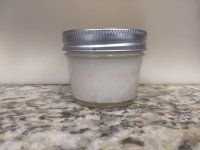
I added NaOH to glycerol. Not much seemed to dissolve, so I added water (about 50%). A bunch of NaOH dissolved. I then added melatonin (2g) and obtained a cloudy solution after some stirring (first picture).

Verified there was excess NaOH.

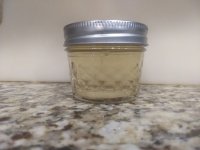
Put in the oven at 285F, solution became clear (second picture). I swirled it ever 15 minutes or so using a jar holder. Eventually, NaOH was all dissolved (or reacted), next time I'll need to add more. Also, the solution started to form bubbles. Looking it up, water/glycerol mixtres can have low boiling points (see attachment) so I'll try the pressure cooker next time.

Took it out of the oven after about an hour, let it cool, began to cloud again.

Moved it to another jar, added IPA. Two layers formed. Under UV both where fluorescent. Added salt in excess, under UV both where still fluorescent. Added NaOH in excess, bottom layer no longer fluoresed. Seems like NaOH alone is great at separating the IPA and the melatonin (and mexamine?) out of the bottom layer. I think NaOH is great at drying the alcohol too: I did a separate test with saturated-salt/water/glycerine/IPA and the pulled IPA layer can be made byphasic again by adding NaOH, this seems consistent with the info here.

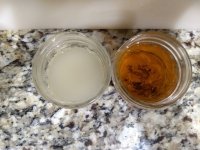
To the IPA concentrated HCl was added. Small particles begin to fallout of solution. Eventually it becomes a clear brown color. Image below has two jars, cooled down IPA pull before and after HCl addition (the pull was split in two for the picture).

So what is falling out of solution could it be mexamine?

I'll try again with the PC. It looks like as long as there is excess NaOH salt may not need needed. Adding water seems to make things easier as mindlusion said.
 

Attachments

Update: I've done several pressure cooker runs sarting with melatonin and recovered fluorescent tryptamine crystals after the runs, but it does not look like I'm getting mexamine.

Don't want to fill the forum with the gory details, but bottom line is that I don't seem to have success in obtaining mexamine based lack of TLC separation from the melatonin standard (However, I don't have a mexamine standard). Assuming failure because there should be a speparation in an alcohol TLC solvent system (mexamine should be lower per mindlusion). I don't have definite proof of fail since I'm missing a mexamine standard, but no TLC separation under different developing solvents makes me think it is not working.

I'm going to do more testing and add a new OTC chemical: sodium dithionite. This may catalize the deacelytation based on info out there. It is also OTC and found in some die removal products.

PS: A good OTC TLC developer seems to be vinegar/IPA/naptha (add enough IPA so no layers form). RF for melatonin for this system is ~ .70. IPA alone gives RF 1, and vinegar gave RF ~ 0. Vinegar with IPA gave Rf ~ 1.
 
Back
Top Bottom