@Albert - no, I think that looks like a good lead and I too would love to read that paper. The only solid things I've found relate to tryptamine and serotonin going through ring closure to become beta-carbolines, and these tryptamines are slightly different in structure to DMT or 5-MeO having an amine group where the dimethyl group of latter compounds are. Wikipedia states:
"The original Pictet–Spengler reaction was the reaction of β-phenethylamine with the dimethyl acetal of formaldehyde and hydrochloric acid forming a tetrahydroisoquinoline."
And further:
"It is the electrophilicity of the imine double bond that is the driving force of the cyclization."
From: [7] Cox, E. D.; Cook, J. M. (1995). "The Pictet-Spengler condensation: a new direction for an old reaction". Chemical Reviews 95 (6): 1797–1842.
Which looks like another good reference to track down.
As for procedural this is from "The xanthydrol reaction for pyrroles and indoles in histochemistry: zymogen granules, lens, enterochromaffin and melanins" R.D. Lillie (1956) Its a print out of a PDF copy, not sure of the origin of publication:
P.191: "Effects of formaldehyde: 200mg tryptamine was dissolved in dH2O with 200mg calcium acetate, the volume brought to 18cc with water and 2cc 37% formaldehyde was added. Opalescence appeared in a few seconds and a copious white precipitate formed. Which remained quite well suspended." It goes on to give how they seperated that out with a centrifuge and and test this in xanthydrol giving a "somewhat retarded purple black reaction". They don't specifically state what this reaction is checking for other than there naturally was formaldehyde in tissue samples.
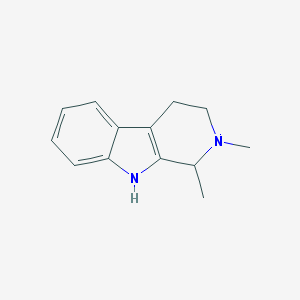
P.192: "Barter and Pearse have explained the negative Ehrlich's reaction of enterochromaffin on the basis that 5-hydroxytryptamine, condensed with formaldehyde to 6-hydroxytetrahydroharman..."
The rest of the info I've found is more casual reference to this ring closure in Shulgin, and maybe one other place.
@endlessness - Thanks for attaching that paper, I will have a good look at it. Any chance of finding the one mentioned here?
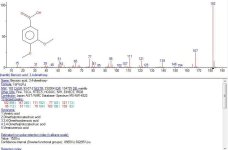
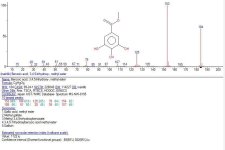
Also, I'm not surprised at the phenols in the methanol soak. Look at catechol and the others and then at yuremamine. These phenol are, or form the basis of the tannins in M. hostilis. I'm surprised there weren't more of them. Very interesting about the NMT, looks like you were correct there =)
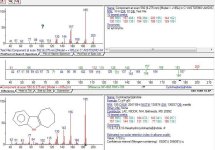
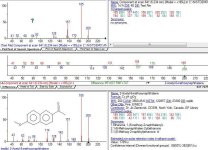
I'm really not sure on the mystery compound. You are doing a great job identifying thus far.
endlessness said:
...because in the mistery substance there is a very strong peak at 200, which is possibly it's molecular weight.
Yea, as I understand it, the highest # peak is the M+ which is the molecular weight, and that the highest peak is the cmpds 'base' peak. As for the compounds I asked about above, they are phenols that have been found in M. hostilis or are close similarly structured phenols that also have some similarity to the phenol attachments on yuremamine.