• Members of the previous forum can retrieve their temporary password here, (login and check your PM).

official extraction help thread

Migrated topic.
Starting material was Acacia after my first experiment I have decided to use the FASA technique to take the guess work out. From my understanding the DMT-Fumarate salt store much better and can then be converted to a freebase in several different ways. No defat step is needed=Bonus
 
A quick question. I have been reading and studying can you use citric acid saturated acetone with a Soxhlet extractor? From my limited understanding, you should be able to extract the alkaloids into the CASA then add FASA to convert the salts to DMT fumarate which will precipitate out saving the basifying and pulling. Then after washing the precipitate with Acetone a couple of times vacuum desiccate it and store for safe keeping.
 
So I tried to convert some freebase to furmates. 50ml Acetone (dried with baked Epsom Salts) mixed with 1G, then poured into an evap dish. Added FASA dropwise until there was no longer a milky reaction. Placed it under a fan for a minute and the milky texture cleared up some and formed crystals in the bottom of the dish. I walked away for a couple minutes and when I came back the crystals were gone and I was left with a yellowish green, slightly syrupy residue.

EDIT: So, left in ambient air overnight it has turned into a thicker goo. If I'm speculating, I would say that there was still a presence of water in my acetone. Curious if this could also be caused by a presence of fats that were still present in my freebase material.

Will leave this goo out for another day or two to see if there is a further hardening off. If the results are unsatisfactory the resulting goo will be scrapped and dissolved into an A-B
 
I am a complete layman. For drying anything would a vacuum distiller run with a homemade water eductor or an epoxy off gassing pot work. That way I could vent the exhaust gas out a window and not smell the house up. It would also be much faster than fan drying. I look forward to hearing the answer.
 
Ananda, for a layman you sure are looking at some highfalutin sciencey crap for your setups. As far as a Soxhlet goes, its looks like a fancy contraption but its really pretty straight-forward.

Solvent is evaporated(boiled) from your flask and travels up to the condenser. The condenser cools the solvent back to a liquid form and drops into the Soxhlet chamber. This then fills up (slowly) and is fed back into your flask via gravity siphon.

In theory, acetone could be run through this setup, but you are going to have to keep that condenser and chamber pretty cold. I've seen it done with cannabis (Chock full of waxes and chlorophyll) but I'm not sure how citric acid saturated acetone would work. I think it would be of dubious value considering the time and setup required to run the experiment.
 
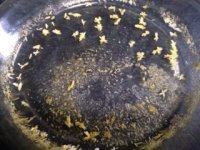
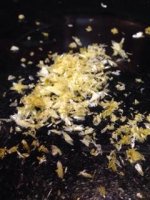
Doing xylene pulls. Added fasa dropwise. No idea if this is looking right. Pictured right is from last night, left I just did.

Edit: ok, so the right was decanted and the precipitate dried in front of a fan. It looked like broken fiberglass, very white. This was washed with acetone to remove excess furmaric acid and dried, yielding a pill like yellowish powder. Weight seems right. Is that it?
 

Attachments

  • 1504565981803984847643.jpg
    1504565981803984847643.jpg
    3.5 MB · Views: 0
I used the search engine with no joy. Could someone go over the steps after you add FASA to get the precipitate washed?

Wash with Acetone they said. I did an A.B pulled with xylene and added FASA stirred it good and set aside all night. I had a bunch of precipitate in the bottom of the beaker I poured off the xylene without getting any of the stuff in the bottom. I then poured everything in the beaker into a large casserole dish under a fan in the garage.

Can I filter this in a coffee filter and pour acetone over it and let it dry? Then I could scrape the DMT off after it is completely dry. Sadly I do not have a Buchner filter yet it is on my wish list.
 
A quick, although somewhat esoteric, question.
Just how shelf stable are the dry freebase quinazoline alkaloids of P. harmala?
Would they show degradation/oxidation after some years storage in a dry dark place?

I've just dumped them in the past but on this kilo I want to save them in case I want to experiment with their chemical or pharmacological properties at some point, and collecting the freebase would be easiest.
 
What a mess!
I did four 4 liter boils on 850 grams of seed, concentrated it to 2.5 liters, added tons of 3M ammonia. Rue tea has an amazing buffer capacity, it stunk of ammonia and was still pH 9.5. So I dissolved in 40 grams of sodium carbonate (anh.) and let stand overnight. Still ~pH 9.5, basification of centrifuged filtrate showed it still needed MORE base, and I couldnt filter the decanted sludge because I dont have vacuum filtration and coffee filters were acting like coffee cups :lol:
VDS apparently didnt consider the lack of vacuum filtration in peoples homes when he advocated basification before salt precips. Or the tremendous buffer capacity of concentrated rue brew.
I stirred in ~250 ml of muriatic acid to get back to pH 6 and am now going straight into manskes just like I always did.

Someone else can have the joy of exploring the chemistry of quinazoline alkaloids :p
 
So I'm tooling up for a series of 5 or 6 mescaline extractions over the next few months, comparing yields from different source material, and I'm stuck on one point of procedure.
In titrating the mescaline down into the aqueous layer all the teks and experienced extractors say to shoot for a final, stable, pH of 6-7 by means of frequent monitoring of pH.
Just how is that monitoring conveniently accomplished?
Say I suspect a 10 kilo pile of fresh cactus could be anywhere from 0.25-1.0% on the dry weight basis. That would require 6-24 ml of 1M HCl. If I started with 6 ml and added acid in 3 ml increments, testing a drop of solution for pH at each step, I could still see the pH go from 8 to 2 from one 3 ml increment.
Are people using pH meters?
Most pH meters in the price range of members here seem to use a polycarbonate probe body, its generally advised not to use polycarbonate plastics with xylene or toluene.
This is the unit I have on order. I love that the probe matches my avatar :lol: but I'd be hesitant to leave it in xylene for an hour...

Also, I never see mention of back titrating when it does go too far. Does anyone add a few drops of ammonia to get it back up to pH 6? Ammonium chloride is used in gram quantities to acidify peoples urine so a few mg should be harmless, lol. An IPA wash may even remove it.
 
Just finished my first extract, a Max Ion tek on MHRB.

At what point do you dispose of the basified mix? My first extraction is (I believe) complete. Just put the product in the freezer to re-x. Prior to re-x, I measured approx 1.1g from 50g of shredded bark.

Being my first extract, and not knowing WTH I was doing (I understand much better now, on this side of it), I'm hesitant to dispose of the basified mix until I know all usable product has been extracted. I ran about 12 pulls. (4) pulls first day, combined in dish, put in freezer. Decanted used NPS (very yellow at this point), re-used for (4) more pulls the next day, put in freezer. These yielded .6g and .5g, respectively. First dish full was very white and crystalline, very little goo (though somewhat tacky while scraping). Second dish was definitively yellow, smaller crystals, more yellow goo in the mix. Still mostly crystalline, but definitely different from first dish.

I then added more salt to the basified mix (having read of success with this), and ran another 4 pulls (again using the same, now yellow, naptha). The results of this pull are inconclusive. The yield was very little, if anything. It may have just rearranged the leftovers in the pan from the previous 2 freezes.
 
Hello Nexus :)
SWIM was thinking about a funghi extraction from dried fly agaric. The Goal is smokeable extract. When you dry and shreed the funghi, put this powder in distilled water for 1 hour at 60 degrees Celsius and mix it once a while.
Now it should be like a funghi soup and hard to sieve the funghis from the water. Normal household screen methods for juices could not sieve this.
Is there any other way to get rid of the funghi matter und get something more pure?


Greets Sativa
 
Thanks moto ;)
I think they have the right size.
Bubble Bags would be a substainable screen.
And another Idea, mixing it with a lot more water so it can separate and suck the water up, evap with fan at 60grad C.


Love
 
A set of theoretical questions (and apologies if these are somewhere in the FAQ);

Does the length of time that solvent sits on base tea (between rolls) increase crossover of the molecule into the solvent?

Does the solvent need to 'make contact' with as much base tea as possible - or is this mostly a chemical transference from polar to non-polar?

Is there an optimum method of agitation? Stirring seems to work and dos not run the risk of emulsification but I ma wondering if this is sufficient

thanks in advance,

Flux
 
JefFlux said:
A set of theoretical questions (and apologies if these are somewhere in the FAQ);

Does the length of time that solvent sits on base tea (between rolls) increase crossover of the molecule into the solvent?

Does the solvent need to 'make contact' with as much base tea as possible - or is this mostly a chemical transference from polar to non-polar?

Is there an optimum method of agitation? Stirring seems to work and dos not run the risk of emulsification but I ma wondering if this is sufficient

thanks in advance,

Flux
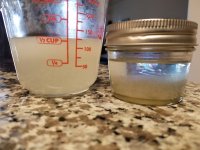
In order, to the best of my limited knowledge :

1.negligible most likely. Any freebase DMT that migrated to the top of the soup *might* pass into the nps layer, but it would have to be in contact. I have left an nps layer sit for some time and noticed no greater amount in the pull than average.

In fact, I've always had a worry that if I do not pull the nps immediately after agitation that some spice may migrate back into the soup. This is due to my chemistry ignorance, I doubt if that's possible once it is freebase into a base solution.

I have not performed an experiment with no agitation to see.

2 ys, this is addressed somewhere on the forum. I had a hard time understanding proportions for awhile, thinking that the was some magic formula of water, base etc to get all the goods out. FWIU now, it is all about consistency of the soup, you want it to be non viscous enough for, yes, the nps to come into contact with the freebase DMT molecules so that it picks them up. There is an optimum mix, but it has more to do with viscosity than anything. I don't separate the plant material usually, ala Cyb's, so I make a pretty watery, flow-ey mix.

3.the ol 'bicycle pedal' along with actually rolling an alembic on the floor (wrapped in a towel) is my method.

Pardon if I got too scientific in my terminology. 😉
 
Thanks heaps null24,

Given the mentioning of viscosity, are you referring to STB as I am primarily performing A/B.

So essentially it is about making maximum contact ? The thing that has me a bit confused is that this being the case, any thing short of problematic agitation (like shaking or vigorous stirring) would seem to still keep the two layers relatively separate - i.e. the rolling method.

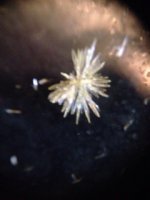
I recently encountered a significant lack of base/tea separation and emulsification - in fact the Shellite was black ! After heating, adding additional NaOH and some NaCl-salt it was still no clearer, so it was pulled (a line of separation could just be made out) and ran through a mini A/B which cleaned it up nicely as well as forming some of the largest crystals I've seen first hand. The Shellite and layers have been a little clearer with 2nd & 3rd pulls

One thing I noticed with the mini A/B though was that after leaving the new basified water and the fresh Shellite, it became much lighter over time (8-12 hours while I was at work) as though more transference had taken place without additional agitation.

I really would like to know what has caused this lack of separation/black Shellite as the only variable this time was a lower heat simmer (which I believe is conducive to higher acacia yields) and extensive freeze/thawing in acidic water... and a combination of phyllodes and bark.

---cheers :)
 

Attachments

  • Xtals+1.jpg
    Xtals+1.jpg
    26.6 KB · Views: 0
  • Xtals+2.jpg
    Xtals+2.jpg
    18.1 KB · Views: 0
  • Xtals+3.jpg
    Xtals+3.jpg
    19.3 KB · Views: 0
Back
Top Bottom