• Members of the previous forum can retrieve their temporary password here, (login and check your PM).

official extraction help thread

Migrated topic.
sirtween said:
Hi,

i use the q21q21 tek since 2years now but instead of pulling with limonene i use naphta. i always have good result, 1.5 % average.
Usually it run well with the consistency 1, crumbly, dry but this time i take a try with the second consistency, the soupy one. So i did it in the same condition as the other time with the same mimosa batch.It use less naphta but nothing precipitate in the freeze, so i would like how i could rectify it. Adding more lime? in order to turn it crumbly as i do usually, or trying to evaporate some water, naphta remaining in the soup?

Thanks all, with all my compassion

I also had issues pulling with the consistency you describe. I was recommended to add more lime (and distilled water if necessary) to make a bread-dough type consistency. How long did you wait until your first pull? Apparently it can take some time for the bark to break down and release the dmt.
 
Hi,

Usually i wait at least 24h our and with the crumbly consistancy its good enough.

I ve tried again after 3days but still nothing, i already done 3 pull with the dry consistency and harvest
0.265
0.250
And 0.500 of big chrystals for the third pull.

I will try to add more lime in order to dry it.

Thanks and take care of you
 

Attachments

  • IMG_20200125_152850_optimized.jpg
    IMG_20200125_152850_optimized.jpg
    542.6 KB · Views: 0
Hello.

I was wondering if a system where you can have your alkaline solution dripping into your warm NPS wouldn't be a more efficient way to pull the dmt out of it ? Or is mixing both remains a more efficient method?(The later seems counterintuitive to me)
 
Hi all! Thanks for being here and willing to share. I've spent more of my life than I care to admit to looking to acquire the God molecule. And, don't get me wrong it's been a great trip with tons of experience with sometimes massive doses. Good stuff, as a matter of fact some of the RCs (e.g. 4HO make me never want to go back to the "real dead." Anywho, mush love to this site. Thanks for being here Nexians.

Finally to my question: What materials are safe and which aren't for extraction? I'd love to see something comprehensive or a link to check generally. Background example to show my concern: bleach is fine in plastic, but don't store it in metal.

So, given the Norman Tek, using Lye and Naptha, what kind of containers are acceptable and which are ideal, and which ones at definitely s nope? May I measure naptha in a plastic measure conrainer? Will the Lye react with anything inorganic, or plastic?

I assume glass is fine across the board, but what about silicone spatulas or plastic syringes oe pipettes?

Thanks in advance,
Bill H.
 
HillyBill said:
Hi all! Thanks for being here and willing to share. I've spent more of my life than I care to admit to looking to acquire the God molecule. And, don't get me wrong it's been a great trip with tons of experience with sometimes massive doses. Good stuff, as a matter of fact some of the RCs (e.g. 4HO make me never want to go back to the "real dead." Anywho, mush love to this site. Thanks for being here Nexians.

Finally to my question: What materials are safe and which aren't for extraction? I'd love to see something comprehensive or a link to check generally. Background example to show my concern: bleach is fine in plastic, but don't store it in metal.

So, given the Norman Tek, using Lye and Naptha, what kind of containers are acceptable and which are ideal, and which ones at definitely s nope? May I measure naptha in a plastic measure conrainer? Will the Lye react with anything inorganic, or plastic?

I assume glass is fine across the board, but what about silicone spatulas or plastic syringes oe pipettes?

Thanks in advance,
Bill H.
The search term you're looking for is "materials compatibility chart".
 
downwardsfromzero said:
The search term you're looking for is "materials compatibility chart".

Materials compatibility is exactly wtf what I was looking for! Thank you. Sincerely.

Also, a separate thank you for caring about page (i^2x-1x10^2)+ in the newb thread. There aren't that many places on the interwebs with real community, but I'm optimistic about the nexus. This one reply made it worth the wait to register.
 
HillyBill said:
Hi all! Thanks for being here and willing to share. I've spent more of my life than I care to admit to looking to acquire the God molecule. And, don't get me wrong it's been a great trip with tons of experience with sometimes massive doses. Good stuff, as a matter of fact some of the RCs (e.g. 4HO make me never want to go back to the "real dead." Anywho, mush love to this site. Thanks for being here Nexians.

Finally to my question: What materials are safe and which aren't for extraction? I'd love to see something comprehensive or a link to check generally. Background example to show my concern: bleach is fine in plastic, but don't store it in metal.

So, given the Norman Tek, using Lye and Naptha, what kind of containers are acceptable and which are ideal, and which ones at definitely s nope? May I measure naptha in a plastic measure conrainer? Will the Lye react with anything inorganic, or plastic?

I assume glass is fine across the board, but what about silicone spatulas or plastic syringes oe pipettes?

Thanks in advance,
Bill H.

In general, plastics are inert and will not react with anything that you will be able to get your hands on. When it comes to metals, they are generally less inert than plastics. Stainless steel should be used in all cases, although not even SS is completely inert. Glass is attacked by some compounds but for our purposes and the mild compounds we are using it's inert.
 
Hello! I have a jar of mimosa/lime/vinegar/traces of naphtha that has been lying around for about 6 months as I had given up on that extraction due to poor yields but did not want to toss the bark. I'd like to give q21's tek another go and was wondering if I should just kind of start from the top with more vinegar and then a bit of lime or should I just try to directly pull with naphtha?
 
This means that you already did the whole procedure with the Bark 1x and the yield was low?

Then if you do not have any clue what exact step could have shortened the yield, just start from the beginning.

You say you have lime + vinegar in your solution, but then the vinegar is definetly already neutralized by lime isnt it? You knew that the pH is definetly above 10 ? If yes, which should be the case (otherwise that would be the reason for low yield) then just acidify back to pH 3 with vinegar. If you think volume increase is bad for any reason then you could just use concentrated hydrochloric acid and of course only add minimal increments while acidifying.

Then at pH 3 just start cooking it again, this will also release the last traces of Naphtha, so dont wonder if it will smell stronger like mineral oil while cooking again. And after this basify again, like you did last time, to pH 10 or higher.

Possible reasons why yield was low:

- too short acidic cook (I would say 2 h would not hurt and is definetly enough)

- too low heat while coking (even 90 °C cant hurt your DMT)

- too low pH for pulling (anything below 10 may not freebase all your DMT)

- too low heat for extraction with Naphtha (DMT solubility in Naphtha strongly rises with T, therefore the migration into Naphtha is also much faster on higher Temperatures). I would even heat the mixture as high as possible (max would be lower vaporization range of Naphtha, mostly 60 °C).

- too short extraction time with Naphtha (for example: using a stirring bar on max setting should get nearly any DMT out in 10 minutes with 2 pulls - maybe even 5, but never bothered)

Maybe some times named here are overkill, but doing this would get everything out in 3 pulls in my opinion.
 
Hi, after adding zinc dust to acidic solution containing some oxides and not, I have based to ph9 and the precipitate sinks. If i base further a huge amount of white precipitate will come out and all of it sink. Whatever this is cant be pulled with solvent. If i re-acidify, i can get everything to go back into solution with the same yellowish colour i started with.

Have i irreversibly ruined this batch? Is there a known problem with using zinc dust as an oxide reduction strategy? How can i get the alkaloids out of this solution?
 

Attachments

  • IMG_20200604_073414260.jpg
    IMG_20200604_073414260.jpg
    2 MB · Views: 0
tripwire said:
Hi, after adding zinc dust to acidic solution containing some oxides and not, I have based to ph9 and the precipitate sinks. If i base further a huge amount of white precipitate will come out and all of it sink. Whatever this is cant be pulled with solvent. If i re-acidify, i can get everything to go back into solution with the same yellowish colour i started with.

Have i irreversibly ruined this batch? Is there a known problem with using zinc dust as an oxide reduction strategy? How can i get the alkaloids out of this solution?

What are you extracting?
 
I believe its not too late, i would try :
Basify slowly to ph12/13/14 or until no solid precipitate
Then decant & filter keep apart the solids an liquid,
Try to pull with solvent on liquid
When evap solvent if you have what you want it could be good if no, the goodies are in the solids.

Take this as a newbie idea, maybe some experienced ppl can answer better.
 
tripwire said:
Hi, after adding zinc dust to acidic solution containing some oxides and not, I have based to ph9 and the precipitate sinks. If i base further a huge amount of white precipitate will come out and all of it sink. Whatever this is cant be pulled with solvent. If i re-acidify, i can get everything to go back into solution with the same yellowish colour i started with.

Have i irreversibly ruined this batch? Is there a known problem with using zinc dust as an oxide reduction strategy? How can i get the alkaloids out of this solution?
By adding metallic zinc to an acidic solution you have made a solution of zinc salts. Adding base to that makes an insoluble precipitate of zinc hydroxide. You would need to be careful if extracting from this sludge as it increases the risk of forming emulsions.

Adding base to already precipitated zinc hydroxide may or may not cause it to dissolve - it can be a bit temperamental. Were you to have added an ammonium salt to the before adding the base, this would have kept the zinc in solution; there is a small chance it may work at this late stage. Adding a strong solution of ammonia may also help to dissolve the sludge but the fumes from the ammonia would be pretty nasty.

Best see what comes out of the solvent pulls before fiddling around too much as your chemical knowledge appears pretty rudimentary. As Pastanostra says, decanting and filtering off all solids before solvent pulls would be most desirable.

Re-acidification would inevitably increase the liquid volume. If you acidify only until the zinc hydroxide has dissolved, then add ammonium chloride, then boil the excess water off, you'll (probably) be able to add base and pull from a clear solution.

Good luck!

(And, IMO, fiddling around with zinc reduction for a bit of coloured DMT is a waste of effort. 😉 )
 
downwardsfromzero said:
By adding metallic zinc to an acidic solution you have made a solution of zinc salts. Adding base to that makes an insoluble precipitate of zinc hydroxide. You would need to be careful if extracting from this sludge as it increases the risk of forming emulsions.

Silly me, especially when i did this before too but had forgotten about it. Thank you for this reply, my limited knowledge left me flat on my face here.

downwardsfromzero said:
Adding base to already precipitated zinc hydroxide may or may not cause it to dissolve - it can be a bit temperamental. Were you to have added an ammonium salt to the before adding the base, this would have kept the zinc in solution; there is a small chance it may work at this late stage. Adding a strong solution of ammonia may also help to dissolve the sludge but the fumes from the ammonia would be pretty nasty.

I am glad i have held back and kept solution at just pH 9 until reading your post. I think this may open a better option from here.

downwardsfromzero said:
Best see what comes out of the solvent pulls before fiddling around too much as your chemical knowledge appears pretty rudimentary. As Pastanostra says, decanting and filtering off all solids before solvent pulls would be most desirable.

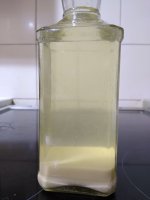
Yes I think thats prudent first step, i have got something from heating the solution as is with some naptha to 60c and got a single pull that was relatively cloudy. The solution as shown in image is relatively clean, so can clearly see whats floated and ready to go into solvent, and there isnt much. Theres actually zero of anything floated to top in the photo, i only got anything by heating to 60c with solvent and deliberately shaking into emulsion, which got a little to fall out. After emulsion settled, some good sign tan precipitate was not wanting to sink.

Perhaps after i got what i can this way, (and as long as not too tedious at ph9) i could filter off those promising looking light tan sediment shown in the photo sunk to the bottom of bottle. As opposed to the bright white zinc salt stuff which would dominate if i basified higher.

downwardsfromzero said:
Re-acidification would inevitably increase the liquid volume. If you acidify only until the zinc hydroxide has dissolved, then add ammonium chloride, then boil the excess water off, you'll (probably) be able to add base and pull from a clear solution.

(Do you really mean ammonium chloride? I just ordered aqueous ammonia which i think is the hydroxide)

This is where im leaning now especially given your balanced assessment of the situation. Im currently only at pH 9. It would only take a few drops of hcl to put all this back into clear solution. And a clear solution i can reduce to give me the volume i might need for say the ammonia.
I cant be reducing a basic mixture with freebase leaking out is that correct? Just mildly acidic to avoid fumes, but only 100ml tops to do.

If i do this, go back to slightly acidic, is it as if i never added the NaOH to basify? At this point would i be able to use the aqueous ammonia as if i had never used the other? If these answers are yes, then i see no downside to going this route instead.

Need confirmation on the aqueous ammonia versus ammonium chloride please :)


downwardsfromzero said:
Good luck!

Thank you! Your reply and some others have really helped here, i will need less luck than i would have had you not replied. Please let me know if any conclusions i have drawn here are wrong, I like to see this as a learning experience.


downwardsfromzero said:
(And, IMO, fiddling around with zinc reduction for a bit of coloured DMT is a waste of effort. 😉 )

I will never sprinkle zinc in my solutions without good cause again. I even added about 4g of not quite good enough fumarate crystals from an ipa re-x which had no business facing the zinc monster. I actually dread to think how much is in that bottle due to a series of amusing mistakes each of which at the time could be easily mopped up with a bit more vinegar. There could be maybe 8g freebase in there!

To anyone reading this, dont take stupidly unnecessary risks. If you want to experiment, use a sample. It might be helpful to post updates to this situation to give hope to others where things go wrong, mistakes are made. The Nexus is a place of learning after all. Watch out for the next update and see if improved i worsened the situation, take your bets! :lol:
 
That single pull of naptha at 60c i mentioned in last post was just left in a small beaker slowly evaporating while i engaged online in chat and forum.

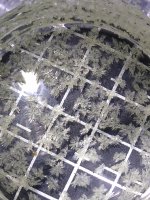
Here's whats showing. I guess thats promising. Theres still most of the naptha in there, only a little has been able to evaporate. There's no yellow layer like i usually get when pulling with naptha at 70c which i think is too hot.

But im not going to get much out of this at pH 9. A decision has to be made that will depend on any response to last post! :)
 

Attachments

  • IMG_20200606_014239601.jpg
    IMG_20200606_014239601.jpg
    2.9 MB · Views: 0
Hi all,
I just attempted my first extraction using Q21Q21's vinegar/lime jimjam tek, everything seemed to go pretty well until the evap step and I want to try to figure out what I did wrong and if my end product is salvageable, deeply appreciate anyone taking the time to read this and try to help me out.

So I started with 50mg of mhrb, used pickling lime, 5% white vinegar, and d-limonene I drained from d-limonene gel capsules. I noticed the d-limonene was clear instead of the orange I'd seen others report. I left the mixed lime mixture for 24 hours before attempting the first pull.

After the non-polar wash and Acid wash/salting, I had about 75ml of clear vinegar/water solution left. Since the instructions said to heat on high until you have 75ml, I started out heating on low. I got it down to 25ml, then heated a smaller container, until I had <5ml of pale yellow liquid/tincture. My liquid never turned anywhere near brown. When I tried dropping some of this 5ml liquid onto a spoon over a candle, it bubbled and evaporated almost completely, leaving very thin brown rings and nothing/tiny amount of salt in the middle, instead of being brown goop all the way through to the middle. I tried scraping this and smoking it but nothing happened.

Did I possibly go wrong by never heating the vinegar solution on high? If I added more vinegar/water to the remaining 5ml solution and then heated it on high again, could that work? Does it sound like there should be dmt in the <5ml I ended up with? Is there a way to salvage what I ended up with? I also still have the jar with the cloudy solvent in it, and since this was the first pull, I'm hoping to figure out where I went wrong so I can do a second pull.

Thank you so much for any help!
 
tripwire said:
downwardsfromzero said:
By adding metallic zinc to an acidic solution you have made a solution of zinc salts. Adding base to that makes an insoluble precipitate of zinc hydroxide. You would need to be careful if extracting from this sludge as it increases the risk of forming emulsions.

Silly me, especially when i did this before too but had forgotten about it. Thank you for this reply, my limited knowledge left me flat on my face here.

downwardsfromzero said:
Adding base to already precipitated zinc hydroxide may or may not cause it to dissolve - it can be a bit temperamental. Were you to have added an ammonium salt to the before adding the base, this would have kept the zinc in solution; there is a small chance it may work at this late stage. Adding a strong solution of ammonia may also help to dissolve the sludge but the fumes from the ammonia would be pretty nasty.

downwardsfromzero said:
Re-acidification would inevitably increase the liquid volume. If you acidify only until the zinc hydroxide has dissolved, then add ammonium chloride, then boil the excess water off, you'll (probably) be able to add base and pull from a clear solution.

(Do you really mean ammonium chloride? I just ordered aqueous ammonia which i think is the hydroxide)


Need confirmation on the aqueous ammonia versus ammonium chloride please :)
Yes, I do mean ammonium chloride. Ammonium chloride would be added at the start in order to provide some ammoniacal nitrogen to form a soluble complex with the zinc before base is added. This means when the base is added, hydroxide ions don't simply pull protons off water molecules complexed to the zinc, which would lead to precipitation of some hydroxide if you tried using aqueous ammonia.
 
Hey guys, really quick question -- I am having a problem now where my end product (be it DMT fumarate, or freebase DMT) tastes a lot like Xylene :?: , I have confirmed it's Xylene in my end product. When the fumarate is placed on my tongue it gives a mild numb/burning sensation/taste literally identical to Xylene. I have washed the fumarates with Acetone multiple times, powdered it, even threw it in the oven (very low setting) for a while to dry, and it will just not stop tasting like Xylene. Hitting the freebase burns and tastes like Xylene too...how on earth can it still taste like Xylene? Here was the process...

2hr acid boils on 500g ACRB > reduced > basify with sodium hydroxide > pull with 800mL Xylene in 2 separate jars (400 each jar), whole mix is double boiled whole time. Xylene is so effective historically if hot in pulling damn near everything out with one pull if you use a fair deal for the pull. Tried second pulls many times, nothing came of it when using this much hot Xylene.

800mL total Xylene was defatted (mini-A/B) once, and only once, with 150mL vinegar mixed with 300mL water. That acidic water was then basified again, and pulled with just 500mL Xylene this time. Used FASA on this Xylene and it resulted in probably a total of 13g of fumarates.

Fumarates were dried and washed with acetone thoroughly, then dried again thoroughly. Any clues why the product tastes and smokes so harsh? :shock: Thanks for any and all help!

EDIT --- Wait, I just had a realization. Since dissolving the fumarates in water and evapping off the water works to rid the xylene (of course cause it mixes with the water and evaps off), couldn't he also just dissolve the freebase in acetone and evap off the acetone in the same fashion since Xylene and acetone are miscible?
 
Washing your Fumarates with Acetone in the beginning should already have removed all the Xylene - if its sticking on the surface of the crystals and not evaporating, then any Acetone would wash it away. Traces might be present inside of the crystal grid, like water is present in a lot of minerals, but that would just be traces and you wont notice them Oô

Any clues why the product tastes and smokes so harsh?

I never placed Fumarates on my tongue, but FB DMT tastes quite spicy and burns, like wasabi / ginger. Any chance that the taste might be the same like other regular DMT that you have?

Also if the smoke is harsh: Did you evaporate the Fumarates? They have a much higher boiling point so any fapor of those should be much harsher than FB DMT.

Since dissolving the fumarates in water and evapping off the water works to rid the xylene (of course cause it mixes with the water and evaps off

Thats confusing, didnt you do a whole procedure with xylene and water and they did NOT mix? :D Just because of this fact you were able to conduct your extraction, as both arent miscible. But nevertheless I would really not do it like this, there is no reason to further add water to help any evaporation of xylene regardless of miscibility. Just leave it in open air in a dark room, but I guess you already tried, otherwise you would not complain about the smell.

Again, washing Fumarates for some minutes with Acetone should remove all the xylene, no idea why it still smells like this as you say ...

couldn't he also just dissolve the freebase in acetone and evap off the acetone in the same fashion since Xylene and acetone are miscible?

Same thing here: Adding Acetone would not speed up evaporation of Xylene. Better use a solvent that does not dissolve DMT - it will mix with any Xylene and then decant it - like when using Acetone with DMT Fumarates.
So to wash Freebase DMT you could use Pentane (can be bought as super-low boiling Naphtha, 40-60 °C, C4-C5) and dont heat the mixture up or better mix it in the freezer or fridge. But keep the container closed to prevent solvent gas to spread.

Another good way to check if there is still Xylene present may be checking the melting point. Any residual solvents will decrease the melting point downwards. Sadly there is no distinct melting point for DMT, as its dependent on the crystalinity - and many compounds have different crystal modifications. But if it is LOWER than 55 °C the chance is high that there is still a relevant amount of Xylene in it.
 
Back
Top Bottom