psilocybin
Rising Star
Any questions or problems you may run into during an extraction can be asked to get other members input in this thread.

I don't really get around too much on the community sites but I like this one. Just got to know our hashtags. Still a thing? LmaoAny opinions on using Illinois bundle flower root? Thanks in advance
#oldskool #dmtnoob

Cheers @DK_one. I had read that, but what I was wondering was can't the base used in the water wash also become suspended in the NPS, just as it does in the main extraction?Afaik the basify water is so the DMT base doesn't move over to the water, but the lye in the NPS will move over.

The toluene turning cloudy might be because the added water cooled it down reducing the solubility of dmt in it, that's why the water wash is usually done warm to keep the dmt solubility in the NPS high (both the water and NPS are warmed). It could also be that the water became suspended in the toluene if you shook it vigorously.After washing the toluene the water became murky with clear blobs attached to the surface of the beaker and the toluene became cloudy (it was close to clear before the water wash).
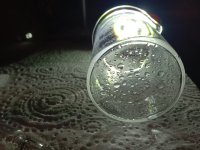
Not sure about the blobs, maybe some thing about water tension, or the NPS causing the galss to become more sticky, or a film counting the blobs. In any case it seems like something that you should resolve as you need full separation to pull the NPS cleanly.1) Why are there blobs in the water? What are the blobs? Is it DMT? (I get the same looking blobs when using Shellite for freeze precipitation).
Bcz water, even distilled water, becomes acidic as it absorbs CO2 from the air, the pinch of soda carb is to counter that and minimize dmt losses. The amount of soda carb you're putting is miniscule compared to the base soup the NPS was in contact with. So you won't be further contaminating the NPS unless it was ultra clean to begin with. And yes the base water can become suspended in the NPS but would you rather have lye or soda carb in your final product? The water wash minimizes the risks.2) Why do we basify the water when we are trying to get rid of base contaminants? Won’t adding base potentially contaminate the NPS further?
Over my pay grade!Cheers @DK_one. I had read that, but what I was wondering was can't the base used in the water wash also become suspended in the NPS, just as it does in the main extraction?
Awesome, thanks @Sakkadelic! That information is incredibly helpful. I'll read through that thread soonHey CheeseCat
The toluene turning cloudy might be because the added water cooled it down reducing the solubility of dmt in it, that's why the water wash is usually done warm to keep the dmt solubility in the NPS high (both the water and NPS are warmed). It could also be that the water became suspended in the toluene if you shook it vigorously.
Not sure about the blobs, maybe some thing about water tension, or the NPS causing the galss to become more sticky, or a film counting the blobs. In any case it seems like something that you should resolve as you need full separation to pull the NPS cleanly.
Bcz water, even distilled water, becomes acidic as it absorbs CO2 from the air, the pinch of soda carb is to counter that and minimize dmt losses. The amount of soda carb you're putting is miniscule compared to the base soup the NPS was in contact with. So you won't be further contaminating the NPS unless it was ultra clean to begin with. And yes the base water can become suspended in the NPS but would you rather have lye or soda carb in your final product? The water wash minimizes the risks.
You'll find this thread very relevant.
No worries, I appreciate the inputOver my pay grade!
Just wanted to hold you steady till someone gives you real awnsers...
Cuz I know sometimes the waiting can be harsh...
Could you try performing a wash just like you're doing on fresh solvent straight from the can? in theory they should stay seperate and nothing should happen, this will indicate whether the cause of murkiness is the dmt and plant material or something else.Hey, here’s a bit of an update @Sakkadelic...
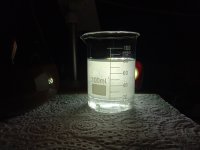
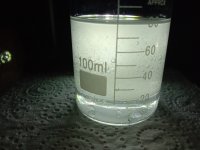
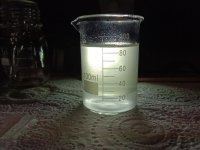
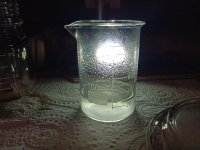
I tried a water wash again but this time heating both the water and the solvent. This prevented the clear blobs forming in the water portion but there were still blobs forming around the glass where the solvent layer was (see photo).
I noted the water was very murky after washing the solvent and I’m skeptical that the solvent I pulled would have this much contaminant suspended in it? Is it possible the water is washing other plant constituents out?
Both the solvent and the water became milky after being in contact with each other (prior they were both clear).
I’d love to know exactly why the water is so murky and if murky is considered normal? ( I used distilled water with added sodium carbonate and salt).
From here, I'll evaporate the solvent and investigate what I have retrieved.

You can also do a mini A/B, it's more effective than a water wash. It depends on what your goal is, if it's to remove base contamination then a wash would do, if it's to have a better chance obtaining purer crystalline dmt then a mini A/B.The sodium carbonate is probably 3 years old....seems ok though, no clumping. I tested the pH and the colour was a dark blue so I assumed it was all good. The water is ultra distilled bottled water with no impurities.
I’ll give just the toluene a water wash and see what happens, it's a good idea for comparison (thanks!)
The other thought I had was maybe a defat during the acidic stage might help, but I'm not sure
That maybe explains things, the acacia and broader extract with toluene pulls more stuff that are making the water murkye and possiby the other observations. I think the best simple path to obtain crystals with acacia is a mini A/B. So after the initial pulls (with shellite preferably) wash the pulls with acidic water, moving the dmt back into water, then remove the shellite and base, then pull with fresh shellite and freeze/precip.Yeah, obtuse does have a variety of constituents, likely more varied than other species.
Initially I was interested in crystals but I’ve abandoned freeze precipitation because I can’t find quality naphtha/heptane/hexane and unfortunately shellite results in melting crystals that turn into clear blobs after precipitation. I found shellite works fine with mimosa though (perfect crystals that don’t melt when drying) so there must be something in the composition of acacia crystals that favours being goo rather than a crystal.
Tbh, I’m not really a fan of goo as it’s hard to dose accurately and not ideal for storage but unfortunately acacia doesn’t seem to like the final stage of freeze precipitation so consequently I’m striving for a broader extract with toluene. It’s just the water wash stage that's doing my head in a bit.
After washing the toluene the water became murky with clear blobs attached to the surface of the beaker and the toluene became cloudy (it was close to clear before the water wash).
Yes and yes, if you wait long enough for full seperation and pull carefully, there won't be a need for a water wash, the main function of which is to minimise the risk of base contamination.Ah ok, I’ll definitely give that a go. Does a mini a/b further refine what is in the NPS, leaving behind fats etc? And no need to water wash after the mini a/b?