• Members of the previous forum can retrieve their temporary password here, (login and check your PM).

official extraction help thread

Migrated topic.
If you have a solvent that can freeze precip you should freeze precip. It's really not much more difficult, if at all.
not to mention, less environmental impact and you can reuse the solvent for less financial impact.
To more directly answer you question, i am not aware of any benefits to evap over freeze precip
thanks
 
Oh yeah, if I am doing an stb and not worrying about trying to get crystals, (just trying to get some kind of yield i.e goo) would it be better to evap instead of freeze precip?
If you're worried about not getting a good yield with freeze precip, it could be from using too much solvent. You want to use a relatively small amount of solvent so that it's saturated before attempting freeze precipitation. DMT's solubility depends on the temperature of the solvent. People warm up their soup before pulls to maximize the amount of DMT that goes in, leading to more that precipitates when cooled down. I'd bet one of the most common issues, with small extractions under 100g of bark, is using too much solvent.

Here's solubility data for DMT in naphtha:
  • Naphtha (20 °C, C6-C7) 2,93 g in 100 ml
  • Naphtha in the freezer (-20 °C, C6-C7) 109 mg in 100 ml
If you extract from 80g of MHRB, you can expect there to be at least 1% DMT in there, so 800mg. You're unlikely to pull the entire amount in one pull though, so you might expect 400mg from the first pull on 80g of bark.

You should use the amount of naphtha that would be saturated at room temp.

2.93g / 0.4g = 7.352
100ml / 7.352 = 13.5ml

Don't use more than 13.5ml of naphtha per pull on an 80g batch of MHRB. It's okay to use even less to stay on the safe side, 10ml each pull should ensure something freeze precipitates out.
 
Last edited:
If you're worried about not getting a good yield with freeze precip, it could be from using too much solvent. You want to use a relatively small amount of solvent so that it's saturated before attempting freeze precipitation. DMT's solubility depends on the temperature of the solvent. People warm up their soup before pulls to maximize the amount of DMT that goes in, leading to more that precipitates when cooled down. I'd bet one of the most common issues, with small extractions under 100g of bark, is using too much solvent.

Here's solubility data for DMT in naphtha:
  • Naphtha (20 °C, C6-C7) 2,93 g in 100 ml
  • Naphtha in the freezer (-20 °C, C6-C7) 109 mg in 100 ml
If you extract from 80g of MHRB, you can expect there to be at least 1% DMT in there, so 800mg. You're unlikely to pull the entire amount in one pull though, so you might expect 400mg from the first pull on 80g of bark.

You should use the amount of naphtha that would be saturated at room temp.

2.93g / 0.4g = 7.352
100ml / 7.352 = 13.5ml

Don't use more than 13.5ml of naphtha per pull on an 80g batch of MHRB. It's okay to use even less to stay on the safe side, 10ml each pull should ensure something freeze precipitates out.
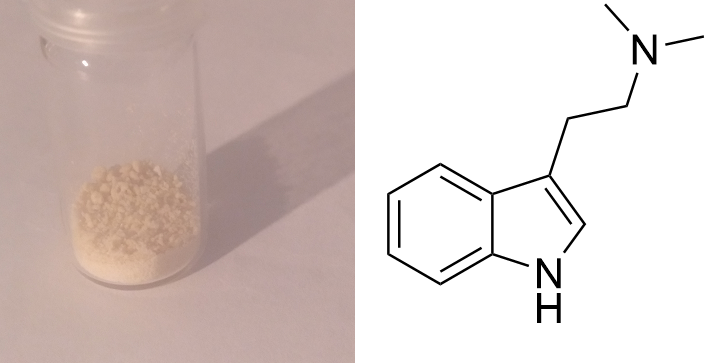
thanks for the proper data about how much naptha can carry at different temperatures
 
Here's the thread with the data:
You might find this useful too:
 
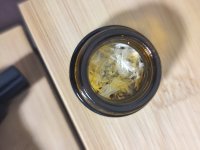
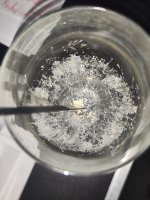
Hey Hellas and good morning world, no, seriously, I need help again. I made MHRB STB, washed it with water, precipitated it in the freezer, and recrystallized it in the glass shown in the picture. I scraped the crystals that formed in the glass with a spatula, and they're in the container in the first picture. Question: From removing the crystals, there are now these residues in the recrystallization glass, like a white gunk. They weren't there before, so they must have been caused by pressure and pushing. Are these residues caused by pushing, pressure, etc., and are they normal, or should they not be there at all? Or, conversely, are these NaOH impurities, which would really shock me.

IMG_20260422_175647.jpg

IMG_20260422_175536.jpg
 
Hey Hellas and good morning world, no, seriously, I need help again. I made MHRB STB, washed it with water, precipitated it in the freezer, and recrystallized it in the glass shown in the picture. I scraped the crystals that formed in the glass with a spatula, and they're in the container in the first picture. Question: From removing the crystals, there are now these residues in the recrystallization glass, like a white gunk. They weren't there before, so they must have been caused by pressure and pushing. Are these residues caused by pushing, pressure, etc., and are they normal, or should they not be there at all? Or, conversely, are these NaOH impurities, which would really shock me.

View attachment 109028

View attachment 109029
That's all DMT residue
Rinse with a small amount of everclear and evaporate on a plate you can more easily scrape off of. If you cant get everclear where you are, you can use IPA or Acetone.
 
Ok thanks!

More about the worries the water wash failed....
But ya, will try to recrystall it.

In the container is a bit polymered yellow, since I work with 100/120 nps.
But will try the 40/60 again next time, again.
 
Thanks, used a stb similar to lazy man’s tek, but if what DrPotato said is true about dry lye frying dmt/ degrading it i think that might have been where I went wrong as I added some extra to my base\bark soup, I realise now also that goo isn’t really that bad of an outcome, was reading a thread where people said goo was all that was available back when extractions were a new thing, will try again soon with a larger quantity of bark (also a different part of the bark) and update with my results. Also this forum is such a great learning resource :D
it will do it a little bit, but probably will cause polymerization that wont resolve if its not subject to a strong acid. But i should emphasize incase i didnt, that there is limited contact. so its not like its going to ruin all of it, or even half.

overbasing in principle though might be responsible for preventing crystalization, since polymeric material will not resolve itself into crystals, and in the presence of trace fats or oils, it doesnt even take a majority of polymer to inhibit your monomer from crystalizing. but a mini AB with a nice strong acid to depolymerize, and a mild or controlled base to re-basify with, will fix that easily.
taking too long in your workup, exposing dmt to excessively strong base, might result in a large amount of polymer buildup. in my case i cant get a full yield without emulsions adding an extra day or two to the process. fortunately a mini AB is really quick, clean and easy.
 
Last edited:
Ran a cielo run, and I think it was a success. Let crystals dry in coffee filter after EA rinses for about an hour. Chopped up on a crystallizing dish and let to sit out for a half day before putting it in a vial. Opened it up the next day, and smell of EA still lingered. Dumped it back out and thinned it into an even layer and did the same process each time letting it sit out for at least 8 hrs in the crystallizing dish. It's been almost a week and I can't quite smell anything but is there anyway I can be sure it's safe? Someone said acetone wash? I guess just dump it into a coffee filter and wash with acetone, let it dry. Thanks for any help and I hope this is the page to post this question.
 
Ran a cielo run, and I think it was a success. Let crystals dry in coffee filter after EA rinses for about an hour. Chopped up on a crystallizing dish and let to sit out for a half day before putting it in a vial. Opened it up the next day, and smell of EA still lingered. Dumped it back out and thinned it into an even layer and did the same process each time letting it sit out for at least 8 hrs in the crystallizing dish. It's been almost a week and I can't quite smell anything but is there anyway I can be sure it's safe? Someone said acetone wash? I guess just dump it into a coffee filter and wash with acetone, let it dry. Thanks for any help and I hope this is the page to post this question.
The tiny trace of ethyl acetate will be harmless. It occurs naturally in apples. But do an acetone wash if you want.
 
Ran a cielo run, and I think it was a success. Let crystals dry in coffee filter after EA rinses for about an hour. Chopped up on a crystallizing dish and let to sit out for a half day before putting it in a vial. Opened it up the next day, and smell of EA still lingered. Dumped it back out and thinned it into an even layer and did the same process each time letting it sit out for at least 8 hrs in the crystallizing dish. It's been almost a week and I can't quite smell anything but is there anyway I can be sure it's safe? Someone said acetone wash? I guess just dump it into a coffee filter and wash with acetone, let it dry. Thanks for any help and I hope this is the page to post this question.
BTW, CIELO-specific questions can also go in the CIELO thread, or the "cactus - preparation" section.
 
just thought of a lil phrase to help good lye mixing practices "every time, water then lye, remember this rhyme if you don't wanna die" (might be abit exxagurating) lolz does that count as extraction help
 
I've been having a lot of issues with my first few extractions. Some small success but continual issues. Today i ran through Cyb's Hybrid ATB tek (MHRB) and followed it to a letter and have run into the same problem. I am now assuming that the heptane I've been using this whole time is failing in some way. All of the other steps seem to mimic my expectations (based on research here and the tek) until i put in the heptane. I very gently figure 8 the solution around for a about a minute and then it never separates. In past attempts I've added absurd amounts of lye, i've doubled the water, etc etc. All to no effect. The only thing that ever worked was a prolonged hot bath that resulted in a rather extreme sports goo. So.... here I am again in the same scenario hoping to navigate it better. . I will replace the heptane for my next run but my current batch is an issue. Any ideas other than a hot bath? Appreciated!
 
I've been having a lot of issues with my first few extractions. Some small success but continual issues. Today i ran through Cyb's Hybrid ATB tek (MHRB) and followed it to a letter and have run into the same problem. I am now assuming that the heptane I've been using this whole time is failing in some way. All of the other steps seem to mimic my expectations (based on research here and the tek) until i put in the heptane. I very gently figure 8 the solution around for a about a minute and then it never separates. In past attempts I've added absurd amounts of lye, i've doubled the water, etc etc. All to no effect. The only thing that ever worked was a prolonged hot bath that resulted in a rather extreme sports goo. So.... here I am again in the same scenario hoping to navigate it better. . I will replace the heptane for my next run but my current batch is an issue. Any ideas other than a hot bath? Appreciated!
Have you tried to recrystallise the goo? also nothing wrong with goo imo, good smoke
 
a few things cause emulsions, you can get it because something is disrupting the barrier between phases, like an emulsifier, anything can become one of these but, if your material seems kinda foamy that could do it. Otherwise, if the phases are too similar, one reason excess lye is advised is its affinity for water is so great it crashes other things out, but its also just endlessly soluble and results in potentially, extremely dense water, this is half of why overbasing is done, besides reducing solubility of literally anything else and altering the charge on the water, it also just straight up makes the water much denser, a barely ph14 alkaline sodium chloride brine will perform similarly to like, 10% lye solution in many situations. the greater the density difference the more rapidly you should see seperation occur.
instead of something interfering with surface tension via some weak surfactant, something that can occur is physical emulsifiers, which need only be very fine particulates. calcium silicates and fluoride precipitates can cause this, basically just common stuff in your tap water. they form annoying precipitates that dont go away once they form, they show up looking like a waxy skin that wraps around the smallest bubbles of your solvent, and they kinda flake away a bit once things do settle. what they are is just solvent wicked around particulates too small to interact with the main volume of solvent, so they stay trapped floating in the water. these can be avoided by using demineralized water. if you have copper in your water, it interacts with calcium and soluble silicates to form the absolute most annoying form of calcium silicate, sulfate, or perhaps just silica, imperceivable quantities of this will clog a vacuum filter.
the lack of seperation may resolve if you add a bunch of salt, just make sure its not pool salt that contains calcium or magnesium, or else youll get a bunch of precipitate. its handy to keep a bottle of salt slurry on hand, full of a saturated brine, it makes the water more dense and adding it can do things that may give insight, like crashing stuff out, or settling at the bottom and clarifying the solution there indicating a density problem, or running tests in a test tube.

if you go with a quicklime base method, you can use calcium chloride to saturate your solution.


a hot bath is needed to get heptane to dissolve your DMT, heptane is a poor solvent for DMT, which is kind of the point. this is why i dont use naptha or hexane anymore for my initial pull, it has to actually be hot or else it wont do very much. a long contact time will more than make up for a lack of stirring though. and the hotter it is, the more it will seperate, this is almost universal in fact, most things that emulsify in water will seperate when heated close to boiling.
Its probably fine to just shake it like crazy into danger-milk while warm, but not so much vapors present a pressure problem, then put it in a hot water bath at 60C or whatever is recommended for heptane, and once it seperates, thats probably going to pull most of it. if your vessel permits, actually pushing it past 80 or almost simmering with a quick stir at the end, would be ideal.

to avoid the hot bath, use a solvent DMT is actually soluble in. toluene, DCM, chloroform, ether, maybe ethyl acetate but you need to salt it and be really gentle with basifying (sodium/potassium carbonate) or youll hydrolyze it and end up with ethanol, limonene, xylene, and if you salt the living daylights out of it, even acetone and isopropanol have precedented phase seperation, though thats highly experimental, and not neccesarily as applicable to a DMT wet process, dry maybe, but not wet.

using other solvents, you then end up with oil or goo that must be dissolved in hot heptane after the solvent is removed, and recrystalized. ideally it ought to be mini AB'd as this will fix any polymerization that occured, and in the case of DCM/chloroform, you might want to defat it first. unless exceptionally pure, DMT wont crystalize out of anything its VERY soluble in, or may struggle to. So thats the tradeoff, two extractions, granted the second one scales down to like 50ml or something, otherwise you have to deal with hot hex/heptane.

if you have a test tube, try experimenting to see what salt and heat does to the seperability after violently shaking it. similarly, what effect demineralized water has. PS, distilled vinegar used as your sole water source satisfies this too.
 
Last edited:
I've been having a lot of issues with my first few extractions. Some small success but continual issues. Today i ran through Cyb's Hybrid ATB tek (MHRB) and followed it to a letter and have run into the same problem. I am now assuming that the heptane I've been using this whole time is failing in some way. All of the other steps seem to mimic my expectations (based on research here and the tek) until i put in the heptane. I very gently figure 8 the solution around for a about a minute and then it never separates. In past attempts I've added absurd amounts of lye, i've doubled the water, etc etc. All to no effect. The only thing that ever worked was a prolonged hot bath that resulted in a rather extreme sports goo. So.... here I am again in the same scenario hoping to navigate it better. . I will replace the heptane for my next run but my current batch is an issue. Any ideas other than a hot bath? Appreciated!

Can you show us the labels of both your heptane and your lye? Your situation sounds like there's some kind of detergent effect involved somewhere.

One more thing - what kind of water are you using?
 
Back
Top Bottom