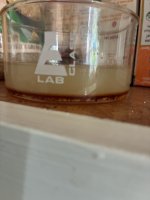
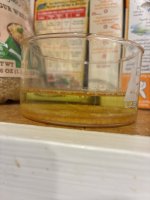
psilocybin
Rising Star
Any questions or problems you may run into during an extraction can be asked to get other members input in this thread.

thanks, just got a bit of goo off my first pull of an ATB with 50g Acuminata bark, ill see how much i get off it and if i think its worth it ill try a mini a/b - have wanted to try a proper hit of the goo/spice so keen to give it a whirl. Do you think freeze precip would be better to form crystals than evaporating for any reason? I evapped this pull.Mini A/B - the acid phase does a good job of breaking up the polymer. Ime, re-x of polymeric goo tends to be wasteful and confusing, as different sizes of polymer dissolve at different temperatures.

While they can both produce good results, freeze precipitation would tend to produce purer crystals, although slow evaporation is the favoured way of producing large crystals.Do you think freeze precip would be better to form crystals than evaporating for any reason?
Small detail, but it might be better to add the hot heptane to the crystals, for more precise control of the solvent ratio. There is a slight issue with the low melting point of at least one of the DMT polymorphs - and all of them melt at a lower temperature than boiling heptane, of course. In that case, a more careful addition of the right amount of FB powder to somewhat cooler heptane could bring better results. Oiling out is more likely to occur if the solvent is oversaturated. This is something that tryptamines are particularly prone to do, especially if the DMT already starts crashing out of the heptane at a temperature above its melting point.I heat up the heptane in a crystalizing dish. Wait till I start to see bubbles and toss the Fb from an STB extraction
Thanks for the insight. In the hot water bath I don’t think the heptane was up to boiling but I’ve checked it before at that point and it was 140-160. Shulgin remarked there were many different ranges of crystallization temps and my old method use to produce great white fluffy crystals. I just never use to have an issue with this. I have tried lower solvent temps and have the same issues, could be bad heptane maybe. What mini ab tek would you recommend? Also as far as basic chemistry regarding these extractions, is there somewhere I can find out about basic terminology? My chemistry knowledge is lacking for sure.Small detail, but it might be better to add the hot heptane to the crystals, for more precise control of the solvent ratio. There is a slight issue with the low melting point of at least one of the DMT polymorphs - and all of them melt at a lower temperature than boiling heptane, of course. In that case, a more careful addition of the right amount of FB powder to somewhat cooler heptane could bring better results. Oiling out is more likely to occur if the solvent is oversaturated. This is something that tryptamines are particularly prone to do, especially if the DMT already starts crashing out of the heptane at a temperature above its melting point.
If polymerisation has become an issue - perhaps due to the starting material, for example - you'll likely see better results if you run the initial product through a mini A/B and crystallise carefully from that.
Reading it over, looks like I can pull it off. Does it matter what kind of salt? Iodized, or non-iodized? Also for the RE-X in this tek, can naptha be swapped with Heptane? Or would that cause an issue at that temp? Thanks
yescan naptha be swapped with Heptane
Thanks againnon-iodized
yes
 - Used 'Acacia acuminata minimalist ATB (50g) bark' (dont think the tek is on here found it on reddit), a small yeild but it was expected as i tried evapping half my solvent and tried to precip the other half just to see the difference - got more pulls to go so will defs freeze precip from now on. Super stoked much appreciate the help. Got more pulls to go as well so super keen to see how much I get in total
Teflon is effectively inert to lye solutions at our usual working temperature, as is stainless steel. Only significantly stronger bases like butyl lithium start causing discoloration of the teflon, while stainless steel starts getting noticeably attacked by highly concentrated lye at a significant rate somewhere above 180°C. Resistance of the steel will depend on the particular alloy, as well as whether there is any contact with alloys of a more inert composition, but it will be practically unaffected by short term contact with aqueous alkaline solutions at room temperature.Ok, I have a magnetic stirrer and by this circumstance I got Teflon stirring things....
Question: I only found information that Teflon is not affected or attacked by lye water even if high lye for stb, is this correct?
Anyone got better knowledge or superior Infos?
Samen question for a stainless steel filter, would it work for a lye soup?
Noticed the language thing. Will try to not post with a beer to much again.
Brownish. Unfortunately that's hard to distinguish from mimosa dye, except the latter should be removable with a short treatment using hypochlorite bleach.Discoloration? You mean if it gets transparent?
Or you mean the Teflon gets brownish?
I forgot the stirring rods in soup for a few days then I was to lazy and so on. Now one of it got slightly brown edges..
Yes, that sounds like a sensible plan. I'm no angel when it comes to abandoning half-finished projects, so it's very relatableOk, G2 let this sink...
2 of 5 rods are messed maybe...
Means I will remove the rods with priority in future over nights ...
Guess I am cool then?!
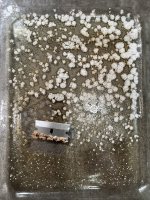
Was this with warm/hot naphtha? It may well be that above a certain saturation, and at temperatures above the melting point of the lowest-melting polymorph of DMT, you'll be far more likely to see the initial precipitation falling out as amorphous goo. Its dark colour does strongly suggest the presence of oligomers, which also aligns with your 90 minutes of base contact time.hmmmm. so, another run of Cybs' Hybrid ATB 'Salt' Tek and there appears to be a layer of the same reddish goo underneath the crystals. I followed the tek to a letter again this time. Lye phase ran for 1.5 hours prior to naptha phase. DId 3 pulls and froze overnight. Anything this can be besides polymerization? What should i do?
View attachment 109363
Keep it down to 40°C max in the soup itself, and get the pulls done sooner and more quickly if you can, and try adding only the absolute minimum of lye, which you can balance out by adding a little more salt if necessary (up to the solubility product for NaCl, of course).(Please Note: Heat baths should 'WARM' the mix...NOT heat them excessively.)
approx 40-55*C bath water is optimal.
Thanks, Transform! yeah, warmed naptha. not doing that again. room temp naptha from here out for this guy. I appreciate the tips and will dial those in.Was this with warm/hot naphtha? It may well be that above a certain saturation, and at temperatures above the melting point of the lowest-melting polymorph of DMT, you'll be far more likely to see the initial precipitation falling out as amorphous goo. Its dark colour does strongly suggest the presence of oligomers, which also aligns with your 90 minutes of base contact time.
Try separating the goo off during the dissolving phase of a re-x, the run it through a mini A/B to break up the oligomers. The oligomers are less soluble than DMT, and close observation of their solubility behaviour during temperature cycling of heptane (or light-medium naphtha) solution becomes more easily understood in light of it consisting of a mixture of poorly-soluble, intensely-coloured compounds besides tie monomeric DMT.
I wonder if you'll be able to get goo-free results by further minimising base contact time, and keeping soup and solvent temperatures a bit lower (if you had been heating either of them).
Keep it down to 40°C max in the soup itself, and get the pulls done sooner and more quickly if you can, and try adding only the absolute minimum of lye, which you can balance out by adding a little more salt if necessary (up to the solubility product for NaCl, of course).