• Members of the previous forum can retrieve their temporary password here, (login and check your PM).

PH too low on Kash AB mescaline extraction

Migrated topic.

Madhattress

Established member
Joined
Dec 2, 2022
Messages
278
Merits
290
Hi guys,

So i did my first ever AB extraction with HCl. Everything went perfectly until i did the last step with HCl to lower PH. When i added my 1 ml (i did .5 increments) it made my water layer containing the alkaloids far too low. Ph 2.5.


Now i am unsure what to do to rectify this. Do i evaporate the crystals and then readd them to my zylene and redo the acid extraction/H20 with a far lower amount of HCl?

Any suggestions would be helpfull.
 
I can suggest two options.

1) Continue with the TEK as is. Too low of a pH is not a big issue. You may have pulled extra stuff into the acidic water as more things become soluble in the lower pH. Slightly dirtier product, shouldn't be an issue.

2) Base the 2.5pH water, re-pull with xylene 5x times, and titrate again. This is a bunch more work. Personally I would not do all this extra stuff for the sake of less contaminants. They should be in trace amounts.

Do i evaporate the crystals and then readd them to my zylene and redo the acid extraction/H20 with a far lower amount of HCl?

No, the xtals won't dissolve in xylene. You need to base the mescaline.
 
Loveall said:
I can suggest two options.

1) Continue with the TEK as is. Too low of a pH is not a big issue. You may have pulled extra stuff into the acidic water as more things become soluble in the lower pH. Slightly dirtier product, shouldn't be an issue.

2) Base the 2.5pH water, re-pull with xylene 5x times, and titrate again. This is a bunch more work. Personally I would not do all this extra stuff for the sake of less contaminants. They should be in trace amounts.

Do i evaporate the crystals and then readd them to my zylene and redo the acid extraction/H20 with a far lower amount of HCl?

No, the xtals won't dissolve in xylene. You need to base the mescaline.

Thanks for the advise. I think ill just skip and do option 1. Is ot normal for the h20 pull to be clear?

Also going to start the cielo tek tomorrow and see how it goes. 🙂
 
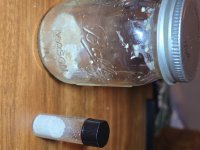
I did Kash's A/B test from 100g of San Pedro dried powder material. I have a concern, as I yielded 8.5g. According to the lit, San Pedro should only consist of .1 - 2.3% of mescalin with rare extreme cases being 4.7%. So I have about 2x the amount of the maximum rare case scenario. The product I came up with is a light grey sandy material that clumps up easily. It melts into an annoying oily material at just above room temp. If I hold the glass too long it melts, and is difficult to work with. I washed it 2x with ice cold MEK, and the MEK stayed clear after decanting. (Although my product did look a little closer to white after the washings) I'm concerned that I pulled more than just mescaline from the procedure. Anyone have any idea on what I have here or next steps to produce a more pure result?
 

Attachments

  • 17891437791248233894471824433751.jpg
    17891437791248233894471824433751.jpg
    1.1 MB · Views: 5
Last edited:
It doesn't seem right, you have some impurity there and quite a lot of it. Could you describe in more detail your extraction?
I followed the Kash AB extraction process, used toluene as my solvent. NaCl solution as my base, and HCl as my acid. My HCl was 32%. I wonder if the conditions were too acidic and pulled more than intended.
 
I accidentally got some water in it, so now I have it in the dehydrater, after a few hours im going to do another cold MEK washing. Or maybe acetone.
 
NaCl? You mean NaOH?
When you separated the toluene, are you sure there was not any water with it? How did the toluene look after separation? Was it clear?
When you say you accidentaly got some water in it, where was it from?
What was your final PH after addition of HCl?
 
Last edited:
Yes i meant NaOH. I should've taken notes as I went because I do not remember all the specific numbers. I thought I followed the process to the T though. I had my product in a 50ml beaker, in an ice bath. As i was stirring a ml or 2 seeped in. But, I think i was able to save it. I evap'd the h2o and did a cold MEK wash, then a cold acetone wash, which i think helped the most. Anyway after the product dried, I still had some off-white oily clumps, but I noticed at the very bottom I had a bright white layer stuck to the bottom. I carefully broke off the top part, before it warmed up and got too oily. The bottom was a beautiful white free-flowing powder. I weighed it and got 1.1g. I might try another acetone wash because there's probably another half gram of good stuff stuck to the impure stuff i removed. I'll test it next week to verify and post an update.
 

Attachments

  • 20260912_000258.jpg
    20260912_000258.jpg
    1.3 MB · Views: 4
Any water remaining in the toluene after separation is problematic. It can carry impurities and sodium hydroxide (NaOH), which will later form sodium chloride (NaCl) upon the addition of hydrochloric acid (HCl). Therefore, ensure there is no water in the toluene next time.

To remove any remaining water and sediments, leave the toluene in a fridge overnight. There are always some sediments, which you want to avoid. Decanting the cold toluene will separate them effectively.

The step of adding HCl must be performed cautiously. Adding too much HCl (which is very easy to do) will introduce significantly more impurities into your final product. Always use a weak acid, not a strong one, to allow for proper dosing.

Washing should be done with anhydrous MEK and acetone. Otherwise, you risk losing alkaloids. If you don't have solid crystals that you can crush to a fine powder before washing, this step is not recommended.

Tasting the product (or its intermediate parts) can offer clues about its composition: if it's salty, you likely have NaCl. If it's sour, residual acid is present. A bitter taste, however, indicates a good result.
 
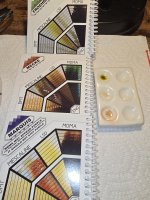
I appreciate the info. I did some testing on what I produced. TLC showed a single spot with Rf being .4 which is a great sign...but, I performed a few more, the Froeme, Marquis, and Mecke. They all looked good except the Marquis. It didn't get dark enough by a mile.8236.jpg8251.jpg
 
It would be helpful if you'd labelled which of the wells on the test tile was corresponds to which reagent. The order in which you've laid out the colour charts does not appear to line up with the tests, so there's only a one in six chance of it being right. It might be a good idea to repeat the tests with some labelling to avoid confusion.
 
T
It would be helpful if you'd labelled which of the wells on the test tile was corresponds to which reagent. The order in which you've laid out the colour charts does not appear to line up with the tests, so there's only a one in six chance of it being right. It might be a good idea to repeat the tests with some labelling to avoid confusion.
They go in order of the guides down. So the bottom well is the Marquis and so on.
 
So Mecke, the middle one, is the concerning one. Anyone have any idea why the other tests would suggest mescaline, but Mecke is the only outlier. I wonder if Mecke has more sensitivity to an impurity that is present. Im going to look into the Mecke test a little more and see what I see. I think I'll do the taste test too.
 
It would be helpful if you'd labelled which of the wells on the test tile was corresponds to which reagent. The order in which you've laid out the colour charts does not appear to line up with the tests, so there's only a one in six chance of it being right. It might be a good idea to repeat the tests with some labelling to avoid confusion.
You're right, Ill test again tonight.
 
What's the problem with Mecke? The color seems right, only too light. It could be just a matter of it being too diluted, maybe your sample was too small. If I'm not mistaken, an impurity could make Mecke change into a different color than it should be, but not make it not react to mescaline. In other words, no change of color would indicate no mescaline, but there is a change of color, only too light. I'd repeat it making sure the sample is big enough (without being too much).
 
Back
Top Bottom