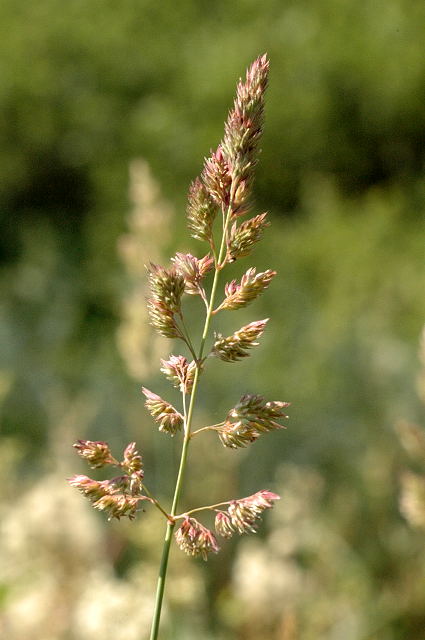
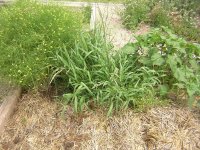
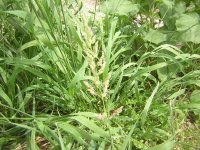
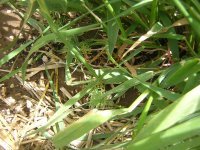
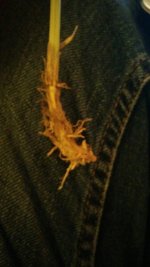
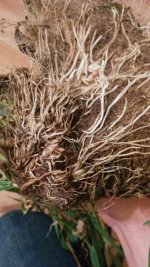
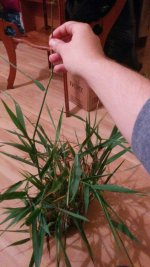
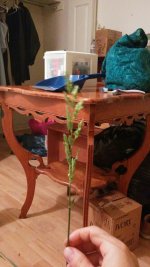
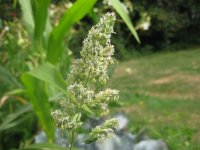
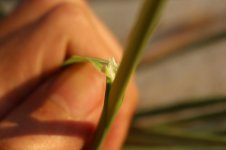
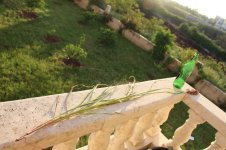
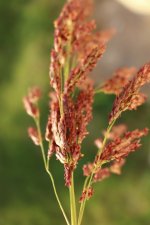
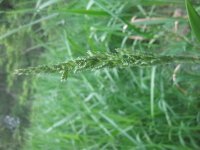
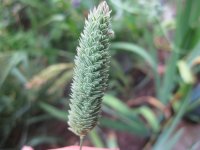
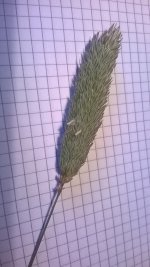
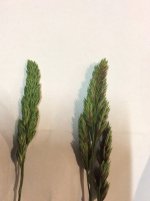
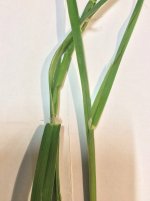
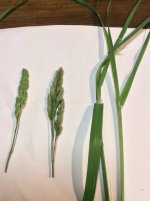
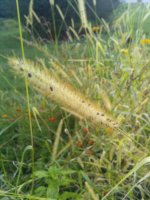
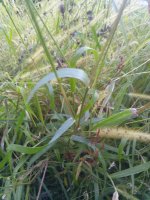
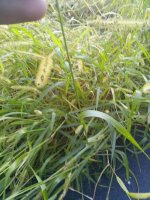
What you have there I believe is Phalaris Truncata.
It is very close in appearance to P. Paradoxa.
If you could post rhizome and aerial foliage photos, that would aid with identification.
The P. Paradoxa rhizome spreads out a little bit like crab grass(Digitaria Sanguinalis).
P. Truncata foliage is a bit thinner, the stem usually shorter, and the rhizomes not as adventitious.
Depending on your geography we could pin point 100% accuracy.
P. Minor would also be a similar strain. P. Minor looks more like Aquatica with more of a stunted inflorescence and appears to be a smaller growth form of Aquatica.
Another indicator(in simple terms) is that P. Paradoxa during anthesis sometimes shoots out tiny "hair-like" extensions from the floret and is a bit more "poofy" than Truncata.
Truncata appears to have more of a bold camouflage green tone whilst Paradoxa may tend to lean towards the purple side of things.
You may observe in the photos contained within the PDF I attached, that Paradoxa seeds if taken prior to when the seed-head is dried, will resemble a "V" shape with a seed in the middle. That's how you know these seeds are viable. If there is a "V" with a gap in the middle then no seed.
Dismantle the floret and see if you find isolated "V"'s with seeds amidst.
This is a tricky one. I have grown both of these strains with great variation in seed-head formation. If in fact you DO find the "V"-like structure found in these photos, please post back on here and we'll settle this once and for all.
Note that aside from P. Arundinacea, there is still a large plasticity within the morphology of Phalaris florets. Not to say they're drastically different, though they may differ in size and color tone from plant to plant.
Phalaris Truncata analyzed by Festi and Samorini contains possibly usable amounts of DMT, NMT and 5-Methoxy-DMT. Other alkaloids may be present.
Also, if this means anything P. Truncata is listed as a variety of P. Brachystachys, though P. Brachystachys var. Truncata is synonymous with P. Truncata.
This key to Phalaris may help with identification. Also I would recommend Agnes Chase's First Book of Grasses to brush up on botanical terms for the Poaceae.
P. Truncata from my knowledge only exists in Europe and North Africa like Tunisia and Algeria.
P. Paradoxa grows wild in the Pacific Northwest down through Mexico and eastward into other parts of the USA. Also, Paradoxa has begun its invasion of Chilean crop fields and parts of Peru.
To conclude, I believe it is P. Truncata. More photographs would provide much more detail and validation. The grass is active. You won't find human bioassays online. Phalaris Paradoxa is also active through smoked/vaporized extract and ingestion with MAOI.
Thanks for posting this! The grass calls...