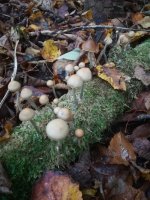
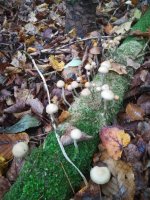
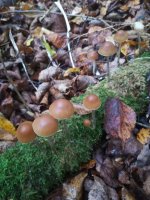
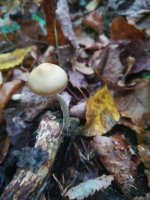
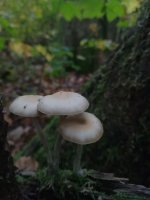
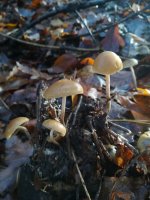
Some photos of this year's season of Psilocybe serbica/bohemica findings.



They are more potent than liberty caps. I have not tried a solid dose yet with these mushrooms. However I did try microdosing. A 1/4 of the normal cap was more than enough for that purpose. I find they have an uplifting spirit, similar to liberty caps in the microdose range. Much better than P. cubensis IME. Cubensis was much heavier for me compared to P. serbica/bohemica and P. semilanceata.dithyramb said:Beautiful! Thanks for sharing! How do these beauties compare to Liberty caps in potency, energy and spirit?
I have plans to try and cultivate those mushrooms. Also I plan to report and how it goes here on the DMT-nexus. They grow well from the already decayed logs where only cellulose remains. Also they grow from the wood debris mixed with the soil.downwardsfromzero said:Lovely pictures!
It's particularly interesting that P. bohemica grows out of solid logs. This would be a fun one to cultivate.
The mycelia seems very strong therefore I belive it would be quite easy to clone and replicate from mycorizza.Lovely pictures!
It's particularly interesting that P. bohemica grows out of solid logs. This would be an fun one to cultivate.


Well spotted, I'm sure our friend meant to write "rhizomorphic mycelium" - perhaps mycorrhiza has been a trendy term of late so I can see how this may have influenced @Prima Materia's thinking.I hate to do the "uhm actually", but i cannot stop myself. Actually, Psilocybe species don't form mycorizza.
Anyhow, keep us posted on how the cultivation efforts go. i am very intrigued by this species.
Yes, indeed, I meant to say rhizomorphic mycelium.Well spotted, I'm sure our friend meant to write "rhizomorphic mycelium" - perhaps mycorrhiza has been a trendy term of late so I can see how this may have influenced @Prima Materia's thinking.
And yes, we do need to see some culivation logs - of both kinds!
That's awesome news! I'd be very interested to see just how close to P. cyanescens this will turn out to be, since there are claims that all three are conspecific (i.e., essentially the same.)i recently gor some spores and started cultivating. innoculated some lc yesterday. will keep u posted here or in a new thread
I was referring to the thread title: P. bohemica, serbica, and cyanescens being the three (or one). [From a European perspective, at least - North American cyanescens appears to be distinct when viewed microscopically.] And I ought to brush up on things mycological, really, since presumably there have been consicerable advances in molecular phylogenetics and clade analysis since I last looked. Where might one find a current summary?What do you mean with "all three"?