TheResearcher
to use your head, you have to go out of your mind
just wondering or is it a matter of the materials it’s made of
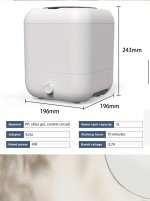


Er, what is it? A water filter? A dehumidifier? What were you planning to use it for?

Answering this is still quite important if you want to get any meaningful inputWhat were you planning to use it for?

Oh I see - and were you planning some kind of 'off-label' use? Or do you just want to know if it's worthwhile as a functioning device?it’s mini washing machine, you can get 5L to a 15L
Answering this is still quite important if you want to get any meaningful input
this is the alternative use my buddy was looking for. 200-500g plant material use. can i post a link yall can check it out maybe get a better understandingTbf, I've sometimes thought about using a washing machine for phalaris extraction, so this device might be of use for the acidic brews of plant material. It might well be fairly alkali resistant too.


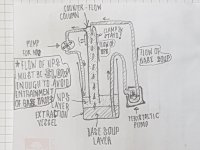
I think I'd go for the peristaltic pump idea, for circulating basic sludge through the NPS, ideally in a fairly tall, thin column, with the NPS being circulated in the opposite direction, up the column.
do you happen to have a pdf or list of the making of this device and where to acquire it. also have you entertained this process and have had success?I think I'd go for the peristaltic pump idea, for circulating basic sludge through the NPS, ideally in a fairly tall, thin column, with the NPS being circulated in the opposite direction, up the column.View attachment 100111
It's a simplification of some of the general ideas of counter-current liquid-liquid extraction. It should be accessible to the home hobbyist using some fairly readily available (and suitably resistant) materials.do you happen to have a pdf or list of the making of this device and where to acquire it. also have you entertained this process and have had success?
could you elaborate possibly on that. you have my full attentionIt's a simplification of some of the general ideas of counter-current liquid-liquid extraction. It should be accessible to the home hobbyist using some fairly readily available (and suitably resistant) materials.
i like the explanation. might be able to get my hands or get in contact with a glass blower. what if you used one of those cannabis bongs with the twisty twirly thingy cut the neck of the bong or get a big enough one. so silicone is okay with the base solution and acidic nps.At its simplest, I could envisage this being achieved with the two pumps, a large jar, some flexible pipe, a wider piece of (ideally, stainless) steel or glass tubing, a few bits of thinner glass tubing and a 2-holed silicone bung, along with a stand and clamp or two. Glassblowing skills would open up the possibility of making a more satisfactory column - being able to look inside it is something of a bonus. The column also could be made by chopping up a spare Liebig condenser, especially one of the old ones without Quickfit ground glass joints. Otherwise you'd have the pipe with the silicone bung and a couple of bits glass of thinner glass tubing to connect up to the piping and pumps. I'd suggest some kind of valve to regulate the NPS flow as well.
[Countercurrent extraction is actually a separate technique for separating substances with similar distribution coefficiets, so I'm taking a bit of a liberty in using the term here.]
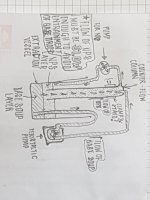
The idea behind the design illustrated in the sketch is simply another way of maximising contact between the aqueous and non-polar phases. With a small modification or two it could also be used for continuous extraction rather than the cyclical mode shown.
 type. that’s advance reading. maybe a a small dremel motor with a stainless steel stirrer rod or glsss rod doing a slow overhead stirrer. love to make a mini version of this creation to give it a decent try. has anyone in particular you know or anyone’s knows that has done this in the recent years with good success mmmmmm…..
The main thing would be to have the inlet pipe for the aqueous phase extending inside the column a little way below the outlet port for the naphtha. Silicone would be good for pipes that need to be flexible, but the chemical compatibility and resistance of the particular cure type of the silicone should be checked beforehand - iirc, platinum cured is best. Polypropylene may also be acceptable where semi-rigid pipes would be OK.i like the explanation. might be able to get my hands or get in contact with a glass blower. what if you used one of those cannabis bongs with the twisty twirly thingy cut the neck of the bong or get a big enough one. so silicone is okay with the base solution and acidic nps.
Overhead stirring would be a lot simpler, indeed!god damn i feel the workers in my their heads are spinning aka brain trying to wrap its cells around thst article. i understand. never was a school person. more hands on see with eyeballs