• Members of the previous forum can retrieve their temporary password here, (login and check your PM).

Research Sceletium alkaloid extraction

Research done by (or for) the DMT-Nexus community
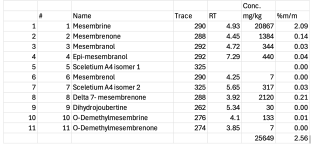
I sent a sample of my clone plant material for testing. Unfortunately, I could not get the extractions from the original post analysed, as they have their own standardised method to analyse Sceletium alkaloids. Nonetheless, I am quite excited about the results. 2.56% total alkaloid seems to be high, as literature generally reports 0.4 - 2%.

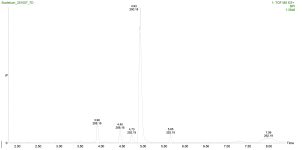
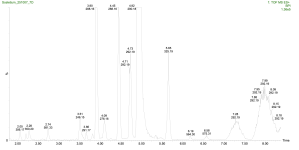
The lab mentioned mesembrenone quantities are slightly lower than what they usually see, while delta-7-mesembrenone was higher. And an interesting peak at 7.99 min with a m/z of 292, which is thought to be epimesembranol and has not been observed by this lab before (they run quite a few Sceletium samples for industry).
 

Attachments

  • Sceletium results.png
    Sceletium results.png
    180 KB · Views: 6
  • Sceletium results1.png
    Sceletium results1.png
    118.2 KB · Views: 5
  • Sceletium results zoomed.png
    Sceletium results zoomed.png
    211.9 KB · Views: 5
Interesting, thanks. 2.56% of dry weight is solid, but I don't think it's unusual for cultivated material. The literature has more wild types, which I guess are mostly weaker without the artificial selection. Did you apply any kind of drought or salt stress before harvest? If not then you can probably push those same genetics significantly higher (preferably on a clone, since I've killed plants that way).

The elution order for their epimesembranol is consistent with Patnala's thesis. The m/z looks right, but there are two peaks and not one, at 7.28 and 7.99 min. Patnala's epimesembranol eluted in a single peak, like in his Figure 3.16a. Are they able to explain this? If not then it would be interesting to investigate further. I've also seen two late peaks with different RT, which I can't explain.

I guess the fragmentation pattern could reveal that one of the peaks isn't actually epimesembranol, but I don't immediately see what else would have that m/z. If you've got the lab access then you could offer to prepare synthetic mesembranols, like by sodium borohydride reduction of purified mesembrine (or even just the crude alkaloids). That reaction appears to produce both epimers, possibly with ratio controlled by reaction temperature; but mesembranol is well-separated from our two mystery peaks, so there's perhaps no need to purify before analysis.

From my own sampling, I believe the mesembrine:mesembrenones ratio has a strong genetic component, stronger than the absolute alkaloid concentrations. I wonder if that lab typically analyzes samples from a single clone, or if they typically get mixed samples over populations. Sceletium is so easy to clone that I'd have guessed commercial growers would choose that for both convenience and consistency, but I have no actual knowledge.
 
The material was a couple of months old, mostly just from branches and leaves that had died and dried out on the plants. I've recently taken a bunch of cuttings from my plants and want to let them get nice and big, then I'll also try some drought stressing.

I don't think I'll have the time right now to work on Sceletium. It is tempting to reduce the mesembrine and maybe add some different alkyl groups and do some bioassay a la Shulgin.

This lab analyses both commercial samples and wild samples for studies.

Yes I'm a bit confused by those two peaks. I'll try find out a bit more. They also mentioned that just after the 7.99 peak there is something which elutes with a m/z of 294 and formula C17H28NO3 (protonated form of epimesembranol?).
I figured I'll provide the method here too:
LC-MS method Sceletium

Extraction: 0.5 g in 10 ml 50/50 H2O/MeOH with 1% FA. Diluted 10x with MeOH.

Instrument: Acquity Ultra-High Performance Liquid Chromatography (UHPLC) system (Waters Corporation, USA) equipped with a binary pump, autosampler, column oven, photodiode array (PDA) detector (500 nL flow cell, 10 mm path length) coupled to a Waters Cyclic Select quadrupole time-of-flight (QTOF) mass spectrometer (Waters, Milford, MA, USA).

Source: ESI source (positive ionisation mode)

Capillary voltage: 2 kV

Cone voltage: 21 V

Source temperature: 120 °C

Desolvation temperature: 350 °C

Desolvation gas: Nitrogen

Desolvation gas flow: 600 L/h

Column: Shimadzu Shim-pack Scepter C18-120 (2.1 x 100 mm, 3 μm)

Mobile phase A: 0.1% NH4OH in water

Mobile phase B: 0.1% NH4OH in ACN

Gradient:
Time (min)Flow rate (ml/min)%A %B
00.359010
0.30.359010
70.353565
7.50.353565
7.60.350100
9.60.350100
9.70.359010
11.50.359010


Injection volume: 0.3 μL

Calibrant: Sodium formate

Lock mass: Leucine encephalin
 
Summary: I purified a larger mass of mesembrine-dominant extract by flash chromatography, yielding a pale yellow oil. I attempted to crystallize as the fumarate, succinate, oxalate, and malate. The fumarate precipitates from acetone within minutes. The malate doesn't, but recrystallizes from isopropanol. Both form clear, colorless, odorless solutions in water. The succinate was always an oil, and the oxalate was a mess.

Purification by Flash Chromatography

I started with 1017 mg crude alkaloids, obtained by CIELO-style extraction into ethyl acetate, salting into water, and extraction back to the base. I used material from a plant that naturally produced mostly mesembrine, and I did not attempt to separate mesembrine from mesembrenone. I therefore used a lot less silica than before, 5 g. I loaded wet this time, and eluted with 7:3:0.1 EtOAc:heptane:NH3(aq) as before. I collected fractions of 12 mL, and analyzed by TLC as before.

Fraction 1 was 51 mg and strongly odorous, but did not contain mesembrine alkaloids. I pooled fractions 2 and 3 and evaporated to obtain 491 mg of a pale yellow oil.
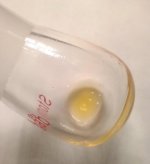
mes9-oil.jpg

I pooled fractions 4-7, obtaining 150 mg. No subsequent fractions contained mesembrine alkaloids. This is inconsistent with my previous run, where the alkaloids ran much slower even adjusting for the longer column and smaller fractions. I can't explain the big difference, and I suspect a mistake in my previous run. The results this time seem more consistent with the TLC. The color stayed almost entirely on the column as before.

I'm happy with this separation. A plug of silica in a Buchner funnel might also work, though to remove the odor and taste it would be necessary to load and elute separately and discard the first fraction, rather than just filtering.

Crystallization of Salts

The best reference on mesembrine salts appears to be UK Patent Application GB 2619907. They screened multiple solvents, including MEK but not acetone. They report twelve counterions, including positive results on the succinate and fumarate and negative on the citrate, benzoate and maleate. Their most stable salt was the besylate (benzenesulfonate), which I was surprised to learn is used in several other approved drugs. I still didn't want to mess with it though. The hydrochloride looks pretty good too, but I didn't want to bother preparing water-free organic HCl solutions.

I screened the fumarate, succinate, oxalate, and malate. I was reasonably careful to exclude water. I dried my acetone over sodium sulfate and distilled it a few days before use. When evaporating fractions I heated to 90 C under moderate (~5 kPa) vacuum. All containers were capped when not actively working.

To each of four weighed 1.5 mL vials I added 1.1 equivalents of the acid and sonicated to dissolve in acetone. I then added a solution of the purified mesembrine (fractions 2-3) in acetone, around 200 mg/mL. For the fumaric acid I used 1.2 mL acetone to dissolve the acid and 40 mg mesembrine. For the others I used 0.75 mL acetone and 50 mg mesembrine, but the fumaric acid isn't soluble enough for that.

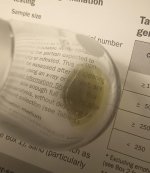
The fumarate crystallized within minutes. The patent application says theirs was "poorly crystalline" from MEK. I don't know if mine from acetone would make sharp peaks in the XRD, but the crystals are pretty and free-flowing. I carefully syringed off the mother liquor, dried the crystals under an air stream, and weighed them in the vial by subtraction yielding 43 mg.
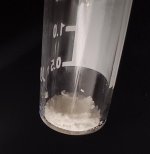
mes9-fumarate-xtals.jpg

None of the others salts showed crystallization after ten hours at room temperature (including the succinate, which was crystalline from their MEK). I put them all in the freezer for nine hours, after which the oxalate and malate showed an oil or resin that quickly redissolved upon warming.

I tried crystallizing the other three from ethanol but they were all too soluble, dissolving easily in 0.1 mL. I added 1 mL ethyl acetate as an antisolvent, which yielded an oil in the malate, a very fine possible solid in the oxalate that reverted to an oil after about an hour, and no change in the succinate.

I tried crystallizing from isopropanol. I sonicated the malate with 1 mL at 50 C. It wouldn't fully dissolve, but fine white crystals appeared on the bottom of the malate vial. This felt promising, so I added ethanol until it did fully dissolve (which was 90 uL), then left the vial to cool and crystallize. This yielded white crystals, though they weren't as free-flowing as the fumarate (though I also might not have dried them enough, with the higher-boiling solvent). Pure isopropanol would probably work at higher temperature and lower concentration, or maybe ethanol/isopropanol as the solvent/antisolvent.

The oxalate also formed a possible solid in isopropanol, but one so fine it seemed hard to separate from the mother liquor. The succinate dissolved completely in 0.5 mL isopropanol and remained clear after an hour or so. I evaporated the succinate down to 0.25 mL, and saw no change after eight hours. I added 0.5 mL heptane and it oiled out. I added 0.4 mL ethanol and it redissolved after long sonication, but then it stayed dissolved on cooling. I froze it, and it oiled out.

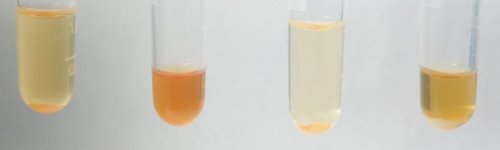
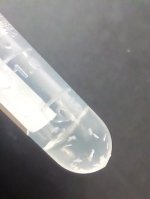
I evaporated the solvent from the two failures, recovering a pale yellow oil in each. I redissolved all four salts in 1 mL water each. The fumarate and malate crystals each made an odorless, water clear solution. The succinate and oxalate resin made a cloudy solution, I assume from a nonpolar impurity that crystallization separated. After filtration through a syringe filter they became a clear, very pale yellow.
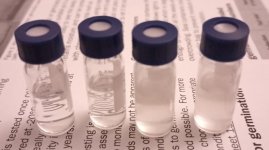
mes9-vials.jpg

Analysis shows that the malate is 95% pure by UV area, and the fumarate is 98%. The remainder is mesembrenone, which was depleted by both the chromatography and the crystallization. Fractions 4-7 are about 80% mesembrine and 20% mesembrenone, correspondingly enriched. The early peak in the fumarate is probably the counterion. The other three counterions probably elute around the same time, but lack the double bond and thus don't absorb.
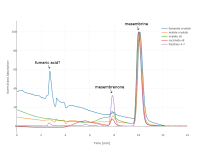
mes9-hplc.png

I now feel some optimism that crystallization could be possible without chromatography, since I'd chosen bad counterions for my previous experiment. I'll retry next time with the fumarate from acetone and malate from isopropanol.

Miscellaneous

@Woolmer's lab's HPLC method looks pretty typical, alkaline conditions on a C18 column. The two epimesembranol peaks still seem mysterious.

I'm quite confident that any bitter taste of Sceletium is mostly not mesembrine, since the purified mesembrine citrate extract tastes much less bitter than crude alkaloid citrate. Extract purified by crystallization has almost no taste, just very slightly bitter and sour.

I think my residual odor and taste after chromatography but before crystallization is from my ethyl acetate, maybe some kind of higher ester impurity. I tried distilling my ethyl acetate and that might have helped somewhat, but not completely. Maybe activated carbon would help. It doesn't come off under 5 kPa vacuum; maybe higher vacuum would help. Perhaps this doesn't matter, since I'll crystallize all material for consumption going forward.

At higher dose, I think mesembrine and mesembrenone are distinguishable, with the former giving more intense but increasingly unpleasant effects while the latter plateaus. Neither seems particularly abusable to me. That said, I'm one person and even some heroin users just don't get addicted, so proceed carefully. Kanna has long history of safe use, but more purified drugs are often more abusable, as demonstrated by refined cocaine, vodka, etc.

I might next try synthesizing mesembranols by reduction of mesembrine. These are natural products but with small abundance, so more easily produced semi-synthetically. Patnala separated the epimers by prep HPLC but there must be a better way, maybe on a C18 SPE cartridge.

A startup is working to bring some mesembrine analogs to market, and PCT Application WO2025101939A1 gives the best SAR insight I've seen published. I haven't studied carefully, but I think most or all of their modifications are achievable only by total synthesis.

I've grown some of my clones outdoors. I harvested one batch this spring during vegetative growth, which I've now finally analyzed. I wasn't expecting much, since I was watering daily; but it's actually lower water content than my indoor material, and roughly as strong. This may be due to nearby Passiflora, which competes aggressively for water and is also known to be allelopathic (and may in fact be killing the Sceletium, since the latter is sickly now and I can't otherwise explain that). I took a later harvest when flowers were present, with similar alkaloid ratio but less than a quarter the absolute alkaloids.

I usually freeze my plant material for storage before I get around to drying it, but I recently dried some unfrozen material in a food dehydrator. The leaf cuticle seems to mostly remain intact, eventually producing a hollow shell. This makes an odd crinkling noise when it eventually crumbles, and also greatly slows drying. I got impatient and milled the damp material to break up the leaves, then resumed drying. I think freezing is probably beneficial if only to disrupt the cuticle, and results from Glyn-Woods may imply that preserves the alkaloids better too.

Handle these extracts with care, since they're active around 1 mg. Accidental exposure is unlikely to be fatal, but an overdose would at least be unpleasant and impairment while working could result in a serious accident. The crystals are easier to mishandle than the resins since they don't stick together. These extracts must always be diluted for consumption.

 
Last edited:
That's great that you managed to crystallise the mesembrine. I wonder whether this could be done without a vacuum and using the crude mix of extracted alkaloids without chromatography.
 
I attempted to crystallize without chromatographic separation. All the methods that worked before failed. The fumarate from ethanol and isopropanol worked with yield around 50%, but only on an extract where the ethyl acetate had been washed with water, and the final resin had been heated under vacuum. The wash costs an additional third of the yield. I don't know whether both steps are necessary, but both separated significant mass. The malate appeared to crystallize after treatment with activated carbon, but the crystals weren't mesembrine alkaloids.

For now I believe chromatography is the most practical option to crystallize. This can probably be simple, like filtration through a pad of silica in a Buchner funnel. I don't plan to experiment further without chromatographic separation. I'd already written this up while I was feeling more optimistic (before I'd analyzed...), so I'll post it anyways in case e.g. someone wants to try improving that fumarate. It's also a good reminder that lots of things can crystallize, not limited to the target product. I don't think it's terribly promising, though.

Effect of Water Wash

I'd previously observed that the CIELO-style extract was less pure than prior extracts that started with acidified water. I'd observed that most of the impurities stick to baseline during normal-phase chromatography, implying they are very polar. I'd speculated this is because the volume of water in the CIELO-style extraction is much smaller; so for the same partition coefficient, a greater mass fraction goes into the ethyl acetate.

That implies a water wash of the ethyl acetate should help, so I tried that. I mixed 34 g dried and powdered plant material, 12 g Ca(OH)2, and sufficient water to make a thick paste, about 60 g. I pulled with 4x 100 mL ethyl acetate, stirring for about 5 minutes per pull. I combined the pulls and washed with 2x 400 mL water made basic with 1% concentrated ammonia.

I salted the ethyl acetate with 3x 15 mL 10% citric acid in water, which showed pH 6, 4, and 2. The low pH of the third pull implies complete transfer of the alkaloids into the water. I combined the pulls and saturated the solution with Na2CO3, then pulled with 3x 15 mL ethyl acetate. The alkaloids precipitated as a red oil that floated on top of the water, so the first pull probably got almost everything. The water was almost perfectly decolorized afterwards. A crystalline precipitate sank in the water, but that didn't seem to hurt anything.

I evaporated the ethyl acetate under an air stream on a water bath at 70 C, yielding 2.74 g of resin. I placed the resin under moderate vacuum (~5 kPa) and it bubbled vigorously with no heat applied. After that stopped, I heated to 70 C, and it bubbled for about ten minutes. I heated to 95 C and it bubbled for another few minutes, leaving 1.96 g resin. After an additional 15 minutes at 95 C, I measured 1.95 g resin and stopped. This resin contained 586 mg mesembrine alkaloids by HPLC. This may not accurately reflect its true purity, since I used a commercial standardized extract as my reference and I'm increasingly suspicious that it's actually stronger than nominal.

Evaporation of the wash water yielded 2.4 g of dark-colored resin, which contained 240 mg mesembrine alkaloids by HPLC. So the wash did pull impurities, but it also pulled about a third of my product. I used ammonia since excess would evaporate, to avoid complicating my weighing. Perhaps a different base would work better.

Crystallization of the Crude Alkaloids

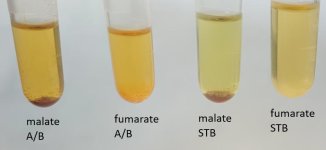
I repeated the crystallization screen. I used the conditions that worked before, the fumarate in acetone and malate in isopropanol. I used two samples of mesembrine alkaloid resin, the STB from above, and an A/B from an earlier extraction into acidified water. Both had ratio of mesembrine:mesembrenone around 5:1. This gave me four combinations to screen, in four 2 mL microcentrifuge tubes.

I prepared a solution of 15 mg/mL fumaric acid in acetone. I dissolved approximately 25 mg of each resin in 300 uL acetone, very easily. To each resin I added 1.2 mol acid per mol alkaloids, calculated assuming pure mesembrine.

I prepared a solution of 60 mg/mL malic acid in isopropanol. I dissolved approximately 50 mg of each resin in 500 uL isopropanol, with extended stirring and scraping. To each resin I added 1.2 mol acid per mol alkaloids.

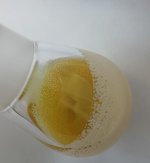
All the solutions were clear prior to mixing, and clouded immediately upon mixing. After a few minutes, both malates showed brown crystals at the bottom. The A/B fumarate oiled out, while the STB fumarate just looked cloudy. I left the tubes overnight, after which the A/B fumarate was still an oil. The STB fumarate was perfectly clear, no solids at all. The malates had reverted completely to a resin at the bottom of the tubes.

mes10-first.jpg

I sonicated at 50 C to redissolve the malates and both tubes went clear. On cooling they quickly went cloudy, forming dirty crystals and then the resin again. I put an extra 0.8 mL isopropanol in each tube and redissolved. This might have been slightly more crystalline initially, but the colored impurities still precipitated and ate the crystals.

I evaporated and dissolved in 0.2 mL ethanol. All the tubes went clear, and remained clear on cooling. I added 0.2 mL isopropanol as an antisolvent and the STB fumarate showed a decent amount of white crystals, while the A/B showed very little. Both malates formed a resin.

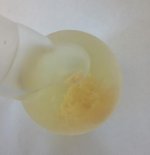
I evaporated the malates and redissolved in 1 mL methanol, then treated the two tubes with about 15 mg activated carbon. This didn't obviously change the color, so I added 65 mg more, for 80 mg total. This still didn't completely decolorize, but I evaporated and sonicated to redissolve in 1 mL isopropanol. This yielded pale yellow crystals at the bottom of the tube.

mes10-second.jpg

I sampled the mother liquor for analysis, carefully syringed it off, then redissolved the crystals in 0.5 mL water. The malates contained less than half the expected alkaloids by HPLC, the rest presumably having been lost in the carbon. This was almost all in the mother liquor, with negligible content in the crystals. I don't know what they are, maybe just malic acid.

The fumarates contained expected alkaloids, but for the A/B extract this was almost entirely in the mother liquor. The STB crystallized about half, with the remainder in the mother liquor. The A/B extract had not been heated under vacuum. That might explain the difference, since the lower-boiling constituents that would remove seem like they might be good cosolvents.
 
Back
Top Bottom