Mitakuye Oyasin
Titanium Teammate
Thanks again endlessness. This is really fascinating information. :d
Keep up the great work! Peace.
Keep up the great work! Peace.



There are actually lots of different ways of categorizing ayahuasca vine types in the Upper Amazon. Mestzio shamans, for example, will distinguish not only red ayahuasca, white ayahuasca, yellow ayahuasca, and black ayahuasca, but also cielo ayahuasca, sky ayahuasca, lucero ayahuasca, bright star ayahuasca, trueno ayahuasca, thunder ayahuasca, and ayahuasca cascabel, rattle ayahuasca, which is supposed to be the best ayahuasca of all.
These distinctions are often based on the types of visions produced, rather than on the morphology of the plant. Sometimes attempts are made to coordinate these various classifications: yellow ayahuasca is said to be the same as sky ayahuasca, black ayahuasca the same as thunder ayahuasca.
Similarly, the Ingano Indians recognize seven kinds of ayahuasca, the Siona recognize eighteen, and the Harakmbet famously recognize twenty-two, distinguished on the basis of the strength and color of the visions, the trading history of the plant, and the authority and lineage of the shaman who owns the plant. All of these variations are a single botanical species, yet shamans can distinguish these varieties on sight, and shamans from different tribes identify these same varieties with remarkable consistency. Indigenous ayahuasqueros look at the shape of the vine, the color and texture of the bark, the shape and softness of the leaves, and the overall nature of the cylindrical shape of the vine, not to mention its smell and taste.
In Brazil, members of the União de Vegetal church distinguish two varieties of Banisteriopsis caapi, which they call tucanaca and caupurí. The tucanaca variety is a smooth vine which grows in the cooler climate of southern Brazil and is known to have a mild purgative effect; the caupurí variety is a knobby-looking vine with large internodes, which grows in the hotter jungles of northern Brazil and is known as a powerful purgative. The table below compares the mean beta-carboline content of these two varieties of ayahuasca vine, expressed as mg/g of dried bark:
Mean Banisteripsois caapi beta-carboline content (mg/g):*
VARIETY......HARMINE.......THH..........HARMALINE
Caupurí.........8.68............5.06..............0.69
Tucana..........5.50............0.19..............0.11
These results indicate, once again, both significant differences in chemical composition among ayahuasca vines and indigenous ability to recognize variants of the same species and correlate these differences with differing physiological effects.
*Callaway, J. C. (1999). Phytochemistry and neuropharmacology of ayahuasca. In R. Metzner (Ed.). Ayahuasca: Hallucinogens, consciousness, and the spirits of nature (pp. 250-275). New York, NY: Thunder’s Mouth Press.


BecometheOther said:Jamie,
Banisteriopsis muricata is a new plant to the scene and if you search up and down you will not find any bioassays, or any solid information at all.
But my understanding is that banisteriopsis muricata and black cappi are 2 very different things. Most black cappi is similiar in alkaloid profile to other cappi strains, it contains harmalas etc.
Banisteriopsis muricata is a different plant altogether, closely resembling the banisteriopsis cappi vine, except only the leaves are used and it contains dmt it is also speculated that it contains b-carbs or harmalas because the leaves are active on its own. This is why you can find b. muricata leaves for sale but not vine....
I cannot be 100% for sure, because i personally have not used b. muricata ( i will be trying as soon as it is again in season). But i HAVE used several different kinds of black ayahuasca, and all of them were black but resembled b.cappi in appearance and effects.
but i believe i am correct, i am in close contact with several people in Peru who are on the frontlines of identifying these plants, and have had several conversations about b. muricata... (with one of the only people to have positively identified this plant)
That is not to say that what one tribe calls black cappi is in fact, b muricata. Thats what complicates it is i think people are putting far too much stake in these local names, when in fact in one place one name can refer to a totally different plant, than in another place where the same name may be used for a different plant.
Black cappi, looks and smells like cappi, it has the pores on the end, and is very strong, but contains no dmt nonetheless.
B. muricata is a vine resembling chaliponga and ayahuasca, but supposedly contains dmt and harmalas and about 20 grams of leaf are used. (as apposed to chaliponga which can be very active at 5 grams)

jamie said:becometheother..you may be correct that muricata is not black caapi..at least according to kiwiboancaya's classification..I ordered "red ayahuasca" from them..I think at the time it was mislabled as "Banisteriopsis Caapi", but now after he got everything correctly ID'd is is labled "Banisteriop Muricata"(red ayahuasca)..so it may be that at least in some parts the muricata is the red vine..either was I have 3 kilos of this vine on the way along with the alicia vine labled as "black ayahuasca" on the site..so I will report back after I test these 2 vines.


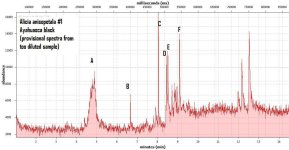
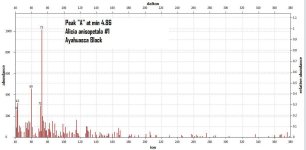
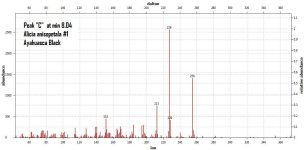
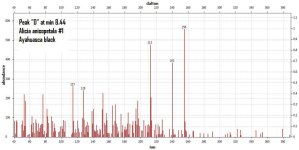
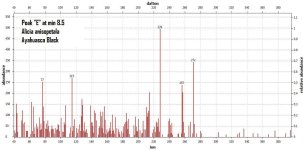
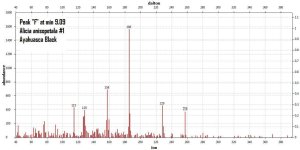
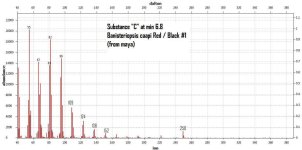
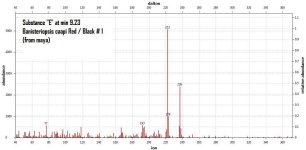
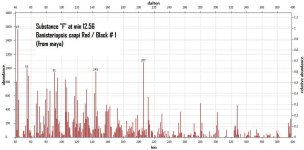
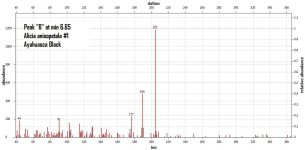
..very interesting..the vine is reported as having psychoactivity..to throw in a guess for possible 'where to start' candidates, if it was a methanol soak, then (being polar) it would extract Flavonoids (A/B wouldn't, AFAIK)I also got the results for Black (Alicia anisopetala) and Grey (Tetrapterys methystica) but so far I couldnt identify ANY of the peaks!! It does not seem to have any beta-carboline that I know, neither that is in NIST's database. I'm not even sure where to begin the search