• Members of the previous forum can retrieve their temporary password here, (login and check your PM).

Research The nexian phalaris breeding programme

Research done by (or for) the DMT-Nexus community

Updated Procedure for TLC Testing of Phalaris aquatica


Equipment and Materials
  • TLC Plates: Macherey-Nagel MN818161 (Silica gel 60, no fluorescence indicator)
  • Solvents:
    • MTBE
    • Isopropyl alcohol
    • Aqueous ammonia (25%)
  • Other Supplies:
    • Microcentrifuge tubes (1.5 mL)
    • Stainless steel dosing cannulas (1.5 inch)
    • Precision scale (e.g., Muaket 50g / 0.001g)
    • Graduated plastic transfer pipettes (1 mL)
    • Glass bottles for mixing solvents
    • UV light source: 275 nm LED module (12VDC, 5 LEDs) ×2
    • Black plastic box (for imaging)
    • Camera


Sample Preparation
  • Drying:
    • Dry plant material in a microwave until crisp.
  • Extraction:
    • Weigh 25 mg of the dried sample.
    • Soak in 1ml MTBE with 3 drops of aqueous ammonia in a 1.5 mL centrifuge tube.
    • Let sit for ~8 hours.
  • Spotting:
    • Dip a stainless steel cannula into the solution.
    • Lightly press the needle tip against the TLC plate to apply the sample.
    • Load up to 9 samples per plate, spaced ~1 cm apart.
  • Development:
    • Use a solvent mixture of Isopropyl alcohol : 25% aqueous Ammonia in an 12:1 ratio.
    • Develop plate as usual immediately after loading. Don't wait more than a few minutes.
  • Visualization:
    • Place the plate inside a dark box illuminated with 275 nm UV LEDs.
    • Photograph the plate while still wet.
    • Let dry, then take another photo.
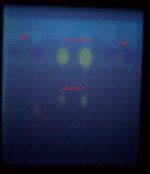
    • The fluorescence pattern reveals the plant’s chemotype.
 

Updated Procedure for TLC Testing of Phalaris aquatica


Equipment and Materials
  • TLC Plates: Macherey-Nagel MN818161 (Silica gel 60, no fluorescence indicator)
  • Solvents:
    • MTBE
    • Isopropyl alcohol
    • Aqueous ammonia (25%)
  • Other Supplies:
    • Microcentrifuge tubes (1.5 mL)
    • Stainless steel dosing cannulas (1.5 inch)
    • Precision scale (e.g., Muaket 50g / 0.001g)
    • Graduated plastic transfer pipettes (1 mL)
    • Glass bottles for mixing solvents
    • UV light source: 275 nm LED module (12VDC, 5 LEDs) ×2
    • Black plastic box (for imaging)
    • Camera


Sample Preparation
  • Drying:
    • Dry plant material in a microwave until crisp.
  • Extraction:
    • Weigh 25 mg of the dried sample.
    • Soak in 1ml MTBE with 3 drops of aqueous ammonia in a 1.5 mL centrifuge tube.
    • Let sit for ~8 hours.
  • Spotting:
    • Dip a stainless steel cannula into the solution.
    • Lightly press the needle tip against the TLC plate to apply the sample.
    • Load up to 9 samples per plate, spaced ~1 cm apart.
  • Development:
    • Use a solvent mixture of Isopropyl alcohol : 25% aqueous Ammonia in an 12:1 ratio.
    • Develop plate as usual immediately after loading. Don't wait more than a few minutes.
  • Visualization:
    • Place the plate inside a dark box illuminated with 275 nm UV LEDs.
    • Photograph the plate while still wet.
    • Let dry, then take another photo.
    • The fluorescence pattern reveals the plant’s chemotype.
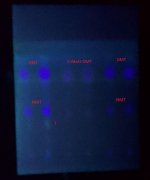
It worked like a charm for me.. although i used the freebase extract dissolved in IPA in this plate and not the dry leaf as sample but the rest is identical. For anyone hesitant to try this It's much simpler than it seems. Only first few tries may seem fussy but it's really very straightforward protocol.

The breeding results speak for themselves as proof for the reliability of this cheap method. I was Francly hesitant to rely on TLC for selection initially lol then i realized even commercial phalaris breeders used it hahaha
 

Attachments

  • RDT_20260731_2016004902478928765295384.jpg
    RDT_20260731_2016004902478928765295384.jpg
    102.1 KB · Views: 1
  • RDT_20260731_2016228462813687758337397.jpg
    RDT_20260731_2016228462813687758337397.jpg
    102.3 KB · Views: 1
Results
1746134527775.png

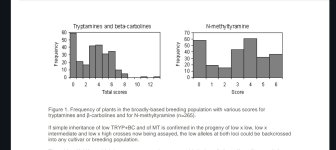
DMT displays a right-skewed distribution, with a high frequency of low-intensity values and a long tail extending toward higher intensities.
CSIRO breeding programme have previously reached a similar conclusion drawn from the broad breeding population 🙂
 

Attachments

  • Screenshot_20250113-193343.jpg
    Screenshot_20250113-193343.jpg
    89.7 KB · Views: 0
Back
Top Bottom