• Members of the previous forum can retrieve their temporary password here, (login and check your PM).

Research The nexian phalaris breeding programme

Research done by (or for) the DMT-Nexus community
Chemical mutagenesis using supermutagens, such as nitrosomethylurea (NMU), is a cost-effective method for developing new forms of canary grass (*Phalaris canariensis* L.). This approach enables a dramatic increase in genetic diversity within a short timeframe, without relying on traditional genetic engineering techniques.

Nitrosomethylurea (NMU) is a highly effective alkylating agent that induces point mutations (transitions and transversions). For *Phalaris canariensis*, the protocol comprises the following steps:

Seed soaking: Dry seeds (M₀ generation) are soaked in aqueous NMU solutions.

Working solutions: The optimal concentration range is 0.01%–0.05%. Higher doses cause mass seedling mortality, while lower doses fail to induce a mutagenic effect.

Exposure: Seeds are exposed to the solution for 6 to 12 hours at room temperature.

Washing: Seeds are thoroughly washed in running water for 30–60 minutes to remove mutagen residues, after which they are immediately sown in soil.
 
Last edited:
Chemical mutagenesis using supermutagens, such as nitrosomethylurea (NMU), is a cost-effective method for developing new forms of canary grass (*Phalaris canariensis* L.). This approach enables a dramatic increase in genetic diversity within a short timeframe, without relying on traditional genetic engineering techniques.

Nitrosomethylurea (NMU) is a highly effective alkylating agent that induces point mutations (transitions and transversions). For *Phalaris canariensis*, the protocol comprises the following steps:

Seed soaking: Dry seeds (M₀ generation) are soaked in aqueous NMU solutions.

Working solutions: The optimal concentration range is 0.01%–0.05%. Higher doses cause mass seedling mortality, while lower doses fail to induce a mutagenic effect.

Exposure: Seeds are exposed to the solution for 6 to 12 hours at room temperature.

Washing: Seeds are thoroughly washed in running water for 30–60 minutes to remove mutagen residues, after which they are immediately sown in soil.

I think mutagenisis is particularly useful if bufotenine is indeed a an intermediate to produce 5-meo-DMT, and the gene responsible for 5-hydroxylation and the gene for O-methylation are either too linked, or we can't find a plant with a disfunction in the O-methylation gene responsible. However the O-methylation might be important for other processes too, so maybe it can't even knocked out.
 
The most recent breeding season did not produce the profile distribution expected under a theoretical random-mixing model, with Type 1 being significantly overrepresented. Future generations will reveal whether these deviations persist or whether the distribution gradually converges toward the theoretical expectation.

From a practical breeding perspective, we can now exert greater control over profile frequencies, as the different profile types have been partially separated into distinct breeding lines.

The available parameters for optimizing selection pressure remain limited and include:
  • Culling rate
  • Frequency of individual profile types
  • Testing and selection intensity
  • Controlled crossing and hybridization
These parameters are continuously adjusted as additional empirical data become available.


The current classification system should be interpreted with caution and will likely require further refinement. For example, gramine-rich and low-alkaloid profiles are currently not included, as they are outside the scope of our breeding objectives. In addition, Type 1 is sometimes accompanied by another, more lipophilic compound with fluorescence properties similar to DMT/NMT that has not yet been identified.

To date, we have not observed relevant concentrations of 5-HO-DMT (bufotenine) in P. aquatica. Based on the number of samples analyzed, it appears to occur only in trace amounts, to be exceedingly rare, or to be obscured analytically by 5-MeO-DMT.

We are continuously refining our analytical methods and expect to obtain more detailed and reliable data as these techniques improve.

We have also considered mutation breeding as a potential approach to further expand the available genetic variation. However, we have deliberately not pursued this strategy at this stage, as the potential of conventional breeding methods has not yet been exhausted. We believe that continued selection, controlled crossing, and the accumulation of empirical data still offer substantial opportunities for genetic improvement before more invasive breeding approaches become necessary.

Seeds from the next generation will be available soon. Once you have established your analytical workflow, we would greatly appreciate your participation in experimental evaluation. Additional data will allow us to further refine our breeding strategy and accelerate genetic progress.
 
Last edited:
However the O-methylation might be important for other processes too, so maybe it can't even knocked out.
There is the CRISPR/Cas gene-editing method, as well as the global DIYbiosphere project. And there are kits available for using this method at home. I’m no expert on this, but it might just work.
 
Thank you for sharing the link to this interesting paper.

Yes, I am referring to the uppermost faint blue compound in samples 107 and 108. It is also present in trace amounts in several of the other samples.
20260607_1__275w[1].jpg
275nm wet plate

20260607_1__275d[1].jpg
275nm dry plate
 
Section 16.5, page 307 is a good read for the most simple method called "Mass selection"

Key takeaways:
  1. Mass selection is most effective if the expression of the trait of interest is conditioned by additive gene action. (chemotype is not)

  2. in cross-pollinated populations, gene frequencies are expected to remain unchanged
    unless the selection of plants was biased enough to change the frequency of alleles that control the trait of interest.

  3. Mass selection is based on plant phenotype. Consequently, it is most effective if the trait of interest
    has high heritability.

  4. Cultivars developed by mass selection tend to be phenotypically uniform for qualitative (simply inherited) traits that are readily selectable in a breeding program. This uniformity notwithstanding, the cultivar could retain significant variability for quantitative traits. It is helpful if the selection environment is uniform. This will ensure that genetically superior plants are distinguishable from mediocre plants.
The case for mass selection

Advantages

  1. It is rapid, simple, and straightforward. Large populations can be handled and one generation per cycle can be used.

  2. It is inexpensive to conduct.

  3. The cultivar is phenotypically fairly uniform even though it is a mixture of pure lines.
Disadvantages
  1. To be most effective, the traits of interest should have high heritability. (As we know, the trait 'alkaloid content' has low heritability, as the effect of environmental variance seems to be rather high, see chapter 4. This points back to point 3 of the advantages, and the next point here)

  2. Because selection is based on phenotypic values, optimal selection is achieved if it is conducted in a uniform environment.

  3. Phenotypic uniformity is less than in cultivars produced by pure line selection. (So if we want to shoot for the stars, other methods are better)

  4. With dominance, heterozygotes are indistinguishable from homozygous dominant genotypes. Without progeny testing, the selected heterozygotes will segregate in the next generation. (If there are cases for where this matters, and this forms a problem progeny testing can be done to determine what the homozygote is.)

I think that this breeding method is really nice for improving general quantative traits, and for traits that are causes by addative gene action, like cold tolerance for example. However for making stable chemotypes. This method is less effective, here controlled crosses would provide the fastest, and probably most easy method.

On the Heritability of Alkaloids in Phalaris aquatica

This paper "BREEDING NON-TOXIC PHALARIS (PHALARIS AQUATICA by Oram and Edlington (CSIRO Division of Plant Industry) confirms the strong heritability of alkaloids yield

Oram explicitly state that the data suggests a simple, recessive genetic model for low alkaloid concentrations:

"Preliminary data suggest that low concentrations of TRYP+BC and TYR result from homozygosity of incompletely recessive alleles at two unlinked loci"

This is strong and not a complex trait. It is controlled by a small number of genes, which is the opposite of weak heritability.

The paper also outlines the breeding strategy based on this genetic model:

"If the concentrations of TRYP+BC and of TYR are simply inherited, the low alleles at each locus will be backcrossed into all agronomic types."

This practical breeding strategy would only be viable if the trait were strongly heritable and under simple genetic control. The low alkaloids selected population

Regarding mass selection this is not needed for selection of alkaloids yield clearly evidenced from the approach oram describes in creating the starting low alkaloids breeding population:

"Fifty plants with low concentrations of TRYP, BC, and TYR and low-moderate levels of HCN, were found in 1994 and re-tested in 1995. Five individuals are being clonally propagated to produce seed for field testing of an experimental population (Lowtox)

This demonstrates that selection for low alkaloids is a practical, ongoing breeding effort based on a solid genetic foundation.
Please note that the seeds obtained from the experimental 50 selected low alkaloids individual clones although not covered up in this paper were later confirmed to retain the low alkaloids trait and were used extensively in subsequent breeding programmes.

The evidence from this CSIRO paper is clear: alkaloid traits in Phalaris aquatica are under strong genetic control, specifically through recessive alleles at a small number of loci in regards to low alkaloids. This is the foundation upon which successful breeding programs—including our own are built.

Further more it's already a proven fact that high alkaloids genes are dominant genes in phalaris aquatica while low alkaloids genes are recessive. This makes selective breeding towards high alkaloids even more strongly hereditary and could explain why we achieved strong shift in the breeding population expression of high yield in only a few reproductive cycles as @Grasshoppers stated.
 
There is the CRISPR/Cas gene-editing method, as well as the global DIYbiosphere project. And there are kits available for using this method at home. I’m no expert on this, but it might just work.

I have done CRISPR/Cas, absolutely overkill, and way to hard to achieve at home, you need al kinds of special equipment. Centrifuges, Fancy freezers, Special and expensive enzymes, pipettes, agrobacterium cultures. Not to talk of the time it this all takes. Lets keep the topic related to classical plant breeding for metabolites :)
 
On the Heritability of Alkaloids in Phalaris aquatica

This paper "BREEDING NON-TOXIC PHALARIS (PHALARIS AQUATICA by Oram and Edlington (CSIRO Division of Plant Industry) confirms the strong heritability of alkaloids yield

Oram explicitly state that the data suggests a simple, recessive genetic model for low alkaloid concentrations:

"Preliminary data suggest that low concentrations of TRYP+BC and TYR result from homozygosity of incompletely recessive alleles at two unlinked loci"

This is strong and not a complex trait. It is controlled by a small number of genes, which is the opposite of weak heritability.

The paper also outlines the breeding strategy based on this genetic model:

"If the concentrations of TRYP+BC and of TYR are simply inherited, the low alleles at each locus will be backcrossed into all agronomic types."

This practical breeding strategy would only be viable if the trait were strongly heritable and under simple genetic control. The low alkaloids selected population

Regarding mass selection this is not needed for selection of alkaloids yield clearly evidenced from the approach oram describes in creating the starting low alkaloids breeding population:

"Fifty plants with low concentrations of TRYP, BC, and TYR and low-moderate levels of HCN, were found in 1994 and re-tested in 1995. Five individuals are being clonally propagated to produce seed for field testing of an experimental population (Lowtox)

This demonstrates that selection for low alkaloids is a practical, ongoing breeding effort based on a solid genetic foundation.
Please note that the seeds obtained from the experimental 50 selected low alkaloids individual clones although not covered up in this paper were later confirmed to retain the low alkaloids trait and were used extensively in subsequent breeding programmes.

The evidence from this CSIRO paper is clear: alkaloid traits in Phalaris aquatica are under strong genetic control, specifically through recessive alleles at a small number of loci in regards to low alkaloids. This is the foundation upon which successful breeding programs—including our own are built.

Further more it's already a proven fact that high alkaloids genes are dominant genes in phalaris aquatica while low alkaloids genes are recessive. This makes selective breeding towards high alkaloids even more strongly hereditary and could explain why we achieved strong shift in the breeding population expression of high yield in only a few reproductive cycles as @Grasshoppers stated.

I have a bit of trouble linking our trains of thought together here. I am not sure if you are disagreeing with some things I said, or that this is additional information that you are sharing. I'm assuming you mean to react to my statement "as we know, the trait 'alkaloid content' has low heritability, as the effect of environmental variance seems to be rather high" I read the Oram paper, To summarize your point from your reply to make sure we are on the same page :

Lets define our trait of interest as 'yield of alkaloids of interest' as that is essentially what was selected for right? defined as, the yield of total N,N-DMT and/or 5-meo-DMT.
  1. low-alkaloid = recessive, high-alkaloid = dominant (from Oram);
  2. therefore selecting toward high alkaloid is "even more strongly hereditary";
  3. therefore that explains a fast population shift toward high yield in a few cycles
My issue is the link between these steps, and it really comes down to what 'heritability' actually means. I reread the book for a bit on it (see section) 4.2.9 , and prompted an LLM to work out what i mean exactly because it can write it way faster, and admittedly better than I can.

*LLM GENERATED*
Heritability isn't "how genetic a trait is" or "how simply it's inherited." Narrow-sense heritability (h²) is a ratio: the share of the total variation we see between plants that's due to additive genetic differences, versus everything else — including environment. h² = V_A / V_P, where V_P is genetic variation plus environmental variation. The key consequence: a trait can be under simple, clear genetic control and still have low heritability, if the environment pushes the phenotype around a lot. Number of genes and heritability are two different axes. So "controlled by a few genes" (which is what Oram argues) doesn't get you to "highly heritable" — those just aren't the same claim.

That's the crux. Oram's data speaks to architecture — the Fig. 1 histograms look trimodal/bimodal and fit roughly one locus each. That's a segregation argument about how many genes are involved. It is not a heritability measurement. There's no h² and no variance components anywhere in the paper, and he even frames the genetic model as tentative — "if simple inheritance is confirmed in the progeny of crosses now being assayed."

And here's the part I think is most telling, because it's in the same paper: the 50 double-low plants were retested under higher nitrogen, and "only five plants remained low in TRYP+BC and MT." Oram notes the higher N "is known to increase the concentrations of TRYP." So 90% of the selected phenotype vanished just from an environmental change (more nitrogen, different season). That's exactly what high environmental variance looks like — and high environmental variance is precisely the thing that lowers heritability. The paper being cited for strong heritability actually contains strong evidence that alkaloid content is environmentally slippery.


So what does this imply about the selections that have been run?
Not that they're pointless — but that a fast, visible shift toward high yield doesn't, on its own, prove the trait is highly heritable. A response to selection depends on both heritability and how hard you select (roughly, response = heritability × selection differential). A strong shift can come from a modestly-heritable trait selected hard, just as easily as from a highly-heritable one. And separately, because the trait is so environment-sensitive (per Oram's own nitrogen result), some of what reads as "the population got better" could be the growing conditions rather than the genes. Those two things are genuinely hard to tell apart from the yields alone.
* END OF LLM*

I'm not saying the selection didn't work! It may have! I'm saying the evidence we have supports "we saw a promising shift" much more than it supports "we've shown high yield is strongly heritable." The traits of the lines definitely responded, But we honestly don't know how much of that is genetic versus environment.
 
Last edited:
I am soooo curious to see targeted crosses in the future. I would love to cross the type 1 x type 1, type 3 x 3 and type 1 x type 3. Thank you guys yet again for setting up this project.
Thank you for sharing the link to this interesting paper.

Yes, I am referring to the uppermost faint blue compound in samples 107 and 108. It is also present in trace amounts in several of the other samples.
View attachment 110563
275nm wet plate

View attachment 110564
275nm dry plate
Super interesting, does the blue fluorescence indicate an indole alkaloid? do beta carbolines look different? The big blue one is DMT?
 
Yes, the largest blue fluorescent spot corresponds to DMT.

Under 275 nm UV illumination, blue fluorescence on wet TLC plates was confirmed for DMT, NMT, and gramine.

Under 275 nm UV illumination, green fluorescence on dry TLC plates was confirmed for 5-MeO-DMT, 5-MeO-NMT, and 5-HO-DMT.

Under 365 nm UV illumination, harmine and harmaline exhibited cyan-to-green fluorescence on both wet and dry TLC plates.

The fluorescence characteristics of the unidentified compound are similar to those observed for NMT, DMT, and gramine, suggesting it may belong to the same class of compounds. However, fluorescence alone is not sufficient for definitive identification.
 
Yes, the largest blue fluorescent spot corresponds to DMT.

Under 275 nm UV illumination, blue fluorescence on wet TLC plates was confirmed for DMT, NMT, and gramine.

Under 275 nm UV illumination, green fluorescence on dry TLC plates was confirmed for 5-MeO-DMT, 5-MeO-NMT, and 5-HO-DMT.

Under 365 nm UV illumination, harmine and harmaline exhibited cyan-to-green fluorescence on both wet and dry TLC plates.

The fluorescence characteristics of the unidentified compound are similar to those observed for NMT, DMT, and gramine, suggesting it may belong to the same class of compounds. However, fluorescence alone is not sufficient for definitive identification.
I wonder if it could be an N-methylated or 2-methylated tryptamine of some sorts. Perhaps even a prenylated Tryptamine. All of those would be a paper worthy discovery. I tried to look at a bunch of existing triptamines, but I can't think of something that has been already found in plants, and that would be more lipophilic than DMT and similar to DMT.

it's probably something simple. Did you have any guesses to what it could be?
 
Last edited:
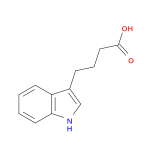
I think I found what it could be. The fluorescence we are seeing is because of the indole structure right? I'm assuming the amine group for DMT doesn't change the fluorescense.

I used knapsackfamily to find related compounds to DMT, then I stumbled on this entry. which is an indole with a longer buteric acid chain instead of an methylamine. KNApSAcK Metabolite Information - C00000116

It's found in many plant species, related to auxin, a plant signalling hormone. Confirmed in wheat!

You are the master of your craft, so you be the one to judge here ;)
I don't know if it would come through in the extractions you are doing.
IBA.png
 
I think I found what it could be. The fluorescence we are seeing is because of the indole structure right? I'm assuming the amine group for DMT doesn't change the fluorescense.

I used knapsackfamily to find related compounds to DMT, then I stumbled on this entry. which is an indole with a longer buteric acid chain instead of an methylamine. KNApSAcK Metabolite Information - C00000116

It's found in many plant species, related to auxin, a plant signalling hormone. Confirmed in wheat!

You are the master of your craft, so you be the one to judge here ;)
I don't know if it would come through in the extractions you are doing.
View attachment 110571
IBA would behave as an anion if the TLC conditions favour the freebase state of the amine. It's in the range of fatty acids with its 12 carbon atoms, so 'lipophilic' makes sense here.

We shouldn't discount other possibilities like caffeic acid or other substituted cinnamic acids, which also display blue fluorescence. This would include coumaric acid and should remind us that coumarins - or at least coumarin itself - are another established group of compounds in the poaceae.

When I get around to running some TLC, I do actually have some coumaric acid which I could test. Judging by the scent, a significant amount of it seems to have cyclised into coumarin.
 
Samples were prepared using aqueous NH₃ and MTBE.

The observations suggest that the concentration of the unidentified compound may increase during autumn. Additional sampling and analysis will be required to determine whether this represents a consistent seasonal trend.

The compound is absent in Type 2 and Type 3 profiles of P. aquatica. It is also absent from P. arundinacea.

Leaves or seeds from the plant species in which this compound has been detected can be provided for further analysis. Analyzing these samples alongside the proposed reference standards may help identify the compound or, at a minimum, rule out several potential candidates.
 
Last edited:
I had one bioassay of a 5-MEO-DMT local wild strain of brachystachys that exhibited that blue high RF on TLC. The bioassay proved mild and sedative. I Just felt high, very calm and sedated in a tryptaminish way. Didn't feel anywhere as potent as synthetic 5-meo-dmt to me. @Grasshoppers I'm sure you remember that same sample I sent you.

Though I noticed that the blue high rf above DMT changes in height and blue hue in one sample to another it may be a group of related or non related compounds. The one I tried felt very benign.
 
Back
Top Bottom