• Members of the previous forum can retrieve their temporary password here, (login and check your PM).

The official "Is this chem ok to use? / Where can I find ...?" thread

Migrated topic.

endlessness

Moderator
Staff member
Moderator
Joined
Feb 20, 2008
Messages
13,679
Merits
869
It is a common question that people ask, if a certain chemical is OK to use for extraction or not, and also where to find such and such chemical. Instead of cluttering up the forum with hundreds of threads about it, those who have these question can post here (and threads made with such questions will be merged here).

But before asking such questions, here's a few important links you should THOROUGHLY read:

Check what your solvent contains here thread

FAQ: Is my solvent/chemical OK to use ?

The Suppliers section
 
Im trying to find a way to make 2C-B without having controlled chemicals by using household things I want to try 2C-B so bad 😫
Unfortunately, that's not possible.

Please stop posting so many comments repeating the same and/or without substance, or you'll be temporarily banned to give you a chance to calm down.
 
A few OCD rinses in isopentane should do the trick 😁

But, seriously, that's a good point - the outside of the crystal will begin to redissolve on warming.

I'll second not evaporating ones solvent as well.
Was just thinking about rinsing away residual mother liquor again and got an idea.

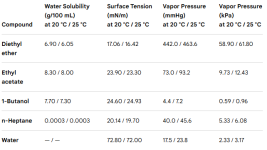
Non-polar solvents with low water solubility seem preferable during extraction for avoiding water-based contaminants. But for recrystallizations, what if you chose a non-polar solvent with some water miscibility, dried it completely before use, then used that property to rinse away the residual mother liquor with alkaline water?

chrome_2026-09-06_14-04-24.png

Seems like diethyl ether, ethyl acetate, and 1-butanol would be suitable for alkaline water rinsing. Then the residual solvent to evaporate would be 99% water and not dissolving or depositing DMT as it does so. Then maybe some distilled water rinses to follow the alkaline rinse, to reduce trace base deposition in exchange for some trace DMT carbonate deposition?

I guess diethyl ether might be an ideal solvent to separate; since it has the lowest surface tension, pouring it off the crystals should result in the least amount of residual, reducing the amount of water it would require to dissolve the residual. Then any trace remaining after the rinses would be most likely to fully evaporate with such a high vapor pressure. It also has the highest DMT solubility, though, so the crystals would be more sensitive to thermal changes, and the evaporated residual could deposit more DMT per volume than the other solvents.

Problem is the high DMT solubility of those solvents make them unviable for freeze precipitation. So the crystals would first have to be precipitated another way, perhaps antisolvent methods. I've seen @benzyme mention dropping n-heptane into diethyl ether. Or 1-butanol's low vapor pressure could make vapor diffusion possible, with an alkane precipitator. But since alkanes have lower water solubility, idk how well the residual mixtures might dissolve in water.

And what happens to the DMT dissolved in diethyl ether when rinsed with water that dissolves some of the diethyl ether? Does DMT go with the diethyl ether into aqueous solution? Or would it precipitate the same as if the diethyl ether were evaporating?

 
Last edited:
Was just thinking about rinsing away residual mother liquor again and got an idea.

Non-polar solvents with low water solubility seem preferable during extraction for avoiding water-based contaminants. But for recrystallizations, what if you chose a non-polar solvent with some water miscibility, dried it completely before use, then used that property to rinse away the residual mother liquor with alkaline water?

View attachment 111674

Seems like diethyl ether, ethyl acetate, and 1-butanol would be suitable for alkaline water rinsing. Then the residual solvent to evaporate would be 99% water and not dissolving or depositing DMT as it does so. Then maybe some distilled water rinses to follow the alkaline rinse, to reduce trace base deposition in exchange for some trace DMT carbonate deposition?

I guess diethyl ether might be an ideal solvent to separate; since it has the lowest surface tension, pouring it off the crystals should result in the least amount of residual, reducing the amount of water it would require to dissolve the residual. Then any trace remaining after the rinses would be most likely to fully evaporate with such a high vapor pressure. It also has the highest DMT solubility, though, so the crystals would be more sensitive to thermal changes, and the evaporated residual could deposit more DMT per volume than the other solvents.

Problem is the high DMT solubility of those solvents make them unviable for freeze precipitation. So the crystals would first have to be precipitated another way, perhaps antisolvent methods. I've seen @benzyme mention dropping n-heptane into diethyl ether. Or 1-butanol's low vapor pressure could make vapor diffusion possible, with an alkane precipitator. But since alkanes have lower water solubility, idk how well the residual mixtures might dissolve in water.

And what happens to the DMT dissolved in diethyl ether when rinsed with water that dissolves some of the diethyl ether? Does DMT go with the diethyl ether into aqueous solution? Or would it precipitate the same as if the diethyl ether were evaporating?
That's a good lot of reasoning and questions. Basically (no pun intended) it boils down (ditto :)) to a trade off in each and every workaround.

Apply the 'KISS' principle wherever possible (y)
 
Back
Top Bottom