• Members of the previous forum can retrieve their temporary password here, (login and check your PM).

The Yoga Practice Thread

Shaking in general is a good practice for releasing nervous tension, especially after a shocking event.
Shaking movements exist in Tibetan yoga and many other traditions. The phrase shake it off most like mirrors these ideas.
I love a bit of ecstatic dance.

Yes, exactly! That is the esoteric method, known to few, and practiced by fewer still.
Bootay yoga is an extremely advanced practice.

It turns out I have more to say than I realised, so will be posting my thoughts tomorrow. Enjoying everyone's contributions to this mighty subject. ❤️
 

Attachments

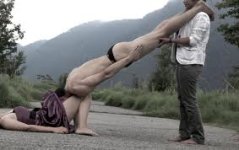
  • beaverasana.jpg
    beaverasana.jpg
    8 KB · Views: 7
Last edited:
In somatic theory, shaking is how other animals process traumatic events.
Shaking, dancing, stretching, and stillness, complement and flow into each other, in my view. Even in traditional Zen contexts, which place great emphasis on sitting (zazen), there is so much attention given to walking meditation, along with ritual eating, and other active practices, such as archery.
 
So, it seems like this is turning into the beginning of a book, or something, and as I'm writing my memory is constantly being jogged.
After this morning's practice, I pulled my old journal I kept in India in 2004, when doing my first yoga training, off the shelf, and had a great time reminiscing.
It's going to take a few days to get all my thoughts in order and typed, so I thought I'd post the first tranche, but when I paste the text, saved from Open Office, it screws the formatting up. Nothing I try seems to help. Anyone got any ideas?
 
Thanks Void, problem solved.
Here is part 1:

So, my story of yoga starts in 2003, but, if you'll indulge me, I need to go back a ways
further than that to explain how I came to be the person I was before I found the mat, and
how the practice has changed me, and allowed me to see who the real person is,
underneath all those layers of bollocks I believed about myself and the world.
When I was a little boy, I was a performer and a massive show-off. At primary school, I
loved to mess about and make people laugh,loved being the centre of attention, and
always had a lead part in any school show.
When I was eleven, I was sent to a private boys school, which had its 450th anniversary
while I was there, and soon discovered that my natural tendencies were not appreciated,
to say the least. I remember my House Master's report at the end of the first term saying
'He seems to think this is some kind of holiday camp. It is not!' Hmmm.
The majority of the other boys had come from the preparatory school, and had started the
senior school the year before, so I was also the 'new boy', who had come from the mixed
infants school, with the rest of the great unwashed.
I struggled with everything, especially the 'important stuff', like Latin (FFS), and so was not
allowed to partake in any of the activities I loved, and couldn't audition for the school play,
as this would waste valuable time that needed to be spent doing the important stuff, like
Latin (FFFS).
Out of necessity, I learned to play the game, not by working hard (I always felt that
academic work was an unwanted imposition on my time), but by cheating. I got caught
once, in a Latin vocabulary test, and spent the next week's lunch breaks copying out the
Latin dictionary in the housemaster's office, from which I learnt one valuable lesson. Don't
get caught.
I was 'bright', and had made it into the top set for maths and science, but the A and B
grades predicted for A-level materialised as Ds and an E (gee, how did that happen?), but
this did nothing to diminish my self-assured arrogance, which was off the charts. I was
going to be a pilot, don't-ya-know). All thoughts and desires to perform had been pushed
so deep inside me, I had forgotten they ever existed, and viewed these activities as for
those not as capable as myself.
I still got a place reading Physics at Bath University, and spectacularly failed the first year,
with nobody standing over my shoulder, making me work, and waaay out of my academic
depth. This led to 6 months as a lifeguard at a local leisure centre, and then, what was
supposed to be, 6 months in Breckenridge CO as a ski-bum, the plan being to return to
university the following year, applying while in the US.
I was introduced to weed, something I had been adamantly opposed to at school, where I
just drank like a fool, and took to it like a duck to water. I was having such a great time,
there was no way I was returning to go to University, so stayed for another season, much
to my mum's displeasure!
Fast forward to 2003 and I was a secondary school teacher in London. I had finally
managed to get a degree (Environmental Science from Liverpool), and had tried various
jobs, never finding anything that resonated. I still believed so much bs about what I 'should'
be doing, but in 2000 had decided I was going to be a teacher (my mum tried talking me
out of it, and she had been a teacher her whole life!), getting a PGCE from Oxford in 2001.
I woke up in a hospital cubicle, not having a clue where was or what was going on.
'Where am I? What's happened?', I asked the nurse who was there.
'You've had an accident, on your bike', she said as she pushed through the curtains.
An accident? On my bike? Was she talking about my bicycle or my motorbike?
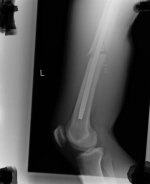
As it turned out, it was my motorbike. I was riding home from school, and someone drove
into me head-on, going for a parking space on my side of the road. I had knee'd the car,
the shock-wave travelling up my femur until it decided enough was enough, and snapped
clean in half, mid-shaft. I also snapped my posterior cruciate, broke my wrist and had a
severe concussion, as I'd headbutted the bonnet (hood) and windscreen. My quality full-
face helmet was definitely a good purchase.
The following weeks were the darkest of my life. I had been turned from an active, sporty
guy into an invalid. I remember thinking if I had a button that would have ended the world, I
would have happily pushed it.
The leg was incredibly slow to heal, and it was 9 months before I could return to work. I
had done a lot of physio/hydrotherapy/gym work, learning to walk again, with a leg that
looked like a pipe cleaner, and initially wouldn't bend past 10degrees, as it had been in an
external brace to allow the bone to heal.
During 2005, I was working as a supply (substitute) teacher in London, as it meant I had no planning or
marking to do, and could be in the gym by 4pm every day, for a couple of hours building
myself back. I'd met a german/spanish girl towards the end of the year, who bought me a month's introductory pass to
The London School of yoga (for Christmas) which was round the corner from her place,
and it was here that I was introduced to Ashtanga yoga and my first teacher, James, who
is the reason I am sat here typing this.
At this point I would say my leg was back to about 70%, and I didn't understand the
practice at all, and was only doing a very shortened version of the primary series, and was
amazed at how utterly draining I was finding it, but I was hooked.
James took me under his wing, commenting how 'amazing' my breath was (my ego loved
that), and we talked lots about his training in India with Master Ji Viswanath.
In the Ashtanga vinyasa system there are six series of 'seated' postures, each joined
together by the vinyasa, a smooth transition, with everything flowing on ujjayi (victorious)
breath, a form of pranayama which should remain deep and even throughout (MUCH
easier said than done!). You also hold a series of three internal 'locks' or bandhas, which
are initially explained as muscular contractions, but ultimately are energetic in nature.
Each posture also has a drishti, or point where your eyes should be focused.
Pattabhi Jois, the guru of Ashtanga yoga is quoted as saying 'Without breath, without
bandhas, without drishti, all is circus.'
The bandhas are:
Mula Bandha, a contraction and raising of the pelvic floor muscles. Think , stopping
yourself going to the toilet.
Uddiyana Bandha – drawing your belly button inwards towards your spine (not contracting
your abs)
Jalandhara Bandha – lowering the chin and constricting the airflow into your lungs.
Jalandhara bandha is an integral part of the ujjayi pranayama, and creates the resonating
sound of the pranayama. Think Darth Vader doing yoga.
You learn the sequence, and the practice is done 'Mysore style', meaning everyone goes
at their own pace, so you have no distraction of anyone talking and giving instructions.
'Adjustments' are an integral part of the classes, where the teacher will come and
physically assist you to go deeper into a posture, giving advice or correcting incorrect
technique/alignment. The system is not as focused on perfect alignment, like Iyengar
yoga, but is more focused on symmetry, flow and the breath.
Towards the end of the month, during shavasana at the end of a class, I began to cry for
no apparent reason. James noticed, and came over, giving me a hug, and telling me I was
not alone, which I remember thinking was a bit strange, and rather inappropriate, but
James was rather strange and inappropriate, so I let it go.
I was becoming more and more interested in the practice, and yoga in general, and after
the class mentioned to James that I was considering going to India myself, to study.
'You absolutely must do it. You are a natural,and you're going to come to all my other
classes and start practising 6 times a week. No charge. Looks like you could be the king of
emotional release'. I had absolutely no idea what he was talking about, but would soon
find out.
With this he took the sheet with the introductory series I was practising, 'No more of this
pussy yoga for you' (James is flamboyantly gay and unapologetically, unabashedly
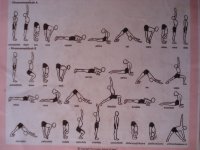
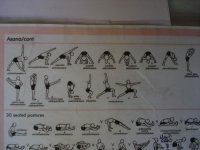
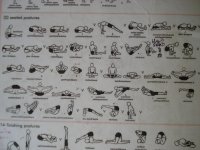
opinionated) and handed me a sheet with the full primary series on.
I could not believe what I was looking at. 'Are you mad?!' I said. 'There is no way I can do
this!'. And so it began.
I was living in Streatham, south London, and James was in Kingston, so each evening,
after school, I got the tube west to whichever hall that night's class was in. We would
occasionally practice together in one of the studios in Esporta gym, where some of his
classes were, on the days he wasn't teaching.
James was practising the second series, and had a very strong practice, and I remember
people looking at us through the glass like we were a circus act.
Every sequence in Ashtanga Vinyasa starts the same way, with 5 each of surya namaskar
(sun salutations) A and B, and 19 standing postures (the standing sequence).
The primary series is called yoga chikitsa, or yoga therapy, and the seated postures are all
forward bends, designed to open up your body, especially your hips. Everyone seems to
think that flexibility in forward bends is to do with your hamstrings, but hamstring flexibility
is only a small part of the equation. The real work is in opening up your hips and pelvis,
and this is much, much harder than lengthening your hamstrings.
By clearing the mind, focusing on the breath & drishti and performing the asanas, you are
not just becoming flexible and strong, you are breaking down samskaras, the
psychological imprints or blockages we store up in our physical body. Do the practice
without these elements, and you are gaining only strength and flexibility, but all your shit
will remain stuck in you, possibly being magnified.
The primary series is forward bending and the second is back bending. The primary
makes you strong and flexible, breaking down your samskaras, the second bends your
spine the other, less natural way, and is energetically an absolute beast of a practice.
BNS Iyengar, the other guru of the Ashtanga vinyasa system (not to be confused with BKS
Iyengar of Iyengar yoga fame) has said that all the asana required is in the primary and
second series, the rest is just to keep the egotistical ashtangis happy (I am paraphrasing).
After you are proficient in the second series, then you need to focus on the important,
deeper practices, like meditation and pranayama.
Ashtanga yoga (as opposed to ashtanga vinyasa yoga), translates from the sanskrit as 8
limbs of yoga, as laid out by Patanjali in The Yoga Sutras, with each limb being a separate
practice, leading to the ultimate goal of yoga, the eighth limb, samadhi or meditative
consciousness.
What we call yoga in the west is merely asana, the first step on the ladder, which builds a
strong, flexible body, free from samskaras, which allows the practitioner to perform the
deeper limbs, free from physical distractions, like the pain of sitting for hours.
A few weeks later, I was getting stronger and more flexible, but was still just seeing the
practice as a physical challenge, something to be 'improved' and go deeper with every
session. This, my friends, is not how asana practice works.
I was being careful with my damaged leg, but paying little mind to my good one, and
ended up straining my medial ligament.
I was furious, and took my anger out on James, telling him I was sick of this yoga bollocks,
and I was going to go back to the gym. At least there I was more aware of what I could and
could not do, and was less likely to hurt myself.
James took this in his stride, telling me I was just being a stroppy Sagittarian (or saggy
hairy arse as he put it), and asking, with a cheeky grin, if I felt better after my outburst.
He also told me that since I had started practising 6 times a week, I could start
experiencing what he called 'emotional releases' at any time, not necessarily when I was
on the mat (as had already happened), and that if I did begin to feel emotional, to not think
about it, and just let whatever was coming up, out.
More of his yogic bollocks, I remember thinking.....how wrong I was.
One evening the following week, I was home after a class, sitting at the computer,
browsing some rubbish or other, when I began to feel very emotional. I distinctly remember
wondering why the hell I was feeling like that, when tears began to flow, and I began to
sob. One half of my brain was telling me to stop this silliness, as there was nothing wrong,
but the other half was remembering what James had told me, and to just let it out. I had
the distinct feeling I was going mad, as I began to sob uncontrollably, James's advice
overriding the part of my brain telling me to stop.
Whatever had come up and been released, I sure did feel great afterwards, as the sobs
turned to laughter at the craziness of what had just happened.
Seemed like there was something to this yoga thing after all.
I booked myself onto a three month teacher training course with Master Ji starting in
February, got my flights sorted, and flew out to Bangalore, excited at the prospect of
returning to India (I'd spent 2 months there in 2000).
I arrived in JPNagar, the suburb the shala was in, and was dropped at Master Ji's house,
taking the steps to the top floor, where the shala was.
Inside was the man himself, sat on the platform at the front of the room, with the other
students sitting on their mats in front of him.
I shook his hand and introduced myself to him, and the other students, who I would be
spending a lot of time with over the next two months (yes, I did say it was a three month
course).
TBC

femur says no.jpg
 
Last edited:
That's quite a journey @EmeraldAtomiser I guess attending Hogwarts was a bit of a culture shock! Glad to hear you were the boy who lived after that accident.

I started Yoga for fitness and flexibility but stayed for the Post-Yoga calm which is kinda addictive. I'm interested in the practice and movement though personally don't commit to memory many of the moves / poses so I know what I'm doing but probably don't remember the name of the position.
My drishti varies during poses and I often find I focus, or rather, I don't focus on the thing I'm supposed to be focusing on and end up with a 1000 yard stare where I'm almost defocusing my eyes to gain my best balance.
 
That's quite a journey EmeraldAtomiser. I guess attending Hogwarts was a bit of a culture shock! Glad to hear you were the boy who lived after that accident.

I started Yoga for fitness and flexibility but stayed for the Post-Yoga calm which is kinda addictive. I'm interested in the practice and movement though personally don't commit to memory many of the moves / poses so I know what I'm doing but probably don't remember the name of the position.
My drishti varies during poses and I often find I focus, or rather, I don't focus on the thing I'm supposed to be focusing on and end up with a 1000 yard stare where I'm almost defocusing my eyes to gain my best balance.
Yes indeed. Hogwarts in well overrated. I haven't told my niece and nephew. They'd be devastated.
I will definitely talk more about focus and drishti during practice, as well as following a set sequence, as in ashtanga, as opposed to varying it. My feelings have changed a lot since starting out.

This morning's practice was great, and drishti was a bit part of it. My mind was wandering, touching on lots of what I'd written and thought about, and it was then that I realised my mind was doing this because my eyes were looking in the direction of the correct drishti, but not focusing on it. Focus returned, and the wandering mind was quietened.

Sounds like your focus is turning inwards, maybe to the third eye, with the 1000yard stare, which can also work well.
 
Last edited:
OK, this is turning into something more of a blog of my general experiences when practicing, but I am doing my best to keep bringing it back to the practice and its effects. It's been great reading over the journal I kept during these times. SO many memories and things I'd forgotten!

Part 2.

Master Ji is from Mysore and studied with Pattabhi Jois for 15 years, starting at age 11.
He is a renowned and respected yoga teacher, starting the Foundation of Pathanjala Yoga
Kendra, and teaching all aspects of the eight limbs of yoga.
The course comprised of Asana (6-8am), Pranayama (11am-12pm), Mantra (3.30-4.30pm)
and satsang (4.30-5.30pm), six days a week with Sunday off. Satsang was a time where
Master Ji would explain different aspects of the eight limbs and yoga philosophy, as well as
being an opportunity for the students to ask questions.
The other students on the course were 5 ladies (one English - Mary, one Mexican -
(Adriana), one American (Jen), one Swiss (Anita with her 4yr old son (Dmitri (I shit you not)
in tow), one Australian (Lauren) and two guys (one Mexican (Moyses) who was friends
with the Adriana and one Austrian (Steffan)who was bf of the Aussie). There was also an
Italian lady, Federica (also with her son Lorenzo, who was 10) who had been on the
previous course, but had not received her certificate, and had stayed on to do some more
asana, and a Polish lady, Malgosia or Mal, who had been there a while just for asana.
We were all staying in a flat round the corner, except for Anita and Dimitri, who had their
own room in another block.
I'd never done any mantra, and was interested to see what that was about, but first thing
was morning practice, where it soon became clear that Master Ji was a very dedicated and
quite serious man, and seemed somewhat dour. This worried me a little, as I was used to
having some humour in the shala with James.
I'd been told I'd have it easy the first few days, as Master Ji, like many Indian Ashtanga
teachers, was renowned for 'forceful' adjustments, but I could feel him prowling around me
at times, and did receive 2 small adjustments.
Mal got more pressure in an asana, and began to squeak a bit. Master Ji clearly thought
that more pressure was what was needed, and with an increase in squealing volume, she
fell out of the posture, whacking Master Ji on the legs! To my surprise and great pleasure,
he broke into a big grin, and we all had a good laugh.
Pranayama was interesting, with Master Ji demonstrating the different pranayams, with us
following along. Some, like lagu bastrica or breath of fire, seemingly easy, were difficult to
coordinate, with my belly moving in the opposite way it should have been.
I'd never done any Mantra before, and really wasn't looking forward to it, as it just wasn't
my scene. Unfortunately, my fears were confirmed and I found it absolutely horrendous. It
comprised of us sitting for an hour, with Master Ji chanting a phrase, and us chanting it
back (call and response). No 'lyric' sheets were provided, and I found it very difficult to
hear what was being said (it's Sanskrit), and after ten minutes or so, I stopped responding,
trying to clear my mind and feel the energy it was supposed to generate, but all I ended up
getting was pissed off, not least of all because my legs and back were killing me from
sitting cross-legged (it went on for an hour!). Hmmm, this was going to be a problem.
It was great being with the other students, and being able to talk about the practice, and I
decided to try slowing my breathing down and relaxing into the postures more, instead of
just zipping through them, which was really positive. I was beginning to receive some
stronger adjustments, and was enjoying trying to relax into the poses, even if this was
difficult with Master Ji applying pressure.
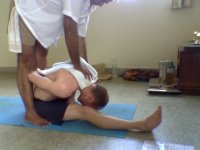
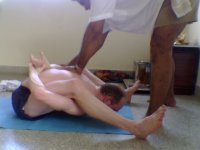
'Come on! Relax!', I remember him saying, as he sat on top of me whilst in Marichyasana
A. Relax?! How the hell am I supposed to relax with you sitting on top of me and me
feeling like I am about to snap!!
Unfortunately, Mantra class had been winding me up to an impossible level, and I was
finishing the hour feeling intensely angry and wound up. I had asked for copies of the
mantras, so I could at least see what we were chanting, but this really didn't help, so after
the first week, I spoke to Master Ji about this, and told him that I didn't want to carry on with
mantra. He explained that I would not be able to receive the full TT certificate if I did this,
but I just felt I was going to explode if I carried on, so we agreed I could stop.
I bought a couple of books on meditation and promised myself I would spend that hour
doing my own practice instead.
Unfortunately, things in the house, specifically with Anita, were not going so well.
It turned out that she suffered from chronic fatigue (and she was doing an Ashtanga
vinyasa TT??), and was also, to my thinking, somewhat unstable and negative.
Delicious meals were delivered to the house for the students, but at breakfast time, after
practice, when I just wanted to try and relax, she would be pouring out her problems, never
giving a thought to anyone else, complaining that the food wasn't right/good enough, and
leaving poor little Dmitri to be looked after by the rest of us. Her parenting skills also left a
lot to be desired, basically leaving Dmitri to play by himself outside, and one afternoon I
had seen him up on the roof of their building, 4 floors up, playing by the edge, which had
no edge protection whatever (this is India, remember). It was becoming extremely
unsettling and irritating.
Federica completed her course and the end of our third week, but that morning she arrived
at breakfast, shouting and in tears. Once we calmed her down and got her side of the
story, it appeared that she and Master Ji had been having a shouting match outside his
house, due to his refusal to give her the TT certificate.
While everyone was rehashing the story, I slipped out and went to talk to Master Ji and
Laxshmi (his wife). It turns out a lot had gone on with Federica over the past few months,
and it sounded like she had been rather manipulative and difficult, but I managed to find
some middle ground that, thankfully, allowed both sides to be satisfied, although later, I did
feel that I had been manipulated by Federica myself, playing on my desires to always try
and find, what I saw, as an equitable solution, and also being something of an easy mark.
I said I understood Master Ji's position, but we were somewhat concerned with his
apparent lack of yogic calm. What he said next, I found both surprising and welcoming.
The gist of it was, if someone pricks you, you can take it, but if they keep doing it over and
over, at some point you will react. We all have limits, even yoga gurus, and simply bending
over (I paraphrase) is NOT yogic.
This came as music to my ears, as I had been struggling with the concept of people
seeking Samadhi (perpetual bliss), through yogic practices. I couldn't accept it was
possible to be so at peace with everything, that nothing could disrupt this state. It didn't
seem humanly possible, but I see now that once you have achieved this state, you are no
longer a corporal Human, but a meditative consciousness, so why would any of these
things be of any consequence to you?
Bear in mind, everyone was quite tired, physically, energetically and emotionally, due to
the relentless nature of the course, and I was finding Anita's energy in the shala very
disruptive and irritating. Because of her condition, she was always huffing and groaning,
opening and then closing windows because she was either too hot or too cold, and
generally looking for attention and sympathy, or this is how it felt to me.
Dmitri, however, took a liking to me, and as I spoke some French, we could chat a bit, and
I could explain I didn't think his mum was right about some of the things she was saying.
One morning, about 6 weeks in, I gave him a little sip of my chai, which ended up being
the catalyst for the catastrophic breakdown between Anita and myself.
That afternoon, after pranayama, Anita stormed in to the house with Dmitri in tow. She was
extremely upset with me, as Dmitri 'wouldn't behave' (she had left him locked in his room
once before because he wouldn't behave, when she came for breakfast), and this was my
fault as I had given him a sip of chai, so I could look after him!
I explained that he was not our responsibility, and that everyone was becoming extremely
tired of her constant drama. She had not practised the day before, and I told her how
lovely it had been not having her in the shala, so all we could hear was everyone's breath,
and not her stomping around, huffing and puffing (this was somewhat ironic in a way she
couldn't understand, as I had behaved in a very similar vein when James started me
practising all the time!). At this she went from ballistic to thermonuclear, screaming in my
face, and I was glad Adriana and Moyses were there as witnesses. She then stormed off
to see Master Ji, taking Dmitri with her.
The upshot of all of this was that she would no longer be having meals in the house with
us, and we would do our best to ignore each other, both of which were absolutely fine with
me, and everyone else!
 

Attachments

  • me marichasana a adjust.jpg
    me marichasana a adjust.jpg
    41.6 KB · Views: 4
  • me supta kurmasana.jpg
    me supta kurmasana.jpg
    37.1 KB · Views: 4
  • bhujapidasana.jpg
    bhujapidasana.jpg
    18.8 KB · Views: 4
  • me and masterJi always mula bandha a.jpg
    me and masterJi always mula bandha a.jpg
    17.5 KB · Views: 4
Thanks for sharing. People can be intense and bring their drama everywhere, spirituality included. Samadhi and emotional release aside, it is ultimately about your life and how you relate to it. I feel that your class environment was a good showcase of the human condition and how we deal with it. Yoga is one of many modalities, and it is certainly a good one.

I feel that people lack general awareness and basic psychological education. Therapy and a simple meditation practice would do wonders for most, but you have to see the value in them first. It is much easier to follow your impulses and find fault in others. We always meet the right people to show us what we need to work on; we can either resent them or see the lesson in it all. Once again, everything comes down to presence and the ability to react freely to a situation without preconceived response patterns.

"Whether wanted or unwanted, pleasant or unpleasant, anticipated or
unanticipated, everything you experience is your life, just as in a dream
everything you experience is the dream."

- from Reflections on Silver River by Ken McLeod
 
Thanks for sharing. People can be intense and bring their drama everywhere, spirituality included. Samadhi and emotional release aside, it is ultimately about your life and how you relate to it. I feel that your class environment was a good showcase of the human condition and how we deal with it. Yoga is one of many modalities, and it is certainly a good one.

I feel that people lack general awareness and basic psychological education. Therapy and a simple meditation practice would do wonders for most, but you have to see the value in them first. It is much easier to follow your impulses and find fault in others. We always meet the right people to show us what we need to work on; we can either resent them or see the lesson in it all. Once again, everything comes down to presence and the ability to react freely to a situation without preconceived response patterns.

"Whether wanted or unwanted, pleasant or unpleasant, anticipated or
unanticipated, everything you experience is your life, just as in a dream
everything you experience is the dream."

- from Reflections on Silver River by Ken McLeod
Absolutely. Before my accident, I would never have contemplated yoga, meditation or therapy. My ego was rampant, knew best and would brook no argument.
 
Part 3

Before I carry on with the story, a few things that I'd forgotten about my time when
practising with James, before I left for India.
The first is to do with the actual practice, when I saw the postures as something to be
conquered and perfected, 'improving' each time I entered them. Something of a gym-boy
mentality, as I see it now.
The most important aspect of Ashtanga vinyasa, as I see it, is the ujjayi breath, and no
matter how impressive your practice looks from the outside, it is the breath and what is
going on inside, that turns callisthenics, no matter how impressive, into something that
opens your eyes, mind and spirit, peeling back the layers and allowing the true you to step
forward.
While I was struggling to get deeper into a posture (pick one), and while the bandhas may
have been engaged (but probably not), my breath and dristi were gone, and James would
sidle up next to me, lean close to my ear and whisper, 'Where's the breath?'
With this, I would usually fall out of the pose, being annoyed with myself and with James,
and have a good huff and puff, before returning to the posture, finding my focus, and
breathing into the pose as far as comfortable.
After the class, James explained that I needed to accept that each practice is different, not
better or worse. Any practice is good practice, no practice is bad practice. Things change.
You change. Accept this and enjoy seeing where you are on a given day. When the breath
is compromised, you have gone too far. Come back a little and simply breathe there,
allowing the exhale to relax you incrementally. There is no rush.
One of the things I remember disliking, was the repetition of the same sequence, over and
over. Why can't we switch things up a bit? It's dull doing the same things all the time. But
what I really meant was, why do I have to keep doing these postures I hate and find
difficult all the time? Why can't I leave them out, and do some others I enjoy and feel good
at? In other words, ego-talk.
I see now, after a few thousand hours on the mat, the absolute beauty and benefits the
repetition of yoga chikitsa, the primary series. It truly is medicine for the mind, body and
soul.
The second was something that happened when I was out and about in daily life.
I had gone into a shop, to get vitamins in a health food place I think, and when I pulled out
the change from my pocket to pay, I pulled out my keys too, which I placed on the counter.
The keyring was a silver dolphin, inlaid with blue glass, that I had bought in France when
on a school trip during my first year teaching. I loved that keyring, and it held a lot of
sentimental value. The girl behind the counter saw it and said how beautiful it was, then
she said something that shocked me.
'Can I have it?'
I was agog at her cheek! 'No!', I blurted out, amazed at how rude I thought she was.
Later, when I got home, I thought about this encounter, and wondered what it was that had
caused such a visceral reaction to her request. I mean, the key-ring was just a piece of
stuff. Yes, it was beautiful, and yes, it had sentimental value, but the memories attached to
it were always going to be with me, so why not let the girl have it? Was Aparigraha (non-
attachment) not one of the 5 yamas or moral guidelines, in Patanjali's eight limbs of yoga?
If I couldn't give up my attachment to this piece of stuff, then what chance letting go of
other, more deeply ingrained patterns?
A few days later, I was passing the shop, and saw the girl behind the counter (she was a
black girl and rather attractive. Maybe that had swayed my decision??;). I went in, said
hello, and pulled my keys out of my pocket, sliding the dolphin off the ring, and handing it
to her, saying something like, 'You can have this. Please take good care of it.'
I remember feeling that she didn't see as grateful as I thought she ought, but this was lost
in the almost overwhelming sense of joy I felt as I left and began walking home, tears
welling in my eyes. Holy shit, did that feel good!
Anyway, back to Master Ji and the practice.
I was feeling stronger and more flexible, but my leg was still quite some way from being
balanced with my 'good' one, and in the finishing sequence I was coming out of
karnapindasana and wondering if I should attempt urdhva padmasana (upside down lotus
holding your knees up), or at least my modification of it, as I was still a long way from
being able to do lotus without buggering both of my knees, when I lost concentration, my
knees slipped off my hands, and I gave myself a double knee-strike to the head. Oooof.
I had a little chuckle to myself, and heard Master Ji, sitting in his chair behind me, having a
good laugh too :)
 

Attachments

  • london school yoga primary01.jpg
    london school yoga primary01.jpg
    690.8 KB · Views: 0
  • london school yoga primary02.jpg
    london school yoga primary02.jpg
    728.7 KB · Views: 0
  • london school yoga primary03.jpg
    london school yoga primary03.jpg
    764.8 KB · Views: 0
  • london school yoga primary04.jpg
    london school yoga primary04.jpg
    780.6 KB · Views: 0
Last edited:
The most important aspect of Ashtanga vinyasa, as I see it, is the ujjayi breath, and no
matter how impressive your practice looks from the outside, it is the breath and what is
going on inside, that turns callisthenics, no matter how impressive, into something that
opens your eyes, mind and spirit, peeling back the layers and allowing the true you to step
forward.
Thank you for sharing. Based on my limited understanding of yoga, I feel that asana prepares you for pranayama and the subsequent steps in the Ashtanga system.
Pranayama works directly with our energy and is the most important step leading toward pratyahara and dhyana. Further, practicing ujjayi on its own induces a very calm and warm state. I think it was ingenious to include it as part of the flow; combined with other techniques, it creates a magical method for inner work. Do you have a separate pranayama session after your practice? What does that look like? How has your practice influenced your meditation and focus in general?
 
Thank you for sharing. Based on my limited understanding of yoga, I feel that asana prepares you for pranayama and the subsequent steps in the Ashtanga system.
Pranayama works directly with our energy and is the most important step leading toward pratyahara and dhyana. Further, practicing ujjayi on its own induces a very calm and warm state. I think it was ingenious to include it as part of the flow; combined with other techniques, it creates a magical method for inner work. Do you have a separate pranayama session after your practice? What does that look like? How has your practice influenced your meditation and focus in general?
Yes indeed, Northape.
I will talk more about this as the story progresses, and am introduced to more teachers, but asana is the first step, bringing flexibility and strength, ultimately allowing the practitioner to get into the deeper, more powerful techniques, such as meditation, mantra (I clearly wasn't ready for mantra at this stage!) and pranayama.
Ashtanga vinyasa gives the physical challenge, allowing the student to be 'tricked' into doing the pranayama practice without realising it, so preoccupied are they with the poses. At least if you are lucky enough to have teachers like I have, who keep brining you back to the breath.
I've never had a personal pranayama practice outside the asana, and meditation has been infrequent and sporadic. I did some chakra meditation for a while, and there's another story there, which I will post the blog I wrote about. I did a vipassana during one subsequent trip, another story to come:)
As my experience with the mantra showed, just sitting for even an hour was total agony, meaning whichever technique you are attempting will simply be an exercise in suffering!
Now, I can sit comfortably on the floor for long periods with very little issue. If I do meditate, I always use ujjayi, as it just feels so natural. I did apply to do another vipassana a few months ago, but was rejected as I practice reiki, which S.N. Goenka decided was not compatible with the practice🤷‍♂️
 

Attachments

  • S.N. Goenka.jpg
    S.N. Goenka.jpg
    665.1 KB · Views: 2
This is the blog I wrote about an experience in 2015, bringing me to chakra meditation.

So this is why I keep coming back to India; she gives me what I need, shows
me the way, opens my heart, and my mind follows.
I arrived in Jaipur at 11 last night, following the slow and delayed train journey
from Agra, and got a rickshaw to my hotel on the edge of the old city. It’s a
pretty swanky place, and nothing like the joints I normally stay in (note to self;
don’t organise things with travel agents when you’ve been awake for 30 hours),
but it is nice to have a bit of luxury, not to mention a lovely hot shower.
Once I’d moved into the room I asked the front desk about any near by places
to get a bit to eat. ‘Everything closed now sir, but our kitchen can make you a
sandwich’.
I declined this as I’d seen a few places on the rickshaw journey which still
seemed open, and made my way outside to have a bit of an explore. Outside,
the porter who’d helped me to my room told me of a ‘nice place’ just down the
road, and off I went.The chef was on the front porch, his single pan resting on
some red hot coals, and greeted me with a big smile and the familiar,
‘Welcome! Your country?’.
I was ushered inside and perused the familiar looking menu as my waiter busied
himself sorting out my lime soda, ‘little sweet’.
The thali (set meal) was what I was after, but I felt a bit unsure as to whether
it’d be a bit much to rustle up at this time, as I was the only person in the place.
Well this is India, so I really shouldn’t have worried. ‘Thali? No problem sir’,
the waiter assured with a smile. ‘Little spicy is OK?’.
‘Oh no, full spice’, I replied. Another big grin in response.
Rather than sit alone and wait I decided to pop out to watch the chef in action,
and minutes later I was walking back to my table having seen him whip up 4
different curries and some jeera rice, in the blink of an eye. The bread chef, who
plied his trade in the back, and the waiter stood with us, discussing England,
cricket, as well as how idly weren’t Indian food as they are ‘from the south’. No
love lost between north and south here, as it is at home.
I got back to the hotel feeling satisfyingly full, already with the tell tale stomach
feel indicating a fiery bowel movement to look forward to .
So, this morning I set off to take a walk through the old city and do some
exploring (hearing a female Indian guest complaining to the front desk of being
sick all night after eating in their restaurant the night before. Delhi-belly-bullet
dodged there). Jaipur is a designated heritage city, as well as being famous for
it’s jewellery and textiles, and it’d take you a week just to visit all the most
famous places, but I had a couple of the most highly recommended spots lined
up, and was just going to wander round the remainder of the time.
I was immediately into my stride (taking care to avoid the multitude of cow-pat
land mines), returning the constant stream of ‘Hello! How are you? Which
country?’ greetings, that are a constant soundtrack, with a ‘Hello, very well,
England’ and a smile, as well as politely refusing the many offers of rickshaw
rides, also with a smile.
It’s interesting to observe many other tourists dealing with the constant stream
of unwanted offers from all quarters that there is no escaping on the sub-
continent. Many will simply walk along, ignoring the pestering until the person
gives up and moves onto the next target, and while this technique is ultimately
effective, it means you miss out on much of the humour that can arise from
these situations, if you meet them with smiling engagement.
For example, at one point I had a cycle rickshaw on my left (20rupees to the
city palace) and a motorised rickshaw driver crawling along on my right asking
me, first, if I’d like a ride, then, after a few polite no thank you’s, changing to
asking if I knew where a garage was as he was having engine trouble. This
really made me laugh, and I told him he’d better ask a local, to which he
replied, with a massive grin, ‘Only joking!’, gunned up and disappeared in a
cloud of two-stroke smoke. Just little parts of what makes the Indian experience
so enjoyable, if you let it.
My first target was the honeycombed pink sandstone ‘wind palace’, built to
allow ladies of the royal household to watch the life of the city, but the place
was rammed with tourists, all walking about permanently looking through their
viewfinders, clickety-clicking away. This really is one of my pet hates (oh
digital photography, how you have ruined us), so I made a quick exit and
wandered down Tripolia bazar, enjoying being back in the ‘real’ India.
One particular random gentleman who’d greeted me, struck up a conversation,
and suggested I pop into the Krishna temple just across the road. Well it didn’t
look like much, but it was free entry, so what the hell, over the road I went, the
seemingly impossible wave of traffic washing around me.
The temple wasn’t very special, but on the roof overlooking the traffic below I
met a guy who introduced himself as MadanJi. Turns out he had travelled
extensively around Europe, and is heading to England next month to take part
in a jewellery exhibition, as that was his trade.
He seemed a very genuine guy, and we carried on talking as we wandered out
of the temple, where he suggested I come and have a chai in his shop where I
could check out his merchandise with no obligation. Now this is a common
offer in these parts, and normally I politely refuse, as it can lead to
uncomfortable situations, but there was something about this guy I liked, so off
we went.
Sitting down in his back room, sipping masala chai, I perused his lapis
collection (my favourite stone) as we talked about his business (manufacturing
as well as gem cutting). He then said he also read auras, and said that I needed
to work on my heart chakra as there was a blockage there.OK, interesting, I
thought, but his next observation had me sitting slack jawed.
‘This is also the cause of your lower back pain.’
Now hold on just a gosh darned cotton picking second. How on earth can he
know that I’ve been experiencing, at times quite serious, lower back pain for
probably around 6 months now. It’s not been unusual to be crawling out of bed
like an octogenarian, and I knew this was nothing to do with the scaffolding, as
I protect my back well (good technique you see), and it had made me nice and
strong. I had been wondering if it was due to some kind of emotional issue
(well known by some to cause back problems), as I’ve been pretty
fundamentally unhappy for a couple of years now, but even with all this
knowledge I still had the twinge of fear in my brain that I was being taken for a
ride.
‘You see,’ he continued, ‘It is obvious you have a high vibration, you have a
lotus flower at your crown chakra, but you are not doing the things which keep
you in balance, and so this blockage is there which is feeding your negative
energy and stopping you from doing what you need to do. You didn’t want this
existence, but you are here now, and you are not here for yourself, but to help
others. This is what you need to do.’
Well blow me down with a fucking feather. I felt emotion bubbling into my
eyes, and went on to explain about all the yoga I’ve done, but that I’d not done
any practice for.. ‘Two years’, he jumped in.
At this point my jaw was close to the floor, as this is about the exact period I’ve
been away from my mat.
Those of you who have seen me recently will know that I’ve been getting more
and more frustrated with the bullshit political system we are saddled with, and
all of it’s policies to stretch the divide between rich and poor to sickening
levels, and I’ve been threatening to actually get involved in some way, as
opposed to just moaning about it. This, it would appear, is what I actually need
to be doing, on a fundamental level. Not teaching, not washing dishes, not
humping scaffold. Helping create a better, fairer, more equitable world. You
know? The one that is so obviously, easily attainable, with empathy and
cooperation, as opposed to our current path of conflict and individualism.
MadanJi said he could see that I could feel others pain, but that the blockage
was making my emotions very close to the surface and difficult to control, so
that I was not able to harness their power and use it positively.
‘You are very close to your parents, yes? You’ve been very lucky to have their
support and let you find your own path I think. This emotional connection
comes through your mother’s mother side.’
OK, now maybe you’re thinking this guy was blowing smoke up my ass, and
that you can say general things like this to most people and they’ll fit it into the
picture they believe about themselves (I mean, who doesn’t want to hear
they’ve got a high vibration and a lotus flower at their crown chakra? And I’m
guessing that most mother’s are more emotionally open than fathers), but there
was something about MadanJi and our interaction that made me push these
thoughts that were tickling the back of my mind, out of my mind.
‘If you like we can do some work to see if there is something you can use to
help you bring yourself back to balance and free the blockage? It will take
about half an hour.’
Well I could hardly say no now could I?
We went into a small room at the back of the shop and sat across the desk from
each other. MadanJi pulled out a 5” quartz crystal from a draw and passed it to
me.
‘Hold this in your right hand and close your eyes. You need to just meditate on
your chakras for about 15 minutes, then we will try some other crystals and see
how you feel with them. And with that he was gone.
I held the cool, obelisk shaped crystal in my hand, feeling its weight, and closed
my eyes. As I became conscious of my breath I focused on my root, and tried to
envisage the red energy centre there, allowing the thoughts my brain threw up
to come and go (‘if the Goa lot could see me now, holding a crystal and doing
chakra meditation!’ was one I remember).
I began to feel warmth and tingling in my lower body and soon moved my
attention to the next centre. Soon I was at my heart chakra, and, without
thinking, my left hand came up and rested on my solar plexus. My breathing
was slow and steady, and still aware of the tingling sensations in my core I felt
the flutterings of emotion start within me.
Now I suppose this is where all the time I’ve spent doing different kinds of
spiritual/hippy/mumbojumbo (take your pick) practices comes into its own, as
I’ve learnt to just go with whatever comes up, and can now do this with pretty
much no resistance from my conscious brain (the first time I had one of these
unexplained emotional releases, I remember my brain going haywire. It felt like
I was going mad, but the true madness lies ins leaving this stuff, whatever it is,
inside). I don’t remember any specific thoughts, just beautiful emotional release
as the tears began to flow.
When I heard MadanJi re-enter I opened my eyes.
‘Very good. Let everything out. This in your left hand.’ he said, proffering a
small, brownish, un-polished rock of some kind. ‘Carry on.’ And with that he
was gone again.
The next time he entered the brown rock was replaced with a polished pink
crystal disk, and when holding these the release became less powerful, the
strange sobbing gasps diminishing and I began to feel more calm and centred.
The last crystal I was handed looked, to my quick, untrained, glance, before my
eyes closed again, like a ruby (expensive! I remember my brain protesting). The
tears stopped and feelings of centredness and purpose replaced the emotion, my
breath returning to its calm rhythm.
I heard the door again, and after a time opened my eyes to see MadanJi sitting
opposite, smiling.
‘How do you feel?’ he asked softly, with a tilt of the head.
‘Great. Calm. Centred.’ I replied.
His eyes closed as his head bowed a little.
‘What kind of stone is it?’, I asked.
‘A ruby.’ he confirmed. ‘Only higher vibrations can work with this stone. I can
set it in a simple pendant for you, copper and silver. You should not wear gold.
The element does not resonate with your energy.’
Pulling a calculator from his draw, he tapped the keys and said, ‘So, would you
like to work with this crystal? I will only charge what it cost me.’
He turned the calculator screen to face me, and I saw 14,150rupees, about £150
‘Yes.’ I replied instantly, before my brain had a chance to throw up any
objections. It was pretty pricy, but I believed in this guy now, or at least wanted
to, and felt that any kind of haggling to save a few quid would sully the
amazing experience I’d just had.
‘OK, if you can come back tomorrow at about midday I will have set the stone
and we will make a small ceremony. Now, for the next 6 weeks you will need to
do a minimum of 30minutes chakra meditation, as you have just done, and then
you will see the difference. One thing though, you should not let anyone else
touch the stone. Maybe a long term partner, if you feel like it, but otherwise
keep it for yourself. It will protect your energy if you are doing any kind of
energetic work on others’ (we’d talked about my reiki and massage trainings).
‘Occasionally,’ he went on ‘let it sit in milk and then water for 10 minutes each
to clear any negative energies. This is all you need to do.’
As I got out of the chair to leave, I realised that the dull, aching stiffness that
had been residing in my lower back was almost totally gone! I rotated myself
about from the waist a bit to see if I was just an aberration, but no, my back felt
supple and strong, just like it used to.
The next morning I woke at 7.30 (the 7am train I’d booked ditched without a
second thought), showered, and sat on my bed to start my meditation. No
pendant yet, but the impetus I’d been energised with was not going to be
wasted, but I wondered how long I’d be able to manage, feeling sure when I
decided to check the watch it’d only show about 10 minutes.
To my surprise, once I’d moved from my root to my crown and back again, the
watch showed it’d been 35 minutes since my eyes closed. Holy crap! That was
like falling off a log, as my old chemistry teacher used to say.
I returned to the shop at noon and entered the small room to see the quartz
obelisk standing on the desk with rose petals scattered around it. I held this,
cleared my mind and breathed as MadanJi lit incense and performed a puja.
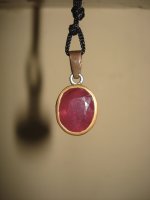
‘Here.’ I heard, and opened my eyes to see the ruby set in copper surround with
a silver loop. I returned the quartz and closed my fingers over my stone, closing
my eyes again as MadanJi repeated a mantra. When he stopped I opened my
eyes.
’OK, now your work begins.’ he said with a smile.
We exchanged contact details, as he is coming to the UK in February for a
jewellery fair in Cambridge, and I told him my folks were coming to India just
after that, and would be visiting Jaipur. They must get in touch, he insisted, as
he would be their honoured guide. What a guy.
I’m now in Mysore, having arrived late last night, and start my yoga practice
tomorrow at 5.30am. Looking forward to it, with slight trepidation, as the
length of time I’ve been away from the mat ensures that my body-mind is in for
a rude awakening, but I’m looking forward to the cathartic pain.
I’ve now had two morning meditation sessions, and each time I’ve easily gone
over the 30minute prescribed minimum. Who’d have thunk it.
So, for 150quid I’ve had an amazing, not hyperbolic to say life-changing,
experience, connected with an fantastic guy, got a beautiful ruby pendant and,
and this is the most spectacular part of it all, found the motivation to sit and
meditate on my chakras each morning.
Only in India my friends. Only in India.
 

Attachments

  • DSC04618.JPG
    DSC04618.JPG
    522.5 KB · Views: 1
So, for 150quid I’ve had an amazing, not hyperbolic to say life-changing,
experience, connected with an fantastic guy, got a beautiful ruby pendant and,
and this is the most spectacular part of it all, found the motivation to sit and
meditate on my chakras each morning.
That is already money well spent, imo. I am on the fence about crystal work, but given how weird this life is, anything is possible. Do you still work with it?
I had an idea to put a crystal in a fresh ayahuasca brew to infuse it with a specific energy, but I never tried it. The motivation to use crystals does come to me in my medicine work from time to time.
 
Back
Top Bottom