Thanks Void, problem solved.
Here is part 1:
So, my story of yoga starts in 2003, but, if you'll indulge me, I need to go back a ways
further than that to explain how I came to be the person I was before I found the mat, and
how the practice has changed me, and allowed me to see who the real person is,
underneath all those layers of bollocks I believed about myself and the world.
When I was a little boy, I was a performer and a massive show-off. At primary school, I
loved to mess about and make people laugh,loved being the centre of attention, and
always had a lead part in any school show.
When I was eleven, I was sent to a private boys school, which had its 450th anniversary
while I was there, and soon discovered that my natural tendencies were not appreciated,
to say the least. I remember my House Master's report at the end of the first term saying
'He seems to think this is some kind of holiday camp. It is not!' Hmmm.
The majority of the other boys had come from the preparatory school, and had started the
senior school the year before, so I was also the 'new boy', who had come from the mixed
infants school, with the rest of the great unwashed.
I struggled with everything, especially the 'important stuff', like Latin (FFS), and so was not
allowed to partake in any of the activities I loved, and couldn't audition for the school play,
as this would waste valuable time that needed to be spent doing the important stuff, like
Latin (FFFS).
Out of necessity, I learned to play the game, not by working hard (I always felt that
academic work was an unwanted imposition on my time), but by cheating. I got caught
once, in a Latin vocabulary test, and spent the next week's lunch breaks copying out the
Latin dictionary in the housemaster's office, from which I learnt one valuable lesson. Don't
get caught.
I was 'bright', and had made it into the top set for maths and science, but the A and B
grades predicted for A-level materialised as Ds and an E (gee, how did that happen?), but
this did nothing to diminish my self-assured arrogance, which was off the charts. I was
going to be a pilot, don't-ya-know). All thoughts and desires to perform had been pushed
so deep inside me, I had forgotten they ever existed, and viewed these activities as for
those not as capable as myself.
I still got a place reading Physics at Bath University, and spectacularly failed the first year,
with nobody standing over my shoulder, making me work, and waaay out of my academic
depth. This led to 6 months as a lifeguard at a local leisure centre, and then, what was
supposed to be, 6 months in Breckenridge CO as a ski-bum, the plan being to return to
university the following year, applying while in the US.
I was introduced to weed, something I had been adamantly opposed to at school, where I
just drank like a fool, and took to it like a duck to water. I was having such a great time,
there was no way I was returning to go to University, so stayed for another season, much
to my mum's displeasure!
Fast forward to 2003 and I was a secondary school teacher in London. I had finally
managed to get a degree (Environmental Science from Liverpool), and had tried various
jobs, never finding anything that resonated. I still believed so much bs about what I 'should'
be doing, but in 2000 had decided I was going to be a teacher (my mum tried talking me
out of it, and she had been a teacher her whole life!), getting a PGCE from Oxford in 2001.
I woke up in a hospital cubicle, not having a clue where was or what was going on.
'Where am I? What's happened?', I asked the nurse who was there.
'You've had an accident, on your bike', she said as she pushed through the curtains.
An accident? On my bike? Was she talking about my bicycle or my motorbike?
As it turned out, it was my motorbike. I was riding home from school, and someone drove
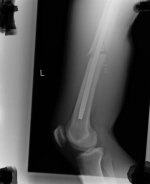
into me head-on, going for a parking space on my side of the road. I had knee'd the car,
the shock-wave travelling up my femur until it decided enough was enough, and snapped
clean in half, mid-shaft. I also snapped my posterior cruciate, broke my wrist and had a
severe concussion, as I'd headbutted the bonnet (hood) and windscreen. My quality full-
face helmet was definitely a good purchase.
The following weeks were the darkest of my life. I had been turned from an active, sporty
guy into an invalid. I remember thinking if I had a button that would have ended the world, I
would have happily pushed it.
The leg was incredibly slow to heal, and it was 9 months before I could return to work. I
had done a lot of physio/hydrotherapy/gym work, learning to walk again, with a leg that
looked like a pipe cleaner, and initially wouldn't bend past 10degrees, as it had been in an
external brace to allow the bone to heal.
During 2005, I was working as a supply (substitute) teacher in London, as it meant I had no planning or
marking to do, and could be in the gym by 4pm every day, for a couple of hours building
myself back. I'd met a german/spanish girl towards the end of the year, who bought me a month's introductory pass to
The London School of yoga (for Christmas) which was round the corner from her place,
and it was here that I was introduced to Ashtanga yoga and my first teacher, James, who
is the reason I am sat here typing this.
At this point I would say my leg was back to about 70%, and I didn't understand the
practice at all, and was only doing a very shortened version of the primary series, and was
amazed at how utterly draining I was finding it, but I was hooked.
James took me under his wing, commenting how 'amazing' my breath was (my ego loved
that), and we talked lots about his training in India with Master Ji Viswanath.
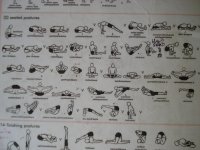
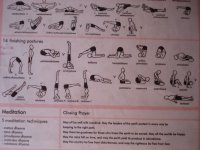
In the Ashtanga vinyasa system there are six series of 'seated' postures, each joined
together by the vinyasa, a smooth transition, with everything flowing on ujjayi (victorious)
breath, a form of pranayama which should remain deep and even throughout (MUCH
easier said than done!). You also hold a series of three internal 'locks' or bandhas, which
are initially explained as muscular contractions, but ultimately are energetic in nature.
Each posture also has a drishti, or point where your eyes should be focused.
Pattabhi Jois, the guru of Ashtanga yoga is quoted as saying 'Without breath, without
bandhas, without drishti, all is circus.'
The bandhas are:
Mula Bandha, a contraction and raising of the pelvic floor muscles. Think , stopping
yourself going to the toilet.
Uddiyana Bandha – drawing your belly button inwards towards your spine (not contracting
your abs)
Jalandhara Bandha – lowering the chin and constricting the airflow into your lungs.
Jalandhara bandha is an integral part of the ujjayi pranayama, and creates the resonating
sound of the pranayama. Think Darth Vader doing yoga.
You learn the sequence, and the practice is done 'Mysore style', meaning everyone goes
at their own pace, so you have no distraction of anyone talking and giving instructions.
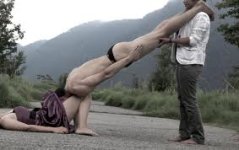
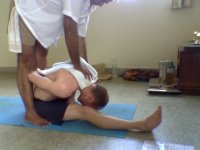
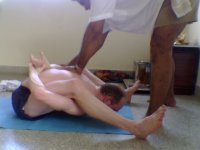
'Adjustments' are an integral part of the classes, where the teacher will come and
physically assist you to go deeper into a posture, giving advice or correcting incorrect
technique/alignment. The system is not as focused on perfect alignment, like Iyengar
yoga, but is more focused on symmetry, flow and the breath.
Towards the end of the month, during shavasana at the end of a class, I began to cry for
no apparent reason. James noticed, and came over, giving me a hug, and telling me I was
not alone, which I remember thinking was a bit strange, and rather inappropriate, but
James was rather strange and inappropriate, so I let it go.
I was becoming more and more interested in the practice, and yoga in general, and after
the class mentioned to James that I was considering going to India myself, to study.
'You absolutely must do it. You are a natural,and you're going to come to all my other
classes and start practising 6 times a week. No charge. Looks like you could be the king of
emotional release'. I had absolutely no idea what he was talking about, but would soon
find out.
With this he took the sheet with the introductory series I was practising, 'No more of this
pussy yoga for you' (James is flamboyantly gay and unapologetically, unabashedly
opinionated) and handed me a sheet with the full primary series on.
I could not believe what I was looking at. 'Are you mad?!' I said. 'There is no way I can do
this!'. And so it began.
I was living in Streatham, south London, and James was in Kingston, so each evening,
after school, I got the tube west to whichever hall that night's class was in. We would
occasionally practice together in one of the studios in Esporta gym, where some of his
classes were, on the days he wasn't teaching.
James was practising the second series, and had a very strong practice, and I remember
people looking at us through the glass like we were a circus act.
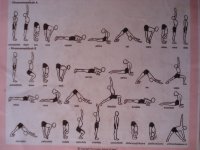
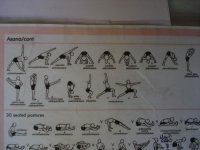
Every sequence in Ashtanga Vinyasa starts the same way, with 5 each of surya namaskar
(sun salutations) A and B, and 19 standing postures (the standing sequence).
The primary series is called yoga chikitsa, or yoga therapy, and the seated postures are all
forward bends, designed to open up your body, especially your hips. Everyone seems to
think that flexibility in forward bends is to do with your hamstrings, but hamstring flexibility
is only a small part of the equation. The real work is in opening up your hips and pelvis,
and this is much, much harder than lengthening your hamstrings.
By clearing the mind, focusing on the breath & drishti and performing the asanas, you are
not just becoming flexible and strong, you are breaking down samskaras, the
psychological imprints or blockages we store up in our physical body. Do the practice
without these elements, and you are gaining only strength and flexibility, but all your shit
will remain stuck in you, possibly being magnified.
The primary series is forward bending and the second is back bending. The primary
makes you strong and flexible, breaking down your samskaras, the second bends your
spine the other, less natural way, and is energetically an absolute beast of a practice.
BNS Iyengar, the other guru of the Ashtanga vinyasa system (not to be confused with BKS
Iyengar of Iyengar yoga fame) has said that all the asana required is in the primary and
second series, the rest is just to keep the egotistical ashtangis happy (I am paraphrasing).
After you are proficient in the second series, then you need to focus on the important,
deeper practices, like meditation and pranayama.
Ashtanga yoga (as opposed to ashtanga vinyasa yoga), translates from the sanskrit as 8
limbs of yoga, as laid out by Patanjali in The Yoga Sutras, with each limb being a separate
practice, leading to the ultimate goal of yoga, the eighth limb, samadhi or meditative
consciousness.
What we call yoga in the west is merely asana, the first step on the ladder, which builds a
strong, flexible body, free from samskaras, which allows the practitioner to perform the
deeper limbs, free from physical distractions, like the pain of sitting for hours.
A few weeks later, I was getting stronger and more flexible, but was still just seeing the
practice as a physical challenge, something to be 'improved' and go deeper with every
session. This, my friends, is not how asana practice works.
I was being careful with my damaged leg, but paying little mind to my good one, and
ended up straining my medial ligament.
I was furious, and took my anger out on James, telling him I was sick of this yoga bollocks,
and I was going to go back to the gym. At least there I was more aware of what I could and
could not do, and was less likely to hurt myself.
James took this in his stride, telling me I was just being a stroppy Sagittarian (or saggy
hairy arse as he put it), and asking, with a cheeky grin, if I felt better after my outburst.
He also told me that since I had started practising 6 times a week, I could start
experiencing what he called 'emotional releases' at any time, not necessarily when I was
on the mat (as had already happened), and that if I did begin to feel emotional, to not think
about it, and just let whatever was coming up, out.
More of his yogic bollocks, I remember thinking.....how wrong I was.
One evening the following week, I was home after a class, sitting at the computer,
browsing some rubbish or other, when I began to feel very emotional. I distinctly remember
wondering why the hell I was feeling like that, when tears began to flow, and I began to
sob. One half of my brain was telling me to stop this silliness, as there was nothing wrong,
but the other half was remembering what James had told me, and to just let it out. I had
the distinct feeling I was going mad, as I began to sob uncontrollably, James's advice
overriding the part of my brain telling me to stop.
Whatever had come up and been released, I sure did feel great afterwards, as the sobs
turned to laughter at the craziness of what had just happened.
Seemed like there was something to this yoga thing after all.
I booked myself onto a three month teacher training course with Master Ji starting in
February, got my flights sorted, and flew out to Bangalore, excited at the prospect of
returning to India (I'd spent 2 months there in 2000).
I arrived in JPNagar, the suburb the shala was in, and was dropped at Master Ji's house,
taking the steps to the top floor, where the shala was.
Inside was the man himself, sat on the platform at the front of the room, with the other
students sitting on their mats in front of him.
I shook his hand and introduced myself to him, and the other students, who I would be
spending a lot of time with over the next two months (yes, I did say it was a three month
course).
TBC









 . I went in, said