
-
Members of the previous forum can retrieve their temporary password here, (login and check your PM).
You are using an out of date browser. It may not display this or other websites correctly.
You should upgrade or use an alternative browser.
You should upgrade or use an alternative browser.
Trying to improve Acacia information
- Thread starter nen888
- Start date
Migrated topic.


..look forward to hearing how your experiments go, polmos..i'm sure a few weeks is fine..
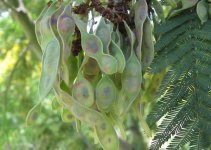
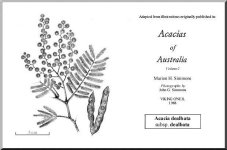
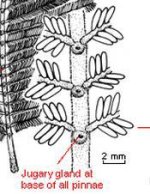
endophytik, regarding pic 2, without easy access to some of the south american acacia descriptions, i for now conclude it is probably the australian A. dealbata subsp. dealbata..do you have a picture of the actual seeds? also, is there a minute circular gland, 1mm or less, in diameter between each pair of pinnae? (the 'jugary' gland in botanical terms, see pic below)
endophytik, regarding pic 2, without easy access to some of the south american acacia descriptions, i for now conclude it is probably the australian A. dealbata subsp. dealbata..do you have a picture of the actual seeds? also, is there a minute circular gland, 1mm or less, in diameter between each pair of pinnae? (the 'jugary' gland in botanical terms, see pic below)
Attachments
..ps, the often stated 0.02% alkaloid in A. dealbata is based on a single screening without detail, and cannot be taken as a definitive description of the species or it's subspecies' content..more research needed..


I have recently been in contact with a friendly Australian who has access to the bark, stems and foliage of some fallen trees suspected to be Acacia acuminata, and he says he wouldn't mind to share.
I've heard from reports that the bark from dead trees do not tend to yield much. Can anyone here verify this? Would it be a better idea to ask for just stems and leaves of the trees?
Much appreciated.
I've heard from reports that the bark from dead trees do not tend to yield much. Can anyone here verify this? Would it be a better idea to ask for just stems and leaves of the trees?
Much appreciated.

pablokabute
"Look up, look within, it's SPACE and it's YOU."
and oh.. didnt see this one before..
"member for the trees"
you clearly lived up to it. great.
anyway.. it might be awesome to try some snuff from trees!!
this is a great field of work.. hmmm..
"member for the trees"
you clearly lived up to it. great.
anyway.. it might be awesome to try some snuff from trees!!
this is a great field of work.. hmmm..

I have posted this in the open discussion in error. It is Acacia related
beautifulsorrow
"If the doors of perception were cleansed, everyth
In my search for special acacias i found this, I think its really helpful, i don't know if its been posted already though.
..firstly, thanks Growpen..i think it's good to get more smaller acacia related threads going (for perhaps more unresolved issues/extractions etc) so that this thread doesn't get too bulky too fast..re your linked thread -so maybe A. Podalyriifolia was relegated too soon..hmm..
thanks also pablokabute, remember the 5meo finding was only 'tentative'..
..beautifulsorrow, welcome and thanks..these acacia notes from Trout 2004 were posted a few pages back too, but that link went dead..
they were a great co-ordination of available info at the time..since then there has been development in acacia-tryptamine knowledge, still growing..one thing that puzzles me about Trout/Appleseed's work at the time (Thin Layer Chromatography etc) is that it does not appear to have been followed up with further tests or assay..as Entheogen Review and Erowid aren't quite what they used to be, it leaves here (the nexus & the net) as the most up to date resource on the subject..
..............................................................................................................................................................................
..the following new information should make it to the next edition of Voogelbreinnder's "Garden Of Eden", still in print in it's 2009 form..regarding oral activity of A. acuminata and A. mucronata phyllodes..
a number of experiments were observed in the past year in which the phyllodes of Acacia acuminata Broad Leaf variety were boiled 3 times in water, reduced, and consumed on their own (as a kind of 'huasca' brew without added MAOI components)
..50 grams of phyllode aqueous brew were consumed as around 300-400mL of 'liquid'..it was extremely astringent and bitter (& slightly sweet), as expected of such acacia brews..
mild effects were noticeable within 5 minutes..over 30-40 minutes mild CEVs of a geometric nature grew, along with strong non-visual 'feelings' hard to characterise, and a deep sense of a very powerful ancient teacher demanding respect..the extreme astringency of the tannin-loaded brew led to stomach distress in one person for 15-20 minutes..strength +1 and a half on the Shulgin scale..effects diminished at around 90 minutes..these leaves were found by endlessness to contain Tetrahydroharman: DMT: Tryptamine: 3-Methyl-Quinoline: Harman: N-Methyl-Phenetylamine: Phenetylamine
49.7 : 11.9: 10.6: 0.7: 0.6: 0.4: 0.1..other collections of leaves would quite probably have different ratios of compounds and effects..it was deep, and not for the flippant..especially when combined with MAOIs...an experiment was done around 7 years ago with 50-60 grams of A. mucronata var. longifolia phyllodes on their own..these were found by GCMS to be around 10% ß-carbolines..they resulted in a milder but similar effect to the acuminata, but a smoother feeling overall..in conjunction with MAOIs, mucronata did not have the prolonged 'stimulation' experienced with the particular acuminata tested..
..i have been told that the Narrow Leaf variety of acuminata yields primarily DMT in the phyllodes..hopefully tests can happen in the near future..this would be a more suitable candidate for more typical 'huacsa' type brews..also, the bark content of the Broad Leaf strain is probably different to the phyllodes..again, future tests..
respect all trees
...
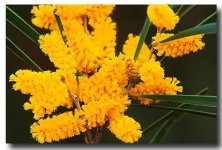
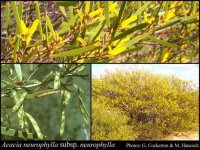
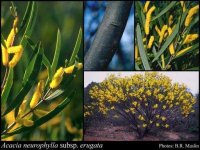
..the closely related Acacia neurophylla (native Western Aus. and South Australia) has two varieties, subsp. neurophylla, fairly variable, and subsp. erugata, with longer phyllodes..as reported in Voogelbreinder 2009, 'J' found bark/stem to contain mainly DMT, and phyllodes mainly Harman, though this varies apparently..needs cultivation, preservation and research..
below are it's two varieties, with the Broad Leaf A. acuminata first..
thanks also pablokabute, remember the 5meo finding was only 'tentative'..
..beautifulsorrow, welcome and thanks..these acacia notes from Trout 2004 were posted a few pages back too, but that link went dead..
they were a great co-ordination of available info at the time..since then there has been development in acacia-tryptamine knowledge, still growing..one thing that puzzles me about Trout/Appleseed's work at the time (Thin Layer Chromatography etc) is that it does not appear to have been followed up with further tests or assay..as Entheogen Review and Erowid aren't quite what they used to be, it leaves here (the nexus & the net) as the most up to date resource on the subject..
..............................................................................................................................................................................
..the following new information should make it to the next edition of Voogelbreinnder's "Garden Of Eden", still in print in it's 2009 form..regarding oral activity of A. acuminata and A. mucronata phyllodes..
a number of experiments were observed in the past year in which the phyllodes of Acacia acuminata Broad Leaf variety were boiled 3 times in water, reduced, and consumed on their own (as a kind of 'huasca' brew without added MAOI components)
..50 grams of phyllode aqueous brew were consumed as around 300-400mL of 'liquid'..it was extremely astringent and bitter (& slightly sweet), as expected of such acacia brews..
mild effects were noticeable within 5 minutes..over 30-40 minutes mild CEVs of a geometric nature grew, along with strong non-visual 'feelings' hard to characterise, and a deep sense of a very powerful ancient teacher demanding respect..the extreme astringency of the tannin-loaded brew led to stomach distress in one person for 15-20 minutes..strength +1 and a half on the Shulgin scale..effects diminished at around 90 minutes..these leaves were found by endlessness to contain Tetrahydroharman: DMT: Tryptamine: 3-Methyl-Quinoline: Harman: N-Methyl-Phenetylamine: Phenetylamine
49.7 : 11.9: 10.6: 0.7: 0.6: 0.4: 0.1..other collections of leaves would quite probably have different ratios of compounds and effects..it was deep, and not for the flippant..especially when combined with MAOIs...an experiment was done around 7 years ago with 50-60 grams of A. mucronata var. longifolia phyllodes on their own..these were found by GCMS to be around 10% ß-carbolines..they resulted in a milder but similar effect to the acuminata, but a smoother feeling overall..in conjunction with MAOIs, mucronata did not have the prolonged 'stimulation' experienced with the particular acuminata tested..
..i have been told that the Narrow Leaf variety of acuminata yields primarily DMT in the phyllodes..hopefully tests can happen in the near future..this would be a more suitable candidate for more typical 'huacsa' type brews..also, the bark content of the Broad Leaf strain is probably different to the phyllodes..again, future tests..
respect all trees
...
..the closely related Acacia neurophylla (native Western Aus. and South Australia) has two varieties, subsp. neurophylla, fairly variable, and subsp. erugata, with longer phyllodes..as reported in Voogelbreinder 2009, 'J' found bark/stem to contain mainly DMT, and phyllodes mainly Harman, though this varies apparently..needs cultivation, preservation and research..
below are it's two varieties, with the Broad Leaf A. acuminata first..
Attachments
beautifulsorrow
"If the doors of perception were cleansed, everyth
Thank you nen888 , besides that one there's the wikipedia page that I think almost everyone here must be familiar with: List of psychoactive plants - Wikipedia
and there's this List of Acacia species known to contain psychoactive alkaloids:
I know this is silly but I've noticed that acacias with signifiacant amounts of DMT very generally have those long yellow corn-shaped flowers (I don't know what that type is called:lol: ) like the ones in the pictures in the previous post (acacia acuminata).
Acacia nilotica is available where I live and is said to contain only trace amounts of DMT and 5-MeO-DMT in seeds but I guess the word "trace" means no chance for extraction?
An interesting thing about Acacia nilotica (It has an extremely wide range of uses for health) is that the Maasai people use it as a drug."Soups are probably the most important use of plants for food by Maasai. Acacia nilotica is the most frequently used soup plant. The root or stem bark is boiled in water and the decoction drunk alone or added to soup. The Maasai are fond of taking this as a drug, and is known to make them energetic, aggressive and fearless","Bark and root decoction is drunk by Masai youths to
acquire strength and courage.
(Brenan & Greenway(1949)
Same preparation has an intoxicating effect and is also
used as an aphrodisiac" The effects described don't seem at all psychedelic but still I wonder what the "intoxication" referred to is like.
I found a research paper that reports the presence of alkaloids in the bark of acacia nilotica (http://www.academicjournals.org/jmpr/PDF/pdf2009/Feb/Banso.pdf)(its on the second page with the title "Test for alkaloids" no. 083) so maybe they have a role to play in the intoxication mentioned, maybe if P.harmala was used along with the bark a "desirable" effect would be pronounced.
, besides that one there's the wikipedia page that I think almost everyone here must be familiar with: List of psychoactive plants - Wikipediaand there's this List of Acacia species known to contain psychoactive alkaloids:
I know this is silly but I've noticed that acacias with signifiacant amounts of DMT very generally have those long yellow corn-shaped flowers (I don't know what that type is called:lol: ) like the ones in the pictures in the previous post (acacia acuminata).
Acacia nilotica is available where I live and is said to contain only trace amounts of DMT and 5-MeO-DMT in seeds but I guess the word "trace" means no chance for extraction?
An interesting thing about Acacia nilotica (It has an extremely wide range of uses for health) is that the Maasai people use it as a drug."Soups are probably the most important use of plants for food by Maasai. Acacia nilotica is the most frequently used soup plant. The root or stem bark is boiled in water and the decoction drunk alone or added to soup. The Maasai are fond of taking this as a drug, and is known to make them energetic, aggressive and fearless","Bark and root decoction is drunk by Masai youths to
acquire strength and courage.
(Brenan & Greenway(1949)
Same preparation has an intoxicating effect and is also
used as an aphrodisiac" The effects described don't seem at all psychedelic but still I wonder what the "intoxication" referred to is like.
I found a research paper that reports the presence of alkaloids in the bark of acacia nilotica (http://www.academicjournals.org/jmpr/PDF/pdf2009/Feb/Banso.pdf)(its on the second page with the title "Test for alkaloids" no. 083) so maybe they have a role to play in the intoxication mentioned, maybe if P.harmala was used along with the bark a "desirable"
effect would be pronounced...thanks beautifulsorrow..i don't think A. nilotica has been properly investigated..it has a wide distribution (most of Africa, Middle East, India & parts of Asia) and several varieties..almost always the reports of 'trace' or no alkaloids in acacias are based on single experiments..i've known A. obtusifolia to contain almost nothing..similarly, if we took a few nexus reports on A. floribunda at face value, we could conclude there was nothing in it, yet experienced researchers have found the species to usually contain fairly large amounts of DMT..i think the art of working with and extracting acacias is quite different to the rushed world of phytochemical 'screening' which often reports a low % in a plant..seasonal or genetic factors may be crucial..
the huge amounts of ethnobotanic data on A. nilotica suggests that, in the right place or time, it must contain some quite active and interesting things..
Trout 2004 writes of A. nilotica..
of 50 medicinal plants from Nigeria D. Kubmarawa, G. A. Ajoku, N. M. Enwerem and D. A. Okorie [2007] tested many of the same plants tested by Odebiyi & Sofowora..they wrote:
http://www.tropicalforages.info/key/Forages/Media/Html/Acacia_nilotica.htm reports:
"A. nilotica subsp. nilotica is restricted to well-drained seasonally flooded and riverine habitats from Senegal and northern Nigeria, to Sudan, Arabia and India.
A. nilotica subsp. kraussiana is the most common form in east tropical Africa including Botswana, Zambia, Rhodesia, Malawi, Tanzania, Angola, Mozambique, Transvaal, and Natal.
A. nilotica subsp. adstringens is the commonest variety in west Africa, from Senegal to Nigeria and widespread in northern parts of tropical Africa. Occurs in wooded grasslands, savannas and dry scrub forests above the flood plains. [this is probably the variety tested by Odebiyi & Sofowora]
Naturalised in: Northern, sub-humid Australia where it is considered to be an invasive weed. Also naturalised in areas of eastern Indonesia."
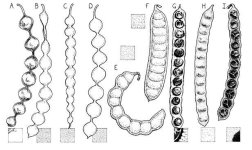
and there are also subsp.cupressiformis, subsp.tomentosa, subsp.subalta, subsp.leiocarpa, and subsp.hemispherica..! see chart attached below [from Manual on taxonomy of Acacia nilotica]..
..according to Medicinal Plants In Tropical West Africa by Oliver-Bever, A. nilotica contains 'Harmane derivatives' and tryptamine..
and lastly, Shulgin reports DMT in A. nilotica in TIKHAL, but because he doesn't provide a reference has been queried by Trout and others..
.. A. nilotica..very interesting and worthy of more study..
the huge amounts of ethnobotanic data on A. nilotica suggests that, in the right place or time, it must contain some quite active and interesting things..
Trout 2004 writes of A. nilotica..
in Preliminary phytochemical and antimicrobial screeningTrace amounts [5meoDMT] tentatively observed in seeds
(unconfirmed), 1995 tlc by J. Appleseed. Not confirmed by subsequent assay. Negative alkaloid assay of roots, stem-bark and leaves by Odebiyi & Sofowora (1978 )
of 50 medicinal plants from Nigeria D. Kubmarawa, G. A. Ajoku, N. M. Enwerem and D. A. Okorie [2007] tested many of the same plants tested by Odebiyi & Sofowora..they wrote:
....they did find alkaloids in A. senegal and tortillis , but not nilotica....some of the results obtained are not in agreement with the previous findings. For example alkaloids were found to be absent in the stem bark of Anogeisus leiocarpus which is contrary to the findings of Baowa et al. (1978 ) and Atal et al. (1978 ). This might be due to climatic and environmental factors.
http://www.tropicalforages.info/key/Forages/Media/Html/Acacia_nilotica.htm reports:
"A. nilotica subsp. nilotica is restricted to well-drained seasonally flooded and riverine habitats from Senegal and northern Nigeria, to Sudan, Arabia and India.
A. nilotica subsp. kraussiana is the most common form in east tropical Africa including Botswana, Zambia, Rhodesia, Malawi, Tanzania, Angola, Mozambique, Transvaal, and Natal.
A. nilotica subsp. adstringens is the commonest variety in west Africa, from Senegal to Nigeria and widespread in northern parts of tropical Africa. Occurs in wooded grasslands, savannas and dry scrub forests above the flood plains. [this is probably the variety tested by Odebiyi & Sofowora]
Naturalised in: Northern, sub-humid Australia where it is considered to be an invasive weed. Also naturalised in areas of eastern Indonesia."
and there are also subsp.cupressiformis, subsp.tomentosa, subsp.subalta, subsp.leiocarpa, and subsp.hemispherica..! see chart attached below [from Manual on taxonomy of Acacia nilotica]..
..according to Medicinal Plants In Tropical West Africa by Oliver-Bever, A. nilotica contains 'Harmane derivatives' and tryptamine..
and lastly, Shulgin reports DMT in A. nilotica in TIKHAL, but because he doesn't provide a reference has been queried by Trout and others..
.. A. nilotica..very interesting and worthy of more study..
Attachments

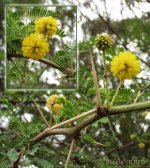
..hi pineal.outburst..photos are a Cassia or Senna..any plant where you can make out the individual flowers is not an acacia..acacias have very small (almost microscopic) flowers bunched together as 'spike' or 'balls', which are what look like the flowers (but are in fact 'racemes', see p17 botanical terms)
..a made a few corrections to the previous A. nilotica post....Oliver-Bever claims 'Harmane derivatives' and tryptamine in the plant...
..a made a few corrections to the previous A. nilotica post....Oliver-Bever claims 'Harmane derivatives' and tryptamine in the plant...

pineal.outburst
Rising Star
nen888 said:..hi pineal.outburst..photos are a Cassia or Senna..any plant where you can make out the individual flowers is not an acacia..acacias have very small (almost microscopic) flowers bunched together as 'spike' or 'balls', which are what look like the flowers (but are in fact 'racemes', see p17 botanical terms)
..a made a few corrections to the previous A. nilotica post....Oliver-Bever claims 'Harmane derivatives' and tryptamine in the plant...
Got ya chief. So that's why I couldn't find this particular species.. Thank you much for the help! Will keep looking for other ones.
beautifulsorrow
"If the doors of perception were cleansed, everyth
Yes I spent some time searching for an explanation for the intoxication caused by the soup of the Acacia nilotica bark and what the intoxication is like and found nothing. I think maybe there might be some details (unlikely but maybe) in the east african agricultural and forestry journal (1966) but i don't have access to that (not free online).. A. nilotica..very interesting and worthy of more study..
The other day i was browsing through the wikipedia list of psychedelic plants ( List of psychoactive plants - Wikipedia )
And i noticed: A. Flavescens (Strongly Psychoactive, Bark.)
A side note. Something that ive never seen being discussed,
a lot of wattles have a very thick crumbly kind of dry outer bark
& then the more wet fleshy\sapy bark on the inside.
Sometimes the outer bark takes up say over 50% of the total weight,
and it is too difficult to seperate from the inner\fresh bark.
Are there alkaloids in the outer\crumbly parts ???
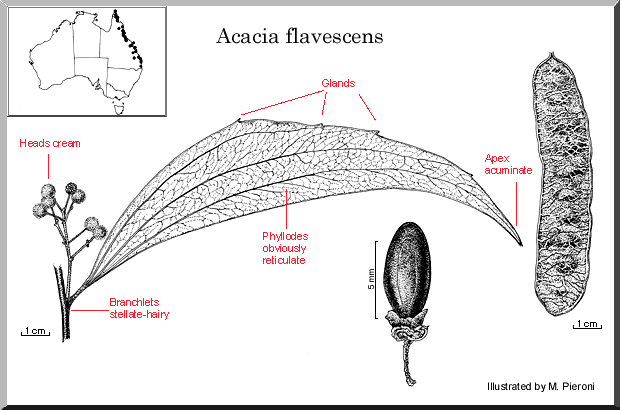

And i noticed: A. Flavescens (Strongly Psychoactive, Bark.)
A side note. Something that ive never seen being discussed,
a lot of wattles have a very thick crumbly kind of dry outer bark
& then the more wet fleshy\sapy bark on the inside.
Sometimes the outer bark takes up say over 50% of the total weight,
and it is too difficult to seperate from the inner\fresh bark.
Are there alkaloids in the outer\crumbly parts ???
Attachments
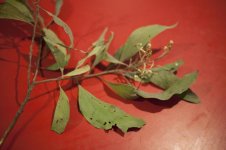
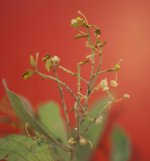
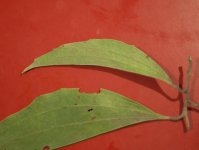
..well spotted and hugely interesting, Polmos..i wonder who came up with the info, can't wait to hear your results
..usually the outer protective layer doesn't contain alkaloids, needs to be where the sap is flowing..
..usually the outer protective layer doesn't contain alkaloids, needs to be where the sap is flowing..

nen888 said:..hi pineal.outburst..photos are a Cassia or Senna..any plant where you can make out the individual flowers is not an acacia..acacias have very small (almost microscopic) flowers bunched together as 'spike' or 'balls', which are what look like the flowers (but are in fact 'racemes', see p17 botanical terms)
..a made a few corrections to the previous A. nilotica post....Oliver-Bever claims 'Harmane derivatives' and tryptamine in the plant...
i reckon the roundish shaped flowered acacia's like on flinders wattle or confusa actually look like dmt crystals
..an afterword on oral effects of acuminata and mucronata phyllodes [p21]..it is my understanding from the very limited information available that Tetrahydroharman would not be expected to be a particularly potent oral MAOI (like it's relative Tetrahydroharmine), though it should have some CNS effects (like tetrahydroharmine)
..Harman seems reasonably potent, but from the amounts of alkaloid components ingested in the described experiments, it could be that other compounds, Flavonoids in particular, may be partially responsible for gut MAOI effects..
..the reported partial oral activity of A. confusa may be due to Flavonoids (which have been found in the phyllodes, see p12#234) ..similarly Dennis McKenna et al. 1984 suggested tannins/anti-oxidants may have been responsible for the amazonian orally active tryptamine pastes, which do not contain enough Harmalas to explain the reported effects..
.
..Harman seems reasonably potent, but from the amounts of alkaloid components ingested in the described experiments, it could be that other compounds, Flavonoids in particular, may be partially responsible for gut MAOI effects..
..the reported partial oral activity of A. confusa may be due to Flavonoids (which have been found in the phyllodes, see p12#234) ..similarly Dennis McKenna et al. 1984 suggested tannins/anti-oxidants may have been responsible for the amazonian orally active tryptamine pastes, which do not contain enough Harmalas to explain the reported effects..
.
Anyone relying on the wikipedia list of psychedelic plants, bear in mind that regarding Acacias, the info is largely from the older, less accurate page for 'list of Acacia species known to contain psychoactive alkaloids.' Also, whoever put that together has used a pretty unusual definition of what to include as 'psychedelic', and has listed all manner of things that are psychoactive but not psychedelic.
The unreferenced claims of psychoactivity from some Acacia species on that list is interesting though...
The unreferenced claims of psychoactivity from some Acacia species on that list is interesting though...
westernspice
Rising Star
Wow nen888, excellent job with the thread, there is so much inconclusive information online, this is a welcome change. Thankyou to you nen888 and all other contributors to this thread.
Once question about Acacia Mearnsii and the unconfirmed 5meo content, have you or anyone else heard any more related to this? In my parts the name "black wattle" is pasted around quite a lot.
Also do you mind doing ID's in this thread? Or would you prefer a separate post, so as to not distract from the main subject matter?
Once question about Acacia Mearnsii and the unconfirmed 5meo content, have you or anyone else heard any more related to this? In my parts the name "black wattle" is pasted around quite a lot.
Also do you mind doing ID's in this thread? Or would you prefer a separate post, so as to not distract from the main subject matter?
Similar threads

- Replies
- 0
- Views
- 525
- Replies
- 6
- Views
- 2K

- Replies
- 4
- Views
- 473

- Replies
- 2
- Views
- 380

- Replies
- 149
- Views
- 16K
