pablokabute
"Look up, look within, it's SPACE and it's YOU."
it might be Acacia auriculiformis. i will be posting pics real soon.

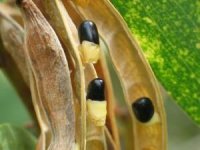
..in one study i read, seeds of A. melanoxylon were still viable after 20 years in seawater! ..but that's still not the record..from "Germination of 151-year old Acacia spp. seeds" by Matti W. Leino and Johan Edqvist:The long lifespan expected for many Australian species is illustrated in NSW by a small batch of Acacia pycnantha seed originating from Australia’s first Arbor Day in 1890, where 80% of seed germinated in 1990 after 100 years of unsealed home storage.
..A collection of seeds from five Acacia species was made in Egypt in 1856. Since then, the seeds have been stored at room temperature in different Swedish museums. Due to the extreme longevity within the seeds of Acacia and related species, germination tests were performed on the now 151-year old seed. Seeds of two of the five species tested germinated. The first, Acacia farnesiana (L.) Willd., had two seeds germinate, and Acacia melanoxylon R. Br. ex Ait. f. had one seed germinate. In addition, DNA was extracted from the aged seed and DNA preservation was analyzed.

 if it has that tryptamine smell it could be subthreshold NMT (seems inactive below about 40mg) or simple tryptamine..could be worth sampling at a different time of year to see if there's variation (as there often is) ..there are a lot species of acacia in north QLD which remain a phytochemical mystery (most, in fact)
..a couple of published studies have found in A.confusa phyllodes DMT, DMT-N-Oxide & NMT in smaller amounts than bark, but these tests are more about what's in the plant than maximizing yields, so i would predict, based on bark amounts (& most other acacias) there could be up to 0.3-0.5% alkaloid in leaf if efficiently extracted..also the phyllodes contain flavonoids (myricetin etc. ) which could possibly aid in oral activity, so the report you mention sounds most plausible..Do we know anything about confusa phyllodes other than the old net reports of no alkaloids? On the corroboree there is a report of someone using a handful of phyllodes in a brew with a few grams of caapi and it being active..
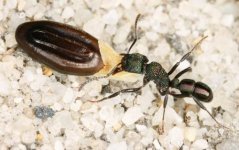
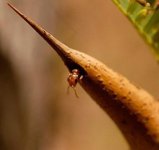
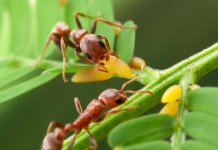
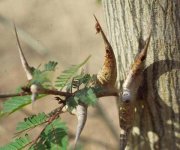
..A. cornigera is often stated in literature to contain alkaloids, but these are never identified..Pseudomyrmex ferruginea...These stinging ants hunt down any insect that dares to eat the bullhorn acacia young fresh leaves. In fact, these ants are so aggressive that they attack any animal or even humans that touches the tree.
The bullhorn acacia provides two types of food. First, it has well located extraforal nectaries at the lower part of base of its leaves. These nectaries exude continuously sweet nectar, derived from phloem sap, all year round. Second, the bullhorn acacia supplies solid food in the form of protein-lipid nodules called Beltian bodies from its leaflet tips. These perfectly distinguishable orange nodules have no known function other than to provide food for the symbiotic ants and their larvae.
It is hard to measure what benefits the most from this symbiotic and mutualistic relationship between the acacia ants and the bullhorn acacia. The main benefit that the tree gets is that it is free from insects that would damage its leaves and suck its sap. This enormous advantage was demonstrated by removing all the thorns and ant nests of the bullhorn acacia. Being thornless and without ants the bullhorn acacia showed itself vulnerable and life threatened when compared with a normally protected tree. One factor that may account for this disadvantage, when made thornless and without its protective ants, is that bullhorn acacias are deficient in the bitter alkaloids usually located in their leaves that defend them against ravaging insects and animals.

5-MeO-DMT
(Reports of this compound relied on co-tlc with known
reference material and a blue reaction with
Xanthydrol. All need confirmation.)
Acacia albida
In twigs. 5 Oct. 1995. tlc by J. Appleseed 1995
Acacia angustissima
Trace amounts tentatively observed in roots
(unconfirmed) in March 1995. tlc by J. Appleseed.
Not observed in second assay.
Trace amounts in seeds. tlc by J. Appleseed 1995
Acacia auriculiformis
Trace amounts in stem-bark (25 April 1995). tlc by
J. Appleseed 1995 (A band at this Rf was also seen
in roots in 2 Sept. 1994 assay but used Ehrlichs
reagent which does not differentiate between DMT
and 5-MeO-DMT.)
Acacia cultriformis
Branch stems, phyllodes and flower spikes of
commercial florist’s material showed separate
positive assay. tlc by J. Appleseed 1996.
Acacia difformis
Stems of two year old seedlings. tlc by J.
Appleseed 1996.
Acacia farnesiana
Traces in green fruit. Not present in ripe fruit. tlc
by J. Appleseed 1995.
Acacia maidenii
Observed in twigs (26 July and in mixed leaf and
twigs 27 Oct. 1995), Traces observed in wood
(October 1995); tlc by J. Appleseed 1995
Acacia nilotica
Trace amounts tentatively observed in seeds
(unconfirmed), 1995 tlc by J. Appleseed. Not
confirmed by subsequent assay. Trace amounts in
separate samples of stems, roots and leaves. 2 yr.
old plant. Unconfirmed. 1996 tlc.
Negative alkaloid assay of roots, stem-bark and
leaves by Odebiyi & Sofowora (1978 ).
Acacia obtusifolia
Presence indicated in multiple human bioassays.
Mulga & anonymous friends.
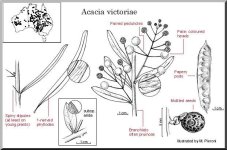
Acacia victoriae
Roots of two year old seedlings. Good banding. tlc
by J. Appleseed 1996.
..now, from the references gathered by endlessness in the linked thread, with Ehrlich's reagent DMT turns "Reddish purple - (as acetate on paper) ", and 5meoDMT is said to turn "Royal Blue on silica gel"..this however refers to the pure compounds under certain conditions..from my limited work with reagents i have seen that a pure alkaloid will give a slightly different hue to one which is, say, 70-80% pure..using Ehrlich's reagent/acetone, australian researcher 'J' takes Blue to indicate tryptamines generally, with GCMS usually showing it to be, in acacias, DMT..in fact, confirmation of 5meoDMT has to date proved rare in acacias, and usually as a trace along with DMT..in A. longifolia (varieties) DMT has been confirmed by extraction a number of times..Ehrlich's reagent and even Xanthydrol (see below) may not always be reliable at differentiating between tryptamines, especially when multiple tryptamines are be present..“Alkaloid agents gave mostly oils, but the
picrate at times showed fern-like forms.”
Base decomposed on manipulation and
standing, developing a skatole like odor and gave
intense blue with p-dimethylaminobenzaldehyde.
[Ehrlich’s reagent]
Good banding was observed in our 1995 tlc assays of
this species. DMT was observed in the aerial parts
and 5-MeO-DMT in the roots. Both are tentative
and need confirmation.
Both relied entirely on co-chromatography with known
reference standards and color reaction with
xanthydrol (Purple for DMT/ Blue for 5-MeODMT.)
Observations by Trout. tlc by J. Appleseed.
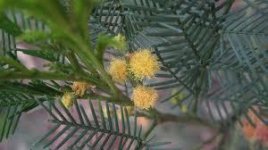
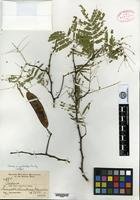
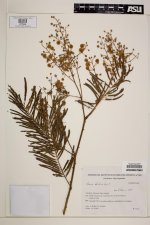
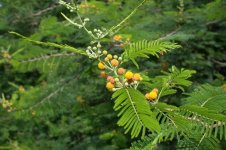
..some of the interesting acacias in this list, not yet looked at, pictured below areSpecies suspected of containing tryptamine
derivatives and needing assays or preliminary
results indicate a need for further study;
Acacia abyssinica, A. albida, A. alpina, A.
angustissima, A. auriculiformis, A. benadirensis,
A. burkei, A. caffra, A.catechu, A. cornigera, A.
dallachiana, A. delayayi, A.difformis, A. durrens,
A. etbaica, A. farnesiana, A. ferruginea, A. giraffe,
A. hetercensis, A. implexa, A. intsia, A. koa, A.
koaia (a rare Hawaiian endemic in desperate need
of cultivation), A. longifolia, A. macradenia, A.
macrothyrsa, A. mellifera, A. montis-usti, A.
nilotica, A. nilotica var. subalata, A. obtusifolia
(distinct chemical varieties of this species appear
to exist), A. orites, A.. pennata, A. piauhyensis, A.
redolens, A. reficiens, A. rhodoxylon, A. saligna, A.
shirleyi, A. sophorae, A. sparsiflora, A.
stenophylla, A. stuhlmanni, A. victoriae and A.
yunnanensis

nen888 said:..welcome endophytik, the first is indeed A. baileyana, but there are a few unpublished tests of this species indicating larger amounts of tryptamines/betacarbolines..a single reference to low percentages should never be treated as definitive information as to what is likely to be in a plant..i would say it's well worth experimenting with A. baileyana..we need more data..only if repeated multiple tests found little alkaloid would i accept a statement of low alkaloid content..i have even been told by one fairly good source that it has yielded DMT..
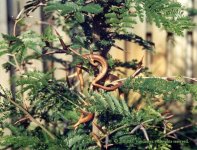
nen888 said:..off the top of my head..2. is possibly a variety Acacia decurrens or A.dealbata (naturalized in Sth. America), a hybrid, or perhaps a form of A. nilotica (also in northern Sth. America) ..will have to compare pods and flowers carefully, plus number of pinnae)


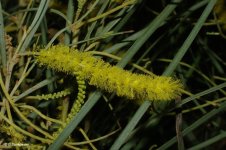
Ok, thank you ... but no personal problems with mosquitoes nor constipation :lol:nen888 said:..3. is (i think) a Senna (Fabaceae) many with laxative properties,
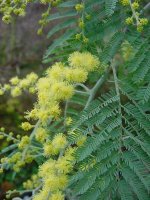
and 4. is a Callistemon, australian natives in Myrtaceae known as 'Bottlebrushes'..mainly cineol type volatile oils similar to eucalypts in them..natural insect repellent..
nen888 said:..below is Acacia decurrens (Sydney Green Wattle) ,which has a few varieties..it has tested positive for alkaloids..below that the related A. dealbata also in need of research..
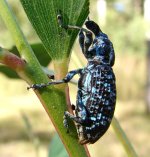
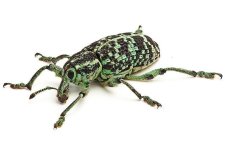
below that is a green Diamond Weevil, as reported by Spice Sailor
..yes, and thank you for that paperSo this means that they are more than 13 Acacia species in South-America (as stated by the precedent paper) ?
, i will study it..i'm no expert on South American acacias, but i know that new ones have been named in the past decade (some mistaken previously as Mimosas) including ..some of these are rare South American species which i'm still learning about..some are synonymous with other species..Acacias recorded in Bolivia
Acacia albicorticata
Acacia alemquerensis
Acacia altiscandens
Acacia ampeloclada
Acacia angustissima*
Acacia aroma
Acacia atramentaria
Acacia boliviana
Acacia bonariensis
Acacia caven
Acacia cultriformis*
Acacia dealbata*
Acacia eburnea
Acacia emilioana
Acacia etilis
Acacia farnesiana
Acacia feddeana
Acacia furcatispina
Acacia glomerosa
Acacia karroo*
Acacia langsdorfii
Acacia loretensis
Acacia macbridei
Acacia macracantha
Acacia martiusiana
Acacia mearnsii*
Acacia melanoxylon*
Acacia monacantha
Acacia multipinnata
Acacia paniculata (maybe synon. M. hostilis)
Acacia parviceps
Acacia pedicellata
Acacia polyphylla
Acacia praecox
Acacia retinodes*
Acacia riparia
Acacia rurrenabaqueana
Acacia rynchocarpa
Acacia saligna*
Acacia tenuifolia (synon. Mimosa hostilis)
Acacia tucumanensis
Acacia velutina
Acacia visco
..well, this is a tricky area to give advice on, but that is what this author and others have done..on p13 #247 i discussed the risks of acacia bioassay..to date there have been no adverse reactions from one-off smoking of acacia extracts which aren't dmt..smell is a key indicator of tryptamines, but as i must always say an unknown is a risk, and most people don't want to be test pilots..suposing you don't have analytical methods (TLC, GC-MS ...) and standards ? Do you evaluate this by the aspect of your product or "simply" by ... smoking it ?
nen888 said:..despite the resemblance to A. cyclops, i think it is actually a form of A. melanoxylon, due to the 'racemes' being 5-numerous and the reverting to juvenile growth.. (A. cyclops the racemes or flower clusters are 2-numerous, and the aril more scarlet) ..while the more twisted-pod form of melanoxylon has been tested several times and only found to have minimal dmt, i'm not sure about this form..
 Too bad ... Anyway I think I'll try extracting this one since it's more abundant. What about a DMT-containing sub-species ? :roll:
 nen888 said:..i will have some time to try and properly identify the bipannate acacia (no.2) this week..will take a bit of comparing..be more than happy if someone else beats me too it..it's the pod shape/size that's really interesting..may well be a native..
nen888 said:ps. i hope yatiqiri is ok..based on his last experiment, Acacia tortuosa is a South American/Carribean acacia worth investigating [see p.12] ..according to the taxonomic revision paper attached by endophytik it is very closely related to A. farnensiana..