• Members of the previous forum can retrieve their temporary password here, (login and check your PM).

Trying to improve Acacia information

Migrated topic.
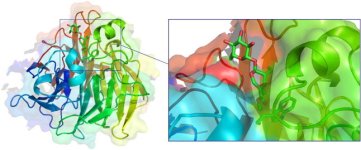
..hi all, to add to Major Tom's comments on internal plant synthesis of medicinal compounds, below are a couple of images of the enzyme N-methyl transferase which is in plants and animals and helps make tryptamines..it's sometimes rather confusingly called 'nmt', but should not be confused with N-methyl-tryptamine (NMT), although it's involved with it. Not even the fastest super-computers can calculate the forms and structural transformations some enzymes can do in nano-seconds..this relates also to my mention of 'why do crystals have certain form?'..and new findings about how the immune system 'pre-empts' incoming, even it's it's not known to Earth! (too off-topic methinks for here:))
..the 2nd image is
Side view of the STR1 β-propeller structure in complex with tryptamine and secologanin (alignment of the crystal structures of STR1-tryptamine- and STR1-secologanin-complex). The zoomed region shows the catalytic pocket with tryptamine at the bottom and secologanin at the top.
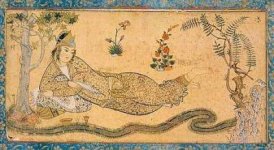
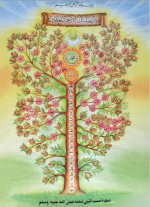
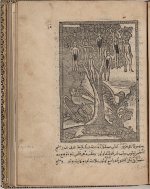
after that, an image that compliments the monk's really cool Retinodes in London Landscape Architecture pic..
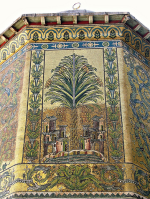
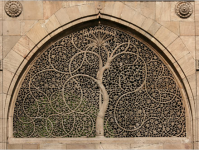
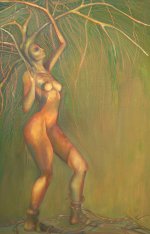
and then one from The Islamic Arts Museum Malaysia (IAMM) who are currently holding an exhibition on the role of women in the Islamic world. Note the 'mimosae-like' leaf structure.;)
 

Attachments

  • 1-s20-S1357272597001052-gr4.jpg
    1-s20-S1357272597001052-gr4.jpg
    160.2 KB · Views: 0
  • 1-s20-S0981942807002446-gr5.jpg
    1-s20-S0981942807002446-gr5.jpg
    60.1 KB · Views: 0
  • ncontent.gif
    ncontent.gif
    97.4 KB · Views: 0
  • 1942_EuwJCwmZ_b.jpg
    1942_EuwJCwmZ_b.jpg
    34 KB · Views: 0
  • women+in+islam+exhibition.jpg
    women+in+islam+exhibition.jpg
    28.1 KB · Views: 0
..thanks bluebird.:) ..first pic in honour..

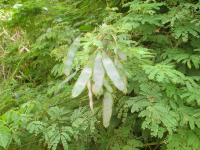
also, below, for South Americans pods of Acacia polyphylla, the Yopo-type snuff tree..see index..
Fruits of the species popularly known as 'mimosa' or black-monjoleiro. The species occurs in several regions of the country, mainly in dry forests.
, so, it's called both black and white
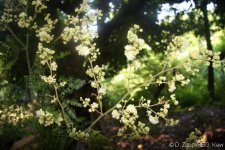
..and below that it's flowers in Brazil..
 

Attachments

  • A+polyphylla.jpg
    A+polyphylla.jpg
    85.4 KB · Views: 0
  • monjoleiro+pods.png
    monjoleiro+pods.png
    841.8 KB · Views: 0
  • th.jpg
    th.jpg
    68.1 KB · Views: 0
..btw..if you've "taken enough 'dmt'" from the plants..then you don't need to actually 'take' it to evoke the state.."use your voice.."
no, ceremony is on occasion, and not near the lights of the net..
the trip stabilises itself, and never ends..unless you poison it..
then it's time for medicine..
.
no, it's been legal meetings for me past two weeks..:) all ok..
.


In Eridu, a stalk grew overshadowing; in a holy place it did become green. Its roots were of white crystal, which stretched toward the deep.… Its seat was (the central place of the Earth). Its foliage was the couch of Zikum the (primeval) mother. Into the heart of its holy house, which spread a shade like a forest, hath no man entered. There is the home of the mighty mother who passes across the sky
[Persian Gulf circa 3500 B.C. in an Akkadian manuscript.]

in the pre-Islamic paganism of the Arabian Peninsula, the soil of Islam. Trees were commonly thought to be the abodes of jinn, supernatural beings, (ancestor of “genie” and “genius”), and were even considered to embody jinn. The Arab pagans, along with the rest of the Middle-East, ascribed a divinatory function to certain trees. There was a sacred tree near Mecca, the sacred acacia of Nakhla, where lived the goddess Al-Ozza.
in several hadîths. Ibn Hanbal traces to Abû-Sa‘îd al-Khudrî the tradition that a Bedouin approached the Prophet and asked, “What is bliss (tûba)?”
The Prophet answered:
Bliss is a tree in Paradise, a tree of a hundred years’ walk, and those under the tree are clothed in clothes from the sleeves (i.e. flower calixes) of the tree.
[The Tree Symbol in Islam: Noble Ross Reat, 1979]

peace unto all of you..
.
 
^You too nen. A. Elata is flowering at the moment. I'm curious and apprehensive based on your earlier description, nen, but what a gorgeous, ancient looking acacia. Reminds me of yopo trees. Did you say mild active orange wax one time as well? Was that during flowering? Smells Ancient!
I'm curious if Timeloop has been further with Mabellae yet? It's a very attractive looking tree.
And Acacian, any luck with the mearnsii or longifolia?

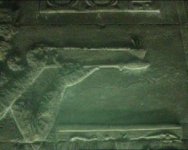
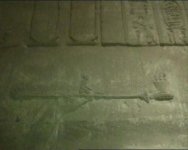
And what Did they smoke in Ancient Egypt? Prehistoric Drugs.
See photos uploaded.
These 'images' on the temple walls of Dendera (left) and Abydoss (right), suggest an association between the the ceremonial nature of the temples and inhaling a 'burning substance'...
 

Attachments

  • Egypt+one+044.jpg
    Egypt+one+044.jpg
    18.4 KB · Views: 0
  • Egypt+one+046.jpg
    Egypt+one+046.jpg
    11.2 KB · Views: 0
phyllode.. in honesty the material is still sitting in my room. having a little break from the extractions for a week. been full on with it lately and wanna focus on some other stuff in my life. Had a really powerful trip the other day and it got me motivated to get out a bit more and go meet more people :)

il try do it at the end of the week. :)

hope your well
 
^..yeah, part social animal too! ha,ha:) acacian..

as this thread moves so fast, and the index is only updated to p45 right now, i'll do a quick
Update of What's been Happening Lately in the thread..and quick guide for Newcomers..

on p.46 we looked at how to ID Acacia mucronata var. longifolia (which of course has one of the most interesting tryptamine and betacarboline profiles of all acacias); and the Logos..
p47. we looked at new findings about Pacific Island phyllode species, and their relationship with Australia..
which led to Acacia simsii..very probable tryptamine candidate..
p48. featured 'god' again, and a chart showing the variability of A. obtusifolia..
and p49. featured enthobotany of Acacias of S.E. Asia, and the announcement of a new tryptamine species by timeloop Acacia mabellae..followed by further revelations from yours truly..;), and then a few of mabellae's relatives..

..Newcomers to the thread..the real key to the thread is the INDEX at the start of p1..
the World Guide To Entheo-Acacias is here on p.39..

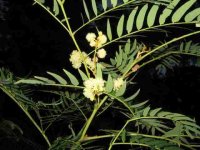
..phyllode..yes the 'mild orange wax' was during flowering of Acacia elata ("Cedar Wattle", pictured below)..actually it was very nice, even though there were no visual effects..kind of relaxing/anxiolytic/meditative..in stark contrast to the punch in the face 5meo laced fury of an extract from a different time and tree..see p.3 and p.7
Fruit : pale yellow, flattened pod, 100 to 150mm long, time:November to December
leaf: , 250mm, notes, bipinnate, 30 to more than 100 per leaf
leaflet: , dark green, narrow lanceolate, often curved, 4 to 10mm wide, length:30to80(mm), undersurface paler, veins:midrib, basal vein and 2 or 3 lateral veins prominent, new shoots:light green, creamy
flower: pale yellow, infloresence:terminal clusters, notes petiole elongated, terete, with a large raised gland (nectary) on the upper surface near the middle
height : to Max. Height(metres):20
.


would love to hear from any and all of you of YOUR views, explorations, research and all matters relating to the Mystery of Acacia..
be safe and well, acacia lovers..
.

below
 

Attachments

  • Cedar+Wattle_01.JPG
    Cedar+Wattle_01.JPG
    21.2 KB · Views: 0
so some good news! that Acacia Mucronata phyllode extract turned out to be active... dmt being the main alkaloid it seems judging by the taste and effects. just bioassayed a few minutes ago and still feeling the effects. I will have to get it analysed but for now I can say its definitely worth pursuing for alkaloids.. it felt and tasted just the same as other dmt extracts. (very warm body feeling, ringing sound in my head, "rubbery" kind of taste.. mild CEVs). It was from that mucronata that you said looked like the pick of the lot from those pics i posted (posted it again below as well as a younger specimen growing in the wild.. which i'm quite certain are the same species.. the pic of the urban one was just losing its flowers as it was taken about a month later)... the effects are very pleasant and warming.. i'm sorry to say i didn't measure my dose.. but it was probably around 10-15mg.. so yeah i know mucronata is a pretty broad species but this one has pointy/slightly sharp phyllodes which seem to grow out of the thicker branches too

it was a hardened goo in the dish which for weeks i assumed was just plant fats .. but after scraping it up i got a deep red powder and decided i'd take it for a spin. success!

img1241mm.jpg


img1103zr.jpg


img1096nf.jpg
 
Just found acacia honey in my market, I was quite suprised to see it :D I wonder if there is any dmt in there. I guess not though(looked for the speciees the flowers came from). It said it was made from acacia flowers. Hehe just throwing it out there.
Hehe found my answer: "Acacia honey is a variety of honey produced by bees that comes from the nectar gathered from the flowers of the acacia plant."

So im guessing no, but it could be awesome to eat some before smoking acacia maybe :D
 
acacian wrote:
so some good news! that mucronata phyllode extract turned out to be active... dmt being the main alkaloid it seems judging by the taste and effects. just bioassayed a few minutes ago and still feeling the effects.
..fantastic news acacian..:d ! ..in my experience dmt is likely the main alkaloid..the sample sent to endlessness for testing was from a 18month old seed grown plant..it does seem increased dmt comes with maturity above 2-3 years in acacias looked at so far..
i suspect the variety you have is intermediate between the shorter inflorescence form (tested) and another variety..var. disstiflora (once considered seperate, and found strong alk+ve by CSIRO) is now considered synonymous with var. longifloia..i guess this allows for the common name, as you said acacian, 'Variable Sallow Wattle'..i have taken this tree orally several times, and it would be my pick so far of known orally active acacias, for a certain quality hard to define..it's a very lovely small tree..:)
main entry on A. mucronata here p.11..
it was a hardened goo in the dish which for weeks i assumed was just plant fats .. but after scraping it up i got a deep red powder and decided i'd take it for a spin. success!
..yes, some results can take weeks to solidify..to date, personally, i have seen no evidence of fabled 'plant oils' except during flowering of some species..it's usually NMT and/or ß-carbolines..i've almost never seen anything much come out of an acacia defat either..Red usually in experience equates to harmalas, which of course have been found in two GCMS tests of mucronata..
awesome news for the day acacian..!:) ..thank you..

and zombicyckel, it is known that medicinal bitter compounds and flavonoids from Leptospernum species (Tea Tree) transfer to the honey..see http://www.medicinalhoney.com.au/activehoney.htm

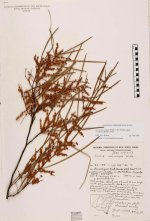
Acacia mucronata sub. sp. longifolia isotype:>
 

Attachments

  • 108001.jpg
    108001.jpg
    123.1 KB · Views: 0
sounds like you might be on the money there nen... its definitely a bit differen't to mucronata subs mucronata.. the phyllodes can get a bit longer and narrower.. and much pointier... ad also differen't to the subs. longifolia.. I can't find any pics of dissitiflora on the net uunfortauntely.. i don't suppose you'd know where to find any? interesting to note about the red being an indicator of beta carbolines.. sounds like this might be the tree for me :) they are everywhere around the area I found them and its good to know that the phyllodes are active.. i'm yet to test the bark

an oral brew might be in order soon i think..
 
^..yeah, this species as well as longifolia and ob are in need of Botanical Revision is would say..NSW botanists tend to be the 'Lumpers' (don't like sub-species), where as in Qld and Vic. they don't mind a being 'Splitters'..i argue the latter orientation of botany is far more useful for any practical or utilitarian purposes..:?:
..var. dissiflora is synonymous with var. longifolia..what i think you have acacian is var. mucronata..images in a moment..remember the oral brews i refer to used only the acacia..no admixture..diet helps imo..the bioassayed youngling extract (only a trace dmt, but a lot of other things) remains (to the assayer:wink: ) one of the most profound feelings of ancient grace ever experienced under the tree..
visuals are not everything..but, as you acacian have so infected others with, the experience of being in the presence of the live plant is a major part of the depth of Acacian Transference..
.

Acacia mucronata is grown in Germany and other parts of Europe, and naturalised in New Zealand and Hawaii..
say Plants For A Future:
Edible Uses
The following uses are for the closely related A. longifolia, they almost certainly also apply to this species[K]. Flowers - cooked[144]. Rich in pollen, they are often used in fritters. Seed - roasted[2, 46, 61, 105]. Starchy[177]. Acacia seeds are highly nutritious and contain approx 26% protein, 26% available carbohydrate, 32% fibre and 9% fat[278]. The fat content is higher than most legumes with the aril providing the bulk of fatty acids present[278]. These fatty acids are largely unsaturated which is a distinct health advantage although it presents storage problems as such fats readily oxidise[278]. The mean total carbohydrate content of 55.8 + 13.7% is lower than that of lentils, but higher than that of soybeans while the mean fibre content of 32.3 + 14.3% is higher than that of other legumes such as lentils with a level of 11.7%[278]. The energy content is high in all species tested, averaging 1480+270 kJ per 100g[278]. Wattle seeds are low glycaemic index foods. The starch is digested and absorbed very slowly, producing a small, but sustained rise in blood glucose and so delaying the onset of exhaustion in prolonged exercise[278]. Seedpods - roasted[177]. The pods are up to 10cm long[219].
Medicinal Uses
Plants For A Future can not take any responsibility for any adverse effects from the use of plants. Always seek advice from a professional before using a plant medicinally.

None known

Other Uses
The following uses are for the closely related A. longifolia, they almost certainly also apply to this species[K]. A yellow dye is obtained from the flowers[168]. A green dye is obtained from the seed pods[168]. The extensive root system of this plant helps to prevent soil erosion[200]. It is used on sandy soils and steep banks[200]. Trees are planted as a screen in Australia[157]. This species is often grown as a rootstock for grafting lime-intolerant members of the genus[11]. Wood - pale, tough[154].
Cultivation details
Prefers a sandy loam and a very sunny position.[1, 182] Succeeds in any good garden soil that is not excessively limey[11]. This species is fairly lime-tolerant[11, 200]. Plants are very tolerant of drought[260], they succeed in a hot dry position[166] and in poor soils[184]. A fairly wind resistant tree, growing well in maritime areas[49, 166, 182]. Tolerates some salt in the soil[200]. Hardy to about -10°c for short periods[200], it can be grown outdoors in many of the milder areas of the country though, even in Cornwall, it is liable to be cut back to the ground in excessively cold winters[11]. It can resprout from the base[11]. This species is closely related to A. longifolia, but is considered to be hardier and is possibly the hardiest of all the Acacias in Britain[11]. Dislikes root disturbance[78]. A very ornamental plant[1]. This species has a symbiotic relationship with certain soil bacteria, these bacteria form nodules on the roots and fix atmospheric nitrogen. Some of this nitrogen is utilized by the growing plant but some can also be used by other plants growing nearby[200].

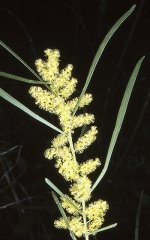
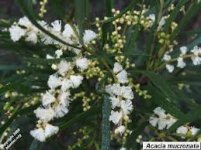
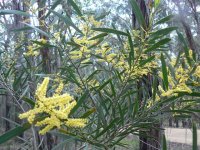
1) A. mucronata var. longifolia (typical)
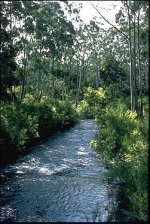
2) var. longifolia habit of first bioassayed tree seed source..please! don't exploit an environment like this..even seed collection should be sparing..the habitat needs it too!
3) var. mucronata (victoria)
4) tasmanian variety
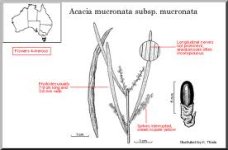
5) var. mucronata drawing
 

Attachments

  • A+mucronata++var+mucronata.jpg
    A+mucronata++var+mucronata.jpg
    30 KB · Views: 1
  • mucronata+tasmanian+var.jpg
    mucronata+tasmanian+var.jpg
    56.7 KB · Views: 1
  • 1008320_orig.jpg
    1008320_orig.jpg
    101.9 KB · Views: 1
  • mucronata.jpg
    mucronata.jpg
    48.8 KB · Views: 1
  • Acacia_mucronata_subsp_longifolia_2-060.jpg
    Acacia_mucronata_subsp_longifolia_2-060.jpg
    203.2 KB · Views: 1
hehe by the way... bit of an acacian dream this morning. me and my friend were looking for a narrow phyllode version of acacia longifolia in a pine forest which was actually out the back of the art gallery in armidale NSW.. we were planning on finding this tree and then visiting a shaman, who was also supposed to be located behind the art gallery. then my housemate interrupted the dream to cook me breakfast before leaving for sydney.. so i never got to dream it out! bummer. but yeah... something keeps saying to me that i need to find an active longifolia to work with. there's something about the look of that plant that draws me in..

anyone else dream about wattle much? nen surely you have some interesting dreamcacia experiences to share :p

here's an acacia and a variant found growing a couple hundred meters away that i've been wondering about the name of.. looks of some relation to longifolia or mucronata.. found growing around the grampian ranges and is everywhere.

img1537j.jpg


img1362y.jpg


oh and would love to know the name of that one.. got a beautiful vibe.
img1509x.jpg
 
Acacian - Well done !!! Clearly a very significant result ; maybe with global implications . Do you know what month [ and time of day ] the sample was collected ? . Keep up the good work ... :thumb_up:
 
Thanks major! (insert salute sign) ;) ..I am pretty stoked with the results too. I really wasn't expecting anything and when I felt that familiar taste I was pleasantly surprised. That'll sure teach me to never judge a book by its cover.. or in this case an extract by its texture.

the material was collected roughly a month ago- so early november, at about 5:30pm. It was a hot sunny day. .. i should have recorded the date. It had finished flowering about a month before it was collected ... fairly small branches were pruned, and I ended up with 110g dry material, mainly phyllodes, but i guess that would include a bit of stem bark too because i broke the sticks up and chucked them in the pot

I was regretteably quite lazy with documenting all this information sorry, and i smoked some of the extract lastnight and still need to weigh the rest.. i am doubting my scales will even pick it up as it only looks like about 100mg or so left. I could have been more thorough scraping it out of the dish too.. there were small amounts left in there which I didn't bother with at the time clumsily assuming it to be plant fats. So i cannot give an exact yield. though when the weather is nice I'll defintely investigate the species further and try get some numbers for you all.. i liked the feel to the extract and I am pleased that the tree is so prevelent!... from what i've been reading, it seems really easy to grow, so it may be a really good candidate for people in other countries

Cultivation Details

Prefers a sandy loam and a very sunny position.[1, 182] Succeeds in any good garden soil that is not excessively limey[11]. This species is fairly lime-tolerant[11, 200]. Plants are very tolerant of drought[260], they succeed in a hot dry position[166] and in poor soils[184]. A fairly wind resistant tree, growing well in maritime areas[49, 166, 182]. Tolerates some salt in the soil[200]. Hardy to about -10°c for short periods[200], it can be grown outdoors in many of the milder areas of the country though, even in Cornwall, it is liable to be cut back to the ground in excessively cold winters[11]. It can resprout from the base[11].
 
..dreams..? it's all been a dream acacian..
i'll tell a little true story that also relates to 'how i find new species'..

..when i was 16 i unknowingly went camping where Acacia mucronata (i many years later found out) grew..i had very deep dreams..to test fear and strength and integrity..

when i first experienced A. maidenii x obtusifolia in my early 20s, i of course began looking at similar looking species..first A. longifolia (got lucky first time)
..i saw a photo of A. mucronata in a book and immediately got a 'vibe' from it, and thought to my-self 'a cousin or sister of the trees i know..'..so i ordered some seed..they sat in a packet for a few years..eventually i grew a few plants up over 3-4 years..and planted them at a rented house, and some friends..then i moved and forgot about them..when one was about 18months old i collected a small amount of phyllodes after a cow broke one by stepping on it, which were later extracted, and left on a shelf for a long time..
then i had 2-3 very strong dreams in a week about those trees..i could see them clearly..'looking at me'..calling me..i drove several hours back to my old house..to my horror someone had sprayed 'weeded' every single native (incl. rare) plant i had landscaped with (the new owners) ..leaving lawn and a few exotic trees! all except, that is, the 2 mucronatas who were away from the others..they were now the same height as me..i gathered a couple of small branches and some seed ( synchronicity? ) ..shortly after my experiential journey with it began..i was drawn to drink it..i had trust..and no information :) ..except from those dreams..
..in one of the dreams about it i actually had a tryptamine-like experience 'of' it..vivid enough that i woke up thinking 'there's something very special or different about that tree…"
..i wet back to the old house a few weeks later and they too had been 'weeded'..they called me in just in time so their spirit could be heard, and their offspring honoured..subjective yes..100% as experienced..logical also..
..flashforward 12 years> in one of those very trees extracts is found by endlessness at the nexus to contain, amongst other things, harmine..and a lot else..special tree indeed!

..what i do works on intuition and 'animist' perspectives if you want the truth..but i'm not saying that's safe..i take the risk test pilot..but also have faith in something, and common sense and instinct..and i take in as much information as possible as well.
i had not ever heard of a no added maoi oral activity acacia report until i tried mucronata (c.'98 )…knew i liked the taste of the phyllodes…and the dreams…
.


..the Acacia thing is on a far bigger scale than our human-history concept of time eras..after 20years of thinking about it (rationally) the full extent of the 'plot' is still dawning on me..

(in internal 'subjective' experience) the 'trees' 'said' a year and a half ago..'…the time of the mimosa will lessen..shadows lurk, and the young are disconnected from the trees..the young 'prince' has done enough..we are ready to step in..we have been counter colonising the devastated lands for years..we are many and we are strong..we cannot, as a whole, ever die..we are far older than your kind…'

then i thought it through rationally while reading information theory books, frank herbert's last 3 dune novels again, ancient manuscripts, and the dmt-nexus..:)
.
ps. khadi - rha … aka - sha …nakhla … chand - rha.. all familiar trees..
.

pps. i think the first of your latest pics is yet another mucronata variation..!? and the lovely last i'll get back to you..:)

Acacia Dream below...
 

Attachments

  • acacia+by+erika+thorpe.jpg
    acacia+by+erika+thorpe.jpg
    265.3 KB · Views: 1
ps..only 3-4 year plants were initially bioassayed..
the 18 month old A. mucronata var. longifolia phyllode (years later) to and tested by endlessness contained: ..NMT, tryptamine, probable trace DMT, 2MTHBC,' telepathine', N-Formly-NMT, Formyltryptamine, and other traces..DMT in larger amounts, along with similar other alkaloids were reported in this thread (by GCMS) prior to that second sample test by endlessness (on p1)
the twig was a tiny bit different in traces..see Acacia Analysis Thread..
the bioassay of 50mg of what remained of the extract by vapor was on the Venus transit 2012..it's reported in the thread..it was a dark-red crumbly powder..
..this finding by acacian represents: i) the 3rd individual i am aware of bioassaying this species..
and ii) the first confirmed finding of probable tryptamines in var. mucronta
:thumb_up: excellent..acacian..the trees love you..

..so, see..i tell you no lies..😉

ps. the House of the Book of the Acacia collective discussion to begin soon..:)
 
wow nen... what can I say? thats really deep brother... you obviosuly have a very powerful intuition! that really is something about the mucronata you grew to know... I now understand why you always speak of this plant with such high regards! I love what you said - "subjective? yes.. 100% experienced.. logical also" .. this is how I see it. I think truths can only ever be so concrete, at the end of the day it has to be recognised that these "truths" have been discovered by an observer.. by an experience. Experience is the precurser to all "knowledge".. so knowledge will always have a subjective root to it in a way. Your a true ally to the plant kindom nen..

i have to go to work.. more thoughts on that post shall be typed out when i get home. that was a really profound read. makes me wonder if there's more of an intrinsic meaning behind some of the dreams I have about acacia.. mucronata has been one of them too though I can't remember details at all, as well as longifolia and obtusifolia. as I said.. i feel something powerful from longifolia.. especially this specific area where they grow out past geelong.. it really felt that they were communicating to me during my mushroom trip one night... like the mushroom teacher took a step back and let the acacia do its thing.
:thumb_up:
 
..i suspect your intuitions pretty deep too, bro..:) and half of you here..😉 if you just go with your heart..<3 ..and it all comes from the plants as far as i'm concerned..it's them i thank for most insights..
Feel them..hear them..
.
 
Back
Top Bottom