• Members of the previous forum can retrieve their temporary password here, (login and check your PM).

Trying to improve Acacia information

Migrated topic.
nen888 said:
^bricklaya..non-crystalizing does not always mean no dmt..take the acuminata extract in the acacia analysis thread which contained harmalas..what does the extract smell like..? on a first test use lots of heat to be sure you're getting a lot out..shellite requires at least 3 'pulls', some other solvents (e.g hexane) only need one..
floribunda is really only common within 50km of the coast..it doesn't have thick phyllodes like maidenii/longifolia etc..

with past DMT containing extracts the shellite I use(if hot) usually gets pretty much everything out in the first pull.. and the second and third will sometimes pull a very small amount

Lastnight I only did one pull, with hot shellite just to get an idea whats in it.. the leftover oily watery substance does indeed have an indole type scent to it, not looking like it wants to dry at all. I'm confused about the wateryness of it.. especially because I made sure I had none in my solvent when i put it in the tray.. it also froze in the freezer giving the illusion that I was getting crystals and then just melted under the fan after pouring sovlent off. Also there's no colouring to it.. it literally looks like there's nothing on the tray it is just a scent

I am really keen to start experimenting with mucronata, it sounds like my best bet for a local source..

Do you think there is a possibility of there being an inactive strain of Floribunda? Or do you reckon they might all be some other strain of maidenii? or a cross
 
i just came across acacia swazica (from swaziland) - the new stems are red as hell - anyone hear anything on this spp ?
 
bricklaya said:
Lastnight I only did one pull, with hot shellite just to get an idea whats in it.. the leftover oily watery substance does indeed have an indole type scent to it, not looking like it wants to dry at all. I'm confused about the wateryness of it.. especially because I made sure I had none in my solvent when i put it in the tray.. it also froze in the freezer giving the illusion that I was getting crystals and then just melted under the fan after pouring sovlent off. Also there's no colouring to it.. it literally looks like there's nothing on the tray it is just a scent
Im getting exactly the same bud, with acuminata. Im sus of the shellite now, I saw zippo lighter fluid the other day and thought...I wonder...
 
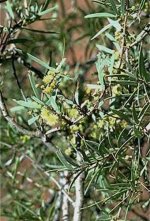
Found these 2 today, huge clumps of them, soon to be houses near Perth. They dont have the charecteristic of the tips being bent over like Acuminata, but they look interesting. These were from a bulldosed land pile.
 

Attachments

  • 100_1080.JPG
    100_1080.JPG
    1.3 MB · Views: 1
Hey brickie i can't be sure because I have never looked at acacias in your area but that does look very maidenii to me, and I have scrutinised hundreds of maidenii, again pods will give you a definitive answer. If its not to much of a mission to get back to the tree , and if it's I'm a natural setting ( somewhere the ground below and around it has not been disturbed.) you may be able to find remians of last seasons pods. Also could you take a look at the branches and see if they are covered in white to yellow dots? They are called lenticels, flori's have them but in my experience less/ not as obvious as A. maidenii.

Spice sailor
 
Gowpen said:
bricklaya said:
Lastnight I only did one pull, with hot shellite just to get an idea whats in it.. the leftover oily watery substance does indeed have an indole type scent to it, not looking like it wants to dry at all. I'm confused about the wateryness of it.. especially because I made sure I had none in my solvent when i put it in the tray.. it also froze in the freezer giving the illusion that I was getting crystals and then just melted under the fan after pouring sovlent off. Also there's no colouring to it.. it literally looks like there's nothing on the tray it is just a scent
Im getting exactly the same bud, with acuminata. Im sus of the shellite now, I saw zippo lighter fluid the other day and thought...I wonder...

When using known active species in the past shellite has worked fine for me and always pulled very efficiently... if heated it pretty much got everything in one pull when using phyllodes..... bark usually took a few to get all the alks out. if there's spice in there the shellite I use should be getting it out fine.. i know of others that use the same brand and get good results as well..

pm me what kind your using?
 
Spice Sailor said:
Hey brickie i can't be sure because I have never looked at acacias in your area but that does look very maidenii to me, and I have scrutinised hundreds of maidenii, again pods will give you a definitive answer. If its not to much of a mission to get back to the tree , and if it's I'm a natural setting ( somewhere the ground below and around it has not been disturbed.) you may be able to find remians of last seasons pods. Also could you take a look at the branches and see if they are covered in white to yellow dots? They are called lenticels, flori's have them but in my experience less/ not as obvious as A. maidenii.

Spice sailor

Thanks Spice Sailer.. the tree is actually just in the area I live in the suburbs round melb...so I doubt there would still be any fallen pods. There are very small lenticels.. although they are quite hard to make out and a very small. I only have very thin twig like branches that I pruned though, I'll pay it another visit today and see if it has them on the larger branches.

Do you have experience with extracting Maidenii?
 
..well, lots going on..!:)

Phlux wrote:
i just came across acacia swazica (from swaziland) - the new stems are red as hell - anyone hear anything on this spp ?
firstly, good to hear from you about Acacia swazica, Phlux :)..really hoping for some african research..
..i can find no records of chemical tests on A. swazica.. it is related to A. giraffe (see p.12#238) and it's relatives..i have been shown an internal university phytochemical survey list (1990s) in which DMT had been found in the leaves (pinnae) of A. giraffe..K. Trout also suspected there were tryptamines in the species..
with less than 5% of Acacias having reported chemical analysis, there is much to be discovered..red tips/twigs is a good sign..


..bricklaya, i agree with Spice Sailor that the recent tree pictures are of an A. maidenii strain (& pods is the key)..the phyllodes are too wide and large looking to be floribunda, and the flower spikes a bit long..it is probably one of the low yield strains by the look of it (c. 0.1% alkaloid)..the 'melting crystal' thing can be due to the presence of some NMT..or, if there's literally nothing left, a volatile fatty acid..i don't work with napatha, but i suspect it may respond in this context to a slightly higher pH (say 12.5-13) than other solvents..

..as for the reliability of A. floribunda, i again quote researcher 'JJ' from last year's EGA conference: "I haven't come across a floribunda which doesn't contain DMT.." ..he's studied a lot of acacias, but there is of course the possibility of variation..
the nursery you got the seedlings from may be able to point you in the direction of a mature specimen..

..& thanks for the cuttings link Growpen..this is interesting with regards to propagating known desired strains..some species take a lot more easily from cuttings than others..it is worth experimentation..maidenii (& floribunda) take more easily than obtusifolia or phlebophylla, which require specialist tissue-culture set-ups, and can still be difficult..
.

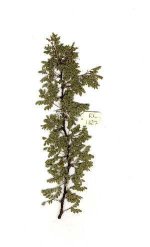
below, a herbarium specimen of Acacia swazica..very interesting looking pinnae (these are dry, of course)
 

Attachments

  • A+swazica+herbarium+sample.jpg
    A+swazica+herbarium+sample.jpg
    17.3 KB · Views: 0
..ok, some exciting news for north Queenslanders in Australia, and some updates to the
Australian Tryptamine & Psychoactive Acacia List here..40 species, carefully checked..

..researcher 'JJ" announced the following species at the EGA conference 2009..(& i have left more for him to publish/announce himself) ..thanks to wira for access to notes..
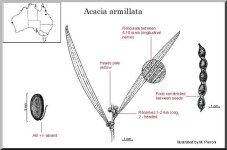
Acacia armillata is restricted to three locations in N.E. Qld./Cape York, it was found to contain 0.4% alkaloids (not sure plant part) roughly 1:1 DMT:NMT..needs conservation..
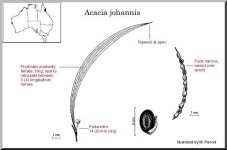
Acacia johannis (restricted to N.E. Qld, where it is more common) – also DMT/NMT, c.0.4%, similar ratio to armillata.
..a third Cape York species was found to contain 0.5% DMT, but this is only found at 1 location, and i think is too rare to list..

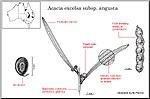
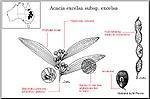
..while neither A. johannis or armillata (in particular) are common, the latter is genetically very closely related to the quite common Acacia excelsa ('Brigalow', Qld., N. NSW)..JJ also found a variety of it to contain DMT/tryptamines by TLC (GCMS not performed at that stage)

..please be kind to trees..this information is presented to further conservation and consciousness, not exploitation..

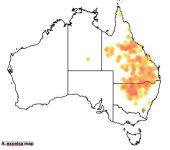
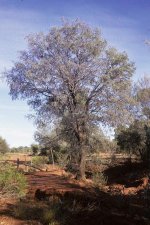
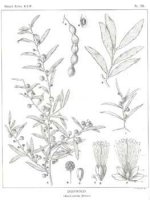
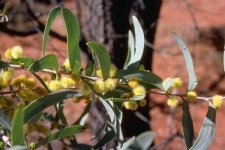
below are A. armillata, A. johannis, and 4 images of A. excelsa (subtype thumbnails) with distribution map bottom..
 

Attachments

  • A+excelsa+map_.jpg
    A+excelsa+map_.jpg
    21.4 KB · Views: 0
  • A+excelsa+habit_.jpg
    A+excelsa+habit_.jpg
    73.8 KB · Views: 1
  • Acacia+excelsa_.jpg
    Acacia+excelsa_.jpg
    46.1 KB · Views: 1
  • excelsa_subsp_angusta.jpg
    excelsa_subsp_angusta.jpg
    4.4 KB · Views: 1
  • excelsa_subsp_excelsa.jpg
    excelsa_subsp_excelsa.jpg
    4.8 KB · Views: 0
  • Acacia+johannis.jpg
    Acacia+johannis.jpg
    27.2 KB · Views: 0
  • Acacia+armillata.jpg
    Acacia+armillata.jpg
    32.9 KB · Views: 0
..a couple more images of Acacia excelsa as it's reasonably common (inland) and a very interesting one..has 2-3 recognized subspecies, mainly differing in the broadness of phyllodes..TLC indicated a few tryptamines in, i think, the phyllodes..ps couple of corrections to p.5 aus. list since previous post
..A. excelsa common in Qld and N. NSW, australia..
.
 

Attachments

  • a+excelsa+(ironwood).jpg
    a+excelsa+(ironwood).jpg
    14.5 KB · Views: 1
  • acacia+excelsa.jpg
    acacia+excelsa.jpg
    31.3 KB · Views: 1
niice ^

just re African acacias, came across a 2012 publication called 'basic principles of forensic chemistry', i'm not sure if it will appear in the link but on p. 196 there's a list of DMT containing acacias, among the ones listed there's A. senegal and A. nubica (also called oerfota) .. link is below

also in the old csiro publications they list the extraction method as
"
repeated maceration with methanol. The extract was concentrated, an equal volume of dilute sulphuric acid added, and
after filtration the filtrate was made basic with ammonia. Extraction with chloroform gave
a crude alkaloid solution. The alkaloid was extracted back into dilute sulphuric acid, the acid
fraction basified with ammonia, and extracted with chloroform. The chloroform was evaporated
off to give the alkaloid (40 g(!), 0.3% dry wt.)."

so a solution of basic methanol is immiscible with chloroform.. that is interesting..


cheers :)
 
..hi Seldom, & thanks for link..you wrote:
also in the old csiro publications list the extraction method as
"
repeated maceration with methanol. The extract was concentrated, an equal volume of dilute sulphuric acid added, and
after filtration the filtrate was made basic with ammonia. Extraction with chloroform gave
a crude alkaloid solution. The alkaloid was extracted back into dilute sulphuric acid, the acid
fraction basified with ammonia, and extracted with chloroform. The chloroform was evaporated
off to give the alkaloid (40 g(!), 0.3% dry wt.)."

so a solution of basic methanol isn't miscible with chloroform.. that is interesting.. does anyone know any other non polar solvents which aren't miscible with methanol?
..this was the technique slightly adapted by 1992 A. maidenii pioneer JG [see 1992 maidenii report]..dichloromethane was substituted as the non-polar solvent (i agree this is a better solvent than chloroform, and is less likely to form possible reaction byproducts)..NaOH was substituted for ammonia..a second experiment using HCl instead of sulphuric acid led to problems, and i have also seen unfavourable reactions caused by HCl..the additional washing of the separated NP solvent with slightly salty NaOH+H20, which i adopted from JG, really helps clean things up..
..ethanol (being polar, and soluble in H20), like methanol, does not mix with non-polar solvents..methanol or ethanol are the most efficient polar solvents for extracting tryptamine alkaloids out of plant material (which is why i always recommend them), however methanol is very toxic and has no smell, so should only be used in equipped labs..ethanol is easily obtainable..if 100% ethanol, however, is used too much of the tar may become soluble [see tars post here]..hence, the extraction method i have recommended a few times [see index]..other non-polar solvents which work well include hexane and d-limonine (purest forms)..these have a higher 'holding capacity' for dmt than napatha, meaning a larger amount dissolves more easily in less, so only 1-2 'pulls' are required to efficiently extract the alkaloids from basic solution..
..the best thing to do to 'master' extraction (if that is possible) is, when you have material you know for sure has what you're looking for, to try things different ways..and understand that every time is slightly different (as is the plant at even different times of day) and requires a degree of observation and intuition..there is no one way, it is a partly creative art (& partly giving act by the plant)

..looking forward to hearing some more reports out there..:)
 
..in my burst to tie up info, i noticed two more formal findings of 'tryptamine' in Australian acacias which somehow got missed in the thread..as mentioned before, White's 1950s findings of 'tryptamine' have mostly turned out to be DMT (floribunda, acuminata, longifolia)
so, the p.5 list already should be bigger..42
[btw, if i'm less frequently online near future for a few weeks, there's good acacia ID people in here like wira & Spice Sailor..]

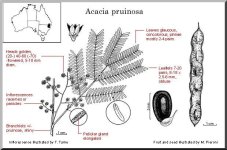
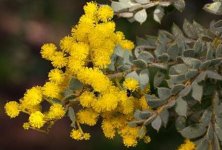
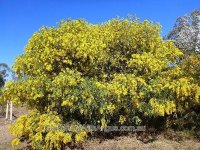
..firstly small amounts tryptamine are reported from the tops of Acacia pruinosa (native s.e. Qld to the tablelands, slopes and adjacent plains of n. N.S.W) by White (1951) citing Henry..aka 'Frosty Wattle'
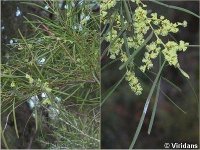
and tryptamine is also reported by in leaves of Acacia vestita ('Weeping Booyung' or Hairy Wattle) .."alkaloid content was highest in autumn and spring (0.12-0.28%), lowest in summer and winter (0.03-0.08%)."
[White, E.P. 1957. “Evaluation of further legumes, mainly Lupinus and Acacia species for alkaloids.” New Zealand J. Sci. & Tech. 38B:718-725.]..A. vestita is native to central NSW around Dubbo..the tested plants were in New Zealand, not their native habitat..

below, A. pruinosa and then A. vestita..both candidates for possible further dmt findings..
 

Attachments

  • A+pruniosa_.jpg
    A+pruniosa_.jpg
    42.3 KB · Views: 2
  • pruinosa_.jpg
    pruinosa_.jpg
    52.8 KB · Views: 2
  • acacia+vestita.jpg
    acacia+vestita.jpg
    29 KB · Views: 2
  • acacia-vestita-.jpg
    acacia-vestita-.jpg
    116 KB · Views: 2
..some exciting results in the Acacia analysis thread..first finding of Harmine in an Acacia species (A. mucronata var. longifolia young seed grown plants) ..also Acacia acuminata Narrow Leaf variety phyllodes came in at around 1.0% DMT (one of the 'cleanest' DMT profiles i've seen, very few traces of anything else)..the branch/stem bark, being around 1.5% would be around the highest % of (just) DMT known from an acacia, and the leaves are the highest DMT % of pretty much any plant..

..please treat these trees with respect..the can take many years to grow..

i actually feel the heavy sacrifice made the the plant every time i pull even a little bit of leaf/twig off one i've grown..

we should be thankful and kind to them
.
 
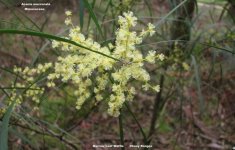
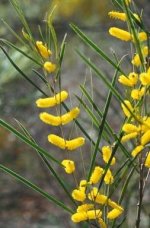
..Acacia mucronata variety longifolia (there are two other varieties of A. mucronata) pictured first,
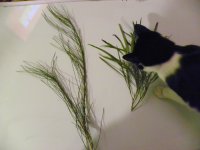
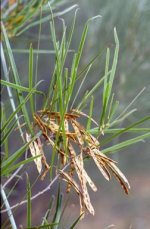
and then two of the Acacia acuminata narrow phyllode variant..the phyllodes can be narrower than these shots, almost needle-like sometimes..
 

Attachments

  • mucronata+var+longifolia+1.jpg
    mucronata+var+longifolia+1.jpg
    35 KB · Views: 2
  • a+mucronata+var+longifolia_.jpg
    a+mucronata+var+longifolia_.jpg
    45.2 KB · Views: 2
  • A+acuminata+narrow+phyllode+var.jpg
    A+acuminata+narrow+phyllode+var.jpg
    21.8 KB · Views: 2
  • acuminata+narrow+phyllode+seed+pods.jpg
    acuminata+narrow+phyllode+seed+pods.jpg
    19.8 KB · Views: 1
Back
Top Bottom