• Members of the previous forum can retrieve their temporary password here, (login and check your PM).

Trying to improve Acacia information

Migrated topic.
> bioassays..?

soon, soon ..

> where do the forms that nature adopts come from?


the form of a tree comes into being as a function of its own agency, people don't construct images of trees, trees create their own images using people. ideas and images appear with the greatest intensity to those most likely to do them justice. who has ears noble enough to hear the call of the acacia ? ..
 
<3^..hey thanks guys..both beautiful answers, or reflections..:) and pirateb0b, you may be right, or half right about precipitates, however high yielding optimum extractions by the CSIRO (incl.phyllodes) were done around pH 9.5-11..with sulphuric acid, an pure ammonium as the basifier..see the acacia extraction workspace OP..

on the subject of crystal shape see attached image..this is what, under magnification, the purest looking crystal that someone had grown of the fabled molecule looked like..really..
and Seldom, what ever happened to Acacia nerifolia..? the one the government told us was interesting..:)
i noticed it's recorded as having decent amounts alkaloids in the leaf (phyllode) says Alkaloid-bearing plants and their contained alkaloids By John James Willaman, Bernice Giduz Schubert..what are the alkaloids? just says 'unn'known..

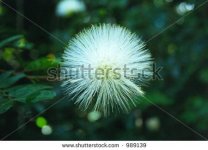
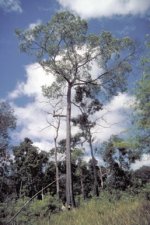
below, crystal form, white-ball acacia, acacia nerifolia habit, it is found in both NSW and Qld, Australia.
the common explanation from a gem-club site:
Crystals are solid material in which the atoms are arranged in regular geometrical patterns. The crystal shape is the external expression of the mineral's regular internal atomic structure. Temperature, pressure, chemical conditions and the amount of space available are some of the things that affect their growth.
 

Attachments

  • crystalform.jpg
    3.4 MB · Views: 0
  • white_ball_acacia.jpg
    white_ball_acacia.jpg
    24.1 KB · Views: 0
  • Acacia%2520nerifolia%2520habit.jpg
    Acacia%2520nerifolia%2520habit.jpg
    104.5 KB · Views: 0
ps. my quote-of-week..phyllode p.45
The spice extends life. The spice expands consciousness...
[Chapter (14) sūrat ib'rāhīm (Abraham)(14:24:9)]: " kashajaratin (is) like a tree كَشَجَرَةٍ طَيِّبَةٍ "

..i don't know what to say to that, except Allah knows best..!

and note that the Masonic images remind me of the Guild of Navigators in Frank Herbert's Dune novels..
keep expanding threaders..!:d
 
low yield on the alpine phyllodes.. first three pulls i got 500mg and then did one last one and i havent scraped it up but it doesn't look like much. regarding what you just said about the lower ph.. is there a possibility that i destroyed some of the precipitates when i added more lye? the amount that came out at first looked like WAY more than what was extracted into the shellite after the second lot of base was added. maybe il try the next extraction at ph 10.. oh and that was from around 400g of fallen phyllodes.. i don't know how old they were. many were stil quite green though

got no phyllodes left to experiment with though unfortunately so it'll have to wait
 
^..as mentioned somewhere in the thread..try extracting at slightly higher or lower pHs..certainly overbasification can rather than bringing more out have the opposite effect..experiment with filtering at these stages..use minimal amounts of liquids and solvents to save time and resources..check what comes up in the index..see acacia extraction workspace ..be well acacian, and all..:)
..intuition..
 
..for those interested in plant relationships and botany here's an about to be published new taxonomic/genetic paper on:
Phylogenetic connections of phyllodinous species of Acacia outside Australia are explained by geological history and human-mediated dispersal Gillian Brown, Daniel Murphy, James Kidman, Pauline Ladiges
Acacia sensu stricto is found predominantly in Australia but there are 18 phyllodinous taxa that occur naturally outside Australia, north from New Guinea to Indonesia, Taiwan, the Philippines, South West Pacific (New Caledonia to Samoa), northern Pacific (Hawaii) and Indian Ocean (Mascarene Islands). Our aim was to determine the phylogenetic position of these species within Acacia to infer their biogeographic history.
The close genetic relationship of species separated by vast distances, from the Indian Ocean to the Pacific, is best explained by dispersal by Austronesians.. early Homo sapiens migrants from Asia.

SB12027 Accepted 29 October 2012

..i've yet to read all the details, but great work, and good to look at what phyllode species are related to others..
..also, from the same team of scientists:
Recent results indicate that the closest relative to Australian Acacia in the strict sense is Paraserianthes lophantha, a member of the tribe Ingeae and a widespread weed, with a disjunct natural distribution in Western Australia and Indonesia.

below, the mysterious Acacia spirobis in New Caledonia, also has Australian variety..
an unidentified acacia growing in the Galapagos Islands..
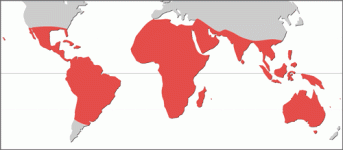
and a map showing the Worldwide Distribution Of Acacias..
 

Attachments

  • A+spirobis+New+Cal.jpg
    A+spirobis+New+Cal.jpg
    92.6 KB · Views: 0
  • galapagos+acacia.jpg
    galapagos+acacia.jpg
    67.2 KB · Views: 0
  • world-distribution-map.gif
    world-distribution-map.gif
    7.9 KB · Views: 0
beautiful tree.. the phyllodes remind me of a cross between acacia confusa and acacia mangium... speaking of acacia confusa lookalikes... I was admiring the beautiful banana shaped phyllodes of implexa the other day which grows EVERYWHERE here.. has there been much done with this tree?
 
^..funny you should mention that acacian..:) relations, that is..i can't resist giving a bit more info from that pre-publication manuscript! ..and a very big thank you to the botanists working on it from me and i'm sure many future acacia researchers!
Two related clades in sect. Juliflorae, show a repeated connection (B), N Australia, S New Guinea, SW Pacific. One of these is the A. auriculiformis clade, which includes A. spirorbis subsp. spirorbis from New Caledonia and the Loyalty Islands as sister to the Queensland species A. auriculiformis; related taxa include A. mangium, A. leptocarpa and A. spirorbis subsp. solandri. The A. aulacocarpa clade includes A. aulacocarpa, A. peregrinalis endemic to New Guinea, A. crassicarpa from New Guinea and Australia, and other Australian species. Acacia spirorbis (syn A. solandri subsp. kajewskii) from Vanuatu (Melanesia)
The third biogeographic connection (C) is Australia, Timor/Flores, represented independently by the widespread taxon A. oraria (sect. Plurinerves), found on Flores and Timor and in north-east Queensland, and the Wetar island endemic A. wetarensis (Juliflorae). The fourth biogeographic connection (D), Hawaii, Mascarene, E Australia, reveals an extreme disjunct distribution, consisting of the Hawaiian koa (A. koa, A. koaia and A. kaoaiensis) sister to the Mascarene (Reunion Island) species A. heterophylla; this clade is sister to the eastern Australian A. melanoxylon and A. implexa (all sect. Plurinerves)

A. spirobis was looked at briefly on p.10..histamines known, maybe other alkaloids..histamines suggests relationship with A. longifolia..
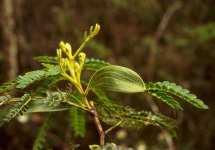
A. simsii [pic next post]..this Australian (N. Qld) and New Guinea acacia is very closely related to A. confusa and possibly A. simplex..a very strong contender for a tryptamine award..

pictured below more Pacific Island Acacias crossing into Australasia
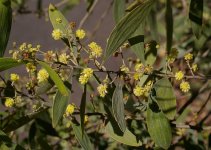
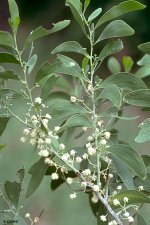
white and then yellow flower forms of A. oraria (in Qld, Aus.) , also found Flores and Timor;
the rare A. wetarensis L. Pedley (type specimen) endemic to Wetar Island;
A. kaoaiensis (synon. A. koa sub. sp. kaoaiensis) Hawaii; and A. spirobis sub. sp. solandra near Townsville in Qld, Aus;
and 2 images of A. spirobis growing in Vanuatu..enjoy your island holiday..:)
and please be kind to trees (especially rare ones) and their ecosystems..
 

Attachments

  • Vanuatu+Acacia.jpg
    Vanuatu+Acacia.jpg
    109.2 KB · Views: 0
  • spirobis+2.jpg
    spirobis+2.jpg
    175.1 KB · Views: 0
  • a+spirobis+1.jpg
    a+spirobis+1.jpg
    227 KB · Views: 0
  • kaoaiensis.jpg
    kaoaiensis.jpg
    151.7 KB · Views: 0
  • A+wetarensis.jpg
    A+wetarensis.jpg
    1.7 MB · Views: 0
  • A+oraria+Qld.jpg
    A+oraria+Qld.jpg
    204.4 KB · Views: 0
  • A+oraria+whiteflower.jpg
    A+oraria+whiteflower.jpg
    342 KB · Views: 0
..had to correct previous post..it was the Trout suspect A. shirleyi on p.18..

below is Acacia simsii mentioned above..strong candidate for nexian experimenters..
may have been spotted by polmos way back..i'll find page when i get time..i want to go to the islands first..!
 

Attachments

  • simsii.jpg
    simsii.jpg
    164.6 KB · Views: 0
interesting about the confusa implexa/melanoxyn connection. a test on implexa may be in order soon. so many trees to test! thought I'd add this beauty of implexa:
6871026830_9ec4ac5f7e_z.jpg


Acacia Simsii is georgous... looks like the tryptamine list may just keep growing :) The phyllodes also remind me a lot of the floribunda's
 
Looking at the Acacia distribution map [ # 919 ] makes me suspect that Acacias / Mimosas are very , very ancient genus - maybe existing and evolving before and after Gondwandaland broke up and the continents drifted apart ?
 
acacia you should swing by the Aboriginal centre while you're in the area its possible to get a light red jelly from implexa for burns, its phyllodes can be used for stun-method fishing, bark with high resistance to breakage, strong wood with a low density gradient, making it not weigh much, it's a cool tree.

it is after all known as 'lightwood' .. its one of my favorites, i've never touched them but there's always been strong stands of them around where i've lived. acrid and irritating sensation in their taste. may be peas, not sure though.
 
..thanks Entropymancer..good to see you! :d ..and yeah, A. simsii is like the direct cousin or sister of A. confusa..
on Seldom's excellent point, see next post..😉

Major Tom wrote:
Looking at the Acacia distribution map [ # 919 ] makes me suspect that Acacias / Mimosas are very , very ancient genus - maybe existing and evolving before and after Gondwandaland broke up and the continents drifted apart ?

..Leguminosae were widespread and differentiated into 3 subfamilies by the end of the Cretaceous period (65 million years ago) ..the genus Acacia was widespread by 40-50 million years ago, but whether the ancestors of the genus were from Africa or South- or Central America has been debated [Guniet 1981; Pedley 1986; Knud Tybrik 1990 http://www.worldwidewattle.com/socgroups/igsm/20/45-53.pdf]
..the ancient ancestor of Phyllodinous acacias (now considered 'Acacia stricto sensu' with bi-pinnate species recently placed in Vachellia, Senegalia and Faidherbia ) is from Australia..circa 20-30 million years ago..a relatively new development in plant evolutionary terms..

The earliest occurrences [known of Acacia pollen] are from the southern hemisphere: Eocene (Cameroon, Africa), Oligocene (Puerto Rico), Miocene (Australia, Mexico, Central & South America) and Pliocene (New Zealand, now extinct) (Muller, 1981). Acacia appears to have diversified and expanded into the Northern Hemisphere from the Miocene onward as global climate cooled and became drier (Tsudy and Scott, 1969; Traverse, 1988 ).
Davis 2001 Uni. of Arizona
..i find the finding of the forthcoming Pacific Phyllodinous paper, that early humans carried these special acacias around quite exciting..although, i threw in the photo of the Galapagos Island acacia to add to further mystery, and mention also that Acacia melanoxylon seeds are recorded as still viable after 20 years in sea water! ..see Long-Term Viability of Acacia Seed p.18..but, if one discovered the great-great ma of confusa/simsii/whatever etc. then i'm sure, if forced to migrate, one would carry some seed..
but, given phyllode species seem to have evolved in australia, which way did the migrations go..?

below, New Guinea's only endemic acacia, A. peregrinates, named in 2000
Acacia peregrina M.W. McDonald & Maslin, Austral. Syst. Bot. 13: 67, fig. 22 (2000), nom. illeg., non A. peregrina (L.) Willd. (1806)...1) habit; 2) pods..

and Acacia kaoaiensis, very rare, once considered sub-species of A. koa, now given it's own status..Hawaiians please conserve and regen this sacred species..

 

Attachments

  • +Acacia+kaoaiensis+.jpg
    +Acacia+kaoaiensis+.jpg
    194.9 KB · Views: 0
  • acacia_peregrinalis-pods.jpg
    acacia_peregrinalis-pods.jpg
    40 KB · Views: 0
  • A+peregrinalis+www.jpg
    A+peregrinalis+www.jpg
    40.2 KB · Views: 0
..thanks Seldom, i'll be looking at a lot of ethnobotanical medicinal knowledge in forthcoming works.
i think the medicinal aspects of Acacias is one of the most important aspects of the genus..
i just want to say that my policy in this thread is to remain as respectful as possible of still existent indigenous cultures and other intact ancient knowledge systems..particularly in respecting both oral tradition and 'secret knowledge' which the Tibetan's have a good ten-point definition of..rule one: 'secret knowledge is not to be given to those who haven't asked'..rule two: 'not to be given to those whose heads are like a 'sieve', meaning that they are told something and then forget it later on.." ..and so on..respect!

..sometime before the morning of december 22nd [edit: circumstance delayed this, sorry, still on way]..this year i'll make a pdf available of Highlights of Acacia Information Vol.1 - a bit like Trout's 'best of' the Entheogen Review, where it will be re-organised into sub-sections..maybe it should be called "2012 - an Acacia Odyssey" as the monk suggested! thanks monk..but the point is it'll make reference and finding key things easier..
then, in the future, will be the first 'book' or IA 'information application'..let me preface that by saying that the late (or is that early rather? ) T. McKenna first discovered the deep mystery of acacias on his visit to australia a year before his death..took many seeds back to hawaii with him..he came so close to one of his life-long dreams (physically, that is) i'm sure he 'knows' now…the first book will be entitled
"Acacia - The Original Tree of Knowledge", Part II by nen. (due approx. 1 year - edit: it all got a lot bigger and at least a decade needs to pass before publishing any book, it has to be in the right time)
..one of it's main themes will be that, in almost every culture, as acacian commented, acacias have important historical, and ongoing medicinal, nutritional and spiritual significance..they are sacred everywhere!
Part I was "Meditations of the Tree" by nen, experiential etc., actually written about a decade ago..still unpublished, still too sensitive
also, as a lot of people, incl government and military agencies, as well as gangsters and religious fanatics, know who nen is, nen will begin making public lecture appearances next year…8)

this thread was created in the interests of all life forms and fairness..
and so that knowledge is not suppressed or manipulated by power interests..

light of the flower of truth shine through you acacians..!
.

@
..
 

Attachments

  • rug2.jpg
    rug2.jpg
    48.2 KB · Views: 0
I wonder if CSIRO had any idea of what they were creating back in back in the days when they PUBLISHED Fitzgerald and Sioumis [ 1965 ] ; Rovelli and Vaughn [ 1967 ] etc , etc , .... :twisted: [ it is wrong for unenlightened authorities , book-burners , bigots , etc , to resent Ott , McKenna , nen , and so many others for the growing interest today in spice , etc , esp in Australia - CSIRO started it !! :d ]
 
I really admire your intentions nen! your doing a great job here and you are guiding many people through the world of ethnobotany in a very humble manner. I'm sure i'm not alone in saying this, but I doubt dmt nexus would be anywhere as far in plant knowledge if you weren't here putting in the yards. You are here at a crucial time it seems, when people are really beginning to worry about the future of dmt and its availability. Without the information and time you put in here, many would probably never be able to experience the wisdom that these trees have on offer, and i think you should give yourself a pat on the back for opening so many people's hearts to nature. rock on mate! can't wait for these books :D oh... and how's that break from the computer going nen? :roll:

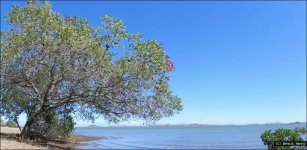
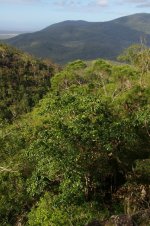
anyways.. I gathered some mearnsii phyllodes and stems today from the yarra ranges. will get started on them probably tomorrow night. I highly recommend people visit this area. It is loaded with deeply euphoric views of vast plains, forests of towering gum trees that make you feel as if your in prehistoric times, huge and ancient looking acacia trees... all in a sea of such majestic ferns that evoke a profound feeling of divine presence.

and thanks seldom, I'll make sure I do :) that sounds handy


img0457hy.jpg


img0480sp.jpg
 
^..lovely photos acacian..your photographic skills are really blossoming..:d
and Major Tom..in reference to what you're saying (thanks and hi:)) , i funnily enough had a chat with Snu Voogelbriender the other day..part of that conversation involved mentioning the source of the confirmation that there does exist unpublished research within australia showing the presence of dmt in 151 species..upon naming the source, snu was satisfied, but..tricky position here..nobody wants to lose their jobs or government funding..the Shulgin african acacias source still remains unresolved..
..also, mr. Voogelbriender wanted to correct me in my statement earlier regarding the net and books..he is happy about the net, and it has helped promote his vast work..his bemoaning was that it just doesn't shift a lot of copies, and that there's still plenty of info not on the internet..i'm certainly looking forward to what he's assembled for Edition 2 of Garden of Eden, which is on the way..:)
...........................................

..also, another point on the transmission of phyllode acacia species by early humans across the pacific, s.e. asia, and the indian ocean by early austronesians..[Phylogenetic connections of phyllodinous species of Acacia outside Australia are explained by geological history and human-mediated dispersal #929]..there is evidence of and still existent traditional knowledge of trading between Macassan fishermen (from Indonesian islands), pre european arrival..i suggest also there are stories of trading with other cultures a long time ago..one of the key tree of knowledge theories..
.
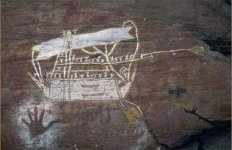
rock art bellow..but, don't want to tread on any toes..respect! and intuition..
 

Attachments

  • picture.jpg
    picture.jpg
    19 KB · Views: 0
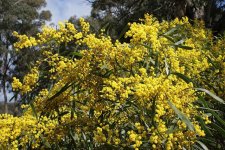
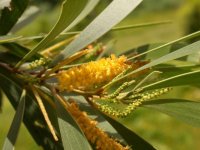
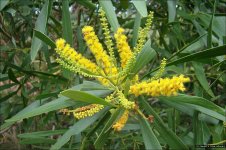
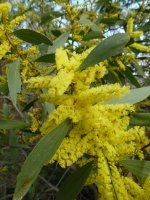
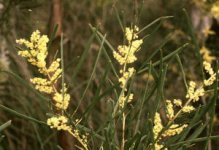
..regarding the photos acacian posted asking if it was A. mucronata var. longifolia..without being able to examine the material, i would class the plant A. longifolia..i've attached an image of typical flowers of a NON-tryptamine type..notice the length and openness rather than color..the phyllode width may be a red herring..and also, without seeds, pods and close examination of all detail, a species ID cannot be botanically confirmed..and the whole longifolia/mucronata/obtusifolia complex is fine and tricky even to plant experts..2nd pic is A. mucronata, shorter flowers, slightly less 'open'..and slightly paler, but, yeah, hybrids confuse eveybody! (except themselves:))
 

Attachments

  • p1050584.jpg
    p1050584.jpg
    4.6 MB · Views: 0
  • mucronata+yellow.jpg
    mucronata+yellow.jpg
    28.4 KB · Views: 0
..Seldom made an interesting comment in Acacia DMT Season, i think, regarding insect bark attack and turpines?..did you find a paper for that Seldom, out of curiosity? ..i've not looked at Insect Gall infestations much, but there's yet another aspect of acacia you could write a whole phd on!

..an interesting study Heil et al. 2002(pdf attached) concluded that the ant-associated acacias (e.g. see A. cornigera) did not moduate their chemistry with regards to phenols, flavones or tannis..but they didn't look at alkaloids (as reported in other literature) ..
Since its original formulation by Janzen in 1966, the hypothesis that obligate ant-plants (myrmecophytes) defended effectively against herbivores by resident mutu- alistic ants have reduced their direct, chemical defence has been widely adopted. We tested this hypothesis by quantifying three classes of phenolic compounds (hy- drolysable tannins, flavonoids, and condensed tannins) spectrophotometrically in the foliage of 20 ant-plant and non-ant-plant species of the three unrelated genera Leonardoxa, Macaranga and Acacia (and three other closely related Mimosoideae from the genera Leucaena, Mimosa and Prosopis). We further determined biological activities of leaf extracts of the mimosoid species against fungal spore germination (as measure of pathogen resistance), seed germination (as measure of allelopathic activ- ity), and caterpillar growth (as measure of anti-herbivore defence).
Yet, as in the data on phenolic compounds we saw no systematic differences between ant-plants and non- ant-plant species. Strongest inhibitory effects on cater- pillar growth were exhibited by extracts of the two non-ant-acacia species A. farnesiana (Isth) and A. macracantha, while extracts of two other non-ant-spe- cies (A. cochliacantha and L. leucocephala) had the most positive effects on caterpillar growth.
..there is evidence that cyanogenic glycosides, while not acutely toxic, discourage over grazing by herbivorous animals..

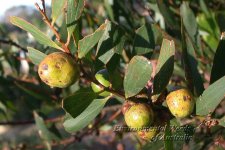
..below is a photo of insect created 'Galls' on Acacia longifolia var. sophorae..one contact said that he believed gall infested trees had larger amounts of alkaloids..i'd believe this if the infestation is not too great..if it becomes out of balance symbiotically and begins to harm the tree's health, i'd predict some nasty defences would be 'synthesised'..

Reduced chemical defence in ant-plants? A critical re-evaluation of a widely accepted hypothesis
Martin Heil, Thibaut Delsinne, Andrea Hilpert, Steffen Schu ̈rkens, Claude Andary, K. Eduard Linsenmair, Mario Sousa S. and Doyle McKey attached below for plant biologists
 

Attachments

  • acacia+longifolia+sophorae26+-+GJ.jpg
    acacia+longifolia+sophorae26+-+GJ.jpg
    164.7 KB · Views: 0
  • Heiletal_Oikos2002_tradeoffs__20.pdf
    460.7 KB · Views: 0
Back
Top Bottom