^..
Infundibulum
..the thing about
A. nilotica is that, despite being classed as a single species by systematic botanists, it's sub-species are quite distinct in pod shape and seed..[see p19]
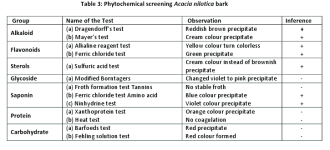
when plants have not been selected/standardised (as is the case for common herbs) then such research needs to be done..hence this thread

now, if the sub-species are consistent in some being tryptamine +ve, and others not, could explain this, rather than seasonal variation..this is why i've so emphasised the sub-varieties of nilotica..
..it is entirely an
arbitrary decision to class all forms as a single species..
in other cases (e.g. some australian species) very similar forms are split into different species..
this, from a utilisation perspective, is potentially more helpful..
plants without long histories of selection can have 'chemical races' or chemotypes..
an example would be the australian Duboisa myoporides (Solanaceae) which in Victoria contains atropine as the principle alkaloid, in most of NSW contains instead scopolamine as the main alkaloid (this chemotype is harvested for scopolamine for opthalmic medicine), where as in another part of NSW it contains no atropine or scopolamine, but instead nor-nicotine (anabasine) as the principal alkaloid [Lassak & McCarthy 1986]..these chemotypes are consistent, but the plant looks the same in all regions..
being sure what sub-species of A. nilotica is being tested would clear this up..in other words the data for your test
Infundibulum could be more precise in this regard, same with chocobeasties 2nd hand india report..
in the case of
A. mearnsii i think identification between it and very similar bi-pinnate species can confuse people..material i carefully checked in victoria was positive for tryptamines (will send off to nexus for test), but, it also may be seasonally variable..but, as i mentioned a few posts back, there are many cases of A. floribunda/obtusifolia/maidenii where alkaloids can be almost absent from bark at some times of year and seem to have migrated to the phyllodes..
..the subspecies of
A. nilotica are also regionally distinct, but to confuse matters, several african varieties are now naturalised in asia..also, the polyploid nature of acacias results in yet more expressions within a gene pool..
A. nilotica subsp. kraussiana is the variety which has oral activity in east africa
A. nilotica subsp. adstringens (more tropical west africa and sudan) tested negative for alkaloids
Phlux achieved a +ve result in another part of africa (Phlux?)
Shakya et al. 2012 may be
A. nilotica subsp. indica
the complete current definition [Brenan, (1983)] of subspecies is:
nilotica Nile Valley, SW Sahel and Sudano-Guinean ecozone of W Africa
adstringens (Schum. & Thonn.) Roberty South Sahara, Sahel and Soudano-Guinean ecozones, E Africa.
indica (Benth.) Brenan India (Rajasthan), Yemen, Oman, Pakistan, Manyanmar (= Burma) ; introduced to E Africa (Somalia).
cupressiformis (J.L. Stewart) Ali & Faruqi NW India, Rajasthan
hemispherica Ali & Faruqi W Pakistan, Sind.
kraussiana (Benth.) Brenan E Africa (Kenya, Ethiopia,Somalia)
leiocarpa Brenan S & SE Africa (Zambia, Zimbabwe, Malawi, Mozambique, Botswana, Namibia, S Africa
subalata (Vatke) Brenan E & SE Africa (Uganda, Kenya, Tanzania, Somalia, Ethiopia)
tomentosa (Benth.) Brenan Flooding areas in the Sahel, Sudanian and Guinean ecozones N of the Equator to NW Uganda.
Polyploidy (Fagg, 1992, Fagg & Stewart, 1994, Wickens et al., 1995) :
subsp. tomentosa hexadecaploid, 16 n = 208, riverine
subsp. nilotica, octoploid, 8 n = 104, riverine
subsp.adstringens, tetraploid, 4 n = 52, sub-riverine savanna.
The other subsp. are tetra ploid, 4 n = 52, dry savannas and woodlands.
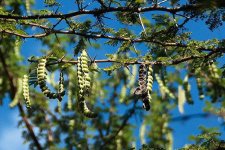
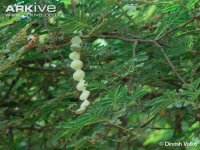
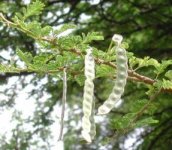
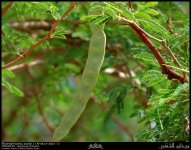
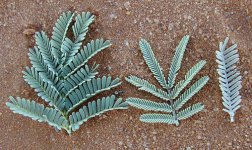
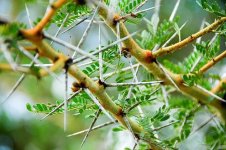
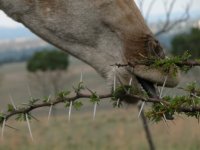
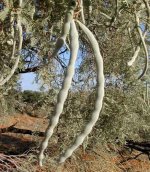
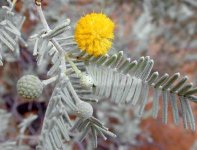
so, below: 4 different sub-species of nilotica, showing distinct pod shapes..
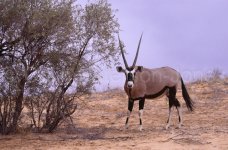
the last photo was captioned: "One tree bearing its fruit at the moment is the 'Scented-pod thorn', or
Acacia nilotica.
These pods have a sweet scent when opened, and are a favourite food for giraffe, antelope, monkeys and baboons."
pictured are
i)
subsp. indica (in Oman, also found Yemen, India)
ii)
subsp. cupressiformis (found Pakistan/N.W. India)
iii)
subsp. tomentosa (equatorial Africa)
iv)
subsp. leiocarpa (found S. Africa)