• Members of the previous forum can retrieve their temporary password here, (login and check your PM).

What Is The Best Small Bottle For Solvent

brokedownpalace10

Titanium Teammate
Donator
Not advanced chemistry, but I didn't know where to post.
I do small extractions, both to learn and also to minimize breathing solvent. (I wear a CPAP mask vented below waist height behind me as well)
Getting solvent out of a big can is my weak link as to solvent fumes. What is a good small bottle to hold even aggressive solvents for longer periods? Without eating the stopper and getting weirdness in the solvent.
 
Getting solvent out of a big can is my weak link as to solvent fumes.
If you're talking about the rectangular canisters, there's a proper way to pour out of them to minimize drips n splashes. Basically, you want the corner with the opening of the can to be the highest point when you tip it to pour. It's not perfect though. I'm guessing you're pouring it like a watering can, which causes air to get sucked in the outlet and make that glug-glug-splish-splash. You could poke a hole in the opposite corner from the cap for air intake, if you want to pour it like a watering can.

I've stopped pouring entirely and use a peristaltic pump with tygon tubing. Tygon is immune to fuel and peristaltic pumps don't make contact with the solvent, it's all contained in-line. It's a $400 setup, mostly for the pump, but it's amazing how many uses I find for it. It makes extraction practically hands-off, I don't even have to be near the fuming jars during a pull, just turn on the pump and check back in 5 minutes.

As Ernestine said, for storage, glass media bottles are good. For caps n gaskets, look into PTFE. You can get by with HDPE milk jugs though, not sure if the caps are HDPE too. Tyvek is PTFE, you could place between the lid and mouth of a mason jar to keep solvent from lapping at the metal/rubber. Plumbers thread tape is PTFE, if you need to seal the threads.

Just found a video of a slick way to start a siphon. You could do it with tygon tubing and an HDPE bottle. Or any plastic bottle as long as you stop the siphon before it reaches the bottle, then swap in your glass bottle.

Another thing you could do is drill two holes in the can of the solvent, maybe the cap. Insert a tygon line snug into each hole, one reaching down into the solvent. The other line just needs to be inserted into the headspace. Use a ball pump to pump air into the headspace, where the pressure increase should cause solvent to flow out of the second line. I think you could use vinyl tubing too, which can be found in hardware stores. Tygon is just specifically flexible enough to be used in a peristaltic pump.
 
Last edited:
Rubber is kind of a vague category, like naphtha. I think some wouldn't be good. Buna-N, aka nitrile rubber is the only one I know is for sure compatible with light alkanes like naphtha. If it's going to come into contact with lye though you should consider its compatibility with that, too.
 
What about rubber stoppers? The ones that come with an erlenmeyer flask, or the ones you buy at a brew store?
You'd need silicone - the red rubber ones will get attacked by many common solvents.

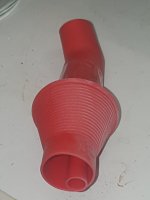
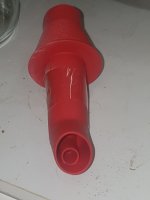
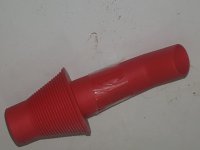
You may be able to find a push-in pouring spout for your jerrycans, there are quite a lot of options there. The pressure-dispense option that @Icon just outlined would couple well with one of these pouring spouts, eliminating the need to drill holes in the can.
20251104_170613.jpg20251104_170544.jpg20251104_170522.jpg
A silicone bung with two holes would facilitate the rigging up of dip tubes somewhat better.

If you're really lucky, you may find a screw-on stopcock for your jerrycan. Suppliers of the materials in the jerrycans sometimes carry stopcocks of the appropriate size in their stocks as well. Check that it has a compatible washer for your solvent.
 
You'd need silicone
Are you sure? I've had silicone gaskets warp. Which isn't necessarily a deal breaker, but I think there's better options.
chrome_2025-11-04_10-14-06.png
Naphtha wasn't in this list, so I checked heptane.

This one has naphtha: D - severe effect.
 
Are you sure? I've had silicone gaskets warp. Which isn't necessarily a deal breaker, but I think there's better options.
View attachment 105948
Naphtha wasn't in this list, so I checked heptane.

This one has naphtha: D - severe effect.
Oops yes! Mind you, it does depend on the grade of silicone. Platinum-cured stuff is far more resistant. Normal food grade silicon in the form of reusable dish covers degraded after several months of indirect exposure to HCl vapours when used as a secondary containment closure (just for the record). At least silicone has less of a tendency to degrade into a sticky mess than some elastomers.

The sensible thing is to look at the appropriate compatibility charts, as you somewhat suggest.
 
I have a black stopper which came with an Erlenmeyer flask and white stoppers which I bought at a brew store. I'm hoping they are OK to shake a reaction vessel with an excess of lye and some Naptha or Xylene. I remove them after shaking.

As to the storage vessel for Naptha or Xylene, I am looking at some glass bottles with ground glass stoppers on the big river.

Thoughts on all this?

I do small extractions and am getting into a system where I do a little every morning since I get up first . So, I'm pulling or adding a little solvent almost every morning for weeks. In my scenario, time is doing the heavy lifting. Naptha ain't so bad getting maybe a tiny whiff of it every day. Xylene is nasty and I want to minimize exposure assiduously.
 
Xylene will eat natural rubber, I'd be extra wary of that and try some compatibility tests. If you can somehow scrape a small sliver off the top surface of each bung, stick each in their own test tube with some xylene and see what happens to them.

If you know what material they're made of, on account of their markings, say, you can of course save yourself the trouble and refer to a compatibility chart. Otherwise, it's hard to say just from a description of their colours. I wouldn't expect rubber intended for use in brewing to hold up against xylene for long, but some elastomers will be more resistant than others. You'll have to look it up if you can, or test it.
 
Xylene will eat natural rubber, I'd be extra wary of that and try some compatibility tests. If you can somehow scrape a small sliver off the top surface of each bung, stick each in their own test tube with some xylene and see what happens to them.

If you know what material they're made of, on account of their markings, say, you can of course save yourself the trouble and refer to a compatibility chart. Otherwise, it's hard to say just from a description of their colours. I wouldn't expect rubber intended for use in brewing to hold up against xylene for long, but some elastomers will be more resistant than others. You'll have to look it up if you can, or test it.
So, the next question is if I'm getting anything in my extractions.
I will use stoppers no more for solvent storage. Bottle with ground glass stopper from Amazon it is.
Is all glass all good for solvents, lye, etc.?

Also wondering the danger of contamination with using the stoppers just to shake the bottle and then immediately removing.
 
So, bottles are on order. I might go back to shaking with my hand over the top (and immediately rinsing it). Processes will be improved.

For what I'm doing now, do you think there's any real contamination of product if the stoppers don't show signs of deterioration?

What is a good, robust bottle and stopper which will hold up to it all as a reaction vessel? I see people online using wine bottles with their screw tops. I'm presently experimenting with overbasing since I have whole chunks of bark and I'm depending on lye breaking it down some.

According to the above chart, I would really need fluorosilicone stoppers if I wanted to use the flasks I have, not silicone. I've found a lot of silicone stoppers, but fluorosilicone seems hard to get for the general public.
 
Last edited:
For what I'm doing now, do you think there's any real contamination of product if the stoppers don't show signs of deterioration?
It's probably negligible. You should freeze precipitate to avoid evaporating out any potential rubber solutes. If you're still worried, you could do a mini-a/b on the end product.

I personally wouldn't store solvent in a flask with a ground glass joint. It's unlikely to be air-tight so it could potentially evaporate overtime. And if it tips over there's not much keeping it closed. Maybe if you wrap the glass stopper in plumbers tape you could get a tighter fit.

This is what I would buy:

It's a PTFE-faced silicone cap liner for GL45 bottles. "GL45" is referring to the size of the opening. If you get a glass GL45 bottle, these liners should fit in the cap. The silicone will compress and give an airtight seal, the PTFE surface coating will protect the silicone from acid, base, pretty much all solvents.

And be careful shaking solvents, especially if they're warm. Pressure can build up fast and blow your stopper.

 
Last edited:
It's probably negligible. You should freeze precipitate to avoid evaporating out any potential rubber solutes. If you're still worried, you could do a mini-a/b on the end product.

I personally wouldn't store solvent in a flask with a ground glass joint. It's unlikely to be air-tight so it could potentially evaporate overtime. And if it tips over there's not much keeping it closed. Maybe if you wrap the glass stopper in plumbers tape you could get a tighter fit.

This is what I would buy:

It's a PTFE-faced silicone cap liner for GL45 bottles. "GL45" is referring to the size of the opening. If you get a glass GL45 bottle, these liners should fit in the cap. The silicone will compress and give an airtight seal, the PTFE surface coating will protect the silicone from acid, base, pretty much all solvents.

And be careful shaking solvents, especially if they're warm. Pressure can build up fast and blow your stopper.

Thanks for the answer. I ordered these, what do you think?


Is there an insert like the one you linked that would fit a mason jar for freeze precipitation?
 
Last edited:
Those are good chemically inert stoppers. I already stated what I think about stoppers, but those will be better than rubber or your thumb.
 
Last edited:
Those are good chemically inert stoppers. I already stated what I think about stoppers, but those will be better than rubber or your thumb.
Thank you, sir. I am redoing how I do things and you all have been a great help. I have a few things on the way, but I'll be getting your last two suggestions likely as well. I'd forgotten your comment on Tyvek and mason jars.
 
personally wouldn't store solvent in a flask with a ground glass joint.
Another thing to remember about them is that leaving base in contact with them for an excessively long time can also lead them to seize up, as can changes in temperature and air pressure. There's a whole subsection of chemistry dedicated to un-seizing ground glass joints without destroying them :ROFLMAO:
 
Tyvek might be a bad idea actually, in the context of an STB extraction.

I've only used it for gas exchange on a mycology spawn jar. It's hydrophobic so water can't pass, but air can still exchange. I'm not 100% sure about non-polar vapors and liquids, but there's a chance they could both pass right through Tyvek. Even though the material is PTFE HDPE and solvent-safe, Tyvek is designed to be a breathable fabric. Sorry for the sketchy suggestion.

I can't think of anything off the top of my head that would make a mason jar better. I just use them as-is honestly, but I do many clean up steps.
 
Last edited:
Tyvek might be a bad idea actually, in the context of an STB extraction.

I've only used it for gas exchange on a mycology spawn jar. It's hydrophobic so water can't pass, but air can still exchange. I'm not 100% sure about non-polar vapors and liquids, but there's a chance they could both pass right through Tyvek. Even though the material is PTFE and solvent-safe, Tyvek is designed to be a breathable fabric. Sorry for the sketchy suggestion.

I can't think of anything off the top of my head that would make a mason jar better. I just use them as-is honestly, but I do many clean up steps.
The thing with Tyvek is that when you use it as a cover to protect materials, it doesn’t actually do a great job. It can still let some vapor through, so it adds little extra protection. What’s more concerning is that Tyvek is a somewhat fibrous material. Tiny fibers can end up in the product you’re making, especially if it’s something meant to be eaten, drunk, or smoked. These fibers are so small you can’t see them, but they’re there. The problem with these “forever chemicals” is that they’re probably better not consumed.

Edit as @aizoaceous points out Tyvec is HDPE and not Teflon, while it’s better to not smoke HDPE it’s not as bad as an fluoropolymer😄
Note: Sometimes Tyvec can be coated with fluoropolymers, depending upon the type of use.


Last edited:
Back
Top Bottom