• Members of the previous forum can retrieve their temporary password here, (login and check your PM).

17th century tek

Migrated topic.

B.Valentinus

Esteemed member
I am trying to decipher a 17th century Tek if anyone has any suggestion please comment below.

Its clear from the text that Acacia, Vinegar and spirit of wine are used.


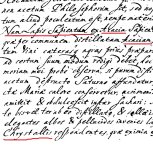
"It is fitting for you to know that this vinegar is not the vinegar of Philosophers, but our vinegar is something else, indeed a drinkable substance, namely the material itself. For the Stone of the Wise is made from the Acacia of the Wise, which must first be prepared through the common distillation of Acacia, Spirit of Wine, and other waters, and must be reduced to its specific measure. Remember this well in memory of me, if pure distilled vinegar is poured upon destroyed Saturn, and preserved with the warmth of Saint Mary, it loses its acridness and becomes sweet like sugar. For with the vinegar distilled once or twice from it, and placed in the cellar, you will find elegant white and translucent stones, resembling crystals."
 

Attachments

  • FmlTPn9XkAAPAhF+(2).jpg
    FmlTPn9XkAAPAhF+(2).jpg
    245.3 KB · Views: 14
Diethyl ether, was that remotely probable/possible in long past Egyptian times?


Current science consensus GPT scrapes all scientific databases regularly and takes the general concensus of that data to show current progress and what the hypotheses are running around about the given subject.

In the past it did not always gave me the newest science papers, though priority seems to be given to the more 'stable' papers first, probably by the anount of references to it, and general attention for to higher videlity of their research. And maybe even publications in the higher regarded peer review magazines/processes?

Anyway this is what 'Consensus' GPT gave as an answer:

Diethyl ether, commonly known simply as ether, is a chemical compound that was first synthesized in 1540 by Valerius Cordus, a German botanist and physician. This synthesis marked the first time ether was produced through a chemical reaction. Given this historical context, it is highly improbable that diethyl ether was known or used in ancient Egyptian times, which predate Cordus' discovery by several millennia.

Evidence:

1. Historical Chemical Knowledge: The knowledge and techniques required for the synthesis of diethyl ether were not available in ancient Egyptian times. The chemical processes known to ancient Egyptians included basic methods like fermentation and simple distillation, primarily used for producing alcoholic beverages and essential oils.

2. Archaeological Records: There is no archaeological evidence or historical records indicating the use or synthesis of diethyl ether in ancient Egypt. The chemical and medical texts from ancient Egyptian civilizations do not mention ether or any related compounds.

3. Scientific Development Timeline: The synthesis of ether required advancements in chemical understanding that were not achieved until the Renaissance period. The tools and theoretical knowledge to perform such synthesis were absent in ancient times.

Conclusion:
It is highly unlikely that diethyl ether was known or used in ancient Egyptian times due to the lack of necessary chemical knowledge and evidence from historical records.


However always remember people from our history were not idiots and even had their very own amazing savants, the only difference between them and ours is a different culture with different priorities and a huge lack of knowledge compared to our more modern times.

Just one introvert savant might have been enough to have slowly starting to connect the dots and create the diethyl ether? 🤷

That savant person might have also put less priority to their findings, scribbled it quickly down on his papyrus, and then moved on to chasing the next big thing: for their culture their next most oppertunistic hype dream?

Cultures can have their subtle (and obviously less subtle) ways to deal with this kind of innovation (or not).

The no findings of traces from that time should raise a big red flag that they might not had the dots connected at that time, even not with the introvert savants or Renaissance people of that time?


Kind regards,

The chappity-Traveler

Thanks The traveler, yes sorry i should have been clearer. I am aware, but what im am arguing is that our current understanding of history is wrong. My belief is that the knowledge was kept secret possibly through an oral tradition only specific members of society would have be trained, in the same way that the mystery method of preparing the Kykeon at Eleusis was kept hidden.
 
Last edited:
Thanks transform, I am only focused on Alchemy in Europe because that all I have evidence for. Hopefully if I can establish the method use by BasilIus Valentinus, we can than use the MS like a rosetta stone and work backwards to Zosimos. The method of extraction definitely could have changed over time based on the raw material available. I cant share here but Pd newman is working hard to bridge what im working hard on finding a path from Zosimos to Egypt,
Thanks, I re-read the title of the thread :LOL: Diethyl ether was certainly known by the C.17th and prior to that there would be strong grounds for concealing this type of plant extraction and its possible uses given the persecution of folk practitioners of herbal wisdom that was an ongoing theme throughout the middle ages. The alcohol/lime process is still easier and (retrospectively) more obvious, however - regardless of the historical period.
 
Thanks, I re-read the title of the thread :LOL: Diethyl ether was certainly known by the C.17th and prior to that there would be strong grounds for concealing this type of plant extraction and its possible uses given the persecution of folk practitioners of herbal wisdom that was an ongoing theme throughout the middle ages. The alcohol/lime process is still easier and (retrospectively) more obvious, however - regardless of the historical period.

Thanks Transform they're maybe more MS waiting to be found with different methods. I think once we push the date back to 17th century it will force "experts" to explore this research further to try "debunk".
 
I have gone down this rabbit hole of DMT in ancient times and have discovered some very interesting facets.

It was almost certainly the Angelical stone that St Dunstan of Canterbury and Elias Ashmole refer to.

My source material was,
  • NKJV bible which I fact checked with an 1818 version of the KJV bible to make sure their stories were congruent with each other.
  • ANCIENT EGYPTIAN ALCHEMY:From Acacia to Zosimos By P.D. Newman Winter 2023 Presented to the McKenna Academy of Natural Philosophy.
  • Raphael Patai and his "Jewish Alchemists" (dokumen.pub_the-jewish-alchemists-a-history-and-source-book-course-booknbsped-9781400863662.pdf)
  • Who was Mary the Jewess? - World History Edu

I basically just went back in time to the first alchemist on record as having performed the Great Work on plants.
This individual is on record as telling King Oros that she can do the Great Work in part of a day, if not 3 hrs and that sounded very much to me like a dmt extraction.

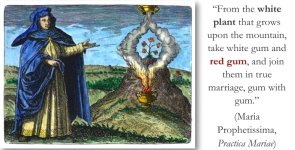
This individual is known in alchemy circles as Maria Prophetissa, there are written texts concerning her "white plant that grows on the mountain" and I came to the conclusion from further research that it was common moonwort.
While Maria Prophetissa wasn't busy with common chemical extractions as we do in modern times, it was a more ancient way of "working" the plant which has to have a female and male component.
Many of her sayings/quotes mention "join the man and the woman and you shall find that which you seek."

Clipboard_07-16-2025_01.jpg

From PD Newman's presentation we have a few persons mentioning acacia, Alessandro di Cagliostro, Heinrich Kunrath and Samuel Hartlieb.
Acacia incidentally, has a male part, the gum that oozes out of cuts in the bark and a female part, the seed pods, perhaps the leaves too.

The bible mentions the "tree of life" in the garden of Eden and that its leaves were for healing of the nations. Revelation 22:1-5 and Genesis 2:9-10.
Whether this is the same tree as the tree of knowledge and good and evil is not quite clear to me at the present.

How the acacia or moonwort is worked alchemically is also beyond my present skill set for the time being, but it almost certainly involves another of Maria's lesser known inventions, the kerotakis.
Where ever you read "Marys Bath" or balneum marie/bain marie, substitute for kerotakis, the wise will soon realize that the modern version of the kerotakis is the soxhlet extractor.

So, imo this pushes dmt use back 2025 yrs at the very least.
Why do I say that?... because Maria Prophetissa is almost certainly the same person as the Mary that had a face to face, meet and greet with the 3 wise men of the bible fame.

As the patron saint of DMT(imo) I have no qualms in bending the knee in worship to Sante Maria de Guadalupe and hope that my prayers for guidance reach her ears. :)

On a side note, I strongly suggest Rudolf Steiner's Knowledge of Higher Worlds and its Attainment, as a way to purifying ones inner spirit, so that you don't get put on hold/banned to the waiting room.
 
The three Magi, often referred to as the Wise Men or Three Kings, brought gifts of gold, frankincense, and myrrh to baby Yeshua (Jesus), as described in the Gospel of Matthew. Frankincense, and myrrh both have ancient medicinal uses. I believe the "gold" that they brought was actually monoatomic gold or Ormus, which also has medicinal powers. That means that they knew a chemical method for turning gold into monoatomic gold, white powder. We also know that the Egyptians had the technology to do gold plating, an electrochemical process, much earlier than the timeframe of Yeshua (Jesus).
 
Thanks 61Pete, would love to learn more about this.
That makes 2 of us. :)
I suspect that they used apple cider vinegar and possibly rectified it a few times.
Im kinda new to all this and only started getting inspiration back in Feb this year.


What caught my eye was a section from Open Entrance to the Closed Palace of the King.
page 16
Chapter XXVI
Of the Regimen of Jupiter
Black Saturn is succeeded by Jupiter, who exhibits divers colours. For after the putrefaction
and conception, which has taken place at the bottom of the vessel, there is once more a
change of colours and a circulating sublimation. This Reign or Regimen, lasts only three
weeks. During this period you see all conceivable colours concerning which no definite
account can be given.

and I was like, mmm sounds like a good 20mg trip to me. :)
 
I have gone down this rabbit hole of DMT in ancient times and have discovered some very interesting facets.

It was almost certainly the Angelical stone that St Dunstan of Canterbury and Elias Ashmole refer to.

My source material was,
  • NKJV bible which I fact checked with an 1818 version of the KJV bible to make sure their stories were congruent with each other.
  • ANCIENT EGYPTIAN ALCHEMY:From Acacia to Zosimos By P.D. Newman Winter 2023 Presented to the McKenna Academy of Natural Philosophy.
  • Raphael Patai and his "Jewish Alchemists" (dokumen.pub_the-jewish-alchemists-a-history-and-source-book-course-booknbsped-9781400863662.pdf)
  • Who was Mary the Jewess? - World History Edu

I basically just went back in time to the first alchemist on record as having performed the Great Work on plants.
This individual is on record as telling King Oros that she can do the Great Work in part of a day, if not 3 hrs and that sounded very much to me like a dmt extraction.

This individual is known in alchemy circles as Maria Prophetissa, there are written texts concerning her "white plant that grows on the mountain" and I came to the conclusion from further research that it was common moonwort.
While Maria Prophetissa wasn't busy with common chemical extractions as we do in modern times, it was a more ancient way of "working" the plant which has to have a female and male component.
Many of her sayings/quotes mention "join the man and the woman and you shall find that which you seek."

View attachment 103971

From PD Newman's presentation we have a few persons mentioning acacia, Alessandro di Cagliostro, Heinrich Kunrath and Samuel Hartlieb.
Acacia incidentally, has a male part, the gum that oozes out of cuts in the bark and a female part, the seed pods, perhaps the leaves too.

The bible mentions the "tree of life" in the garden of Eden and that its leaves were for healing of the nations. Revelation 22:1-5 and Genesis 2:9-10.
Whether this is the same tree as the tree of knowledge and good and evil is not quite clear to me at the present.

How the acacia or moonwort is worked alchemically is also beyond my present skill set for the time being, but it almost certainly involves another of Maria's lesser known inventions, the kerotakis.
Where ever you read "Marys Bath" or balneum marie/bain marie, substitute for kerotakis, the wise will soon realize that the modern version of the kerotakis is the soxhlet extractor.

So, imo this pushes dmt use back 2025 yrs at the very least.
Why do I say that?... because Maria Prophetissa is almost certainly the same person as the Mary that had a face to face, meet and greet with the 3 wise men of the bible fame.

As the patron saint of DMT(imo) I have no qualms in bending the knee in worship to Sante Maria de Guadalupe and hope that my prayers for guidance reach her ears. :)

On a side note, I strongly suggest Rudolf Steiner's Knowledge of Higher Worlds and its Attainment, as a way to purifying ones inner spirit, so that you don't get put on hold/banned to the waiting room.
Hi 61 pete

Thanks PD is great, I actually showed him with the Samuel Hartlib MS.
I agree with his work on Cagliastro / Mellisino but I think the later texts espicially German and Roiscrucian MS are discussing Diethyl ether.
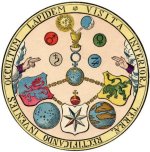
Vitriol (copperas) - Oil of Vitriol (Sulphuric Acid) - Sweet oil of Vitriol (Diethyl ether)


See image below

"Vista Interiora Terrae Rectificando Invenies Occultum Lapidem" (english transulation "Visit the interior of the earth and, by purifying, you will find the hidden stone")

Vista
Interiora
Terrae
Rectificando
Invenies
Occultum
Lapidem

First letter of each V.I.T.R.I.O.L

86fa14c98d26000cc49847a3e04298e7_480x480.jpg
 
Last edited:
Hi 61 pete

Thanks PD is great, I actually showed him with the Samuel Hartlib MS.
I agree with his work on Cagliastro / Mellisino but I think the later texts espicially German and Roiscrucian MS are discussing Diethyl ether.
Vitriol (copperas) - Oil of Vitriol (Sulphuric Acid) - Sweet oil of Vitriol (Diethyl ether)


See image below

"Vista Interiora Terrae Rectificando Invenies Occultum Lapidem" (english transulation "Visit the interior of the earth and, by purifying, you will find the hidden stone")

Vista
Interiora
Terrae
Rectificando
Invenies
Occultum
Lapidem

First letter of each V.I.T.R.I.O.L

View attachment 104008

"Visit the interior of the earth and, by purifying, you will find the hidden stone")

After distilling the prime, the black matter left behind is also called terra damnata or foul laton, many different names but basically some form of earth.
This earth consists of red oil, white oil and salts. Its the 1 into 4, ie from a single prime matteria the 4 elements are extracted, air fire, water and earth.
These elements are then refined with an alembic/ short path distillation, combined to form the stone of the wise.

I havent gone into the RC texts beyond a surface level as I find them very confusing.
I believe there were 2 schools of Rosicruicians, the Golden cross that dealt with the practical lab work and the Rosy Cross that focused more on the Inner or Spirit side of the Great Work.
 
After distilling the prime, the black matter left behind is also called terra damnata or foul laton, many different names but basically some form of earth.
This earth consists of red oil, white oil and salts. Its the 1 into 4, ie from a single prime matteria the 4 elements are extracted, air fire, water and earth.
These elements are then refined with an alembic/ short path distillation, combined to form the stone of the wise.

I havent gone into the RC texts beyond a surface level as I find them very confusing.
I believe there were 2 schools of Rosicruicians, the Golden cross that dealt with the practical lab work and the Rosy Cross that focused more on the Inner or Spirit side of the Great Work.

Yeah there are many different opinions on the symbolism in the RC texts but I approach them all a instructions. I think there is a clear cross over with Basilius Valentinus.

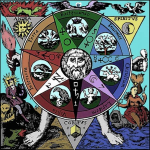
Look at this from BV same hidden VITRIOL message as the post above

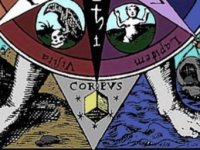
See the smooth/perfect/finished stone or ashlar at the bottom.
 

Attachments

  • Vitriol.png
    Vitriol.png
    980.8 KB · Views: 4
  • _20250719_095324.JPG
    _20250719_095324.JPG
    35.6 KB · Views: 4
See the smooth/perfect/finished stone or ashlar at the bottom.
That cube is also a dual meaning item.
1. can refer to the rough peasant/ field worker(rough ashlar) being transformed into a higher more pure soul.(made cubical)
2. when working on acacia with rectified vinegar, the vinegar becomes sweet and small cubes form in solution.
I think I read about no2 in Jewish Alchemists by Raphael Patai, but I've read so many alchemical pdfs that it becomes a bit of a fog as to what I read where.


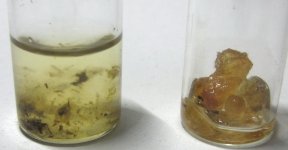
On a side note, I chipped off some gum from an acacia trunk and it wasnt soluble in either IPA or Petrol ether 40-60, but turned to jelly in plain apple cider vinegar.
 
That cube is also a dual meaning item.
1. can refer to the rough peasant/ field worker(rough ashlar) being transformed into a higher more pure soul.(made cubical)
2. when working on acacia with rectified vinegar, the vinegar becomes sweet and small cubes form in solution.
I think I read about no2 in Jewish Alchemists by Raphael Patai, but I've read so many alchemical pdfs that it becomes a bit of a fog as to what I read where.


On a side note, I chipped off some gum from an acacia trunk and it wasnt soluble in either IPA or Petrol ether 40-60, but turned to jelly in plain apple cider vinegar.
I searched Patai's text but couldnt find the reference, let me know if you remember where you read it.

What colour was the jelly?
 
I searched Patai's text but couldnt find the reference, let me know if you remember where you read it.

What colour was the jelly?
It was the PD Newman doc, referencing Hartlib Papers.

it loses its
acridity and becomes sweet like sugar; and
you will find transparent stones,
corresponding to crystals…”
(Samuel Hartlib, The Hartlib Papers)

Jelly was the same color as the cider vinegar, a light golden color, the left hand vial, the other vial crystals were soaked in various NPS that I have used for extractions of MHRB, but it did nothing.
IMG_2723.JPG


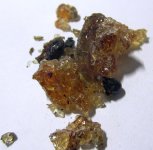
This pic is the raw gum shards pried off the tree, I initially wanted to see if I could remove all the foreign bits of insect and bark and thought maybe I could dissolve it into solution and then filter.

IMG_2725.JPG


I'm pretty sure there will be no dmt hiding in the gum, but I'm thinking it will be in the seed pods as a resource for the seeds once they have fallen off the tree and are lying on the ground.
 
It was the PD Newman doc, referencing Hartlib Papers.


Jelly was the same color as the cider vinegar, a light golden color, the left hand vial, the other vial crystals were soaked in various NPS that I have used for extractions of MHRB, but it did nothing.
View attachment 104035


This pic is the raw gum shards pried off the tree, I initially wanted to see if I could remove all the foreign bits of insect and bark and thought maybe I could dissolve it into solution and then filter.

View attachment 104036


I'm pretty sure there will be no dmt hiding in the gum, but I'm thinking it will be in the seed pods as a resource for the seeds once they have fallen off the tree and are lying on the ground.
Sorry for the confusion I should have said before this whole tread is about the Basilius Valentinus MS in the samuel hartlib collection.

Thanks for the pics might help with another MS.
 
Back
Top Bottom